The Mysterious Husky That Led Us to an Extraordinary Rescue
How a daily visitor to our new home became the unlikely hero in a forest rescue that changed our family forever
A Fresh Start in an Old House
Moving into our new home felt like stepping into a story that had already begun. The colonial-style house sat nestled among towering oak trees, its wraparound porch and weathered shingles speaking to decades of family memories. For my husband Kyle, our ten-year-old son Ethan, and me, this represented more than just a change of address—it was our chance at a fresh beginning.
Ethan had endured a difficult year at his previous school, where persistent bullying had gradually eroded his confidence and joy. The once-outgoing boy who loved soccer and made friends easily had become withdrawn and reluctant to engage with new people. As parents, Kyle and I had watched helplessly as our vibrant child retreated into himself, questioning his worth and dreading each school day.
The decision to relocate hadn’t been made lightly. We’d considered multiple options—changing schools within the same district, homeschooling, even family therapy—but ultimately decided that a complete environment change offered the best opportunity for Ethan to rebuild his sense of self in a place unmarked by painful memories.
The Previous Owner’s Legacy
The house had belonged to Christopher Hendricks, an eighty-three-year-old widower who had passed away peacefully in his sleep three months before we began our house search. His daughter Tracy, a soft-spoken woman in her forties with her father’s kind eyes, had handled the sale with a mixture of grief and determination to find the right family for her childhood home.
“Dad lived here for forty-seven years,” Tracy had explained during our initial walkthrough, her fingers trailing along the mahogany banister that Christopher had installed himself in the 1980s. “After Mom died five years ago, this house was his entire world. He knew every creaking floorboard, every flowering bush in the garden, every bird that nested in the eaves.”
The house showed evidence of Christopher’s meticulous care. Original hardwood floors gleamed under layers of careful refinishing, the kitchen had been updated with modern appliances while maintaining its vintage charm, and the gardens displayed the kind of mature landscaping that only comes from decades of patient cultivation.
“I can’t bring myself to live here,” Tracy had admitted as we stood in the sunlit living room where family photographs still lined the mantelpiece. “There are too many memories in every corner. But I also can’t bear the thought of it falling into the wrong hands. I need to know that whoever buys this house will love it as much as our family did.”
Her words had resonated deeply with Kyle and me. We weren’t just purchasing property; we were accepting stewardship of a place where love and care had been invested across generations.
The Daily Visitor
Our first morning in the new house began at dawn with an unexpected sound—the soft scratch of claws against our front door. Kyle and I exchanged puzzled glances as we sipped coffee in the kitchen, wondering if perhaps a neighborhood cat had mistaken our porch for its territory.
When Ethan bounded downstairs, eager to explore his new surroundings, he was the first to spot our visitor through the front window. “Mom! Dad! There’s a huge dog on our porch!”
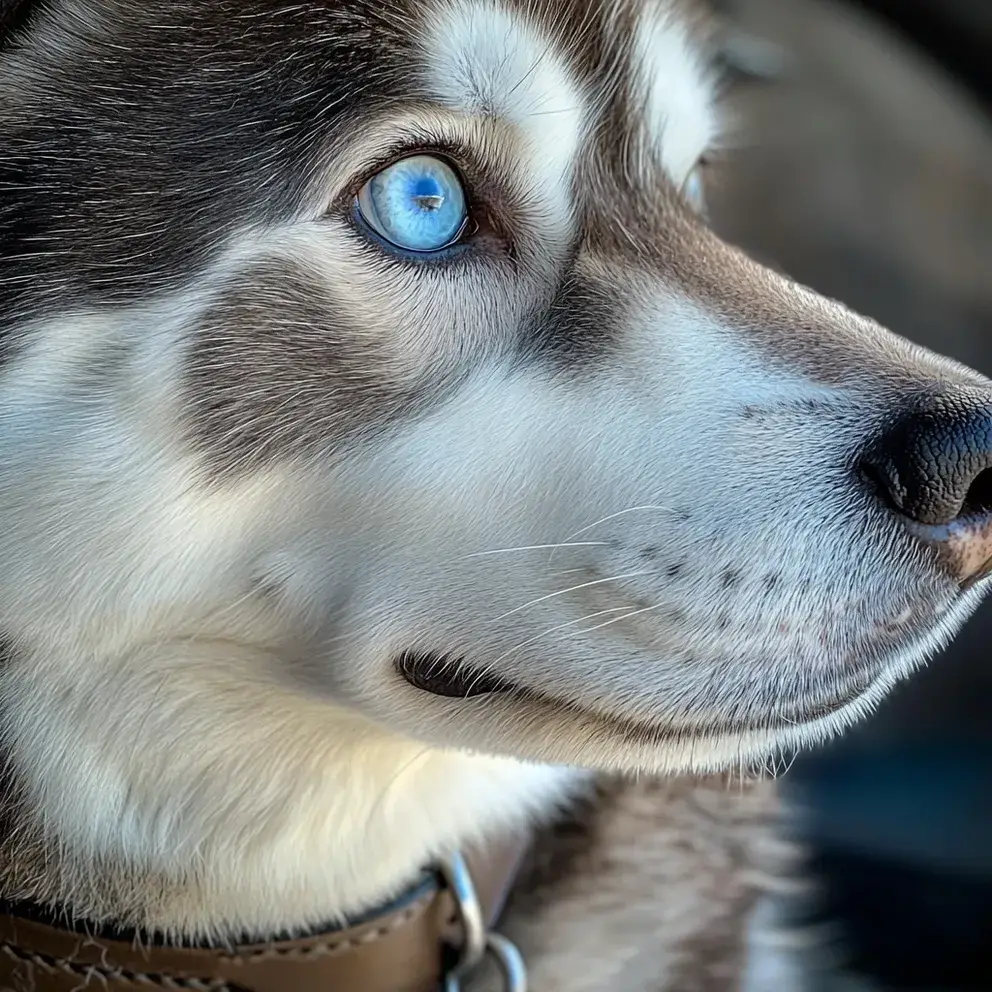
Indeed, sitting with remarkable patience beside our welcome mat was a magnificent Siberian Husky. His thick coat showed the silver-gray markings of an older dog, but his ice-blue eyes held an intelligence and alertness that suggested vitality despite his years. He wasn’t barking or pawing at the door—simply sitting in quiet expectation, as if this were the most natural thing in the world.
“Well, he’s certainly beautiful,” I said, opening the door cautiously. The husky’s tail gave a single, dignified wag, but he made no move to enter the house. Instead, he seemed to be waiting for something specific.
Kyle grabbed a bowl of water while I found some leftover chicken from the previous night’s dinner. The dog accepted our offerings with gracious appreciation, eating with the careful manners of an animal accustomed to human company. After finishing his meal, he surveyed our yard with the air of someone conducting an inspection, then trotted away into the woods behind the house.
“Do you think he’ll come back?” Ethan asked, his face pressed against the window as he watched the husky disappear among the trees.
“I don’t know, sweetheart,” I replied, though something in the dog’s demeanor suggested this hadn’t been a random visit.
Establishing a Routine
The husky returned the next morning at precisely seven-thirty, taking the same position on our front porch with the same patient expectation. And the morning after that. Within a week, his daily visits had become as much a part of our routine as morning coffee and Ethan’s breakfast.
“I think we need to get some actual dog food,” Kyle observed on our third trip to the grocery store that week, noting how our chicken and turkey supplies were diminishing rapidly.
Ethan enthusiastically agreed, selecting premium dog food, treats, and even a few toys from the pet aisle. “What if he’s lonely?” he asked as we loaded supplies into our cart. “Maybe he just wants some friends.”
The transformation in Ethan was remarkable to witness. The withdrawn, anxious child who had struggled to engage with classmates was now animated and purposeful, planning activities for his daily canine visitor. He would wake early each morning, preparing food and water before settling on the porch to wait for his friend’s arrival.
The dog—whom Ethan had begun calling “Blue” for his striking eyes—seemed equally invested in their developing friendship. After eating, he would remain in our yard for hours, allowing Ethan to brush his thick coat, playing gentle games of fetch, or simply lying in the grass while Ethan read aloud from his favorite books.
“It’s amazing,” Kyle commented one evening as we watched through the kitchen window. “I haven’t seen Ethan this relaxed and happy in months.”
The observation was painfully accurate. For the first time since the bullying began, our son was exhibiting the natural joy and curiosity that had always been his defining characteristics.
The Name Revelation
Two weeks into Blue’s regular visits, Ethan made a discovery that changed our understanding of the situation entirely. While giving the husky his customary morning brushing, his fingers encountered something unusual in the thick fur around the dog’s neck.
“Mom, there’s something here!” he called, carefully parting the silvery coat to reveal a worn leather collar nearly hidden beneath the dense fur.
I knelt beside them, helping to expose the collar completely. The leather was darkened with age and weathered from exposure, but a small metal nameplate was still securely attached. The engraving was faded but clearly legible: “Christopher Jr.”
The name hit me like a physical blow. Christopher—exactly like the previous owner of our house. The coincidence seemed too significant to dismiss, yet Tracy had never mentioned a dog during any of our conversations about the property.
“Do you think this is the old man’s dog?” Ethan asked, his voice filled with wonder and concern. “Do you think he’s been coming here because it used to be his home?”
The question hung in the air as I studied the husky’s intelligent face. His behavior certainly suggested familiarity with our property—the way he navigated the yard, his knowledge of the best sunny spots for afternoon naps, even his apparent comfort with the house’s rhythms and routines.
“It’s possible, sweetheart,” I replied carefully. “But if that’s true, then where has he been living since Christopher passed away?”
The mystery deepened rather than resolved. If this dog had indeed belonged to Christopher Hendricks, why hadn’t Tracy mentioned him during the sale? What had happened to him in the months between his owner’s death and our arrival?
Unusual Behavior
For several more days, Christopher Jr.—as we now called him—continued his regular visits without incident. But on a crisp Thursday morning in early October, his demeanor was markedly different. Instead of settling into his usual routine of eating and relaxing in the yard, he displayed obvious agitation.
The dog paced restlessly along the edge of our property line, whining softly and frequently looking toward the dense woods that bordered our backyard. His body language conveyed urgent purpose, as if he were trying to communicate something important that we couldn’t understand.
“Mom, look at CJ,” Ethan said, using the nickname that had naturally evolved. “He’s acting really weird today.”
Indeed, the husky’s behavior was unlike anything we’d observed previously. He would approach us, make eye contact, then trot toward the woods before returning to repeat the sequence. His message seemed clear: he wanted us to follow him.
“I think he wants to show us something,” Ethan said, already reaching for his jacket. “Can we go with him? Please?”
My maternal instincts immediately raised objections. Following a dog into unfamiliar woods seemed inherently risky, especially with my ten-year-old son. The forest behind our house was extensive, stretching for miles in several directions, and we had no experience navigating its paths or understanding its potential dangers.
“I don’t know, Ethan,” I said hesitantly. “Those woods are pretty dense, and we don’t really know our way around yet.”
But CJ’s urgency was unmistakable, and his obvious distress tugged at my conscience. This was clearly not random animal behavior—something significant was driving his agitation.
“We could take our phones,” Ethan suggested practically. “And I’ll send Dad our location so he knows exactly where we are. We don’t have to go far.”
The compromise seemed reasonable, and my curiosity was admittedly piqued. CJ had demonstrated remarkable intelligence and what appeared to be genuine concern for our family’s welfare. Perhaps trusting his instincts wasn’t as irrational as it initially seemed.
Into the Woods
After texting Kyle our planned route and estimated return time, Ethan and I followed CJ into the woods. The husky immediately assumed the role of guide, maintaining a steady pace while frequently checking to ensure we remained close behind.
The forest was beautiful in its autumn splendor, with golden and crimson leaves creating a natural canopy that filtered sunlight into dancing patterns on the ground. Well-worn deer paths made walking relatively easy, though the terrain grew increasingly uneven as we ventured deeper into the woods.
“How far do you think we’ve gone?” Ethan asked after twenty minutes of hiking.
“Maybe a mile,” I estimated, though the winding paths made distance difficult to judge accurately. “Are you getting tired?”
“No, I’m okay,” he replied, his excitement about the adventure overriding any physical discomfort. “But CJ seems to know exactly where he’s going.”
The observation was accurate. Unlike a dog exploring randomly, CJ moved with definite purpose, choosing specific paths and maintaining consistent direction. His familiarity with the terrain suggested regular travel through these woods, adding another layer to the mystery of his background.
As we climbed a small ridge, CJ suddenly stopped and assumed an alert posture, his ears forward and tail rigid. He had found what he’d been seeking.
The Discovery
In a small clearing ahead of us, partially hidden beneath a fallen log, lay a red fox in obvious distress. Even from a distance, it was clear that something was seriously wrong. The animal was barely moving, its breathing labored and shallow.
“Oh no,” I whispered, rushing forward to assess the situation more closely.
The fox was trapped in a steel leg-hold snare, the kind used by hunters and trappers. The device had clamped shut around her right hind leg, and her struggles to escape had only tightened the grip and deepened the wounds. Blood stained the ground around her, and her beautiful red coat was matted with dirt and debris.
Most striking was her obviously pregnant condition. Her swollen belly indicated she was very close to giving birth, which made her situation even more urgent and heartbreaking.
“Mom, we have to help her!” Ethan said, his voice thick with emotion. “She’s hurt really bad!”
CJ approached the trapped fox carefully, whining softly in what appeared to be sympathy or distress. The fox’s eyes followed his movement but she lacked the energy to show fear—a troubling sign of how weakened she had become.
“I know, sweetheart,” I said, pulling out my phone to call Kyle. “We need to get her to a veterinarian immediately.”
The trap was more complex than I had initially hoped. The release mechanism required specific pressure applied in a particular sequence, and my hands shook with adrenaline and urgency as I worked to free the fox. She remained remarkably still during the process, as if she understood we were trying to help rather than harm her.
The Rescue Mission
Kyle arrived with veterinary supplies from the farm store and a large carrier that he’d borrowed from our neighbor. Together, we carefully extracted the fox from the trap and examined her injuries more thoroughly.
The steel jaws had caused significant damage to her leg, creating deep lacerations and possibly fracturing bones. Her pregnancy complicated treatment options, and her overall condition suggested she had been trapped for at least twenty-four hours, possibly longer.
“The nearest veterinarian who handles wildlife is about thirty minutes away,” Kyle said, consulting his phone’s GPS. “I called ahead—they’re waiting for us.”
We wrapped the fox gently in soft blankets, taking care not to restrict her breathing or put pressure on her injured leg. She submitted to our handling with resigned acceptance, too exhausted to struggle even if she had wanted to resist.
CJ insisted on accompanying us to the veterinary clinic, positioning himself in the back seat beside the carrier as if assuming guard duty. His presence seemed to calm the fox, whose breathing became less labored when the husky was near.
Emergency Veterinary Care
Dr. Rebecca Martinez specialized in wildlife rehabilitation and had extensive experience treating trapped animals. Her examination confirmed our worst fears: the fox had suffered a compound fracture of her right tibia, along with severe soft tissue damage from the trap’s serrated edges.
“She’s been pregnant for about seven weeks,” Dr. Martinez explained as she prepared for emergency surgery. “Normally, we’d wait until after birth to address injuries this severe, but the infection risk is too high. We need to operate immediately.”
The surgery lasted nearly three hours while Ethan, Kyle, and I waited anxiously in the clinic’s small reception area. CJ remained alert and attentive throughout the wait, as if he understood the gravity of the situation.
“Do you think she’ll be okay?” Ethan asked repeatedly, his concern evident in his voice and posture.
“Dr. Martinez is very skilled,” I reassured him, though my own anxiety made confidence difficult to maintain. “She’s helped lots of wild animals before.”
When the veterinarian finally emerged from the operating room, her expression was cautiously optimistic. “The surgery went well,” she announced. “We were able to repair the fracture and clean out the infected tissue. Her leg should heal completely, though she’ll need several weeks of recovery time.”
An Unexpected Bond
The fox regained consciousness slowly, disoriented and obviously frightened by her unfamiliar surroundings. Dr. Martinez had warned us that wild animals often became extremely agitated upon waking from anesthesia, and we had prepared for aggressive or panicked behavior.
But something remarkable happened when I approached her recovery cage. Instead of displaying the expected fear or hostility, the fox made direct eye contact with me and grew visibly calmer. Her rapid breathing slowed, and she stopped struggling against the bandages securing her injured leg.
“That’s highly unusual,” Dr. Martinez observed. “Most wild foxes remain terrified of human contact even after receiving help. She seems to recognize you specifically.”
The connection was unmistakable and moving. Perhaps the fox understood, on some instinctive level, that I had been instrumental in her rescue. Or maybe the shared trauma of the experience had created a bond that transcended the usual barriers between human and wild animal.
CJ’s presence also had a calming effect. When the husky positioned himself near the cage, the fox’s anxiety decreased noticeably, as if she drew comfort from his familiar scent and steady presence.
Recovery and Revelation
Dr. Martinez recommended keeping the fox—whom Ethan had named Vixen—at the clinic for the first few days while her condition stabilized. But as her strength returned, it became clear that she would need a quiet, secure environment for the remaining weeks of her pregnancy and initial recovery period.
“She could potentially be released now,” the veterinarian explained, “but her mobility is still limited, and she’s due to give birth within the next week or two. In the wild, she’d be extremely vulnerable to predators or complications during delivery.”
Kyle and I exchanged glances, both thinking the same thing. “Could we set up a temporary rehabilitation space at home?” I asked. “We have a large garage that could be converted, and we’re committed to providing whatever care she needs.”
Dr. Martinez looked surprised but pleased. “That would be ideal, actually. Home rehabilitation often produces better outcomes than clinic housing, especially for animals that have already bonded with their rescuers.”
With professional guidance, we transformed a section of our garage into a comfortable recovery den. We installed heating lamps, created secure barriers, and furnished the space with natural materials that would help Vixen feel at home while keeping her safely contained.
The Birth
Ten days after her rescue, Vixen went into labor. Dr. Martinez had prepared us for the possibility, providing detailed instructions and emergency contact information in case complications arose.
The birth process was both beautiful and intense to witness. Vixen labored for nearly six hours, and I remained nearby throughout, offering what comfort I could while respecting her need for space and privacy. CJ maintained his vigil as well, lying quietly outside the recovery area but clearly attuned to everything happening within.
Four tiny kits were born that October evening—three males and one female, each no larger than my palm and covered in the dark, fluffy fur characteristic of newborn foxes. Vixen proved to be an attentive and capable mother, immediately beginning the instinctive behaviors necessary to ensure her babies’ survival.
What amazed me most was her continued acceptance of human presence during this vulnerable time. Most wild animals become extremely protective and aggressive after giving birth, but Vixen allowed me to observe the process and even check on the kits’ condition without displaying distress.
“She really does trust you,” Ethan marveled as we watched the new family through the glass partition we’d installed for observation purposes. “It’s like she knows we saved her life.”
Integration and Growth
The following weeks were filled with the daily routines of wildlife rehabilitation. Vixen required medication for her healing leg, nutritious food to support nursing, and careful monitoring to ensure both she and her kits remained healthy.
CJ appointed himself as unofficial guardian of the fox family, spending most of his time near the garage and displaying obvious concern whenever the kits made distressed sounds. His protective instincts seemed to extend naturally to these wild creatures, perhaps recognizing them as fellow woodland residents in need of care.
Ethan thrived in his role as caretaker, taking responsibility for feeding schedules, cleaning duties, and maintaining detailed records of the family’s progress. The experience was teaching him valuable lessons about compassion, responsibility, and the interconnectedness of all living creatures.
“Mom, do you think Christopher knew that CJ would find Vixen?” he asked one evening as we watched the kits nurse contentedly. “Like, do you think this was supposed to happen?”
The question struck me as surprisingly profound for a ten-year-old. While I didn’t believe in predestination, the sequence of events—CJ’s appearance at our house, his urgent behavior leading us to the trapped fox, and the successful rescue that followed—did seem remarkably purposeful.
“I don’t know about destiny,” I replied thoughtfully, “but I do think CJ is a very special dog who cares deeply about the animals in these woods. Maybe Christopher trained him to watch over wildlife, or maybe it’s just his natural instinct to help others.”
The Release
After eight weeks of recovery, Vixen had regained full mobility in her injured leg, and her kits had grown into energetic young foxes capable of surviving in the wild. Dr. Martinez confirmed that the family was ready for release, though she recommended doing so gradually to ensure successful adaptation.
Working together, Kyle, Ethan, and I constructed a proper den site at the edge of our property, where the woods met our backyard. The location provided easy access to water, natural food sources, and shelter while allowing us to monitor the family’s transition back to wild life.
The release itself was emotional for all of us, but especially for Ethan, who had formed deep attachments to each kit and worried about their ability to survive independently.
“What if they can’t find enough food?” he asked as we prepared to open the recovery enclosure for the final time. “What if other animals hurt them?”
“That’s the natural way of things,” I explained gently. “Vixen will teach them everything they need to know about living in the wild. And they’ll always be safer and happier in their natural environment than in captivity, no matter how comfortable we try to make it.”
Vixen emerged from the enclosure cautiously, her kits following in single file behind her. She paused at the entrance, looking back at us with what I could only interpret as acknowledgment or gratitude, before leading her family into the forest where they belonged.
Ongoing Connections
In the months that followed, our routine shifted but maintained its essential elements. CJ continued his daily visits, though now his time was often spent traveling into the woods, presumably checking on Vixen and her growing family.
Every weekend, weather permitting, Ethan and I would walk the forest paths where our rescue adventure had begun. Invariably, Vixen would appear, approaching close enough for us to observe her continued health and the remarkable development of her kits.
The young foxes had grown into beautiful, confident animals, their red coats gleaming and their movements displaying the grace and alertness characteristic of successful wild predators. They maintained a respectful distance from humans but showed no fear, suggesting they retained positive associations from their early rescue experience.
“Look how big they’ve gotten!” Ethan would exclaim during these encounters, his pride evident as he watched the kits demonstrate hunting skills and social behaviors their mother had taught them.
CJ’s role as woodland guardian became increasingly apparent as we spent more time exploring the forest. He seemed to know the location of every den, nest, and feeding area, and his presence was accepted by the resident wildlife in a way that suggested long-standing relationships.
Unraveling the Mystery
Six months after our first encounter with CJ, Tracy contacted us unexpectedly. She had been going through more of her father’s belongings and discovered a box of documents that shed light on the husky’s background and behavior.
“I found his diary,” she explained during a phone conversation. “Dad wrote about CJ almost every day for the past five years. I never knew how much that dog meant to him, or how much time they spent together in the woods.”
According to Christopher’s journal entries, he had found CJ as an injured stray approximately five years earlier and nursed him back to health. The dog had never shown interest in leaving, and Christopher had eventually accepted him as a permanent companion.
“They had a morning routine,” Tracy continued, her voice thick with emotion. “Dad would take CJ for walks through the forest every single day, checking on the wildlife and helping injured animals when they found them. CJ learned to locate trapped or hurt creatures and guide Dad to them.”
The revelation explained everything—CJ’s familiarity with our property, his knowledge of the forest paths, and his instinct to seek human help when he discovered Vixen in the trap. Christopher had trained him, intentionally or through routine, to be a wildlife guardian.
“There’s something else,” Tracy added. “Dad left specific instructions about CJ in his will. He wanted the dog to go to whoever bought the house, believing that the right family would understand his special nature and continue his work.”
Full Circle
Learning about Christopher’s intentional bequest added new meaning to our relationship with CJ and our ongoing involvement in wildlife rescue. We weren’t just random beneficiaries of an amazing dog’s loyalty—we had been chosen, in a sense, to continue a mission that had defined the previous owner’s final years.
Dr. Martinez helped us establish a more formal wildlife rehabilitation setup on our property, with proper permits and training to assist injured animals legally and effectively. CJ’s natural abilities, combined with our growing experience and professional guidance, created a successful partnership that had already helped dozens of creatures.
Ethan flourished in this environment, developing knowledge and skills that far exceeded typical childhood interests. His confidence and sense of purpose grew as he took on increased responsibilities and witnessed the direct impact of compassionate action.
“I think this is what I want to do when I grow up,” he announced one evening after successfully treating a baby squirrel that had fallen from its nest. “I want to help animals like CJ taught us to do.”
The transformation from the withdrawn, bullied child who had struggled to find his place in the world to this confident, purposeful young person was remarkable to witness. CJ and the fox rescue had provided exactly what Ethan needed—a sense of belonging, meaningful work, and the knowledge that he could make a positive difference in the world.
Legacy of Compassion
Three years have passed since CJ first appeared on our doorstep, and our lives have been enriched immeasurably by his presence and the adventures he has led us on. The shy husky who waited patiently for breakfast has become an integral part of our family and our daily routines.
Vixen’s kits have grown to adulthood and established their own territories throughout the forest, but they still visit occasionally, bringing their own offspring to be inspected by their human friends. The woodland community that CJ protects has expanded to include multiple fox families, several generations of raccoons, countless birds, and various small mammals who seem to understand that our property represents safety and assistance when needed.
Our house has truly become the forever home I promised Tracy it would be. But more than that, it has become a sanctuary where the values Christopher instilled in CJ continue to flourish and evolve.
The bullying that once defined Ethan’s existence is now just a distant memory, replaced by confidence, purpose, and the deep satisfaction that comes from meaningful work. He has learned that true strength lies not in dominating others but in protecting and caring for those who need help.
Kyle and I have discovered that the fresh start we sought for our family came not just from changing locations but from embracing a mission that transcends our own immediate needs and connects us to the larger community of life that surrounds us.
Conclusion: The Ripple Effect
When CJ first led us into the woods to rescue a trapped fox, we thought we were simply helping one injured animal. But that single act of compassion set in motion a series of changes that have touched every aspect of our lives and extended far beyond our own family.
We’ve learned that kindness creates ripple effects that expand in ways we could never predict or control. Ethan’s transformation from victim to protector has inspired his classmates to become more aware of animal welfare issues. Our wildlife rehabilitation work has connected us with a network of like-minded families who share resources and support each other’s efforts.
Most importantly, we’ve discovered that home isn’t just a place where you live—it’s where you find your purpose and make your contribution to the world. Christopher’s legacy lives on through CJ’s continued guardianship of the forest, through our family’s commitment to wildlife rescue, and through the lesson that every creature deserves protection and care.
The mysterious husky who appeared at our door wasn’t just seeking food or shelter. He was carrying a mission that needed new hands to fulfill it, new hearts to embrace it, and new voices to share its importance with others.
In saving one fox, we found our calling. In following one dog’s lead, we discovered our true home. And in opening our hearts to the unexpected, we learned that the most meaningful adventures often begin with a simple decision to trust, to care, and to follow where love leads us.
The wildlife rehabilitation work continues at the Hendricks property, now officially recognized as a sanctuary where CJ still serves as chief scout and guardian. The house Christopher built has indeed become a forever home—not just for the family who lives there, but for all the creatures who find safety and healing within its embrace.

Sophia Rivers is an experienced News Content Editor with a sharp eye for detail and a passion for delivering accurate and engaging news stories. At TheArchivists, she specializes in curating, editing, and presenting news content that informs and resonates with a global audience.
Sophia holds a degree in Journalism from the University of Toronto, where she developed her skills in news reporting, media ethics, and digital journalism. Her expertise lies in identifying key stories, crafting compelling narratives, and ensuring journalistic integrity in every piece she edits.
Known for her precision and dedication to the truth, Sophia thrives in the fast-paced world of news editing. At TheArchivists, she focuses on producing high-quality news content that keeps readers informed while maintaining a balanced and insightful perspective.
With a commitment to delivering impactful journalism, Sophia is passionate about bringing clarity to complex issues and amplifying voices that matter. Her work reflects her belief in the power of news to shape conversations and inspire change.