The summer sun blazed mercilessly over Lincoln Elementary School, its rays creating shimmering heat waves that danced across the asphalt playground. Children scattered across the yard in colorful shorts and lightweight t-shirts, their laughter mixing with the sound of sneakers on hot pavement as they played tag, jumped rope, and sought shade under the few trees that bordered the school grounds. The temperature had climbed to eighty-five degrees by noon, and even the teachers had shed their cardigans and rolled up their sleeves.
Inside the air-conditioned corridors of the school, Nurse Sofia Martinez was conducting her routine monthly health screenings—checking vision, hearing, and overall wellness for students whose parents had requested the service. After fifteen years as a school nurse, she had developed an instinct for spotting problems that others might miss, an ability to read the subtle signs that children often couldn’t or wouldn’t verbalize themselves.
When eight-year-old Marcus Williams entered her small office that Tuesday afternoon, every professional alarm in Sofia’s mind began ringing simultaneously.
The boy was dressed as if he were preparing for a blizzard rather than enduring one of the hottest days of the year. Heavy dark jeans that looked uncomfortably thick, a long-sleeved hoodie zipped up to his chin despite the sweat beading on his forehead, and most conspicuously, a thick woolen winter hat pulled down so low over his head that it nearly covered his eyebrows. The hat was the same one she remembered him wearing throughout the previous winter—a faded blue and gray pattern with loose threads and a slightly stretched brim that suggested frequent, anxious handling.
Sofia had seen children who were self-conscious about their appearance, kids who used clothing to hide everything from acne to awkward growth spurts. But this was different. Marcus moved with the careful, controlled movements of someone who was protecting something fragile, and his eyes held a wariness that seemed far too mature for his eight years.
“Good afternoon, Marcus,” Sofia said gently, gesturing to the chair beside her desk. “How are you feeling today?”
“Fine,” he answered quickly, automatically, the kind of response that revealed nothing while seeming to answer everything.
“It’s quite warm today, isn’t it?” she observed, making her tone conversational rather than confrontational. “Most of the other kids are wearing shorts and t-shirts. Don’t you feel a little hot in all those layers?”
Marcus’s hands immediately moved to his hat, pressing it more firmly onto his head with a protective gesture that was both unconscious and revealing. “No, I’m okay. I like my hat.”
“I can see that,” Sofia replied, keeping her voice warm and non-threatening. “It’s a nice hat. But wouldn’t you be more comfortable if you took it off while you’re indoors? It’s nice and cool in here with the air conditioning.”
The reaction was immediate and telling. Marcus shrank back in his chair, his small hands clutching the edges of his hat with white-knuckled intensity. His eyes darted toward the door as if calculating whether he could escape before she pressed the issue further.
“No,” he said, his voice barely above a whisper but carrying an undertone of panic that made Sofia’s chest tighten with concern. “I have to keep it on. I’m not supposed to take it off.”
Sofia had worked with enough children to recognize the difference between normal childhood stubbornness and genuine fear. This was fear—raw, immediate, and connected to something far more serious than simple embarrassment about a bad haircut or hat hair.
“That’s okay, sweetheart,” she said, deliberately backing off from the subject while making mental notes about everything she was observing. “We don’t have to take it off today. Let’s just check your height and weight, and then you can get back to class.”
Throughout the rest of the brief examination, Marcus remained tense and hypervigilant, flinching whenever Sofia moved near his head or when any motion caused his hat to shift even slightly. When she checked his temperature with a forehead thermometer, he pulled away so abruptly that she had to steady him to prevent him from falling off the chair.
“Sorry,” he mumbled, looking genuinely distressed about his reaction. “I just… I don’t like people touching my head.”
“No need to apologize,” Sofia assured him, but her concern was deepening with each interaction. “Is there anything else you’d like to tell me? Anything that’s bothering you or making you uncomfortable?”
Marcus shook his head quickly, too quickly, in the way children do when they’re hiding something important but don’t know how to talk about it. “No, I’m fine. Can I go back to class now?”
Sofia let him go, but as soon as he left her office, she pulled out his file and began documenting everything she had observed. The behavior was concerning enough to warrant follow-up, but she needed to proceed carefully. Children who were protecting secrets often clammed up completely when they felt pressured, and she couldn’t help Marcus if she destroyed the fragile trust that might allow him to open up eventually.
Later that afternoon, during lunch period, Sofia sought out Marcus’s homeroom teacher, Mrs. Chen, a twenty-year veteran educator who had a reputation for both kindness and keen observation skills.
“I wanted to ask you about Marcus Williams,” Sofia said, settling into a chair across from Mrs. Chen’s desk. “I noticed some concerning behavior during his health screening today.”
Mrs. Chen’s expression immediately grew serious. “The hat situation? I’ve been worried about that for weeks. He started wearing it right after spring break in March, and he’s never taken it off since then, not even during PE class. Coach Martinez tried to get him to remove it during a particularly hot day last week, and Marcus had what I can only describe as a complete breakdown—crying, hyperventilating, begging not to take it off.”
“Has he given any explanation for why he needs to wear it?”
“Nothing coherent. Just that he has to keep it on, that it’s important. I’ve tried gentle questioning, but he shuts down immediately whenever the subject comes up. His academic performance hasn’t suffered, and he’s not disruptive in class, but he’s definitely more withdrawn than he was at the beginning of the year.”
Sofia nodded thoughtfully. “What’s his family situation like? Any red flags in his records?”
Mrs. Chen pulled out Marcus’s file and flipped through several pages. “Father is listed as primary contact—Robert Williams. Mother is mentioned but no contact information provided. There’s a note from the beginning of the year requesting that all communication go through the father only. We’ve had a few minor incidents where Marcus came to school with unexplained bruises, but when we asked about them, he said he fell or bumped into something. Nothing that seemed definitively suspicious at the time.”
“Any siblings?”
“An older brother, I think. Marcus has mentioned him a few times. The brother doesn’t attend this school—probably in middle school by now.”
That evening, Sofia wrestled with the decision of whether to make contact with Marcus’s family. Her instincts told her that something was seriously wrong, but she also knew that premature intervention could sometimes make dangerous situations worse if she wasn’t careful about how she approached them.
Finally, she decided to make a preliminary phone call to the number listed in Marcus’s file, keeping her tone professional and non-accusatory while gathering information about the hat situation.
“Hello, this is Sofia Martinez, the nurse at Lincoln Elementary School. I’m calling regarding your son Marcus.”
“Is he sick?” The man’s voice was gruff and immediately defensive, as if he expected trouble. “Because we’re not the kind of family that runs to doctors every time a kid gets a sniffle.”
“No, he’s not sick,” Sofia replied carefully. “I was just wondering about the winter hat he’s been wearing. Even on very hot days, he seems reluctant to remove it. I wanted to check if there might be a medical reason—perhaps a scalp condition or sensitivity that requires him to keep his head covered?”
There was a long silence on the other end of the line, the kind of pause that suggested the person was deciding how much information to reveal.
“It’s a private family matter,” Robert Williams finally said, his tone carrying a warning that Sofia recognized from years of dealing with defensive parents. “The boy wears the hat because he needs to wear it. I’d appreciate it if you wouldn’t interfere with our family decisions.”
“Of course, I understand wanting to maintain privacy,” Sofia said, trying to keep her voice non-confrontational while gathering as much information as possible. “I just noticed what looked like some staining on the hat, and I wanted to make sure he hadn’t had an injury that might need medical attention.”
“It’s just a scratch,” Robert said quickly, too quickly. “Nothing serious. We’re handling it ourselves. Kids get bumps and scrapes all the time. And I’d prefer if you didn’t call here again unless there’s a real emergency.”
The line went dead, leaving Sofia staring at her phone with a growing sense of unease. In her experience, parents who were genuinely concerned about their children’s welfare were usually grateful when school personnel showed interest in their child’s health and safety. Parents who became defensive and secretive when asked reasonable questions about unusual behavior often had something to hide.
Over the following week, Sofia made a point of checking in with Marcus whenever their paths crossed in the hallways. She offered him bottles of water during recess, reminded him about the availability of the nurse’s office if he ever felt overheated, and tried to create opportunities for casual conversation that might allow him to open up about whatever was troubling him.
Marcus remained polite but guarded, accepting her offers of water but deflecting any attempts to discuss his hat or his home situation. However, Sofia noticed other concerning details during their brief interactions. He moved more slowly than other children his age, as if simple actions required extra care and planning. He frequently touched his head through the hat in a way that suggested either pain or extreme sensitivity. Most tellingly, he seemed to be losing weight, his clothes hanging more loosely than they had at the beginning of the school year.
The situation came to a head on a Thursday morning in early July, when the temperature was predicted to reach ninety-five degrees. Mrs. Chen appeared in Sofia’s office doorway, her face pale with concern.
“You need to see Marcus immediately,” she said, her voice tight with worry. “Something is seriously wrong.”
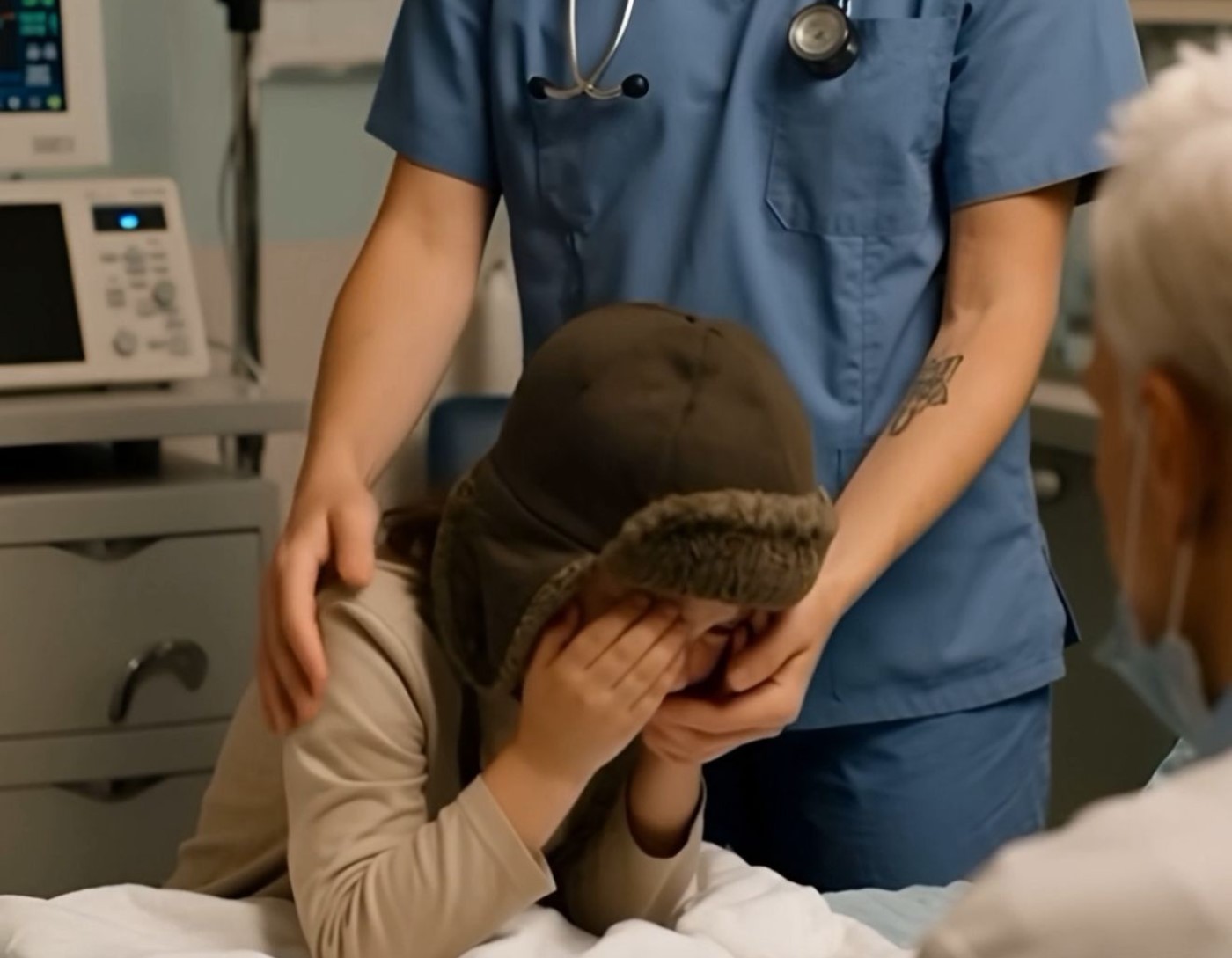
Sofia followed Mrs. Chen down the hallway to her classroom, where they found Marcus curled up on a reading couch in the corner, his arms wrapped around his head and his body rocking slightly in a rhythm that suggested he was in significant distress. Even from across the room, Sofia could see that he was trembling, and there were tears streaming down his cheeks.
“Marcus,” Sofia said softly, kneeling beside the couch so she could speak to him at eye level. “What’s happening, sweetheart? Are you in pain?”
He nodded without lifting his head, his voice muffled by his arms. “It hurts so bad. Everything hurts.”
“Can you tell me where it hurts?”
“My head,” he whispered. “Under the hat. It’s been getting worse for days, but I can’t… I’m not supposed to take it off.”
Sofia exchanged a meaningful look with Mrs. Chen, who quietly left the room to ensure their privacy. This was the moment Sofia had been waiting for—an opportunity to help Marcus without violating his sense of safety or triggering whatever fear was keeping him from seeking help.
“Marcus, I’m going to close the classroom door so we can have some privacy, okay? No one else will see or know what we talk about. It’ll just be between us.”
He looked up at her for the first time, his eyes red with tears and shadowed with exhaustion. “You promise? Dad said no one can know. He said if anyone finds out, they’ll take me away from my family, and it’ll be my fault for telling.”
The words hit Sofia like a physical blow. In fifteen years of school nursing, she had heard variations of this statement from dozens of children who were being abused, neglected, or otherwise harmed by the adults who were supposed to protect them. The language was always similar—the child was made to feel responsible for protecting the family secret, guilty for any consequences that might result from disclosure, and terrified of the punishment that would follow if they broke the code of silence.
“Oh, sweetheart,” Sofia said, her voice gentle but firm. “Listen to me very carefully. Nothing that’s happening to you is your fault. Nothing. And my job is to help you feel better and be safe. That’s the only thing I care about right now.”
Marcus studied her face with the intensity of a child who had learned to read adult expressions for signs of danger or deception. Whatever he saw in Sofia’s eyes seemed to satisfy him, because after a long moment, he gave a small, barely perceptible nod.
“Okay,” he whispered. “But you have to be really careful. It’s stuck.”
Sofia felt her heart rate increase as she began to understand the implications of his words. She put on latex gloves and gathered supplies from her emergency kit—antiseptic solution, sterile gauze, and gentle cleansing wipes. Whatever was under Marcus’s hat had been there long enough to become adherent to his scalp, which suggested infection, dried blood, or some other medical emergency that had been left untreated for weeks or possibly months.
“I’m going to go very slowly,” she told him, her voice calm despite the adrenaline coursing through her system. “If it hurts too much, you tell me and I’ll stop immediately, okay?”
As soon as Sofia touched the edge of the hat, Marcus cried out in pain, confirming her worst fears about what she was likely to find underneath.
“It’s stuck,” he gasped, tears flowing freely now. “It’s been stuck for a long time. My brother gave me the hat after… after Dad got really mad. He said I had to wear it so no one would see, and that eventually it would heal and everything would be okay.”
Sofia’s hands were shaking as she carefully worked to separate the fabric from Marcus’s scalp using warm, wet cloths and antiseptic solution. The process was slow and delicate, requiring frequent breaks when the pain became too intense for Marcus to bear. After nearly twenty minutes of painstaking work, she was finally able to lift the hat away from his head.
What she saw underneath made her gasp in horror and immediately reach for her phone to call emergency services.
Marcus’s head was almost completely bald, with only small patches of hair remaining around the edges where the hat hadn’t covered. But the absence of hair was the least shocking aspect of what Sofia was seeing. His scalp was covered with circular burn marks of various ages—some healed into shiny scar tissue, others still raw and infected. The pattern was unmistakable: someone had been systematically burning this child’s head with cigarettes or possibly a cigar, over a period that appeared to span several months.
The most recent burns were still weeping and showed signs of serious infection. The smell of infected tissue and the greenish discoloration around several of the wounds told Sofia that Marcus was likely suffering from a systemic infection that could be life-threatening if not treated immediately.
“Oh my God,” Sofia whispered, her professional composure cracking as the full scope of the abuse became clear.
Marcus sat very still, his eyes closed, as if he was relieved to finally have the secret exposed. “Daddy said I was bad,” he said quietly, his voice carrying the resigned tone of a child who had been systematically broken down. “He said I needed to learn lessons about being good. My brother tried to help by giving me the hat, but it just made everything hurt worse.”
“Marcus, listen to me,” Sofia said, fighting to keep her voice steady while she documented the injuries with photographs and prepared emergency medical treatment. “You are not bad. You have never been bad. What someone did to you is a crime, and it’s not your fault in any way.”
She immediately called 911 for emergency medical transport, then contacted Child Protective Services and the school administration. While they waited for help to arrive, Sofia carefully cleaned and bandaged the worst of the infections, giving Marcus pain medication and fluids while trying to keep him comfortable and calm.
“What’s going to happen now?” Marcus asked, his voice small and frightened.
“First, we’re going to get you to a hospital where doctors can treat your injuries properly,” Sofia explained. “Then, there are people whose job it is to make sure you’re safe and that no one ever hurts you like this again.”
“What about my brother? Will he get in trouble for giving me the hat?”
“Your brother was trying to help you the only way he knew how,” Sofia said gently. “Sometimes when families are in bad situations, people make choices that seem like the best option at the time, even if they’re not perfect solutions.”
When the paramedics arrived, they were visibly shaken by the extent of Marcus’s injuries. The lead EMT, a veteran with fifteen years of experience, told Sofia privately that it was one of the worst cases of child abuse he had encountered. The systematic nature of the burns, the evidence of repeated torture over an extended period, and the infected wounds that had been left untreated suggested a level of deliberate cruelty that was difficult to comprehend.
Marcus was transported to the regional children’s hospital, where a team of specialists began the complex process of treating his physical injuries while social workers and child psychologists began addressing the emotional trauma he had endured.
The investigation that followed revealed the full scope of the abuse that had been occurring in the Williams household. Robert Williams was arrested and charged with multiple counts of child abuse, assault, and criminal torture. During questioning, the horrifying details emerged: the burns had been inflicted as punishment for minor childhood infractions like spilling milk, speaking too loudly, or failing to complete chores to his father’s satisfaction.
Marcus’s older brother, twelve-year-old David, had been trying to protect his younger sibling by helping him hide the evidence of abuse, knowing that their father’s violence escalated when he thought his actions might be discovered. David had given Marcus the winter hat and coached him on how to avoid detection, believing that keeping the secret was the only way to prevent even worse violence.
The investigation also revealed that Marcus’s mother, Linda Williams, had been a victim of domestic violence for years but had been too frightened and isolated to seek help. She had been systematically cut off from friends and family, threatened with violence if she attempted to leave, and convinced that her children would be harmed if she tried to report the abuse. The discovery of Marcus’s injuries finally provided the evidence and support system she needed to escape the marriage and begin rebuilding her life.
Linda had been living in a constant state of terror, knowing that her husband was hurting her children but feeling powerless to stop it. She had been physically and emotionally abused to the point where she believed that any attempt to seek help would result in worse violence against her sons. The guilt and trauma of watching her children suffer while feeling unable to protect them had left her severely depressed and struggling with complex PTSD.
The medical treatment for Marcus’s injuries required multiple surgeries and months of intensive care. The burns had caused permanent damage to his scalp, and doctors had to perform skin grafts to repair the worst of the scarring. He required antibiotics for the serious infections that had developed, pain management for the ongoing discomfort, and specialized wound care to prevent further complications.
Beyond the physical healing, Marcus needed extensive psychological counseling to address the trauma he had experienced. At eight years old, he had endured systematic torture while being convinced that he deserved the abuse and was responsible for protecting his family from the consequences of disclosure. The psychological damage was profound and would require years of careful therapeutic intervention.
However, with proper medical care and a safe environment, Marcus began to heal both physically and emotionally. He was placed in protective custody with his mother and brother, who were provided with housing assistance, counseling services, and legal support to ensure their safety and help them rebuild their lives.
Linda Williams, freed from the constant threat of violence, was able to access mental health services and begin her own healing process. She had been living with severe trauma for years, and the discovery of her son’s abuse forced her to confront the full impact of the domestic violence that had dominated her family’s life. With the support of counselors and social workers, she slowly began to develop the skills and confidence necessary to protect her children and create a stable, nurturing home environment.
David Williams, Marcus’s older brother, also required significant support and counseling. He had been living with enormous guilt and responsibility, believing that his failure to find a better way to protect Marcus made him partially responsible for his brother’s suffering. Child psychologists worked with him to understand that he had been a child trying to navigate an impossible situation, and that his efforts to help Marcus showed love and courage rather than inadequacy.
The healing process was long and complex for the entire family. Marcus had nightmares and anxiety attacks, struggled with trust issues, and required ongoing medical care for his physical injuries. There were setbacks and difficult days when the trauma seemed overwhelming. But gradually, with consistent professional support and the love of his mother and brother, he began to show signs of recovery.
One of the most significant milestones came six months after his rescue, when Marcus voluntarily removed a lightweight baseball cap he had been wearing to cover his healing scalp. It was a small gesture, but it represented enormous progress in his journey toward feeling safe and secure in his own body.
“It doesn’t hurt anymore,” he told Sofia during a follow-up visit to the school nurse’s office. “And nobody’s going to hurt me if people see.”
The scars on Marcus’s scalp were permanent, and his hair would never grow back completely in the areas where the burns had been most severe. But he was alive, safe, and surrounded by people who were committed to his healing and protection. He was learning to be a child again—to play, laugh, and trust that the adults in his life would keep him safe rather than cause him harm.
Robert Williams was sentenced to fifteen years in prison for child abuse and domestic violence. The investigation revealed that he had a pattern of escalating violence that likely would have continued to worsen if Marcus’s injuries hadn’t been discovered. Expert testimony at his trial indicated that the systematic nature of the abuse and the young age of the victim suggested a high likelihood of future violence that could have been fatal.
The case became a catalyst for changes in how the school district trained staff to recognize signs of abuse and respond to concerning behavior. Sofia worked with administrators to develop protocols that would help teachers and support staff identify children who might be suffering in silence, and to create systems that made it easier for children to seek help when they needed it.
Marcus’s story, while deeply traumatic, ultimately became one of survival and healing. The winter hat that he had worn through forty scorching summer days had been both a symbol of his suffering and the key to his salvation. By protecting him from immediate discovery while his injuries healed enough to be safely examined, the hat had inadvertently provided the evidence necessary to rescue him from a situation that was rapidly becoming life-threatening.
Today, three years after his rescue, Marcus is a thriving eleven-year-old who loves baseball, reading, and spending time with friends. He still sees a counselor regularly and sometimes struggles with anxiety, but he has learned to trust that he is safe and valued. His relationship with his mother and brother has grown stronger as they’ve healed together, and he has become an advocate for other children who might be suffering in silence.
The scars on his head tell a story of unimaginable cruelty, but they also represent his survival and the caring professionals who refused to ignore the signs that something was wrong. Nurse Sofia still works at Lincoln Elementary, where she continues to watch over children with the vigilance and compassion that saved Marcus’s life. She keeps a photo of him on her desk—not from the dark days of his abuse, but from his recent birthday party, where he’s smiling broadly and wearing a baseball cap by choice rather than necessity.
Sometimes the most important thing an adult can do for a child is simply pay attention and refuse to look away when something doesn’t seem right. Marcus’s winter hat in summer was a cry for help that almost went unheard, but thanks to one nurse’s willingness to ask difficult questions and one child’s courage to finally trust an adult with his terrible secret, a life was saved and a family was set free from a cycle of violence that had threatened to destroy them all.

Adrian Hawthorne is a celebrated author and dedicated archivist who finds inspiration in the hidden stories of the past. Educated at Oxford, he now works at the National Archives, where preserving history fuels his evocative writing. Balancing archival precision with creative storytelling, Adrian founded the Hawthorne Institute of Literary Arts to mentor emerging writers and honor the timeless art of narrative.