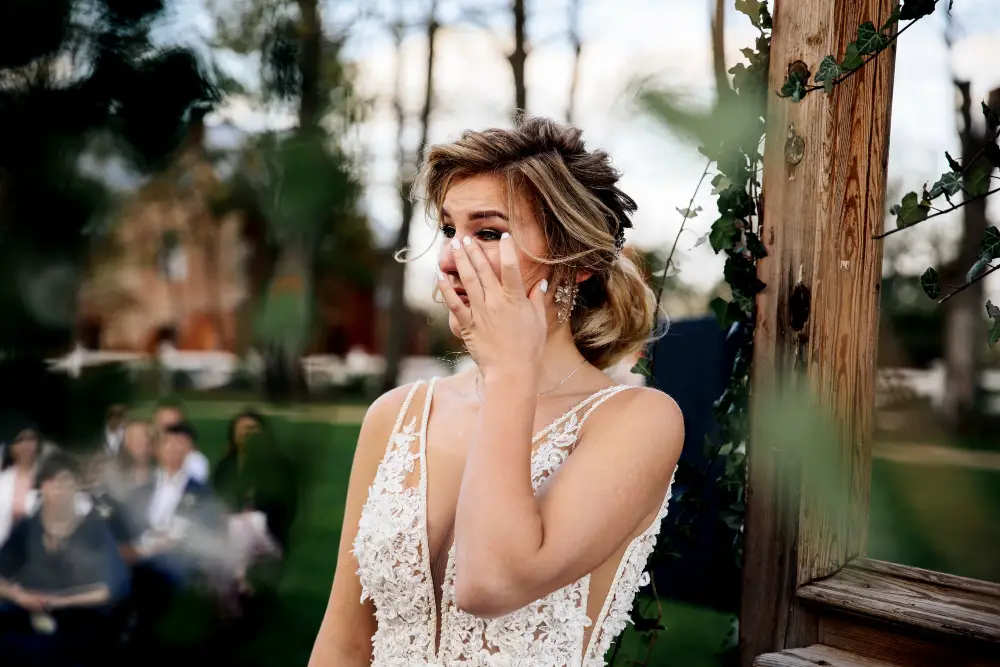
The Photograph That Stopped a Wedding
An Expanded Story
My name is Ross Bailey, and I’ve been a wedding photographer for eight years. In that time, I’ve captured over three hundred ceremonies—nervous grooms fumbling with rings, brides crying during their vows, flower girls stealing cake, groomsmen making inappropriate toasts. I’ve seen family drama, weather disasters, wardrobe malfunctions, and once, an actual runaway bride who bolted mid-ceremony because she realized she’d forgotten to feed her cat.
I thought I’d seen everything. I was wrong.
The wedding of Victoria Reed and Peter Russell was supposed to be the pinnacle of my career. Instead, it became the day I learned that sometimes the most important photograph you take is the one that helps someone save themselves.
I fell into wedding photography almost by accident. Fresh out of college with a journalism degree and romantic notions about being the next great photojournalist, I spent three years freelancing for local newspapers, covering city council meetings and high school football games. The pay was terrible, the hours worse, and my student loans were crushing me.
A friend asked me to photograph her wedding as a favor. I figured, how hard could it be? Point, shoot, make people smile. Turns out, it was harder than I thought—but also more rewarding. There was something about capturing those genuine moments of joy, of witnessing people at their most vulnerable and hopeful, that felt meaningful in a way my other work never had.
I discovered I had a gift for it. Not just the technical aspects—anyone can learn aperture and shutter speed—but the ability to see the real moments hiding beneath the staged ones. The nervous glance between a couple during the ceremony. The way a father’s hand trembled as he walked his daughter down the aisle. The split-second of pure happiness before someone remembered they were supposed to pose.
Within two years, I was booking fifty weddings a season and charging rates that actually let me pay my bills. I loved the work, loved being part of people’s happiest days, loved the way my photographs became family heirlooms.
But I also developed a sense—call it intuition, call it pattern recognition—about couples. After photographing hundreds of weddings, you learn to spot the real thing versus the performance. You see which couples have that ineffable spark and which ones are going through motions for reasons that have nothing to do with love.
Which brings me to Victoria Reed.
The call came in late March from someone who introduced herself as “Victoria Reed’s assistant,” which should have been my first clue that this wasn’t a normal wedding.
“Miss Reed is getting married on June fifteenth at the Reed family estate,” the woman said crisply. “She needs a photographer. Your name came highly recommended.”
“That’s wonderful,” I said, pulling up my calendar. “I’d love to set up a consultation with Victoria and her fiancé to discuss their vision for—”
“Miss Reed’s schedule is quite full. Her father, Charles Reed, will handle the consultation. He’ll expect you at the Reed offices downtown tomorrow at ten a.m. Please bring your portfolio.”
She hung up before I could respond.
I did some quick googling. Charles Reed was a name I vaguely recognized—something to do with commercial real estate and old money. The Reed family was Boston society royalty, the kind of people who appeared in the Globe’s society pages and had buildings named after them at Harvard.
This was a big deal. This was the kind of wedding that could elevate my career to an entirely new level. I spent that evening organizing my best work, practicing my pitch, trying to tamp down my excitement.
The Reed offices occupied the entire top floor of a downtown high-rise. The reception area alone was bigger than my apartment, all gleaming marble and modern art that probably cost more than I’d make in a decade.
Charles Reed’s office was even more intimidating. The man himself was in his early sixties, silver-haired and commanding, the kind of person who was accustomed to being obeyed without question. He didn’t stand when I entered, just gestured to a chair while he flipped through my portfolio.
“The Whitmore wedding,” he said, tapping a spread. “I know James Whitmore. He said you did excellent work.”
“Thank you, sir.”
“This wedding is important, Mr. Bailey. Very important. My daughter Victoria is marrying Peter Russell, combining two of Boston’s most prominent families. There will be three hundred guests, many of them influential people. I need comprehensive documentation—every guest, every moment, every detail. Nothing can be missed.”
He wasn’t asking about my artistic vision or what would make his daughter happy. He was hiring me to document a business transaction.
“I understand,” I said carefully. “Though typically I like to meet with the couple first, understand what they want from their wedding photos—”
“What they want is what I’m telling you. Full coverage. No artistic liberties. I’m paying you twenty-five thousand dollars to capture this event exactly as I’ve planned it.”
Twenty-five thousand dollars. That was more than I’d ever been paid for a single wedding. It was nearly half my annual income. I should have been thrilled.
Instead, I felt vaguely uneasy.
“I’d still like to meet with Victoria and Peter,” I said. “Even just briefly. It helps me capture their personalities, their relationship—”
“Fine,” Charles interrupted, checking his watch. “Victoria has fifteen minutes at three o’clock next Tuesday. My assistant will send you the details.”
That was it. Meeting over. I’d been hired for the biggest wedding of my career, and I hadn’t even met the bride.
The consultation with Victoria and Peter took place at an upscale restaurant in Back Bay. I arrived early, nervous in a way I hadn’t been for a wedding meeting in years.
Victoria Reed was stunning—the kind of beauty that belonged in old movies, all classic elegance and perfect posture. She was twenty-six but carried herself with the poise of someone much older. Her handshake was firm, her smile polite and practiced.
Peter Russell was equally polished: tall, handsome, with the easy confidence of someone who’d never doubted his place in the world. He looked like he’d stepped out of a Ralph Lauren ad.
They looked perfect together. Completely, utterly perfect.
And completely, utterly wrong.
“Ross comes highly recommended,” Peter said, not to me but to Victoria, as if I weren’t sitting right there. “The Whitmore wedding he photographed was featured in Town & Country.”
“That’s wonderful,” Victoria replied, her tone pleasant but distant.
I tried to engage them, asking about how they met, what was important to them for the wedding day, what moments they wanted to make sure I captured.
“Our families have known each other since childhood,” Peter said. “We’ve been expected to marry eventually, so we’re just making it official.”
Expected to marry. Not wanted, not chose—expected.
“And what drew you to each other specifically?” I pressed, trying to find something genuine beneath the polish.
They exchanged a glance. “Shared values,” Peter said. “Similar backgrounds. We want the same things from life.”
“Which are?”
Another glance. Victoria spoke this time, her words sounding rehearsed. “To honor our families’ legacies. To contribute meaningfully to society. To build a life of purpose and stability.”
It was a beautiful answer that said absolutely nothing about love.
“What about you, Victoria?” I asked gently. “What do you want from your wedding day?”
For just a moment—less than a second—something flickered across her face. Longing? Sadness? It was gone before I could identify it.
“I want whatever my father thinks is best,” she said. “He’s planned everything beautifully.”
The rest of the meeting was professional and productive and utterly devoid of any warmth between the couple. They sat at opposite ends of the table. They didn’t touch. They barely looked at each other. When Peter’s phone rang, he excused himself for ten minutes, and Victoria sat in silence, staring at her untouched water glass.
“Are you happy?” I asked quietly when we were alone.
She looked up, startled. “Excuse me?”
“I’m sorry, I shouldn’t have asked. It’s just—I’ve photographed a lot of weddings, and usually couples are more…”
“More what?”
“More present with each other. More excited.”
Victoria’s expression went carefully blank. “Peter and I have a very mature relationship. We’re not silly or overly demonstrative. That doesn’t mean we’re not committed to each other.”
She was lying. I knew she was lying. But it wasn’t my place to push further.
Peter returned, and we wrapped up the meeting with logistics—timeline, shot list, family photo requirements that read like a corporate org chart. They left separately, Victoria mentioning she had a charity board meeting, Peter heading to his office.
I sat in that restaurant for another twenty minutes, finishing my coffee and feeling deeply troubled. I’d just agreed to photograph a wedding that felt like a beautiful, expensive lie.
The months leading up to the wedding were strange. Most couples want multiple meetings, engagement photo sessions, venue visits. Victoria and Peter communicated exclusively through their assistants. When we did an engagement shoot, they were polite and cooperative, but there was no chemistry. Every smile looked like it required effort.
I tried to capture something genuine, but it was like photographing mannequins. Beautiful, well-dressed mannequins going through the motions of a relationship.
The week before the wedding, I met with Victoria one final time to confirm details. She looked exhausted, with dark circles under her eyes that makeup couldn’t quite hide.
“How are you feeling?” I asked. “Excited?”
“Of course,” she said automatically. Then, softer: “I’ll be glad when it’s over.”
That’s not what brides say. Brides say they can’t wait for the day to arrive. They say they’re nervous but thrilled. They don’t say they’ll be glad when it’s over.
“Victoria,” I started, but she cut me off.
“Please don’t ask if I’m happy. Everyone keeps asking that, and I don’t know how to answer anymore. I’m doing what I’m supposed to do. That should be enough.”
“Should it?”
She looked at me with such profound sadness that it took my breath away. “It has to be.”
The morning of June fifteenth dawned perfect—the kind of flawless early summer day that seems designed for outdoor weddings. I arrived at the Reed estate at seven a.m. to begin shooting preparation photos.
The property was staggering: a sprawling mansion that looked like it had been transplanted from an English countryside, surrounded by manicured gardens where three hundred white chairs were arranged in perfect rows. A massive white tent had been erected for the reception, complete with crystal chandeliers and enough flowers to stock a florist shop for a month.
The bridal suite was chaos of the expensive variety. Five bridesmaids in matching silk robes, two hair stylists, a makeup artist, a manicurist, and an assistant whose only job seemed to be managing everyone else. In the center of it all sat Victoria, looking like a beautiful statue.
She wasn’t glowing with bridal joy. She looked resigned.
“Victoria, darling, you need to smile more,” one of the bridesmaids chirped. “It’s your wedding day!”
A smile appeared instantly on Victoria’s face—bright, beautiful, and completely hollow. It was the same smile I’d seen in every consultation, every meeting. A smile that never reached her eyes.
I photographed the chaos, capturing details: the dress hanging in the window, the shoes lined up, the bouquet being assembled. But my lens kept returning to Victoria’s face, searching for something genuine beneath the performance.
Around nine a.m., Charles Reed arrived to see his daughter. “My beautiful girl,” he said, but his tone was proprietary rather than affectionate. “Are you ready for your big day?”
Victoria’s entire body tensed when he placed his hands on her shoulders. It was subtle—most people probably wouldn’t have noticed. But I’d spent years learning to see the micro-expressions people don’t know they’re making.
“Yes, Father. Everything is exactly as you planned.”
“As we planned,” he corrected, squeezing her shoulders hard enough that I saw her wince. “This is your day, Victoria. The day you become Mrs. Peter Russell and take your rightful place in society. I’m very proud.”
It didn’t sound like pride. It sounded like a business deal closing.
After he left, Victoria sagged in her chair, the tension draining from her body. “Twenty more hours,” she whispered to herself. “Just twenty more hours.”
The groom’s suite was a completely different energy. Peter and his groomsmen were relaxed, joking, drinking mimosas even though it was barely ten a.m. They looked like they were preparing for a golf outing, not a wedding.
“Nervous?” I asked Peter as I photographed him adjusting his tie.
“Not at all,” he said confidently. “Victoria and I have known each other our whole lives. This has always been the plan—our families are friends, our values align, we want the same things from life. It’s really quite perfect.”
There was that word again. Perfect.
Perfect except for the complete absence of love.
It was one of the groomsmen who introduced me to Logan Russell, Peter’s younger brother. Where Peter was conventionally handsome in a Ken-doll way, Logan was more understated—slightly shorter, with thoughtful eyes and an easier smile. He was the only person in the groom’s suite who seemed at all concerned about the day ahead.
“You must be the photographer,” he said, approaching me while I was packing up my gear. “Have you spent time with Victoria?”
“A bit. She seems lovely.”
Logan was quiet for a moment, looking like he wanted to say something but didn’t know if he should. “She is. She’s actually the kindest, most intelligent woman I’ve ever known. She has this incredible laugh—this real, genuine laugh that just lights up everything around her. She’s funny and smart and so much more than just…”
He trailed off, looking uncomfortable.
“More than just what?” I prompted.
“More than just the perfect society wife everyone expects her to be. I just hope…” He stopped again, shaking his head. “Never mind. It’s not my place.”
But the way he talked about Victoria—the warmth in his voice, the genuine affection—it was more emotion than I’d heard from Peter all day.
“You care about her,” I observed.
“She’s going to be my sister-in-law,” Logan said carefully. “Of course I care about her.”
But it was more than that. I could see it in his eyes, hear it in his voice. Logan Russell was in love with his brother’s bride.
And judging by the sadness in his expression, he knew it was hopeless.
The formal family photos were scheduled for noon, three hours before the ceremony. Both families assembled in the mansion’s grand library—the Reeds on one side, the Russells on the other, with Victoria and Peter in the middle like treaty negotiators.
The photos were stiff and formal. Everyone knew exactly where to stand, exactly how to smile. These weren’t candid moments—they were carefully constructed images designed to project success, legacy, power.
I shot what I was hired to shoot, but my heart wasn’t in it.
During a break while I adjusted my lighting, I saw Logan approach Victoria, who was standing apart from everyone else, looking out a window. He said something I couldn’t hear, and suddenly—miraculously—her entire face transformed.
She laughed. Really, genuinely laughed—head thrown back, eyes crinkled, one hand reaching out to touch Logan’s arm. For just that moment, the mask fell away completely, and I saw who Victoria really was underneath all the polish and performance. She was radiant.
Logan was looking at her with such open affection, such tenderness, that it made my chest ache.
I raised my camera on pure instinct and captured it: Victoria mid-laugh, her hand on Logan’s arm, both of them looking at each other with an intimacy and joy I hadn’t seen anywhere else all day.
Then Charles Reed’s voice cut through the moment like a knife. “Victoria! We’re ready for the next round of photos.”
The light in her eyes died instantly. The mask snapped back into place. She dropped her hand from Logan’s arm and turned away, her expression carefully neutral once again.
But I had seen the truth. More importantly, I had captured it.
As the ceremony time approached, I found myself increasingly agitated. I had a job to do—document this wedding, collect my twenty-five thousand dollars, and move on. But I also had evidence that the bride was desperately unhappy, that she was being pushed into a marriage she clearly didn’t want.
What was my responsibility here? I was hired to take pictures, not interfere with people’s lives. But could I really stand by and watch someone make a terrible mistake when I had the power to show her something that might change everything?
The decision crystallized when I saw Victoria alone in the bridal suite ninety minutes before the ceremony. Her hair and makeup were perfect, her dress was stunning, and she looked absolutely miserable. She was staring at herself in the full-length mirror with an expression of such profound sadness that it broke my heart.
I knocked gently on the doorframe. She turned, panic flashing across her face. “Is it time already?”
“No. You still have over an hour. I just… I wanted to show you something.”
I shouldn’t have done it. It violated every professional boundary. But I pulled up the photo on my camera’s screen—Victoria laughing with Logan—and turned it toward her.
Her breath caught. For several seconds, she just stared at the image, her eyes filling with tears.
“Why are you showing me this?” she whispered.
“Because in the hundreds of photos I’ve taken today, this is the only one where you look truly happy.”
A tear spilled down her cheek, ruining her perfect makeup. “You don’t understand. This wedding—it’s not about what I want. It’s about family obligations, business relationships, expectations that were set before I was even old enough to have opinions.”
“But what do you want, Victoria?” I asked gently. “Not your father, not society, not your family’s business interests. What do you want?”
She stared at the photo, her finger hovering over the screen like she wanted to touch it. “I want to feel like this,” she said finally, her voice breaking. “I want to laugh like this, to be myself without apology or fear. I want to be with someone who sees me—really sees me—not just the Reed family name or the perfect society wife I’m supposed to become.”
“Then why don’t you?”
“Because I can’t!” The words burst out of her. “Do you have any idea what would happen if I called off this wedding? The scandal, the embarrassment, the disappointment? My father would never forgive me. The families have been planning this for years. There are business arrangements tied to this marriage, social connections, expectations from hundreds of people. I can’t just walk away because I’m not… because I don’t…”
“Because you’re not in love with Peter,” I finished quietly.
She closed her eyes. “I’m not in love with Peter.”
“But you might be in love with someone else.”
Her eyes flew open, fear and hope warring in her expression. “I didn’t say that.”
“You didn’t have to.”
A knock on the door made us both jump. “Victoria?” Charles Reed’s voice called. “It’s almost time. I need to speak with you.”
Victoria looked at me, then back at the photo on my camera screen. Something shifted in her expression—a hardening of resolve, a spark of defiance I hadn’t seen before.
“Thank you,” she said quietly. “For showing me this. For seeing me.”
The ceremony began at three p.m. The garden was breathtaking—three hundred guests in their finest clothes, seated among flowers that must have cost a fortune, with a string quartet playing something classical and beautiful.
I positioned myself to capture the processional, my telephoto lens focused on the spot where Victoria would appear.
The music swelled. The guests stood. And there she was—Victoria on her father’s arm, looking like something out of a fairy tale in her elaborate gown.
But there was something different about her expression. The resigned sadness was gone, replaced by a kind of fierce determination that made her look more alive than I’d seen her all day.
They walked down the aisle—Charles Reed gripping his daughter’s arm possessively, Victoria’s head held high. When they reached the altar, Charles kissed her cheek and whispered something I couldn’t hear.
“I know, Father,” Victoria replied, her voice carrying in the hushed garden. “But I need to tell you something. I’m about to make my own choices now.”
Charles frowned, confused, but stepped back to his seat. Victoria turned to face Peter at the altar, and the ceremony began.
The minister’s words were traditional, elegant, exactly what you’d expect for a high-society wedding. Peter’s vows were polished and appropriate, all about partnership and respect and building a life together. No mention of love, I noticed. No mention of passion or desire or any of the things that actually make a marriage worth having.
Then it was Victoria’s turn. She took a breath, looked at Peter, and began to speak.
“Peter, I… I need to tell you the truth.”
Peter’s confident smile faltered. “Victoria?”
“The truth is that you’re a good man. You’re kind and decent and you deserve to marry someone who loves you with their whole heart. But I’m not that person.”
Confused murmurs rippled through the guests. Charles Reed was half-rising from his seat, his face darkening.
“I’ve spent my entire life doing what I was supposed to do,” Victoria continued, her voice growing stronger. “Being the perfect daughter, following the perfect plan, preparing for this perfect wedding. But none of it is perfect if it’s not what I choose. None of it means anything if I’m just going through motions to please other people.”
“Victoria, what are you doing?” Peter asked, genuine alarm in his voice now.
The minister had frozen mid-ceremony, looking between Victoria and Peter like he’d forgotten his lines.
Victoria pulled off her engagement ring—a massive diamond that probably cost more than my car—and placed it in Peter’s hand.
“I’m sorry,” she said, and she meant it. I could see real regret in her eyes, real guilt for the embarrassment she was causing him. “I’m so sorry for not being brave enough to tell you this before. But I can’t marry you. Not when I don’t love you. Not when my heart belongs to someone else.”
The garden erupted. Three hundred guests gasped, whispered, turned to their neighbors in shock. Charles Reed was on his feet, his voice thundering across the garden. “Victoria Reed, you stop this nonsense right now!”
But Victoria wasn’t looking at her father. She had turned to face the guests, her chin raised, her expression defiant and free in a way I’d never seen.
“I know this is shocking,” she said, her voice carrying over the chaos. “I know I’m embarrassing my family and disappointing everyone who came here today expecting a wedding. But I hope—I desperately hope—that somewhere in this crowd, there’s someone who understands that choosing your own happiness isn’t selfish. It’s necessary. It’s survival.”
Her eyes found Logan in the crowd of groomsmen. He was staring at her with his heart in his eyes, frozen between hope and disbelief.
“I hope,” Victoria continued, still looking at Logan, “that when I do get married someday, it will be to someone who makes me laugh. Someone who sees who I really am, not who they want me to be. Someone who makes me feel alive.”
And then she gathered her elaborate dress in both hands and walked back down the aisle—not as a bride walking toward her future, but as a woman walking toward her freedom.
The guests parted for her like she was radioactive. Charles Reed looked like he might have a stroke. Peter stood at the altar, still holding the engagement ring, looking more confused than heartbroken.
And I kept photographing, capturing every moment of this beautiful disaster.
Victoria had almost reached the back of the garden when Logan broke free from the stunned groomsmen and ran after her.
“Victoria!” he called. “Victoria, wait!”
She turned, and when she saw him, her face lit up with that same genuine joy I’d captured in the photograph. “Logan.”
“Are you okay?” he asked, slightly breathless. “That was… that was incredible.”
“I’m better than okay,” she said, laughing through tears. “I’m free. For the first time in my life, I feel free.”
“What will you do now?”
“I have no idea,” she admitted. “No plan, no expectations, no predetermined path. It’s terrifying.”
Logan took her hands in his, and I saw Victoria’s breath catch. “Would you like some company while you figure it out?”
“Logan, you can’t. Your family will never forgive you. Peter will never forgive you.”
“I don’t care,” he said simply. “I’ve spent years watching you prepare to marry my brother when I—” He stopped, took a breath. “When I’ve been in love with you since we were teenagers. I never said anything because I thought you wanted this. I thought you loved Peter. But if there’s even a chance that you might feel the same way I do…”
Victoria threw her arms around him, and Logan lifted her off her feet, spinning her around while her wedding dress billowed around them. When he set her down, she was crying and laughing at the same time.
“I love you,” she said. “I’ve loved you for so long, but I thought it was impossible. I thought I had to follow the plan.”
“Forget the plan,” Logan said, and kissed her right there in front of three hundred scandalized guests and her apoplectic father and his confused brother.
I captured it all—the joy, the freedom, the love that had been hiding beneath years of expectations and obligations.
It was the most beautiful thing I’d ever photographed.
The aftermath was chaos. Charles Reed threatened to disown Victoria on the spot. Peter, to his credit, was more bewildered than angry. The guests scattered like they couldn’t escape fast enough, already pulling out their phones to spread the scandal.
Victoria and Logan disappeared together, driving away in Logan’s car still in their wedding attire.
And I was left standing in an empty garden with thousands of dollars of equipment and the most extraordinary set of wedding photos I’d ever taken—photos of a wedding that never happened, but a love story that finally could.
My phone rang three hours later. It was Victoria.
“Ross, I just wanted to thank you. For showing me that photo. For helping me see what I was giving up.”
“You made your own choice,” I said. “I just gave you information.”
“You gave me courage,” she corrected. “And I wanted you to know—Logan and I are leaving Boston for a while. Going somewhere we can figure out our next steps away from all this drama. But when we come back, when we’re ready to actually get married… we’d like you to photograph it. If you’re willing.”
“I’d be honored.”
“Fair warning—it won’t be anything like today was supposed to be. Small ceremony, just family and close friends. Nothing fancy.”
“That sounds perfect,” I said, and this time the word actually meant something.
A year later, I received a formal invitation: Victoria Reed and Logan Russell request your presence at their wedding.
It was everything Victoria had promised—small, intimate, held in a garden at Logan’s friend’s house with maybe forty guests. Victoria wore a simple dress, Logan wore a suit he already owned, and they exchanged vows they’d written themselves.
The photographs from that day were some of the most beautiful I’ve ever taken, because they captured something money can’t buy: two people who had chosen each other freely, who had risked everything for the chance to be together, who looked at each other with absolute certainty that this was right.
My favorite photo from that day shows Victoria mid-laugh, her head thrown back with pure joy while Logan looks at her with an expression of complete wonder. It’s the same genuine happiness I’d captured in that first photograph—the one that had given her the courage to choose her own path.
That photo now sits framed in my office, a reminder that sometimes the most important thing a photographer can do isn’t just document what’s happening, but help people see the truth they’re too afraid to look at themselves.
I never did get paid my twenty-five thousand dollars for the Reed-Russell wedding that didn’t happen. But Victoria and Logan paid me double for their actual wedding, and more importantly, they gave me something I didn’t know I needed: proof that love is worth fighting for, even when everyone tells you it’s impossible.
Especially then.

Lila Hart is a dedicated Digital Archivist and Research Specialist with a keen eye for preserving and curating meaningful content. At TheArchivists, she specializes in organizing and managing digital archives, ensuring that valuable stories and historical moments are accessible for generations to come.
Lila earned her degree in History and Archival Studies from the University of Edinburgh, where she cultivated her passion for documenting the past and preserving cultural heritage. Her expertise lies in combining traditional archival techniques with modern digital tools, allowing her to create comprehensive and engaging collections that resonate with audiences worldwide.
At TheArchivists, Lila is known for her meticulous attention to detail and her ability to uncover hidden gems within extensive archives. Her work is praised for its depth, authenticity, and contribution to the preservation of knowledge in the digital age.
Driven by a commitment to preserving stories that matter, Lila is passionate about exploring the intersection of history and technology. Her goal is to ensure that every piece of content she handles reflects the richness of human experiences and remains a source of inspiration for years to come.