The Last Inheritance
I never expected to bury my child. It is the most unnatural posture on earth—to stand while they lower your boy beneath it. Richard was thirty‑eight. I was sixty‑two. The mathematics of it felt obscene, a violation of the contract I thought I’d signed when I first held him and counted his fingers in the hospital light. April rain threaded through the oaks at Green‑Wood Cemetery and slicked the marble angels until they looked like they were weeping with us. Sound came thin and far away: shovel on wet soil, a zipper of thunder somewhere over the harbor, the soft human noises people make when they don’t know what to do with their hands. Grief walled me off from the living world. Faces blurred at the edges until only the polished mahogany, the raw mouth of earth, and my own name spoken in softened tones remained. I had dressed in black without thinking, the way your body remembers rituals your mind refuses to accept.
Across the grave stood my daughter‑in‑law. Amanda—precision hair, liner that wouldn’t dare smudge, posture like a trademark. Married three years and somehow the gravitational center of every room she entered. Her black Chanel looked like a dress made for sponsorship dinners, not for the edge of a grave. The fabric probably cost more than the flowers surrounding us. She accepted condolences with a professional tilt of the head, her hand touching each mourner’s arm with the exact pressure of practiced sympathy. When our eyes met across the casket, she arranged a sympathetic smile that never touched anything living. Her gaze slid away before I could find anything human in it.
“Mrs. Thompson?” A man in a gray suit waited until the last handful of soil hit wood, the sound like a period at the end of a sentence no one wanted to finish. “Jeffrey Palmer. Palmer, Woodson & Hayes. Richard’s attorney. The reading will be at the penthouse in an hour. Your presence is requested.”
“At the house?” The words sounded like they belonged to the rain, distant and not quite mine. “That’s… soon. We haven’t even—”
“Amanda—Mrs. Conrad‑Thompson—was insistent.” He corrected himself with the reflex of a man who knows where the center of the room is now, whose paycheck depends on reading the shift in power.
Of course she was. Amanda loved theater almost as much as she loved the audience for it. Richard had believed himself happy with her, and after cancer took his father five years earlier, I had learned to let happiness sit where it landed, to stop excavating my son’s choices for weaknesses. But there had always been math in her eyes—columns and totals hidden under the glow, a calculator running behind the smile.
The Fifth Avenue penthouse sailed over Central Park like a glass ship, all clean lines and expensive silence. Richard bought it before her; she remade it after. Books banished to storage or donation—my gift of first editions vanished within a month. Angles everywhere. Seating that punished the idea of sinking in, furniture that looked sculptural but felt like penance. Fashion friends, board members, glossy strangers drifted through the space as if this were a launch party instead of a wake. Someone had put out champagne. Champagne. At my son’s funeral reception.
“Eleanor, darling.” Amanda offered an air‑kiss that landed safely a breath from my cheek, her perfume sharp and floral and too much. “So glad you could make it. Richard would have wanted you here.”
As if I needed permission to mourn my own child.
“No wine,” I said, my voice steadier than I felt. “Thank you.”
She pivoted to a tall man in an Italian suit, her transformation instantaneous. “Julian, you came.” Her hand fell to his knee and stayed there, familiar and possessive. I recognized him vaguely—one of Richard’s business partners, the kind of man who spoke in quarterly projections and called everyone “chief.” I found a corner by the window and held to the last thin rope of composure, watching clouds darken over the park.
Palmer positioned himself by the marble fireplace, briefcase open at his feet. “Ladies and gentlemen,” he said, and the room fell into the hush of expensive rooms where important things happen. “This is the last will and testament of Richard Thomas Thompson, executed and notarized four months ago.”
Four months. Richard updated every August on his birthday, a ritual inherited from his father who believed in keeping things current. January was nowhere near August. New Year’s had changed something I didn’t yet know the name for, some shift I’d missed while I was busy believing my son was fine.
“To my wife, Amanda Conrad‑Thompson, I leave our primary residence at 721 Fifth Avenue, including all furnishings and art contained therein. I also leave to Amanda my controlling shares in Thompson Technologies, my yacht—Eleanor’s Dream—and our vacation properties in the Hamptons and Aspen.”
A soft intake of breath moved the room like wind over wheat. It was almost everything. Thompson Technologies wasn’t just a company; it was my son’s name in code, then in contracts, then in the crawl on financial news. Those shares were a kingdom. The yacht he’d named for me—gone. The Hamptons house where we’d spent last Fourth of July watching fireworks scatter over the water—no longer mine to remember in.
“To my mother, Eleanor Thompson…” I straightened, bracing for something that felt like us—the cedar‑shingled Cape house where we traced constellations with flashlights and made up stories about bears in the sky; the first editions we hunted at auctions, outbidding each other for the pleasure of it; the vintage MG his father kept alive with tenderness and wire, teaching Richard patience with a wrench. “…I leave the enclosed item to be delivered immediately following the reading.”
Palmer produced a crumpled envelope. It sat on his palm like it weighed more than paper, like it carried a message he didn’t want to deliver.
“That’s it?” Amanda let the syllables ring through the silence, her voice pitched for the back row. “The old lady gets an envelope? Richard, you sly dog.” Laughter chimed—hers first, bright and cutting, then the satellites that orbited her, then a couple of Richard’s newer associates who didn’t know any better, even Julian, whose hand had not moved from its place on her knee. The sound wrapped around me like barbed wire.
Palmer approached, his face apologetic in a way that suggested he’d seen uglier will readings but not by much. “Mrs. Thompson, I—”
“It’s fine,” I said in the careful politeness women learn to use when cruelty wears etiquette like evening dress. I opened it because refusal would have been a second spectacle, another story for these people to tell at their next dinner party. The envelope stuck slightly, grief making my fingers clumsy.
A single airline ticket slid into my hand. First class to Lyon, France. Connecting train to a village I’d never heard of—Saint‑Michel‑de‑Maurienne. Departure: tomorrow morning. Not next week, not when I’d had time to grieve or think. Tomorrow.
“A vacation?” Amanda sang, her voice dripping with false sympathy. “How thoughtful. Time alone. Far, far away from everything that mattered.” The laughter sounded like glass breaking somewhere you couldn’t reach in time to catch it, sharp and dangerous and impossible to clean up.
“If there’s nothing else,” I said, refolding the ticket with hands I kept from shaking by force of will alone.
“Actually,” Palmer winced, looking like a man being forced to kick someone already down, “a stipulation. Should you decline to use this ticket, Mrs. Thompson, any potential future considerations will be nullified.”
“Future considerations?” Amanda’s brows knit and then smoothed like silk, her lawyer’s mind engaging. “What does that even mean, Jeffrey?”
“I’m not at liberty to explain,” he said, and looked like a man who disliked the shape of the room he was in, who wanted to be anywhere but here delivering this message.
“It hardly matters.” Amanda’s smile sharpened into something that belonged on a blade. “There’s clearly nothing else of value. Please—everyone—stay and celebrate Richard’s life. He would have wanted us to remember the good times.”
The party resumed its forward motion. Clinks of crystal. Business cards exchanged by the bar. A laugh from the kitchen that didn’t know its place, too loud and too soon. I rode the elevator down inside a soundproof box of grief, watching the numbers descend like a countdown I couldn’t stop. At my Upper West Side apartment—where Richard’s height was still penciled on the kitchen doorjamb and the curtains held the smell of old paper and afternoon sun—I set the ticket on the table and watched the afternoon step down the brick of the building across the way. Shadows lengthened. The city moved outside my window, indifferent to loss.
I could have called a lawyer. Could have contested the insult delivered with witnesses, the humiliation performed for an audience. But under the rage and grief there was a stubborn frequency only one voice in the world carried. Trust me, Mom. One last time. Richard had been nine when he first said it, standing on a dock with a rope swing and water below, afraid and defiant. Trust me, at sixteen with his first car and a road trip he swore was safe. Trust me, at twenty‑five when he started the company everyone said would fail. Against reason, against the evidence of the envelope and the laughter, I tuned to it.
By dawn I had packed a single suitcase, watered the philodendron that had outlived my husband, and ordered a car to JFK. Airports are designed for people pretending not to think, all distraction and movement and fluorescent purpose. Grief knows every gate.
Lyon greeted me with pale sun and the elegance of a city older than my country by centuries. The Rhône and Saône met and separated like dancers who knew the steps. My college French woke like an old cat—stretching, stiff, willing but unsteady. Tickets, platforms, merci. The regional train climbed into the Alps through a world that seemed designed to make grief feel small against its scale. The world rose on both sides—stone and snow, fields stitched to mountain like patchwork made by giants; church spires perched like sentries watching valleys; tunnels that held your breath and bursts of blue that gave it back. Why here, Richard? Why me? Why now? The questions rattled against the window with my reflection.
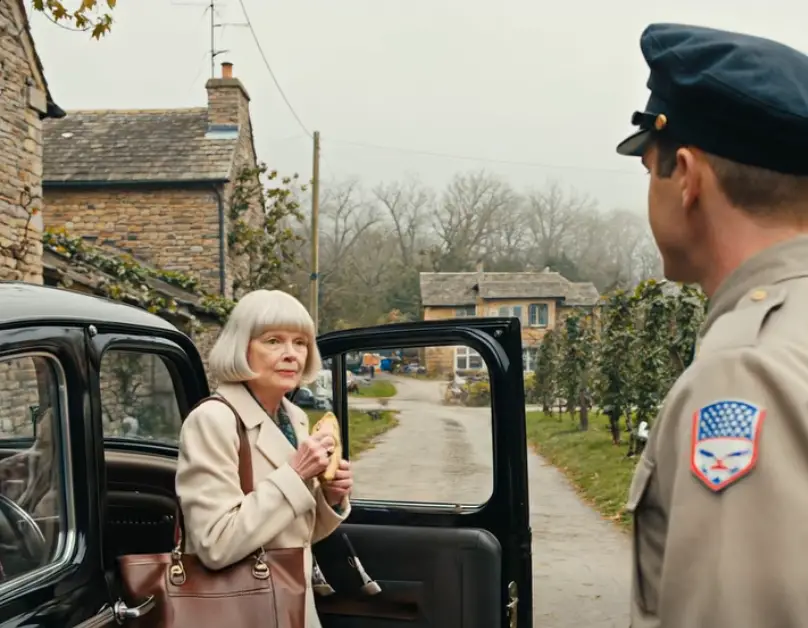
Saint‑Michel‑de‑Maurienne was the sketch a child would draw if you said “French village”—slate roofs, cream walls worn soft by centuries, café chalkboards promising tartes and vin du jour in looping script. The platform thinned to me, a family herding ski bags toward a waiting car, and an older man in a driver’s cap holding a sign in elegant script: Madame Eleanor Thompson.
“I’m Eleanor,” I said, the name feeling strange in my mouth after days of silence.
He studied my face with bright blue eyes set in a weathered map of laugh lines and sun. Then he spoke five words that moved something old inside my ribs, something I thought I’d buried decades ago.
“Pierre has been waiting forever.”
The platform tilted. Sound dimmed. The mountains held their breath.
He stepped forward, steady as the peaks behind him. “Madame? Are you well?”
“Pierre… Bowmont?”
“Oui.” His voice softened with understanding, with knowledge of what that name meant. “Monsieur Bowmont sends apologies. After your journey—and your loss—he feared it might be… too much. To see him waiting. I am Marcel.”
Pierre was alive. The name I had buried with my twenties tore the years like paper, made tissue of time: the blue‑shuttered apartment off Boulevard Saint‑Germain where we’d made coffee and love and plans; a boy with midnight hair and a future he described with his hands like he could shape it; the roommate who told me two days before my flight home that there had been a motorcycle crash, that Pierre had died in the hospital, that I should go home and not make this harder; the way I ran with a secret growing in my belly and married a good man who agreed to build a life around it, who loved the boy without questions because Thomas believed love wasn’t accounting.
Marcel guided me to a black Mercedes that purred like confidence and took us up a road bordered by fir and sky. An iron gate. A discreet brass plate. Then the chateau rounded the last curve like a wish granted—golden stone starred with windows, turrets remembering history, terraces tumbling to gardens where roses still bloomed in late April, vineyards combed into stanzas across the hill.
“Château Bowmont,” Marcel said with the kind of pride the French save for things that outlast war and fashion and revolution. “Monsieur has modernized—with respect. The wines… you will see.”
The front door opened before the car fully stopped. He stood there—silver where he had once been ink, lines where there had been none, eyes the same startling dark that had made me believe in futures I couldn’t name. He carried himself like a man who carried a place, and the place agreed to be carried. Sixty‑two looked good on him, looked earned.
“Eleanor,” he said, and my name arrived with the accent it had always preferred, the slight softening of the R.
“You’re alive,” I told him, and the edges of the world narrowed to just his face, the door frame, the impossible fact of him breathing.
The rest blurred. Marcel’s concerned voice. Pierre’s arms catching me as my knees forgot their purpose. The smell of lavender and old wood and wine.
I woke in a study—bookshelves climbing to crown molding, a stone hearth, the grammar of old wood. A blanket tucked over my legs. My shoes set neatly side by side, as if the future still had manners, still believed in order.
“You’re awake.” He sat in a leather chair that had shaped itself to him over years, hands folded, taking in what time had done to my face like he was grateful for every line, every mark. “Marcel is preparing a room. I thought we should talk first. There is… much to say.”
“Richard,” I said, because the mind can swing only so far in an afternoon before it needs anchor. “Did he…? Is he—?”
“Your son came to me six months ago,” Pierre said, voice gentled by time and sorrow. “A medical question sent him to a DNA service. One of those kits people give as gifts without thinking. A private investigator followed the thread. It led to me.” He searched my face for blame and found grief instead, found exhaustion. “Biologically, he is mine. In all the ways that matter—he was Thomas’s. I know this.”
“He was.” The words caught on love and omission, on decades of careful truth‑telling and the one lie I’d kept. “Thomas loved Richard like breath. Like his own heartbeat. He never asked. I think he knew. But he never asked.”
“You knew,” Pierre said—no accusation, only a fact set down carefully between us like something fragile.
“I knew,” I said, meeting his eyes. “But I thought you were dead. Your roommate—Jean‑Luc—told me there’d been a motorcycle accident. That you didn’t make it through the night at the hospital. That I should go home, that staying would only make it worse. I was twenty. I ran.”
Pierre’s jaw altered, something cold settling behind his eyes. “There was no accident,” he said, iron under velvet. “I waited at our café near the Sorbonne for hours. You never came. At your pension they said you’d checked out early, taken a taxi to the airport. You were gone. I thought—” He stopped, the old wound visible. “I thought you had chosen differently.”
We sat inside a silence with edges sharp enough to cut.
“Jean‑Luc,” he said at last, tasting the name like something spoiled, something that had rotted in the cupboard of memory. “He was in love with you. I did not see it. Too close, perhaps. He told you I had died, and he told me you had left. He wanted to punish us both for being happy when he was not.”
Forty years rearranged like furniture you thought you knew the placement of until you struck your shin on it in the dark. I had built a life on a lie I never thought to test, never thought to question because grief at twenty is absolute, is unquestionable.
“How did Richard find you?” I asked.
“He showed me your picture.” A smile ghosted across his face and stayed, pinned there by grief and wonder. “From last Christmas. You looked the same—only elegant with time, beautiful in the way women become when they stop apologizing for taking up space. And he looked like my father when he was twenty, the photographs we keep in the library. The cheekbones, the way he held his head. After that, I could not unknow it.” He poured cognac from a crystal decanter and handed me heat cupped in glass. “There is more. There is always more.”
“Richard discovered something else,” he said carefully. “About Amanda. About your son’s business partner—Julian. Financial transfers. Shell companies registered in the Caymans. A plan to force him out of his own company. And when that proved difficult, when Richard fought back—talk of removing him another way. Permanent removal.”
“The boat,” I whispered, the memory rising like nausea. “The accident off Maine. They said the steering mechanism failed.”
He didn’t answer. A certain quiet is an answer louder than words.
“He revised his will four months ago,” Pierre said. “Left the visible world to Amanda. Performed it like theater. But he had hidden more than anyone realized—investments, properties, accounts scattered across three continents. He drew a second, valid will, witnessed and notarized by different attorneys, leaving the bulk of his true estate to a trust administered by you and me.”
“The plane ticket,” I said, finally seeing what it was. “A key disguised as an insult.”
“If you used it, the second will activated,” Pierre said. “If you didn’t, everything reverted to Amanda. He called it a test of faith. Said you were the only person he trusted to hear a door slam and still check the back of the house for one quietly opening.” He set a leather folder on the desk. The clauses made ruthless, clean sense when I forced my eyes to focus. A trust. A schedule of assets. A garden of legal language that bloomed only if I kept faith one more time.
“He left you a letter,” he added, producing an envelope addressed in the forward‑leaning scrawl of the boy who misspelled February every year and laughed about it, who wrote thank‑you notes in purple ink because it made people smile. I opened it the way you open a second chance—carefully, afraid of what breaking might mean.
My dearest Mom… He apologized for the theater, for the cruelty of the will reading. He explained the ancestry kit he had teased me about, the way it detonated in his life like a grenade in a careful room. He found Pierre through the investigator and felt something lock into place in his chest, some piece of himself he’d always wondered about. He uncovered Amanda’s affair with Julian and the embezzlement glimmering under the gloss of charity events and board meetings. He began gathering evidence and feared he might not live to finish. If you’re reading this, assume the worst. Trust no one except Pierre and Marcel. The evidence is in the blue lacquer box you gave me at sixteen, the one I said I’d treasure forever. Hidden where only you would think to look. Remember our treasure maps? X marks the spot.
X is not a letter. It is a location. “The Cape house,” I said, memory clicking into place. “The iron bench beneath the X‑trellis where we watched meteors. We built a hidden drawer there when he was twelve, for his ‘important papers.’ Mostly baseball cards and a love letter he was too embarrassed to send.”
“We need it before Amanda does,” Pierre said, face sharpening into something that remembered how to fight.
“She owns the deed now,” I whispered, the will reading playing back. “The house is hers.”
“Paper burns,” he said simply. “Fact remains. Memory remains.” He was already on the phone, speaking rapid French. “Marcel can ready the jet.”
“The jet?” The day had rewritten nouns, made nothing mean what I thought it meant. “Richard’s other jet,” he said with a dry smile that held pride. “The one Amanda doesn’t know about. The one registered to a holding company in Luxembourg. He was very thorough, your son.”
We left at first light. The mountains wore their deep blue like robes. Love and fury proved they could still run in the blood of the old.
Boston met us in pewter light and salt wind. A black SUV idled on the tarmac, no markings, no company logo. The driver—Roberts—moved with the quiet competence of a man who could iron a shirt and disarm a stranger without changing expression. He briefed us as the city fell away in the mirrors: Amanda and Julian had reached the Cape at dawn, faster than expected; a caretaker had manufactured a water leak to slow them, calling about burst pipes and flood warnings; the delay would not hold long.
“We’ll need a distraction,” Pierre said from the passenger seat.
“Already arranged,” Roberts answered with the ghost of a smile. “A furniture delivery insisting the neighbor signed for three sofas at the wrong address. Loudly. With documentation.”
We tucked the SUV behind scrub pines near the private road. Roberts checked a small device. “Their vehicle’s present. Two occupants.” The ocean matched the sky, both the color of pewter and patience. The dunes hunched against wind. The house wore its cedar silver, weathered and beloved. The trellis waited like a promise kept.
At noon, chaos bloomed next door—men heaving sofas off a truck, a foreman arguing with clipboards and receipts, a bathrobed neighbor conducting a symphony of inconvenience. Amanda and Julian stepped onto the deck to watch the spectacle. “Now,” Roberts said.
We took the back path Richard and I used when he was a boy hunting pirates, past hydrangeas beaded with morning mist, to the hedged‑in rectangle of our hidden place. The iron bench sat beneath the X‑trellis where jasmine would bloom in June. I knelt on ground that knew my knees, found the rose‑shaped latch in the concrete base that looked decorative to anyone who didn’t know its secret, pressed. A click like a lock remembering its key. A shallow drawer slid out on runners my son had oiled for forty years. The blue lacquer box lay where it had been waiting for the moment the story remembered itself.
“You found it,” Pierre breathed, wonder in his voice.
“We need to go,” Roberts said, eyes on the house. “They’re heading back in. Ninety seconds.”
I rose with the box against my ribs like a heartbeat and turned into Amanda’s voice.
“Well,” she said, stepping through the garden gate with Julian at her shoulder like matched predators, “look who decided to trespass. On my property. Again.”
She’d traded funeral silk for casual luxury—cashmere the color of money, perfect denim that cost more than I spent on groceries in a month, boots more expensive than my first car. Her ponytail was a blade. “Breaking and entering is a felony, Eleanor. Especially when the property belongs to me. I could call the police right now.”
“This house belonged to Richard,” I said, finding steel in my spine. “A place he loved. Where he learned to swim and read and dream.”
“And now it belongs to me,” she said, each word a period. Her gaze flicked to the box, interest sharpening. “What’s in that? Anything I need to report as stolen? Family heirlooms, perhaps?”
“Personal effects,” Pierre said, stepping between us with a politeness that refused to retreat, that had been forged in older wars. “Items excluded from the estate by prior agreement.”
Her eyes slid to him, interest curdling into calculation. “And you are? I don’t remember you from the funeral.”
“Pierre Bowmont,” he said, dignity requiring no permission, no apology. “Richard’s father.”
Shock cracked her mask, then froze into something harder. “Impossible. His father is dead. Thomas Thompson died five years ago.”
“The man who raised me is dead,” said a voice behind her, and the world stopped. “The man whose blood I carry is not.”
Richard stepped into the garden from the beach path, flanked by two men in suits that screamed federal. For a heartbeat the world forgot its job. The box slipped; Pierre caught it. Roberts moved like a man whose training had been written in multiple languages for exactly this second.
“Richard,” I said, because there is no right word for grief turning back into a person, for the dead becoming flesh. He crossed the stones in three strides and held me like he was checking that I had weight, that I was real. “I’m sorry, Mom,” he murmured into my hair. “It was the only way. The only way to keep you safe.”
Amanda went white, then red, then a color I didn’t have a name for. “We saw your body. At the morgue. I identified—”
“Did you?” Richard asked, eyes on hers like a prosecutor. “Or did you see what a cooperating medical examiner told you to see? A John Doe with similar build, similar coloring. You were so eager to confirm it was me, weren’t you? So eager to start the clock running.”
Julian’s hand twitched toward his pocket. Roberts had the gun a breath later, steady and certain. “I wouldn’t,” he said, calm as weather. “The property is surrounded by federal agents. This entire conversation is being recorded. Multiple angles. Multiple devices.”
An older man in a plain suit stepped into the garden and the air shifted to make room for him, the way space makes room for gravity. “Agent Donovan,” Richard said. “Lead on my case. Fraudulent death investigations unit.”
“You faked your death to frame us,” Amanda spat, her composure finally cracking.
“We documented your crimes to convict you,” Donovan replied with the patience of a man who’d seen this play out before. “The speed with which you moved to liquidate assets, the offshore transfers to accounts we’d been monitoring for months, the property listings that went up three days after the funeral—none of it reads like grief. It reads like a woman who knew exactly what she was getting and couldn’t wait to cash in.” He nodded to the agents. They materialized from hedges and fog like tricks of light becoming solid. A voice read rights in a cadence that made my knees want to sit, made the world feel both more real and less possible. The garden held its breath and then exhaled.
Inside, the sunroom became a room again. The ocean hardened and softened in the glass as the light changed, as afternoon became evening became night. Donovan came and went with updates delivered in careful language. The recordings—legal and otherwise—were devastating. Conversations about insurance payouts, about accelerating Richard’s “accident,” about what they’d do with the company once he was gone. The mechanic who’d been hired to sabotage the yacht cooperated in exchange for leniency. Shell companies unfolded their nesting dolls of deception. Board members who had looked away began to remember their names, their responsibilities, their sudden desire to cooperate.
We stayed on the Cape while the case grew teeth, while prosecutors built walls around Amanda and Julian until the only door left led to plea agreements. Officially, Richard remained dead—a witness wrapped in paperwork and protection. Unofficially, my son made coffee in the morning and took calls late with prosecutors while I made blueberry pancakes because ritual is a way to tell your heart it may continue, because normal is a country you have to rebuild one morning at a time. Some afternoons Pierre and I walked the beach and said out loud the things we had carried for decades in our respective chests, in the locked rooms we’d each built.
“They recorded the funeral,” Richard said one morning at the stove, voice quiet with something like shame. “Donovan showed me the footage. Your face. I’m sorry you had to go through that, Mom. If there had been another way—”
“Was there?” I asked, not unkindly.
He shook his head. “They had someone tailing you. They were afraid you’d see through me the way you always do. If they’d suspected you knew I was alive, they might have run—or worse. They might have decided to tie up loose ends. I couldn’t risk you.”
“You brought Pierre in,” I said, smoothing a small, unhandsome hurt.
“That started before I knew what Amanda and Julian were,” he said carefully. “The DNA test, the discovery—that was personal. Then it became tactical. He was in France, beyond their reach. And he had resources—secure communications, people like Marcel and Roberts. Security experience. It helped build the case.”
Later, on the deck, Pierre watched Richard dismantle a spreadsheet for a young prosecutor, translating financial crime into narrative. “He has your mind,” Pierre said softly. “Quick. Fair. Seeing patterns others miss.”
“He has your stubborn,” I said. “Once he sets a course, God help the storm that tries to change it.”
Pierre’s hand found mine on the railing. “Perhaps he has the best of us both. And none of our mistakes.”
Three weeks later, plea agreements were signed in rooms that smelled like recycled air and defeat. The press conference was scheduled for the following morning. Richard would stand beside Donovan while the FBI explained that his death had been staged to catch embezzlers and would‑be murderers, that justice sometimes requires theater. The story had everything America loves and everything it forgives—the wronged son, the evil wife, the triumphant return. The news cycle chewed it for forty‑eight hours and moved on to a flashier outrage involving a senator and a yacht.
On the night before his resurrection, Richard found me watching the sun drop a copper coin into the ocean, watching light die and be reborn. “Pierre invited us to France,” he said, a dare wrapped in kindness. “Not for a visit. For six months. Maybe longer. I can run most of the company remotely while we rebuild, while I figure out who’s loyal and who was just waiting for me to turn my back. I need distance. I want to know where half my face comes from.” He took my hand. “Come with me. Please.”
Six months is either everything or nothing. “We’ll call it an extended visit,” I said, because commitment still felt like risk. “I’ll pack sensible shoes.”
The press conference did its work. Donovan did gravelly justice. Richard did solemn redemption. Markets dipped and remembered themselves, the way markets do when the story is good enough. The board called with apologies that melted when he asked for accountability, when he started listing names. We sublet my apartment to a young couple expecting their first child. I left the philodendron’s moods with my neighbor, who promised to read it poetry. Pierre flew ahead to make a place for us in a place that had always been his, that might become ours.
France, the second time, felt less like a dream and more like a calendar you could trust. Marcel met us at the airport with a bow and a joke about Americans and luggage that I was proud to understand well enough to laugh at. The drive wore late‑September light like silk, like gold thread through gray fabric.
We walked the vineyard before our coats were off, before we’d seen our rooms. The rows ran straight until the land told them a better way to go, following slope and sun with the wisdom of centuries. Pierre showed Richard the winery—steel and stone, hoses and yeast and patience made liquid. He talked about barrels like elders deserving respect. About how a cool year changes how a grape wears its sugar, how challenge becomes character in the bottle. Richard listened like a man who had found another language he’d always spoken without knowing, asking questions about fermentation and terroir and what makes one vintage sing while another merely speaks.
We learned the schedule of a place that had been home without us for generations: sunrise combers of vines, the unproud chuff of the tractor, the way night smells sweet and damp in September even when the day runs hot. We learned the village—Madame Arnaud at the bakery who insisted I take an extra apricot “pour la chance,” the priest who was also the volunteer EMT and could set a wrist in a storm while reciting prayers, the café owner who called Richard “le fils” before he knew where to put his hands or how to order properly.
Evenings, we ate in a small dining room because large rooms are for strangers, because intimacy requires different architecture. Pierre pulled bottles with dust older than some countries and told us harvest stories that had set his spine, that had taught him who he was. Richard told us about the first time his firewall caught a threat no one else saw coming, the satisfaction of being right about danger. I told them how a kid named Angelo learned to love Steinbeck because we read it aloud in a classroom that smelled like chalk and hope, how teaching is just another word for witnessing.
Some nights, after Richard took late calls to New York to handle crises and opportunities, Pierre and I stayed at the table. A candle collapsed into itself, wax remembering what it used to be. We asked the questions you don’t ask at twenty because you think time owes you answers, because you believe the future is infinite.
“Did you marry?” I asked, the wine making me brave.
“No.” He poured another half‑inch of something that tasted like summers I’d missed. “I built a life on work, friends, this place. It was good. It was also missing a room I boarded up and pretended wasn’t there.”
“And you?”
“Thirty‑one years,” I said. “We weren’t you and me. We were us. Different. Kind. Stubborn. We raised a boy and paid bills and made Sundays mean something. It was real. It was good. It just wasn’t… this.”
He nodded slowly. “I’ve been thinking about the word again,” he said softly. “That word. It’s dangerous. It carries ghosts. Also possibility.”
“I’m not twenty,” I told him, needing him to understand.
“Nor am I,” he said. “Which is why the word feels less like fire and more like a hearth. Something to gather around rather than something to burn in.”
We moved carefully after that. We learned not to reach for a past we couldn’t have and instead reach for a present that didn’t ask us to pretend the years hadn’t happened, that the distance hadn’t been real. Some afternoons our hands found each other without ceremony, without declaration. Some nights we said goodnight in the hall like teenagers being careful for no one’s sake but their own, for the simple pleasure of anticipation.
Richard took to rebuilding like a man relieved to use different muscles. The board fought him on everything they should’ve been ashamed to resist—ethics policies, clawbacks, resignations of the complicit. He won the way honest people win—slowly, with receipts, with patience that looked like weakness until it revealed itself as strategy. When he flew back to New York for a week of meetings, the chateau felt both too quiet and exactly right: proof a place can hold you even when the person who invited you is beyond the horizon.
On the last night of harvest, when the grapes were in and the work was blessed, the courtyard smelled like fruit and gratitude and woodsmoke. Students and lifers and cousins ate at long tables that had held generations. Someone sang something older than the oldest person there, a song about land and labor and love. When the bottle reached our end, Pierre stood with an expression that wasn’t performance but prayer with his eyes open, with his heart visible.
“To new beginnings,” he said, and his voice carried to the far tables.
“To truth,” Richard added, the moon pin‑bright on his raised glass, on his face.
“To family,” I said, a word that had taken me fifty‑plus years to earn and two countries to understand, to believe I deserved.
We drank. The wine tasted like summer saved for winter and like a promise kept through decades.
Later, in the study where I’d woken with a blanket over my knees and a different life waiting behind the door, Richard opened his laptop. “I have something,” he said, and pressed play. The café near the Sorbonne filled the screen, rendered in phone camera quality. His phone propped against a saltshaker, the shot slightly crooked. His face uncertain. Pierre’s face across from him learning a new map in real time, realizing the stranger across the table shared his blood, his bones. The first conversation stumbled and then found its way, like people do when the truth is larger than the fear. Gestures I’d seen on both of them for years made sudden sense—the way they both tilted their heads when thinking, the way their hands moved to illustrate points. When it ended, we didn’t speak. Grief and joy had finally learned how to share a room, how to exist without canceling each other out.
We talked that night about pruning schedules and a CTO who said “we” like he meant it, like loyalty had returned. About a scholarship fund Pierre wanted for the children of vineyard workers who dreamed of studying anything but wine, who wanted to become doctors or teachers or engineers. We argued about baseball because, even in France, you can’t take Boston out of a man’s blood. We argued about poetry—Rumi versus Neruda—because some arguments are just another way of saying we’re alive, we’re present, we’re here.
When we finished, we didn’t mark the exact moment something ended and something else began. Life had taught us the important things rarely announce themselves, rarely arrive with trumpets and declarations. Pierre walked me to my door. He didn’t kiss me. I didn’t ask him to. We stood in that small, honest distance between two people who had finally earned patience, who understood that some things build slowly or not at all.
In bed, I listened to a house that had outlived kings settle around me, stone and wood speaking their old language. Somewhere down the hall slept a man who had once been a boy I loved, then a ghost, then a man again—real and solid and possible. Across the wing, my son drafted an email to a board that had learned the person they underestimated was the one they should have bet on all along, the one whose absence had taught them what leadership meant.
I thought of a crumpled envelope that looked like an insult and became a door. I thought of a plane ticket that felt like exile and turned into a map. I thought of a garden where X does not mean wrong but here, but this is the place, but dig.
In the morning, the mountains would put on their blue like a familiar coat, the vines would lift their slow hands in praise, and the day would begin—as days do—with coffee, work, and the quiet heroism of ordinary love. And when someone asked me, months or years from now, how it began, I would tell a story that sounds like a fairy tale but is only the truth, the stubborn fact of it: my son died and left me a plane ticket. Everyone laughed. I went anyway. At a train platform in a town I’d never heard of, a stranger held a sign with my name and said five words that made my heart race and skip and remember.
Pierre has been waiting forever.
He had been. And so, it turned out, had I.

Lila Hart is a dedicated Digital Archivist and Research Specialist with a keen eye for preserving and curating meaningful content. At TheArchivists, she specializes in organizing and managing digital archives, ensuring that valuable stories and historical moments are accessible for generations to come.
Lila earned her degree in History and Archival Studies from the University of Edinburgh, where she cultivated her passion for documenting the past and preserving cultural heritage. Her expertise lies in combining traditional archival techniques with modern digital tools, allowing her to create comprehensive and engaging collections that resonate with audiences worldwide.
At TheArchivists, Lila is known for her meticulous attention to detail and her ability to uncover hidden gems within extensive archives. Her work is praised for its depth, authenticity, and contribution to the preservation of knowledge in the digital age.
Driven by a commitment to preserving stories that matter, Lila is passionate about exploring the intersection of history and technology. Her goal is to ensure that every piece of content she handles reflects the richness of human experiences and remains a source of inspiration for years to come.