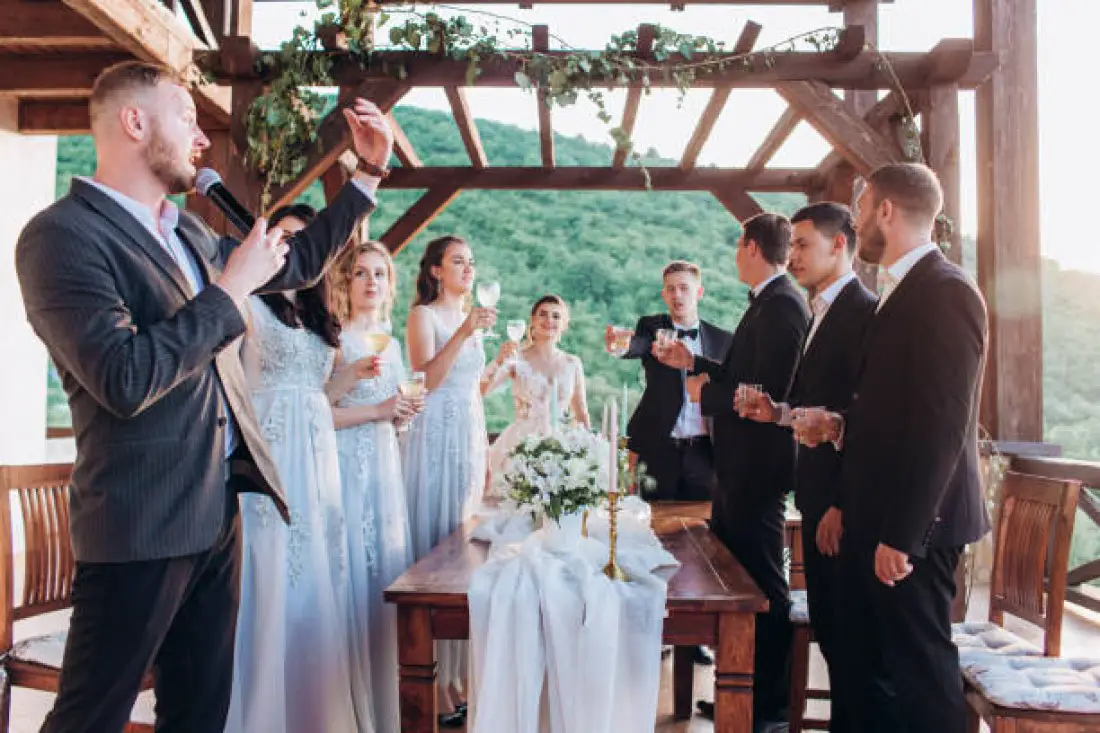
The silence in the wedding hall wasn’t just quiet—it was the kind of heavy, suffocating silence that presses against your chest and makes every breath feel like a betrayal. I stood at the back of the venue, my trembling fingers clutching the cascading bouquet of white roses and baby’s breath that suddenly felt like it weighed a thousand pounds, staring down an aisle that seemed to stretch into infinity.
Two hundred empty chairs lined both sides of that aisle. Two hundred seats I’d carefully reserved, agonized over, arranged and rearranged in my mind a dozen times. And every single one of them was filled—filled with people who had turned their backs to me.
Not metaphorically. Literally turned their backs.
My name is Emma Richardson, soon to be Emma Chen, and this was supposed to be the happiest day of my life. I was twenty-eight years old, marrying the man I loved more than anything in this world, in a beautiful historic venue with vaulted ceilings and stained glass windows that caught the afternoon light like captured rainbows. I’d spent a year planning every detail—the flowers, the music, the menu, the color scheme of dusty rose and champagne gold.
But none of that mattered now, because the moment I appeared at the entrance in my ivory lace gown with its cathedral train, every single member of my family had deliberately, coldly, turned their chairs to face away from me.
My mother Linda sat in the front row on the bride’s side—the seat of honor, where she should have been beaming with pride. Instead, her back was rigid, her shoulders squared, her face pointed resolutely toward the wall. Beside her sat my Aunt Patricia and Uncle Robert, my cousins Jessica and Michael, my grandmother’s sister Ruth—an entire row of Richardsons, all facing the wrong direction.
The groom’s side was different. David’s family sat properly, facing forward, their expressions ranging from confusion to outright horror at what they were witnessing. David’s mother Helen had her hand pressed to her mouth, tears already streaming down her face—but not happy tears. Tears of shock and sympathy for what I was enduring.
“Emma,” my maid of honor Sarah whispered beside me, her voice cracking with fury and disbelief. “We don’t have to do this. We can leave right now. Just say the word.”
I wanted to. God, how I wanted to turn around and run from this nightmare, from the humiliation burning through every nerve in my body. But my feet seemed rooted to the floor, my eyes locked on David standing at the altar in his charcoal gray suit, his face stricken with an anguish that mirrored my own.
This was David Chen, the man who had loved me through everything—through my family’s disapproval, through their constant criticism, through a year of them telling me I was making the biggest mistake of my life. David, who worked as a high school teacher because he genuinely loved helping kids learn, who volunteered at the community center on weekends, who had proposed to me on a simple beach at sunset because he knew I’d always dreamed of it.
But to my family, David wasn’t good enough. He wasn’t wealthy enough, prestigious enough, connected enough. He was “just a teacher” in a family where my Uncle Robert ran a successful law firm, where my cousin Jessica worked in finance, where status and money were the only currencies that mattered.
“She’s throwing her life away,” I’d heard my mother tell Aunt Patricia six months ago, not realizing I was standing just outside the kitchen door. “Emma could have had anyone—Mark Stevens was interested, and his family owns half the commercial real estate downtown. But no, she has to marry some schoolteacher who’ll never give her the life she deserves.”
“Maybe we should just refuse to come to the wedding,” Aunt Patricia had suggested, her voice dripping with disdain. “Make her see sense.”
“Oh, we’ll come,” my mother had replied, and I could hear the cold smile in her voice. “We’ll come and make sure everyone sees exactly what kind of mistake she’s making.”
And now here we were. They’d come, all right. Came and turned their backs on me in the most public, devastating way possible.
The wedding coordinator, a kind woman named Margaret who’d been helping me plan for months, appeared at my elbow. “Emma, honey, I can delay the processional. We can figure something out. This is—” She paused, clearly at a loss for words. “This is unprecedented.”
Through the open doorway behind me, I could see guests still arriving—David’s extended family, our friends from college, colleagues from my graphic design firm. All of them were walking into a nightmare, witnessing my family’s spectacular act of cruelty.
I heard a soft gasp from somewhere in the middle rows—one of David’s aunts seeing what was happening. Then whispers started, spreading through the hall like wildfire. “Why are they turned around?” “Is this some kind of tradition?” “Oh my God, they’re actually shunning her.”
My cousin Jessica’s voice cut through the murmurs, deliberately loud enough for everyone to hear: “Well, what did she expect? Actions have consequences. If she wants to marry beneath her, she can do it alone.”
Hot tears pricked at my eyes, but I refused to let them fall. I would not give them the satisfaction of seeing me break.
“Emma.” David’s voice rang out from the altar, strong and clear. He’d pulled out his phone, was pressing buttons with shaking fingers. “Emma, wait. Don’t move. Just… wait.”
I froze, confusion cutting through my misery. What was he doing?
David looked up from his phone, and despite the tears streaming down his face, he smiled. It was the same smile that had made me fall in love with him three years ago—warm, genuine, filled with a hope that seemed impossible in this moment.
“Grandpa’s here,” he said simply.
The words didn’t make sense at first. David’s grandfather had passed away two years ago—I’d been at the funeral, had held David’s hand through his grief. And my own grandfather…
My grandfather Thomas Richardson lived three states away in Arizona, spending his retirement in a small town where he’d built a successful construction company from nothing. He was eighty-four years old, his health declining, and the last time I’d called to invite him to the wedding, he’d said gently, “Emma, sweetheart, I don’t think I can make the trip anymore. My heart’s not what it used to be, and the doctors don’t want me flying. But you have my blessing, and you know I love you.”
I’d understood, had told him it was okay, that I’d video call him from the reception. So what was David talking about?
Then I heard it—the distinctive sound of a cane tapping against marble floor.
Tap. Tap. Tap.
The sound came from somewhere behind me, outside the hall. Every head in the venue turned toward the entrance, even my mother and her family twisting to look while trying to maintain their pointed shunning.
And then he appeared.
My grandfather Thomas Richardson stood in the doorway, leaning heavily on his carved mahogany cane, dressed in the same navy suit he’d worn to my college graduation. He looked older than I remembered, more frail, his face lined with exhaustion from what must have been an arduous journey. But his eyes—his sharp, intelligent eyes that had built an empire and raised five children and buried a beloved wife—those eyes were blazing with an anger I’d never seen before.
“Grandpa,” I whispered, the word barely making it past the lump in my throat.
He took another step into the hall, his cane tapping methodically. Behind him came his nurse Jennifer, carrying his oxygen tank and looking both concerned and determined. And behind her—my heart nearly stopped—came David’s father Marcus, who must have somehow arranged this, who must have secretly contacted my grandfather and helped make this impossible journey happen.
Grandpa surveyed the wedding hall with the same assessing gaze he’d once used to evaluate construction sites and business deals. He took in the turned backs of my family, the shocked faces of the guests, me standing alone and abandoned at the entrance.
“Why does my granddaughter stand alone on the most important day of her life?” His voice rang out across the hall, not particularly loud but carrying such authority that every whisper died instantly.
The silence that followed was deafening.
My mother shifted in her seat, her rigid posture wavering for the first time. Uncle Robert tugged at his collar, his face flushing red. Jessica, who’d been so smug just moments ago, actually dropped her phone into her lap as if holding it in my grandfather’s presence was somehow disrespectful.
Grandpa moved forward, each tap of his cane echoing like a judge’s gavel. Tap. Tap. Tap. He moved past rows of David’s family, who remained respectfully seated and silent, past our friends who watched with a mixture of relief and anticipation, past the flower arrangements and the carefully placed candles.
When he reached the front row where my mother sat, he stopped. His gaze locked onto her with an intensity that made her physically flinch.
“Linda,” he said, her name dropping from his lips with no warmth, no affection. “Care to explain why you sat still while your daughter walked alone?”
My mother’s face drained of all color. Her mouth opened and closed several times before any sound came out. “Dad… I… we… she—” The words tumbled over each other, incomplete and inadequate.
Grandpa raised one weathered hand, silencing her instantly. “Don’t you dare insult my intelligence with excuses.” His gaze swept across the entire Richardson family row like a spotlight exposing criminals. “I asked a simple question. Why does the bride—my granddaughter, my Emma—stand here without her family behind her? Why does she stand abandoned, mocked, ridiculed on the day she should be celebrated?”
Uncle Robert cleared his throat, trying to muster some authority. “Dad, she… she chose this path. We warned her. She turned her back on family values, on everything we stand for. She’s marrying someone who can’t provide for her, who doesn’t meet our standards. And look where it’s gotten her—alone.”
The word “alone” seemed to hang in the air for a moment.
Then Grandpa laughed—a short, sharp, humorless sound that made several people jump. “Alone?” he repeated, his voice dripping with contempt. “Is that what you call it?”
He reached into his jacket pocket with his free hand, pulling out a sealed envelope. The movement was deliberate, theatrical even, and every eye in the room locked onto that envelope like it might contain nuclear codes.
“Well, Robert, Linda, Jessica—all of you who think Emma is so foolish, who think she’s beneath you now, who believe you have the right to judge her choices—I didn’t come here empty-handed.”
He held up the document, his hand remarkably steady despite his age and obvious fatigue. “This is my will. My last will and testament. Signed two days ago. Sealed. Notarized. Final.”
Gasps rippled through the hall like a wave. My mother half-rose from her seat, her face going from pale to flushed. “Dad, you can’t. This isn’t the place. This isn’t appropriate—”
“It’s exactly the place,” Grandpa cut her off, his tone like steel wrapped in ice. “Because apparently, this family needs a very public reminder about what actually matters.”
He broke the seal on the envelope with his thumb, the sound of tearing paper somehow thunderous in the silent hall. He unfolded the document slowly, deliberately, making everyone wait.
“I built Richardson Construction from absolutely nothing,” he said, his voice carrying easily now that everyone was hanging on his every word. “Started with one truck, one crew, and a willingness to work harder than anyone else. Forty years later, it’s worth $40 million. Forty million dollars that I earned with my own hands, my own sweat, my own choices.”
He looked down at the will in his hands, then back up at his family. “I’ve watched all of you over the years. Watched how you treat people—the people you consider beneath you, the ones who don’t have enough money or status to matter in your little world. I’ve watched you become exactly the kind of people I never wanted to raise.”
My mother’s voice came out as barely a whisper. “Dad, please…”
“Linda, you married Richard because he came from money. You raised your daughter to value the same things—wealth, status, appearances. And when she finally found real love, genuine happiness with a man of integrity and character, you turned your back on her.” Grandpa’s voice cracked slightly with emotion. “Your own daughter. On her wedding day.”
He turned to look at me, and the hardness in his eyes melted into something soft and achingly tender. Tears glistened on his weathered cheeks.
“Emma has been the only one in this entire family who remembered what actually matters. She visited me every month, even when it meant a six-hour drive. She called me every week to check on me, to tell me about her life, to ask my advice. She sent me photos of the sunset from my favorite beach because she knew I couldn’t travel there anymore.” His voice grew stronger. “She loved me not because of my money, not because of what I could do for her, but because I’m her grandfather and she genuinely cared.”
I was crying now, unable to hold back the tears any longer. Sarah squeezed my hand so hard it hurt, but I barely felt it.
Grandpa held up the will. “Therefore, I’m leaving the entirety of my estate—the business, the properties, the investments, all $40 million—to exactly one person.” He paused, his eyes never leaving mine. “My granddaughter Emma Richardson Chen.”
The hall erupted. My mother screamed “No!” and leaped to her feet. Uncle Robert was shouting about lawyers and mental competency. Jessica was crying hysterically about how unfair it was. Aunt Patricia looked like she might actually faint.
But Grandpa wasn’t finished.
“I’m also leaving specific instructions that none of you—not Linda, not Robert, not any of you who turned your backs today—are to receive a single penny. Not now, not ever. I’ve set up a trust that ensures Emma has complete control, with David as co-trustee should anything happen to her.” He smiled at David, who looked absolutely stunned. “Because unlike all of you, I can recognize a good man when I see one. A man who loves my granddaughter for who she is, not what she has. A man who would stand with her even when her entire family abandoned her.”
Grandpa turned back to the family row. “You wanted to make Emma feel alone today? You wanted to punish her for choosing love over money, integrity over status? Well, congratulations. You’ve succeeded in showing everyone exactly who you really are. And it’s cost you everything.”
He took another step forward, his cane tapping. “Now stand up. All of you. Stand up and turn around and watch this young woman marry the man she loves, or get the hell out of this wedding and out of her life forever.”
For a long moment, nobody moved. The tension was so thick I could barely breathe.
Then my mother stood slowly, her face crumpling as decades of carefully maintained composure shattered. “Emma,” she sobbed. “Emma, I’m sorry. I’m so sorry. Please.”
One by one, the others stood—Uncle Robert, Aunt Patricia, Jessica, Michael, all of them turning their chairs around to face forward, their faces masks of shock and devastation and desperate regret.
But Grandpa held up his hand again. “Too late. Emma doesn’t need you anymore. She never needed your approval. She just wanted your love, and you couldn’t even give her that.” He gestured toward the door. “Now leave. All of you. You’re not welcome here.”
“Dad, please—” my mother tried again.
“I said leave, Linda. This is Emma’s day, and you’ve already ruined enough of it.”
Security guards appeared—arranged by David’s father, I realized—gently but firmly escorting my mother and the rest of the Richardson family toward the exit. My mother was sobbing openly now, reaching toward me as she was led past, but I couldn’t find it in myself to respond. The wound was too fresh, the betrayal too deep.
When they were gone, when the doors had closed behind them, the hall seemed to take a collective breath.
Grandpa made his way to me, each step clearly painful but determined. When he reached me, he cupped my face in his weathered hands.
“I’m sorry I wasn’t here sooner, sweetheart. I’m sorry you had to endure even one moment of their cruelty.”
“You came,” I managed to choke out through my tears. “Grandpa, you came. The doctors said—”
“Doctors don’t know everything,” he said with a small smile. “And they certainly don’t understand that some things are more important than medical advice. I wasn’t going to let my favorite granddaughter walk alone. Not while I still have breath in my body.”
He looked over at David, who had come down from the altar and was standing nearby, respectfully waiting. “Young man, you take care of her.”
“With my life, sir,” David replied, his voice thick with emotion.
Grandpa nodded approvingly, then turned to address the remaining guests. “Now then. We have a wedding to attend, don’t we? Emma, if you’ll do me the honor, I’d like to walk you down this aisle.”
My heart swelled so large I thought it might burst. “Grandpa, are you sure? Your heart—”
“Has enough beats left in it for this. I promise.” He offered me his arm, the one not holding his cane.
I looked at Sarah, who was crying happy tears now and nodding enthusiastically. I looked at David’s parents, at Helen who was dabbing at her eyes with a handkerchief. I looked at all our friends, at the people who truly cared about us, who’d come to celebrate our love rather than mock our choices.
And I took my grandfather’s arm.
The string quartet, which had been waiting in confused silence this entire time, began playing Pachelbel’s Canon in D. Margaret, the wedding coordinator, was frantically signaling them and rearranging the ceremony order to accommodate this unexpected turn of events.
As Grandpa and I began walking down the aisle—slowly, carefully, at his pace—something remarkable happened. Every single person in the hall stood up. Not because they had to, not because it was tradition, but because they wanted to. They stood and they smiled and some of them cried, and when we passed David’s grandmother in the third row, she reached out and squeezed my hand and whispered, “Beautiful bride.”
David was crying openly at the altar, making no attempt to hide his tears. His best man handed him a handkerchief that he didn’t use, just clutched in his hand as he watched us approach.
When we finally reached the front, Grandpa carefully transferred my hand to David’s. “She’s the best thing that could ever happen to you,” he told David quietly. “I trust you know that.”
“I do, sir,” David replied. “I promise you, I’ll spend every day of my life making sure she knows it too.”
Grandpa nodded, satisfied, and then slowly made his way to the front row on the bride’s side—the seat my mother had occupied and abandoned. He sat down with a sigh of relief, Jennifer immediately fussing over him and adjusting his oxygen.
The officiant, Pastor Williams, stepped forward. He was an older man who’d known my family for years, who’d witnessed the entire drama unfold, and his eyes were suspiciously bright as he looked at David and me.
“Well,” he said with a slightly shaky smile, “I’ve been officiating weddings for thirty-five years, and I can honestly say I’ve never seen anything quite like this.” The comment drew scattered, tension-relieving laughter from the guests. “But I can also say that I’ve rarely seen two people more clearly meant for each other, or more deserving of the love and support they’re receiving today.”
He opened his Bible. “We’re here today to witness the marriage of Emma and David, two people who have shown us what it truly means to choose love—not the easy love, not the convenient love, but the real, courageous, stand-by-each-other-no-matter-what kind of love that marriage is actually built on.”
The ceremony proceeded from there, but it felt dreamlike, surreal. David and I held hands so tightly our fingers went numb, both of us still processing everything that had just happened. When it came time for our vows, David’s voice was steady and clear.
“Emma, I promise to stand with you always—in front of your family when they support us, and in front of them when they don’t. I promise to love you not for what you have, but for who you are. I promise to be your partner, your supporter, your friend, and your love for every single day we’re given together.”
My own vows came out between tears. “David, you’ve shown me what real love looks like. You’ve stood by me through the hardest year of my life, never once asking me to choose between you and my family, even when they made it clear there was a choice to be made. I promise to love you with that same fierce, unwavering dedication. I promise to build a life with you based on kindness, respect, and genuine care—all the things that actually matter.”
When Pastor Williams finally said, “You may kiss your bride,” David cupped my face in his hands and kissed me with such tenderness and love that I heard several people in the audience openly sobbing.
The reception was held in the adjoining ballroom, and it was everything I’d dreamed of—but better, because it was filled only with people who actually loved us. David’s family welcomed me with open arms, his mother pulling me aside at one point to say, “You’re my daughter now, truly. And I promise we’ll never make you doubt that.”
Grandpa stayed for the first hour, long enough to share a dance with me—more of a slow sway while I supported most of his weight, but it was perfect. As we moved in tiny circles to “What a Wonderful World,” he spoke quietly in my ear.
“I need you to understand something, Emma. The money, the business, the will—that’s not about punishing them, though they certainly deserve it. It’s about making sure you and David have the life you want, free from their manipulation and judgment.”
“Grandpa, I don’t care about the money—”
“I know you don’t. That’s exactly why you deserve it.” He pulled back to look at my face. “Use it well. Build something good. Be happy. That’s all I’ve ever wanted for you.”
“Thank you,” I whispered. “For everything. For coming, for standing up for me, for—”
“For loving you? Emma, that’s not something you thank someone for. That’s just what family does—real family.” He smiled sadly. “Your mother will come around eventually, I think. She’s not evil, just… lost. Confused about what matters. But that’s her journey to make, not yours to fix.”
Jennifer approached then, concern on her face. “Thomas, we really need to get you back to the hotel. Your heart rate is elevated.”
Grandpa nodded reluctantly. “Take care of yourself, sweetheart. And call me tomorrow. I want to hear all about the honeymoon plans.”
I hugged him carefully, aware of how fragile he’d become, and watched as Jennifer and David’s father helped him out of the ballroom. I didn’t know it then, but that would be the last time I’d see my grandfather. He passed away peacefully in his sleep three months later, having lived long enough to see the photos from our honeymoon in Costa Rica, to hear about David’s promotion to department head, to know that I was truly, completely happy.
The rest of the reception was joyful in a way I hadn’t imagined possible just hours earlier. David and I danced, laughed, celebrated with people who genuinely cared about us. My phone buzzed incessantly with calls and texts from my mother and other family members—desperate pleas for forgiveness, angry demands that Grandpa change his will, threats of legal action—but I ignored them all. That was a problem for another day.
For now, I was exactly where I was supposed to be: in David’s arms, surrounded by love, starting the life we’d chosen together despite every obstacle placed in our path.
As midnight approached and we prepared to leave for our hotel, Sarah pulled me aside one final time. “Emma,” she said, tears in her eyes again. “I know today was traumatic, but I want you to know—the way your grandfather came through those doors, the way he stood up for you—that was one of the most beautiful things I’ve ever witnessed.”
I hugged her tightly. “I still can’t quite believe it happened.”
“Believe it. You deserved every bit of it. You deserved to have someone fight for you, stand with you, show the world that you matter.” She pulled back, smiling. “And now you have David, who’ll do that every single day for the rest of your lives.”
David appeared then, holding my hand out to me. “Ready, Mrs. Chen?”
I took his hand, feeling the weight and promise of my new name, my new life, my new beginning. “So ready.”
As we walked out of the ballroom together into the cool night air, I thought about how the day had started—with me standing alone, humiliated, ready to run. And how it had ended—married to the love of my life, defended by my grandfather, surrounded by genuine love and support.
My family had tried to break me with their cruelty, to punish me for choosing my own path. Instead, they’d shown me exactly who they were and what they valued. And in doing so, they’d freed me from ever having to try to earn their approval again.
I looked up at David, who was smiling at me with such open adoration it made my heart ache in the best possible way. “I love you,” I told him.
“I love you too,” he replied. “Always have, always will. No matter who stands with us or against us.”
“We’ll stand together,” I said. “That’s all that matters.”
And as we drove away from the venue toward our new life together, I realized something profound: sometimes the greatest gift isn’t having everyone stand with you. Sometimes it’s discovering who will stand with you when it matters most—and having the courage to build your life around those people, and only those people.
The ones who turned their backs taught me what I didn’t want to be. The ones who stood—Grandpa, David, Sarah, David’s family, our real friends—taught me what love actually looks like.
And that lesson was worth more than $40 million, more than any inheritance, more than any family name or social status.
It was worth everything.

Adrian Hawthorne is a celebrated author and dedicated archivist who finds inspiration in the hidden stories of the past. Educated at Oxford, he now works at the National Archives, where preserving history fuels his evocative writing. Balancing archival precision with creative storytelling, Adrian founded the Hawthorne Institute of Literary Arts to mentor emerging writers and honor the timeless art of narrative.