The Envelope
I was already awake when the alarm would have gone off. That’s how it works after years of military schedules: your body stops asking permission and just moves. It learned the rhythms and it keeps them, mornings that begin the same way whether you’re on base or at home, your feet finding the floor in the dark before your mind has fully assembled itself.
I lay there for a moment in the pre-dawn quiet, listening to the house. Then I swung my legs over the side of the bed and stood.
My daughter was asleep on the couch. She migrated there occasionally, when something about her room felt wrong in a way she couldn’t articulate. I stood in the doorway for a moment and watched her breathe — the slow, complete rhythm of a seven-year-old for whom the world has not yet gotten complicated, her stuffed rabbit halfway off the cushion, her hair spread out against the pillow in a way she would find annoying when she woke up. I watched her for a longer moment than I probably needed to. Then I moved toward the kitchen.
The venue was just over three hours from our house, a little outside Nashville, and I’d decided to leave early. Not because anyone asked me to — no one had, specifically — but because showing up early and making myself useful was simply what I did. I had been doing it my whole life, and then the army had given it a name and a structure and made it into something formalized, but it had existed in me before any of that.
I moved through the kitchen in the practiced quiet of someone who has learned not to wake a sleeping child. Coffee into the travel mug. Snacks packed for the road. Bag checked twice, which was once more than necessary and once less than I would have liked. My leave had taken two weeks of back-and-forth to arrange, the kind of negotiations that make you aware of exactly how much each personal day costs in favors and logistical debt. But this was my sister’s wedding. You make it work.
My uniform stayed in the closet.
My mother had called a few days before to make that clear: just wear something normal, Lauren, we don’t need the military thing at the wedding. She hadn’t said it as a criticism, or at least hadn’t intended it as one. It was practical. The uniform would have drawn attention, changed the photographs, introduced a note that didn’t fit the aesthetic she had assembled in her head over months of planning. I understood this. I chose the navy dress, simple and neat, appropriate and safe.
On the counter sat the envelope.
I picked it up and held it for a moment. Not counting, just feeling the weight of it. Close to ten thousand dollars — overtime shifts accepted when I was already tired, weekends I hadn’t taken, small consistent denials over the better part of a year. I had started putting it aside before Emily even announced the engagement, because that was how I operated with things I cared about: I began before there was a deadline.
In my bag I had also packed a small jewelry box. A silver necklace and matching earrings I’d found months earlier, after paying attention to what she wore, what she liked, what felt like her. Simple and clean and exactly right.
I had a picture in my head of how the moment would go. She’d find me during the reception, somewhere in the comfortable middle of the evening when the formalities had eased. We’d hug. I’d hand her the box first. She’d open it, say it was too much. I’d shrug it off. Then the envelope. Her face when she felt the weight of it.
I’d say it was nothing.
That was the plan.
I put the envelope in my bag, checked on my daughter one last time, and headed out.
The drive was the kind of quiet that only exists before the world has fully started — long stretches of highway, pale early light just beginning to come through the trees, the road mostly empty ahead of me. I went through the schedule in my head. Ceremony. Photos. Reception. Where I’d stand, where I wouldn’t. I wasn’t in the bridal party. That had been decided early, something about simplicity, and I hadn’t pushed back on it. I rarely pushed back. It cost more than it returned.
About halfway there, my phone rang through the car speakers.
My mother.
“Are you on the road?” she asked.
“About an hour and a half out.”
“Good. When you get there, check in with the coordinator first. Don’t go straight to Emily — she’s already stressed and doesn’t need extra people hovering.”
“I know.”
“And Lauren.” A brief pause that she used for framing. “Just keep things low-key today. Don’t make it complicated.”
I almost laughed at that, but I didn’t. I never did.
“Of course,” I said.
Her voice eased slightly. “Good. We just want everything to go smoothly.”
We. That word always did a specific thing in my chest. Not us, not the family, not everyone — just whatever version of everything she had already decided on, with the rest of us arranged around it.
“See you soon,” I said, and ended the call.
The venue came into view around a long curve in the road a little before eight. A restored historic hall, white flowers massed at the entrance, staff moving through the grounds with the focused efficiency of people who had done this exact thing many times. I parked, sat in the car for one deliberate breath, and got out.
Inside I found the coordinator and introduced myself. Within ten minutes I was tying ribbon onto chair backs and carrying boxes from the supply room. No one asked me to. No one stopped me either. I found a rhythm quickly, the way I always did, and worked through the details that needed doing.
Relatives I hadn’t seen in years came over to say hello. Told me I looked good, asked whether I was still in, said good for you, that’s not easy. I smiled and gave the short answers and let them drift back to wherever they’d come from. Easier that way. Less to navigate.
Around nine I saw Emily for the first time since arriving.
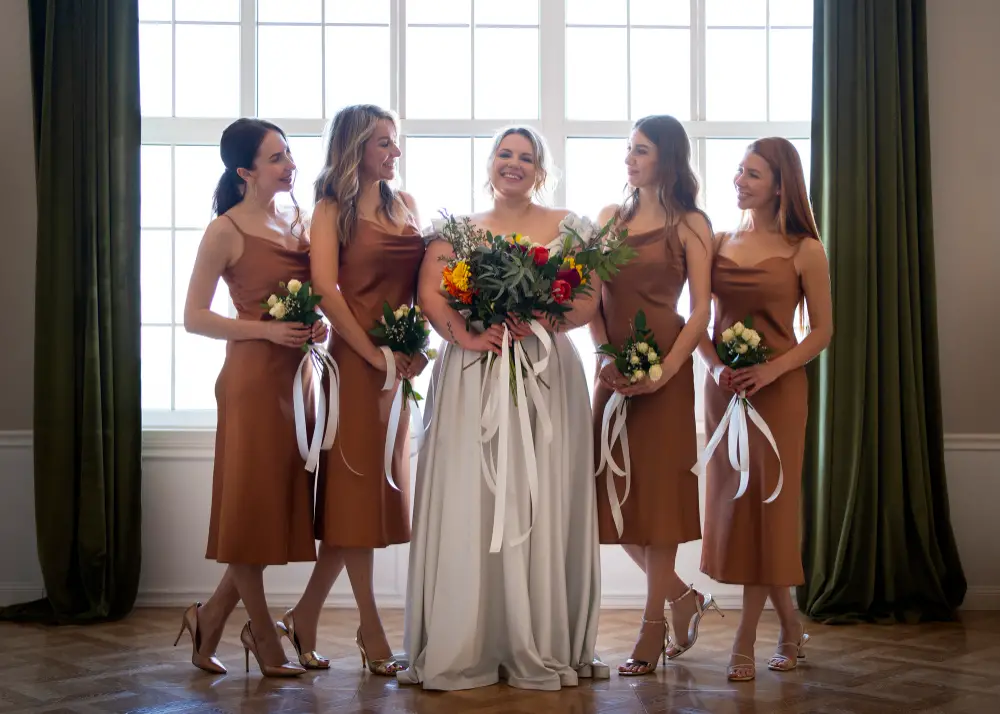
She was near the back of the hall with her bridesmaids, already in her dress — white lace, fitted perfectly, hair done, makeup flawless. She looked exactly like what she was supposed to look like on this day, which was to say she looked like someone who had always been certain she would get here and had arrived without surprise.
She caught my eye across the room. She gave me a quick smile and a small wave. Not a step toward me, not an opening of any kind, just a gesture from across a crowded room, the kind you give someone you haven’t quite placed. I waved back. She turned back to her bridesmaids.
I went back to straightening things that were already straight.
I stepped outside for air at some point during the setup, and my phone rang. Mark. We had never been close, and I had always found something in him difficult to locate clearly — a quality of always seeming to calculate the angle of a conversation before he entered it.
“Hey, Lauren,” he said. His tone was practiced-casual. “You there already?”
“Yeah. Helping out.”
“Nice. Hey, random question.” A brief pause, the kind that comes just before something that isn’t actually random. “That place you’re living in now — that’s still your grandparents’ house, right?”
I leaned against the railing outside. “Yeah.”
“Good area,” he said. “Property values have been going up crazy out there.”
I waited.
“You ever think about selling it?” he added, as if this had just occurred to him.
There it was.
“Not really,” I said. “It works for us.”
“Sure, sure.” Too quickly. “Just saying — if you ever did, now’s a good time. You could probably get a solid return.”
“I’ll keep that in mind.”
I ended the call and stood outside a moment longer. It wasn’t the first time someone had raised the house in that particular register — as a financial asset, as something to be evaluated and potentially liquidated. But the timing bothered me in a way I didn’t have the bandwidth to examine closely right now. I pushed it to one side and went back inside.
My assigned seat was toward the rear of the hall, and I found it and settled in with my bag beneath the chair and confirmed, with a hand, that the envelope was still there. It was. Everything was in place. All I needed was the right moment, and the right moment would come.
The ceremony happened around me and I was present for it: the music, the doors, Emily walking in with the calm certainty of someone who had never doubted this day would arrive, the vows that were both formal and genuine, the rings, the question, the answer. When they kissed and the room erupted I clapped along with everyone else, and for a moment I let myself feel the thing you feel when someone you love is happy — just that, without the other things.
During the reception I stayed near my assigned table and watched. Emily and Mark made their rounds. My mother moved in their orbit, adjusting. My father stayed near the front with relatives. Everything exactly arranged. Everyone exactly where they were supposed to be.
I checked my bag once more. Still there.
The first dance was announced and the room gathered itself. I stayed at my table and watched them move together, completely enclosed in the moment. She looked genuinely happy — not the performance of it for the photographs but the real thing. That held.
When the music ended and the room applauded and the formation broke apart, the particular quality of the moment I had been waiting for arrived: the in-between time, after the formality and before the real dancing started, when the evening breathed for a few minutes and things became possible that weren’t possible before.
Emily stepped in through the opened doors and for a moment the crowd simply received her.
She was radiant. That was the accurate word. The dress caught the light from the tall windows perfectly, her hair done exactly how she had clearly planned it for a long time, her face calm and sure in the way of someone who has been imagining this day for years and has finally arrived inside it. She walked toward Mark at the front with a pace that was unhurried and perfect, and the room smiled at her the way rooms smile at brides, collectively, without thinking about it.
Her eyes swept across the gathered faces as she walked.
They passed over me without pausing.
I stood with everyone else. I clapped when it was time. The vows were good — Emily’s especially, spoken with a steadiness that made it clear she’d worked on them, that what she was saying about partnership and choice was something she actually believed. Mark’s had the right structure: a small joke that released the tension, the sincere thing that came after it. The rings exchanged without incident. The question posed and answered.
When they kissed, the hall erupted, and in the noise I let myself feel something uncomplicated for a moment. Just glad for her. Just glad to be there watching.
The reception came together quickly around the ceremony. Tables that had been ceremony seating became reception seating, staff moving through the room with the efficient magic of people who have done this a hundred times. Champagne appeared. The noise level rose to the comfortable hum of a party in its early stages.
I found my position at a side table and held it. Far enough from the center of things not to be in anyone’s way. Close enough to watch.
I watched Emily and Mark make the rounds, table to table, hugging and thanking and posing for photographs. My mother moved in their orbit, close enough to smooth anything that needed smoothing. My father stayed near the front tables, absorbed in a conversation I couldn’t hear. Everyone where they were supposed to be. Everything arranged just as it had been planned.
I reached down and confirmed my bag was still under the chair. Still there.
The first dance was announced and the room gathered itself around the dance floor. I stayed at my table and watched them move together, slow and practiced, completely enclosed in the moment. She looked happy in the real way — not the performance of happiness for the photographs, which I’d seen in brides before, but something actual. That stayed with me.
The music faded. Applause. The room broke apart and became a reception again — voices rising, people moving, the circle around the dance floor dissolving.
This was the moment.
I recognized it immediately: the quiet opening I had been waiting for since that morning. The in-between time, after the formality and before the dancing really started, when things slowed just enough for something personal to be possible.
I picked up my bag, stood, settled the strap on my shoulder.
Nothing dramatic. Just one step forward. Then another.
I moved the way I’d been moving all day — quiet, careful, not interrupting anything. I headed toward where Emily was standing with a small group of friends, still laughing at the tail end of something.
For a second it felt completely normal. I was just walking toward my sister at her wedding reception, the way I had pictured doing that morning when I stood in my kitchen holding the envelope.
She turned slightly, scanning the room, and her eyes found me.
The smile didn’t disappear. It did something smaller and more specific — tightened, just at the corners, just enough.
She didn’t step toward me. She didn’t hold out her arms.
She stood there for a beat, and then she moved — not toward me. Past me. Close enough that I caught her perfume as she went, redirecting herself toward the far side of the room with the smoothness of a person who has decided something.
I stopped.
Maybe she hadn’t seen me clearly. Maybe someone had called her over. These things happened at weddings, this kind of missed connection.
I adjusted my direction to follow.
My mother appeared from my right.
Not from across the room, not materializing from a distance. She was right there, as if she had been positioned specifically for this, watching and waiting for the right moment.
“Lauren.”
Low. Controlled. The voice she used when she was very certain.
I stopped.
“You need to leave.”
I processed the words one at a time, because the first pass didn’t produce meaning.
“I’m sorry?”
“You need to go,” she said, her tone tightening just fractionally. “You heard me.”
I looked past her. Emily was three or four steps away, facing partly away from us. Close enough to hear. Not turning toward us.
“I was just going to give her the gift,” I said. I shifted the bag slightly.
My mother’s eyes moved to the bag. Then back to my face. Her jaw set.
“That’s not necessary,” she said.
Not necessary.
I looked at her and waited. I gave her the space to hear what she’d just said and reconsider it. She didn’t reconsider it.
Behind her, Emily turned. She walked the few steps over to us and stopped just behind my mother, close enough to make it a three-person conversation, far enough to let my mother remain the one speaking.
“Emily,” I said, and my voice had gone quieter than I intended. “I just wanted to—”
“You need to leave.” She said it without heat, the words coming out level and practiced. “You’re making people uncomfortable.”
“By standing here.”
“It’s not just that.” She folded her arms slightly across her front. “It’s the whole situation.”
I waited. I let the silence sit there and gave her every opportunity to say what the whole situation was.
She didn’t.
My mother took a small step forward.
“You’re bad luck here, Lauren.”
That sentence landed differently from the others. Not louder. Just more specific. More chosen.
I looked at my mother. I gave it a moment, in case she heard it and wanted to walk it back.
She did not walk it back.
“This is her day,” she continued, her voice dropping just slightly, as if she were explaining something reasonable. “We’re not going to have anything negative around.”
Negative.
I looked past both of them.
My father had drifted apart from the group he’d been talking to. I could see him from where I stood. His eyes found mine.
I held it. I waited.
He looked away.
That was the whole answer, everything I needed to know about whether anything was going to change.
I became aware of the envelope in my bag. The weight of it, the specific weight of it. The picture in my head that morning — the hug, the jewelry box, the envelope, her saying you didn’t have to. The year behind that picture.
I exhaled.
“Okay,” I said.
One word. Nothing behind it except the word itself.
My mother nodded once, as if something had been settled.
I set my champagne glass on the nearest table. Slowly, carefully, without a sound. I adjusted the strap of my bag on my shoulder, the bag with the envelope still inside and the jewelry box still closed and everything I had brought untouched.
No one said anything else. No one apologized. No one reached for me.
I turned and walked.
My heels found a rhythm against the floor that was steady without being hurried. I moved through the room the same way I had moved through it all day, quietly and without taking up more space than necessary. I passed tables of people absorbed in their own conversations, passed the photographer who glanced at me and went back to his camera, passed couples laughing over something on a phone. I passed the entrance area where the last guests were still drifting in, stepping around me without looking up.
Behind me, the music had already resumed.
I pushed through the doors and stepped outside.
The afternoon air hit me differently than the hall air had. Cooler and less managed, the real temperature of a November day. I walked straight to my car without stopping and got in and closed the door.
The silence inside the car was different from the silence outside. I sat with it for a moment.
Then I opened my bag.
The envelope was there, exactly as it had been when I put it in that morning. Flap still sealed. Untouched. I held it in my hands and felt the weight of it — not just the paper, but everything the paper represented. Twelve months of overtime. Weekends given back. Things I should have said yes to that I said no to because I was building toward something.
The jewelry box was there too, still closed.
I put the envelope back.
My hands were steady when I reached for the keys. That surprised me more than anything else that had happened in the last fifteen minutes.
I started the engine and pulled out of the parking lot and merged onto the highway without looking back at the venue. The road opened up ahead of me, flat and clear, the kind of driving that lets your body do the work without requiring your mind.
For a while I held the wheel and watched the road and kept my breathing even.
About ten minutes into the drive, something tightened in my chest without warning. Not pain — pressure. The kind that builds up when there’s nowhere for it to go, when you’ve been holding something carefully for too long and the holding has become its own effort. I exhaled through it slowly, the way you learn to do when you can’t fix the thing itself.
Another mile.
I pulled onto the shoulder without quite deciding to. The tires crunched on the gravel. The engine stayed on. The air vents kept blowing. Everything inside the car went still.
I leaned forward over the wheel.
And then I laughed. One dry sound, shorter than I expected, that came out before I could stop it.
Because of course. Of course that was how it went.
Three hours. Approved leave I had fought for. Arrived early and carried boxes and tied ribbons and stayed out of the way and done every single thing that was asked of me, and several things that weren’t. Done everything right, and I was leaving with a bag I’d never gotten to open.
Bad luck.
I said it out loud, not loudly, just at a volume that made it real. It didn’t make it make more sense. But something about releasing the words into the air — the specific words she had chosen, said back to myself from the inside of my own car — stripped something away from them. Made them smaller than they had sounded when she said them.
My hands were shaking slightly. Just enough to notice. Not enough to be afraid of. I pressed them flat against the wheel.
I sat on the shoulder for a while. Not tracking the time, not planning what came next, just letting the pressure work its way through. The highway was mostly quiet. A car passed every couple of minutes. The sky was white and flat and absolutely indifferent to any of it.
Eventually the shaking stopped. I checked my mirrors. I pulled back onto the road.
I thought about the house during the last hour of the drive. My grandparents had given it to me specifically, without conditions, and the lawyer’s office where the will had been read was one of those rooms I still carried clearly in my memory — the specific quality of the silence after my name was said in connection with the property. My mother going very still. Emily’s expression recalibrating, measuring something it hadn’t measured before.
Mark’s call this morning. The timing of it. The way he had asked.
I filed it away. I would deal with what it meant in the morning.
The streets became familiar again as I got close to home. Same gas station, same corner with the grocery store. I pulled into the driveway and sat in the car for a moment after the engine went off.
Then I got out and walked up to the front door and let myself in.
The house was still and quiet. My daughter’s shoes were by the door, one tipped over the way she always left them. A toy on the floor near the couch. Everything where it had been.
I set my bag on the kitchen counter.
I stood there with my hands flat against the surface and looked around the room. The cabinet I had repaired by myself last summer. The table with the marker stain I had never quite gotten out and had eventually decided to regard as a feature. The fridge with her drawings held up by the animal-shaped magnets she had insisted on.
My grandparents had given me this place without asking anything back. That was the specific quality of it — the thing I hadn’t had words for as a child but had understood in my body long before I understood it in my head. That there were people in the world who gave without attaching the gift to what they needed from you. My grandparents had been those people, almost the only ones I had reliably found in my life, and this house was the last concrete expression of that. It was mine in a way that nothing else had ever been mine.
I was not going to give it away. I was not going to let it be made into something to divide.
Whatever was coming next, that part was decided.
From down the hall came the sound of my daughter stirring. Small footsteps. She appeared in the kitchen doorway with her hair messy and her eyes still adjusting, holding on to the sleeve of her shirt the way she did when she was coming up from sleep.
“You’re back early,” she said.
“Yeah.”
She climbed up onto her kitchen chair and looked at me with the direct, undefended attention that children have when they’ve registered that something has happened and are deciding how to respond to it.
“Did you give Aunt Emily the present?” she asked.
I looked at the bag on the counter.
“Not today,” I said.
She nodded once, absorbing this. She slid off the chair, retrieved a juice box from the fridge, stabbed the straw in, and took a sip. She looked at me over the top of it for a moment.
“Are we going to see them again?” she asked.
“Eventually,” I said. And then, because she was seven and watching me carefully: “Nothing’s wrong with us.”
That seemed to land. She nodded again and walked back toward the living room, carrying her juice box, already moving on to the next thing.
I watched her go.
I stayed at the counter a while longer. I reached into my bag and took out the envelope and set it on the kitchen surface. Almost ten thousand dollars, saved in careful increments, meant for a moment that hadn’t come.
It would be useful for something else. I didn’t know what yet. But it would find its purpose.
I left it on the counter and walked into the living room.
My daughter had arranged herself on the floor with her toys around her. She looked up when I came in.
“Sit with me?” she asked.
I sat down on the floor beside her.
She went back to what she was doing, and I watched, and the room was quiet in the way rooms are when nothing is required of you, when you’re simply somewhere rather than on your way to somewhere or away from something. The afternoon light came through the window at the angle it always came through at this hour.
The bag with the jewelry box was still on the kitchen counter. The envelope was beside it.
For now, they could stay there.
Tomorrow would have its own requirements. The phone would ring at some point, she had said enough and so had Mark, and I had a fairly clear sense of what would be asked when it did. I would deal with that when it arrived.
But tonight, this was enough. My daughter on the floor beside me, working on something only she understood. The house around us, still and solid and ours.
I had driven three hours that morning toward a moment that I had been building toward for a year.
The moment hadn’t arrived.
But I was still here.
That was what I was going to hold onto, for now.
That was enough.

Specialty: Legal & Financial Drama
Michael Carter covers stories where money, power, and personal history collide. His writing often explores courtroom battles, business conflicts, and the subtle strategies people use when pushed into a corner. He focuses on grounded, realistic storytelling with attention to detail and believable motivations.