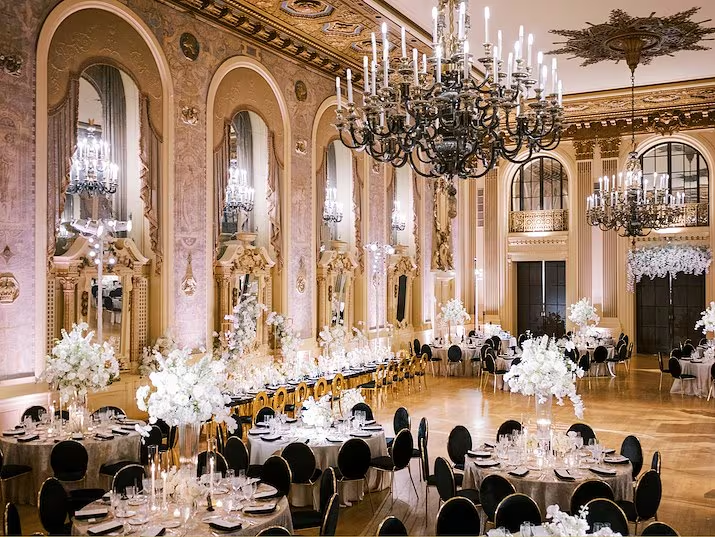
The first thing Mason Harper did when he saw me at his wedding was stop breathing.
Not a look of surprise — something more complete than that. His body forgot its next instruction. One second he was standing beneath the gold light of the Crawford Hotel foyer with Avery Langford tucked beneath his arm, smiling for a photographer as if he had personally invented privilege. The next, his face emptied out so completely it looked unplugged. His hand fell away from Avery’s waist. His lips parted. Nothing came out.
I stopped in front of him in the white silk dress I had made for myself and let the silence do what a scream never could.
It moved through the room slowly at first, then all at once. A ripple of attention, a string quartet stumbling half a measure, the electric shift that happens when everyone in a room feels a private disaster turning public.
“Congratulations, Mason,” I said.
My voice was steady. That mattered, because he remembered the version of me who used to tremble when he raised his voice.
His gaze dropped to the embroidery over my heart. Vale Atelier, stitched in white thread nearly the same shade as the gown. Under the chandeliers the letters glimmered just enough. Recognition hit him so hard he actually stepped backward.
Avery followed his gaze and frowned. She was beautiful in the polished, editorial way — sculpted calm, expensive makeup — but there was intelligence in her eyes. The kind that notices when a room changes temperature.
“Mason,” she said quietly. “Who is she?”
Then my mother saw me.
Laura Harper was carrying two champagne flutes when her eyes found my face. The glasses slipped. Crystal burst across the marble floor. Guests turned. Conversations snapped off. My mother stared at me as if the dead had learned tailoring and come back dressed for something worse than revenge.
My father stepped forward from behind her, and for the first time in my life I watched fear break through Richard Harper’s composure before anger could cover it. He had aged the way men with money usually age — carefully, expensively, without grace. His suits were sharper. His hair was thinner. The force in him had curdled into something heavier. But his eyes were unchanged. They had always been the coldest thing in any room he entered.
Now they were not cold. They were calculating.
He looked at the envelope in my hand, then at the logo on my chest, and I knew he understood both disasters at once. I had survived. Worse for him, I had prospered. I had not come back as the girl he threw into a blizzard. I had come back as the woman who could finally prove what he stole.
Twelve years earlier, on a January night that turned Denver’s sidewalks white in minutes, my father opened the front door of our house and told me to get out.
I was nineteen. I had mild cerebral palsy that affected my right leg and balance — a fact my family had spent years treating as evidence of defect rather than difference. I was slow on stairs, careful on ice, tired more easily than Mason. To him that translated as weakness. To my father it was embarrassment. To my mother it was the kind of shame she believed good jewelry could cover.
That night I had made the mistake of seeing something I was never supposed to see.
My grandmother Beatrice had died six months before. She was the only member of the family who looked at me without pity or irritation. She had taught me to sew in the quiet upstairs room of her old textile warehouse on the edge of what would later become Denver’s RiNo district — let me drape muslin across mannequins while other girls my age were out at parties, moved a chair closer when my right leg ached, never stopped the lesson. She never used the word disabled as an apology. She used it as a fact, the way you say tall or left-handed or brown-eyed.
After her funeral, my father took over everything. Her estate, her business archives, her personal effects — all of it disappeared into locked offices and attorney meetings I was never invited to attend. Six months later I found a folder on his desk while carrying coffee my mother had asked me to bring upstairs.
Inside were probate documents, a trust inventory, and a signature that looked like mine but wasn’t. There was also an affidavit declaring that I lacked the capacity to manage any inheritance because my physical disability had created emotional instability and dependence.
My father had not merely cut me out. He had built paperwork around the lie.
When I confronted him, Mason was the first one to laugh. He had been leaning in the doorway of the study, twenty-one and already learning cruelty from the master. He looked me over the way he always did when he wanted an audience, then said with perfect casual disgust that I was an ugly disabled idiot and nobody in their right mind would leave real assets to me.
My mother whispered for everyone to calm down, which was how she always announced she planned to do nothing.
My father took the papers from my hand, called me hysterical, and by midnight my suitcase was on the front steps. He gave me eight hundred dollars. He told me I would never carry the Harper name again.
Mason watched from the foyer while snow blew through the open door, smiling like banishment was entertainment.
I remember the cold first. Then the silence.
What saved me was not resilience in some movie-worthy surge. It was smaller and less elegant than that. A bus station. A church shelter. A lunch shift waitressing job where I limped home with aching hips and counted tips on a shared bathroom counter. Then, six weeks after the door closed, a Dominican seamstress named Elena Delgado who saw me hemming my own coat in a laundromat and asked where I had learned to sew like that.
She owned a bridal alterations shop on Federal Boulevard. The first day I worked for her, she placed three ruined gowns on a table and said that if I could rescue one of them, she would pay me cash and let me come back tomorrow.
I rescued all three.
Elena did not save me by being gentle. She saved me by being exact. She corrected my seams, cursed my shortcuts, taught me fabric memory and bead weight and shoulder balance, how to read the kind of women who wanted to feel expensive without looking desperate. When my leg gave out on long days she shoved a stool under me and kept talking. Never pity. Never heroics. Just work.
At night I sketched on receipt paper, napkins, the backs of alteration invoices — dresses that moved the way I wanted my own body to move in rooms where people had spent years deciding what it could not do. Clean lines, hidden structure, softness with spine.
Two years later Elena bullied me into applying for a scholarship to Parsons extension courses in New York. I got it. I left Denver with one rolling suitcase, a sewing machine she pressed into my hands, and a new name built from the only part of my old life worth keeping: my grandmother’s maiden name.
I became Eve Vale.
The years that followed were ugly in the way honest success often is. Shared apartments. Patternmaking at dawn. Studio assistant positions for designers who wanted ideas from people they had no intention of promoting. I ate badly and slept less and learned that fashion worships beauty while feeding on invisible women. I also learned I was better than most of the people standing above me.
My first break came from a disaster. A sample gown for a major editor arrived torn through the waist seam an hour before a charity gala. The head seamstress panicked. I rebuilt the center structure, recut the drape, and added a soft folded panel that transformed the entire silhouette. The editor asked who had altered it. Six months later one of my own designs appeared in an editorial spread. A year after that an actress wore another to the Oscars. Three years later Vale Atelier had a waiting list. I became known for bridal gowns that looked simple until you stood close enough to understand how much engineering was hiding inside them. People called it quiet luxury. I called it survival stitched clean.
I did not go looking for the Harpers. For a long time I wanted distance more than justice. But justice has a way of arriving whether you pursue it or not.
On my thirtieth birthday, a lawyer named Thomas Weller called my studio. He had been a junior associate at the firm that handled my grandmother’s estate. He was retiring. He could no longer live with a file he had been pressured to bury. Two days later he sat across from me in my office and slid a sealed envelope onto my desk.
Inside was a codicil to my grandmother’s will. Witnessed, notarized, and devastating.
Beatrice Harper had left me her textile archive, her original warehouse property in RiNo, and a controlling interest in a family real estate holding company attached to the warehouse land. She had also written a private letter explaining her reasoning. She knew my father considered me an embarrassment. She knew Mason would follow him. She said the only person in the family who understood how to build anything with hands, discipline, and care was me.
The warehouse land was not sentimental dead weight. It had become the anchor property used years later to secure a major line of credit for Harper Hospitality’s expansion. Which meant my father had not merely stolen from me. He had pledged assets he never legally owned.
Weller also brought the incompetency affidavit, along with internal correspondence showing that two associates had raised objections and been pushed off the matter.
Then I found the second betrayal.
Among the archived inventory were photographs of my old sketchbooks — the ones I had believed vanished the night I was thrown out. Several gowns from Avery Langford’s upcoming bridal capsule matched those sketches line for line, right down to a hand-drawn asymmetrical shoulder fold I had invented at seventeen because it disguised the way my own balance shifted when I stood for too long. Too specific to be coincidence. A discreet investigator traced the source. Mason had sold a set of what he described as family archive concepts through an intermediary three years earlier when Avery’s team was hunting for heritage inspiration. She had likely been told the designs came from a dormant Harper collection.
That explained her face in the foyer when she saw my logo.
She knew those lines. What she didn’t know yet was whose hands had drawn them first.
I had choices. I could file from a distance, let attorneys do the work, never look at any of them again. But some endings need witnesses. Some truths deserve to be spoken in the rooms where the lies were celebrated.
So I timed the injunction for the morning of Mason’s wedding and asked my attorneys to wait until I signaled.
In the foyer, my father recovered enough to step close and lower his voice. “This is not the place.”
“For fraud?” I said. “It seems appropriate.”
Mason found his voice — sharp with panic, the way it always got when the performance slipped. “You’re insane if you think you can walk in here and make a scene.”
I looked at him. Older now, handsome in the way men can be when cruelty gets mistaken for confidence, but still fundamentally the same boy in the hallway. “You made the scene,” I said, “the night you watched your sister get thrown into a snowstorm and laughed.”
Avery’s expression tightened. She slipped her arm from Mason’s and looked at me with the particular attention of someone reassessing a room they thought they understood.
“Whatever this is,” she said, “I need to hear it before I marry him.”
My father said no. Mason said absolutely not. The fact that both of them said it simultaneously was enough for her.
She turned to them with the look I had only ever seen on women who were done being managed. “Private room. Now.”
We went into a salon off the ballroom. Avery. Mason. My parents. Avery’s father Benjamin Langford, who was less investor than shark in a tuxedo. And me. Outside, guests went on drinking. Inside, the air felt thin.
I laid everything on the table in careful stacks. The codicil. The deed history. The forged affidavit. The financial documents showing the warehouse holdings bundled into Harper Hospitality’s collateral structure. The investigator’s report tracing the sketchbooks. And last, I placed one of my original notebooks on top — recovered from a reseller six months earlier. Inside the front cover, in teenage handwriting, were my initials and a coffee stain shaped like Colorado. On page thirty-two was the bodice design Avery’s seamstresses had used as the hero look for her launch collection. I turned the page to show the construction notes in my handwriting, including measurements adjusted for balance compensation on the right side.
Avery sat down slowly. She looked from the notebook to me to the digital renderings she had approved months earlier. Her mouth tightened.
“Mason told me these came from his grandmother’s archive.”
“They came from his sister’s bedroom,” I said.
Mason started talking fast the way liars do when facts become physical. Family work belonged to family. I had been given opportunities I never appreciated. Old misunderstandings. The word extortion appeared.
Benjamin Langford read the deed summary once, then again. He was a finance man before he was a father, and what shook him was not sentiment but exposure. “Richard,” he said quietly, “tell me this property was not used as collateral without clear title.”
My father said nothing.
That silence did more damage than any confession could have.
My mother began to cry — not loudly, just enough for the mascara. She kept saying she had told Richard to handle it years ago, which told me precisely how much she had known all along.
Avery lifted the engagement ring to eye level and looked at it as if it belonged to someone else’s hand. Then she asked Mason one question.
“Did you know those sketches were hers?”
He hesitated. Less than a second. It was enough.
She set the ring on the table beside the codicil. The sound it made was small. The room heard it like a gunshot.
“We’re done,” she said.
Mason reached for her wrist. Benjamin stepped between them so quickly even Mason looked startled. Avery stood, her face composed in a way I trusted more than tears.
“You sold me a lie,” she said. “You stole from your sister, used your family’s fraud to finance your company, and expected me to stand in front of three hundred people and tie myself to it. I won’t.”
She turned to me then, and there was shame in her expression but not self-pity. “I didn’t know. I should have asked harder questions. I’m sorry.”
I believed her.
Five minutes later Avery walked into the ballroom alone and took the microphone. She told the room the wedding would not proceed. She said there were serious legal and ethical issues involving the Harper family requiring immediate attention. She apologized to the guests and thanked everyone for respecting her decision.
The room erupted — gasps, whispers, phones appearing like metal flowers. But by then two process servers and my lead attorney had entered through the side doors. One handed papers to Richard Harper. The other handed them to Mason.
For twelve years I had imagined feeling triumph in that moment.
What I actually felt was stillness.
My father looked at the top page, then at me, and for the first time in my life I saw him as a limited man rather than a large one. Just a bully with cufflinks. A thief with expensive tailoring. A person who had mistaken the silence of women around him for proof he was untouchable.
He said my old name. “Evelyn.”
I had not heard it from his mouth in twelve years.
“That name belongs on your evidence exhibits,” I said. “Not on me.”
The legal process was not fast, but it was decisive. Benjamin Langford withdrew every pending investment tied to Harper’s expansion. Lenders, alerted to the title defect and fraud claims, moved with the unsentimental speed of people protecting their own. Harper Hospitality’s debt structure began unraveling within weeks. Discovery was brutal. Emails surfaced. Internal memos surfaced. A former accountant testified that Richard had referred to me as “the limp daughter” while discussing how to move the warehouse through shell entities without triggering questions. Two former employees confirmed Mason had boasted about selling my designs as dormant family property.
Richard settled the civil case only after criminal investigators became interested in the forged affidavit and related financial filings. He pleaded to fraud charges requiring restitution, asset forfeiture, and a public admission. Mason escaped prison but lost his executive roles, his reputation, and every investor who had mistaken his swagger for leadership. He was named in the civil judgment, barred from several fiduciary capacities, and spent the following year trying unsuccessfully to rebrand himself in cities that already knew his name.
My mother left my father before sentencing. She wrote to me twice. The first letter was excuses arranged to look like regret. The second was quieter — an admission that she had seen enough to know I was telling the truth even then and had chosen comfort over courage. I did not forgive her in the way people like to demand from survivors. But I wrote back once. I told her accountability mattered more to me than apology, and that silence was never neutral. It was the first honest exchange we had ever had.
Avery testified voluntarily. She canceled the launch collection built on my stolen work and paid every member of her design team through the end of their contracts so nobody else went down for Mason’s theft. Six months later she called and asked whether I would consider licensing a capsule under my own name to replace it. I said no to the capsule and yes to coffee. We were never exactly friends, but we became two women who had looked at the same lie from different sides and refused to keep feeding it.
The deed to my grandmother’s warehouse came back to me after the settlement closed. I stood inside it on a cold February morning with dust on my boots and sunlight cutting through the high windows in long pale bands. The cutting tables were gone. The freight elevator groaned. Pigeons had claimed the rafters.
It was perfect.
I restored the building instead of selling it. The first floor became Vale Atelier’s design lab. The top two floors became Beatrice House — an apprenticeship and scholarship program for young designers from disabled, low-income, and displaced backgrounds who had talent but no doors open to them. We built cutting tables with adjustable heights, fitting rooms with full accessibility, workstations designed for seated and standing use, quiet rooms for chronic pain flare days, and scholarships that covered rent stipends as well as tuition, because talent cannot survive on admiration alone.
On opening night it snowed. Denver has a way of doing that when it wants to remind you who you used to be.
I stood at the warehouse window in a black sweater and watched flakes spin through the streetlights while guests filled the studio below. Elena Delgado was there, furious that the catering trays were too small and proud enough to cry only when she thought nobody was looking. Thomas Weller came with a cane and a shy smile. Avery sent flowers with no card. My first class of apprentices moved through the space touching bolts of fabric as if they were entering a cathedral.
One of them — a nineteen-year-old girl with a forearm crutch and a brutal eye for line — stayed behind after the speeches to show me a sketch. Imperfect and daring and full of nerve. She asked whether structure like that could really hold.
I told her yes. Then I showed her how.
Later, when the crowd thinned and the snow deepened, I walked out to the loading dock and stood in the cold for exactly one minute. Long enough to feel it in my lungs. Long enough to remember the girl with the suitcase and the eight hundred dollars and the door closing behind her in the dark.
The difference was simple now. Back then the cold had meant exile.
Now it meant weather.
I went back inside, locked the door from the warm side, and turned off the lights one row at a time.
My name was on the glass. My grandmother’s legacy was alive. The people who tried to bury me had to live with records and judgments and consequences that bore their own names.
I did not leave that building carrying the Harper name.
I left carrying keys.

Sophia Rivers is an experienced News Content Editor with a sharp eye for detail and a passion for delivering accurate and engaging news stories. At TheArchivists, she specializes in curating, editing, and presenting news content that informs and resonates with a global audience.
Sophia holds a degree in Journalism from the University of Toronto, where she developed her skills in news reporting, media ethics, and digital journalism. Her expertise lies in identifying key stories, crafting compelling narratives, and ensuring journalistic integrity in every piece she edits.
Known for her precision and dedication to the truth, Sophia thrives in the fast-paced world of news editing. At TheArchivists, she focuses on producing high-quality news content that keeps readers informed while maintaining a balanced and insightful perspective.
With a commitment to delivering impactful journalism, Sophia is passionate about bringing clarity to complex issues and amplifying voices that matter. Her work reflects her belief in the power of news to shape conversations and inspire change.