I read that last message three times.
A judge won’t like how extreme you’re being.
He had moved from I love you to legal threats in the span of four texts, which told me everything I needed to know about the love and nothing I did not already know about the threats. I forwarded everything to Maya. She replied within six minutes with a single word: Perfect.
Perfect because every message built the record. Every pivot, every minimization, every you’re acting crazy added a brushstroke to the portrait the judge would eventually examine. Caleb thought he was applying pressure. He was actually assembling my case for me.
I stopped reading the texts in real time after that. I let them arrive, screenshot automatically with the app Maya had recommended, and checked the folder at the end of each day the way I checked patient charts at work. Systematically. Without letting any single entry overwhelm the whole.
That distance was hard-won.
The fourth morning, I made coffee before dawn and stood at the kitchen window watching the yard emerge from darkness. The boxwoods along the driveway held their shape in the gray light. The bird feeder needed refilling. Mason pressed his nose against the glass door and breathed fog onto it, watching the yard with the patient optimism of a dog who believes every morning contains the possibility of a squirrel.
Tessa’s house was dark.
Her car was in the driveway.
I had not decided yet what I wanted to do about Tessa Riley. Maya had advised against direct contact, which was straightforward legal counsel, but the human part of it was murkier. Tessa was not my marriage. She had not stood in a ceremony and promised me anything. She had not built a future with me on the foundation of someone’s word. Caleb had. The specific weight of each betrayal was different, and I was not yet ready to sort them into clean categories.
What I knew was this: she had used a code I gave her. She had crossed my threshold on nights I trusted my husband with the house. She had looked at me over brownies and backyard wine and said “you’re so lucky” while already deciding I was not. That was its own thing, the deliberate warmth of a woman building access while performing friendship.
I refilled Mason’s water bowl and let the thought sit without resolving it.
Thoughts do not always need resolution. Sometimes they just need to be acknowledged and given a specific drawer.
The temporary hearing was eleven days after I found them.
Maya had prepared me in the way she prepared everything, which was to say thoroughly, chronologically, and without sentimentality. We met at her office the day before in a conference room with a white board and a parking lot view and the specific quiet of a building full of people handling other people’s worst days. She was small and precise, her dark hair pulled back, reading glasses she only wore at the desk, a legal pad covered in her particular shorthand.
“Caleb’s attorney filed a response,” she said, sliding a copy toward me.
I read it.
In summary: Lena had overreacted to a platonic social situation. Lena had been emotionally unavailable for months. Lena had locked him out unlawfully. Lena had frozen financial access unreasonably. The exclusive-use order was retaliatory and unsupported by evidence of domestic violence or genuine emergency.
“He called it platonic,” I said.
“He did.”
“There’s a video.”
“Yes.”
“And a smart-lock log showing her there eleven times.”
“Yes.”
“And phone records I haven’t pulled yet.”
Maya looked at me over her glasses. “We don’t need phone records for a temporary hearing. We need the video, the timestamps, the access log, the financial pattern, the text progression, and your testimony. It is enough. Let them use platonic. Platonic is a choice they will have to defend in a room where the judge will watch that video.”
“What does he want?”
“To go home.” She said it plainly. “He says the house is his primary residence and excluding him violates his rights. His attorney is good. He’s going to make you sound paranoid.”
“Based on what?”
“Based on nothing concrete, which is why they’ll focus on tone. They’ll say you escalated beyond what the situation warranted. They’ll say you were already planning to leave and used this as a trigger. They’ll say a single night of falling asleep on a couch does not constitute evidence of an affair.”
I set down the papers.
“He texted me that he fell asleep and nothing happened.”
“Yes.”
“And then he texted that I had been emotionally unavailable.”
“Yes.”
“Both of those can’t be true.”
Maya almost smiled. “That is exactly what you say if asked.”
The hearing lasted less than two hours.
Caleb’s attorney was good, as advertised. He had the cultivated calm of someone who knew his client’s position was thin and had decided that elegance was the best strategy when substance was unavailable. He called it a marital misunderstanding. He called the lock change punitive. He called the smart-lock log circumstantial. He pronounced platonic as though the word itself was a verdict.
Caleb sat beside him in a gray suit I had not seen before. He had gotten a haircut. He looked at me once when I entered, the same way he had looked at me after our worst arguments, searching for the version of me that would eventually give.
I looked through him.
My voice during testimony was the voice I used when a patient’s family demanded answers and I needed them to hear information rather than react to emotion. Level. Detailed. Chronological. The judge, a woman in her late fifties with reading glasses on a beaded chain and the expression of someone who had heard seventeen variations of this story and was primarily interested in the facts, asked her questions cleanly and took notes without editorializing.
Maya played the video.
Thirty seconds.
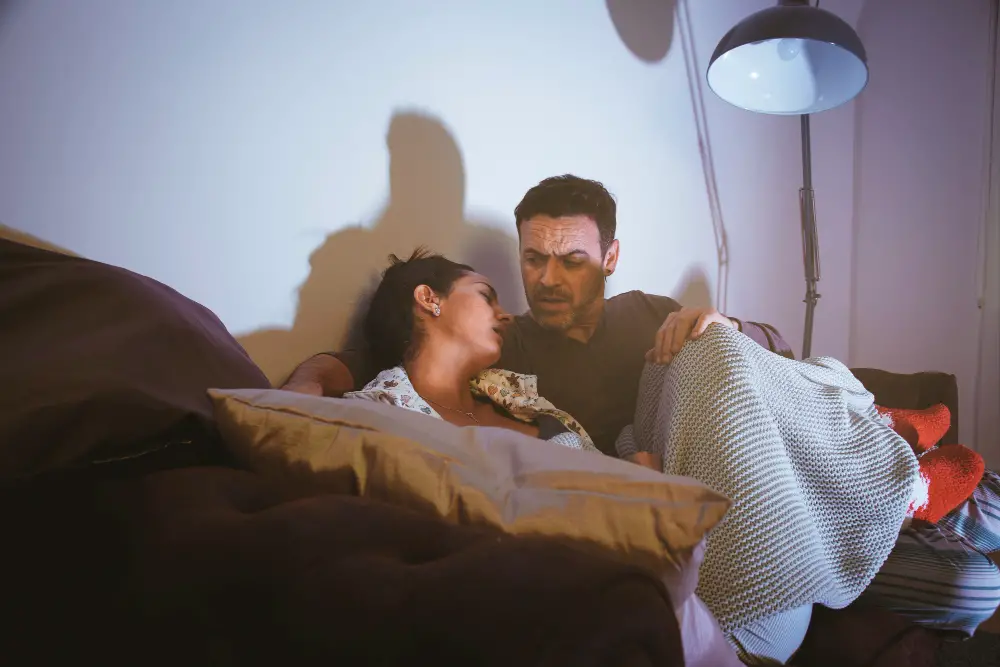
The low television. The slow breathing. Caleb’s arm tightening around Tessa in sleep. The wineglass with the lipstick smudge. The timestamp in the corner: 12:13 a.m., a late-shift night, my house, my couch, my blanket.
Caleb’s attorney shifted in his chair.
I watched the judge watch the video.
Then Maya laid out the smart-lock entries. Eleven occasions. Always late. Always when my shift ran long or I was not home. The deleted porch camera archives alongside the local logs showing motion at those same windows. The financial withdrawals Caleb could not fully account for. The progression of his texts from whatever you think you saw to nothing happened to you’ve been distant for months, laid out in chronological order like a man arguing himself into a corner.
When Maya said, “The behavior pattern here is not a single night, Your Honor, but a structure built around the petitioner’s absence,” I felt the room shift slightly, the way air shifts when a window opens.
The judge granted the extended temporary orders.
Exclusive use of the residence.
Financial restraints.
No contact except through counsel.
No harassment, direct or indirect, including through third parties.
Caleb’s attorney immediately requested a sixty-day review. The judge agreed. Standard procedure. Not a victory or a defeat, just the machinery of the process beginning to move at its own pace.
Caleb stood when the judge left. I was already gathering my folder. He said my name once.
I kept my eyes on my papers.
Maya put her hand briefly on my elbow.
We walked out.
In the parking garage, in the sudden concrete quiet after the courthouse noise, I leaned against Maya’s car and let my legs shake for thirty seconds. She stood beside me without filling the silence with commentary. That was the gift she gave me that I had not known to ask for. She understood that sometimes the aftermath of being right is just as hard as the fear of being doubted.
“How long will this take,” I asked. “All of it.”
“Depends. If he fights, a year. Maybe more. If he sees the math and negotiates, six months.”
“He’ll fight.”
“Probably. Men who blame the response usually fight the consequences.”
“What do I do for a year?”
She looked at me. “You live.”
The weeks after the hearing had a texture I had not expected. Not relief exactly. Not grief in the simple sense. Something more like the particular exhaustion of holding yourself upright for so long that when you are finally allowed to rest, you do not immediately know how.
I went back to work.
The urgent care center was the same: fluorescent lights, the half-controlled chaos of intake, patients who were frightened and took it out on the nearest administrative person, the rhythm of authorizations and coordination and the thousand small decisions that filled twelve hours without leaving room for private suffering. I was grateful for all of it. Work had always been the place where my competence was undeniable. No one at work was managing a narrative about me. The facts of the job were the facts of the job.
My supervisor, a meticulous woman named Dr. Patricia Owens who noticed everything and said nothing unnecessary, stopped by my desk on my second day back and placed a coffee on the corner of my computer.
“The Hendricks authorization came back approved,” she said.
“I submitted it Tuesday.”
“I know.” She paused. “You look tired.”
“I’m okay.”
She did not press. She walked away. The coffee was the whole message.
That kind of kindness, quiet and not requiring performance in return, was something I stored carefully. Kindness that asks nothing of you is a different thing from the kindness that always seemed to come with an invoice.
I thought about that a lot in those weeks. How much of my marriage had been organized around managing Caleb’s emotional temperature. Not overtly. He had never called me a servant or demanded I subordinate myself. But the logic of the household had been built around his comfort: his sleep, his mood, his need for admiration, his need for entertainment when the job felt stagnant, his need for softness when I arrived home too tired to provide it. I had metabolized all of it so gradually that I had stopped seeing the cost. I thought I was being loving. I was also, partly, being managed by my own desire to keep the peace, and peace-keeping in a marriage where one person defaults to accusation is not peace at all.
It is just deferred conflict.
Mason helped more than anything.
He did not know about Tessa Riley or the smart-lock log or the temporary orders. He knew that I had been sad and that he was available for sadness. He slept against my legs and followed me from room to room and looked at me with the bottomless patience dogs have for humans who are taking longer than expected to be okay.
I redecorated slowly.
Not dramatically. Not the furious rearrangement of a woman burning things down. But the gray knit throw blanket was gone, and its absence was a decision I had made, which made the absence different from loss. I moved the couch six inches to the left because the indent of two bodies felt specific even after cleaning. I bought a new floor lamp because the old one had been Caleb’s and its light was the same light he had watched Tessa by. Small things. But ownership requires maintenance. You have to keep walking through your own rooms and deciding that they belong to you.
I put my grandmother’s china on the table.
Not for guests. For dinner. My dinner. The good plates on a Thursday because I had earned them and she had left them to me and keeping them in a box because someone was afraid of breakage was no longer a principle I intended to live by.
The china gleamed under the kitchen light.
I ate pasta from my grandmother’s plates and read a novel and did not feel guilty for it.
Maya and I spoke twice a week during the negotiation period that followed. Caleb had hired a more aggressive attorney for the formal proceedings, someone sharper than the first, and the early rounds of the divorce were the predictable back-and-forth of two people who had once merged their lives and now had to disaggregate every shared decision. The house. The accounts. His retirement fund contribution overlap. My student loan he had nominally helped with years ago. The dog, briefly, though that did not last long because Caleb had never once taken Mason to the vet alone and his attorney apparently advised him not to make a spectacle of sentiment.
He told people we had grown apart.
I know this because our friend Daniel told me gently over coffee in November, his eyes careful and apologetic. “He’s saying it was mutual. That you were disconnected. That things had been bad for a while.”
“What do you think?” I asked.
Daniel looked at his cup. “I think I remember him complaining about work and you covering everything with a smile, and I thought that was just how you guys were. I didn’t look close enough.”
“You didn’t need to look closer. It was my marriage.”
“Still.”
“No,” I said. “This is what happens. People watch a marriage from the outside and they see what both people agree to show. I agreed to show fine. So everyone saw fine.”
He nodded.
“I’m sorry he did this.”
“Thank you,” I said. “That’s the right sentence.”
Tessa put her house on the market in January.
I do not know the full story of what happened between her and Caleb. I do not want the full story. The shape of it was clear enough: she had expected proximity to become more than it was, and it had not, or perhaps it had but not in a way that held. People who conduct relationships at other people’s expense tend to find that the thing they built is smaller than it looked from outside the window. Caleb had never been interested in leaving me, I think. He had been interested in the addition, not the replacement, which is a particular kind of dishonesty that gets dressed up as complexity.
When the For Sale sign appeared in her yard, I stood at my living room window and looked at it for a moment. I did not feel triumph. I did not feel sad. I felt the specific neutrality of watching a chapter close without knowing yet what the next one would contain.
The final settlement was reached in March.
I kept the house.
I had expected to want that more than I did, and was surprised to find the wanting had changed shape during the months of proceedings. At the beginning I wanted the house because it was mine, because my name was on the deed, because I had chosen the boxwoods and the kitchen tile and the location near the school that backed the neighborhood and had imagined children there someday. By March, I wanted the house differently. Not because of what it had been but because of what I had made it since: the china on the table, the relocated couch, the lamp that gave a different light, the rooms I had walked through every morning and claimed back an inch at a time.
The house had been the scene of the crime, and I had refused to let it remain one. That was its own kind of verdict.
Caleb received his portion of the accounts and retirement equity. The figure was fair and I did not argue it because fairness had never been the injury. The injury was the assumption. The injury was whatever you think you saw. The injury was building a structure of access and deception inside a life I was working twelve-hour shifts to sustain, and then looking up at my window when the locks changed as if I was the one who had broken something.
Paper was signed on a Tuesday afternoon in Maya’s conference room.
Caleb did not look at me directly when he signed. He had a new haircut again, different from the courthouse one, and he had lost some weight in the months of proceedings in the way men sometimes lose weight during divorce, as though the process burned something off. I signed my copies quickly, without drama, and when Maya slid the final page toward me and said that’s the last one, I did not feel what people describe when they describe the end of a marriage. No flood. No collapse.
I felt a door close.
Quietly. The way I had entered the house that night, trying not to wake the lie.
Afterward, Maya walked me to my car.
“You did well,” she said. It was not effusive. It was factual. She knew I needed facts.
“I fell asleep crying in a hotel holding a notepad.”
“And then you made a checklist,” she said. “That’s the same thing, done competently.”
I drove home on roads that had become familiar again, roads that were mine now in a way they had not been when they were ours. The March afternoon was gray and cold, the sky the specific flat white of the Midwest at the end of winter, right before it gives way. I passed the Sandersons’ maple tree, now bare and spare against the pale sky, and thought about the last time I had parked under it. The trunk lights off. The quiet engine cooling. The sound I was trying not to make.
I pulled into my own driveway, on the gravel, not at the curb.
The stones crunched under my tires and I let them.
Inside, Mason met me at the door with the full body enthusiasm of a dog who has been expecting you for exactly as long as you have been gone. I hung my coat, filled his bowl, and put the kettle on. Then I stood at the kitchen window with my hands wrapped around an empty mug and looked at the yard while the water heated.
The boxwoods needed trimming. The bird feeder was empty again. A robin, early and probably confused by the March cold, sat on the fence post and looked at the feeder with the patient displeasure of someone who had been promised something better.
I went to the garage and found the birdseed.
I filled the feeder and went back inside and stood at the window until the robin came back, dipped its head, and began to eat.
Then the kettle started and I made tea in a mug I had bought myself, part of a set I had chosen alone, and I sat at the kitchen table where my grandmother’s china still occupied the shelf above the window, the white plates catching the thin afternoon light in the way of things that have been put where they belong.
Nora came for dinner that weekend with a bottle of wine too good for the occasion, which was exactly right.
We ate at the table with the good plates and she told me about a student who had drawn a portrait of her in abstract art that was either a profound emotional statement or deeply unflattering, she could not decide which. I told her about a patient who had complained about the waiting room music for forty minutes and then tipped the front desk jar twenty dollars on his way out because, he said, at least someone had the decency to listen. We laughed. The house absorbed the sound of it, easy and unguarded, and did not ask anyone to keep it down.
Late in the evening, Nora leaned back in her chair and looked at the room.
“You changed the lamp,” she said.
“Bought a new one.”
“And the couch is different.”
“Six inches to the left.”
She nodded slowly. “It looks like your house now.”
“It always was,” I said. “I just had to finish moving in.”
She raised her glass.
I raised mine.
We sat in the kitchen until nearly midnight, in no particular hurry, because there was nowhere else to be and no one whose arrival would change the temperature of the room. That was its own luxury. Quiet that belonged to me. Warmth I had not calibrated to anyone’s mood but my own.
When Nora left, I washed the dishes and dried the good china and put it back on the shelf. Then I moved it down to the accessible cabinet, the one at eye level, the one I opened every morning for mugs.
I was going to use the plates.
Not every day. Not for performance. But often enough that they would not sit untouched behind glass because someone had decided they were too valuable for regular living. Things that are loved deserve to be used. Evidence of a life is not kept in boxes.
In April, the robin came back.
Not the same robin, probably. Or maybe the same one. I have no scientific basis for the claim I am about to make, but that particular robin came to the bird feeder on the fence post every morning that spring with an air of entitlement I found quietly magnificent. It did not knock. It did not announce itself. It simply arrived, ate, and left, and came back the next morning as though this were settled.
I bought better birdseed.
I started running in the mornings again, not to train for anything, not to prove anything, just because my body had been mostly useful to other people for several years and I wanted to take it somewhere for no reason except that movement is its own pleasure when you remember it can be. The neighborhood was beautiful in early spring, the boxwoods budding, wet lawns, that particular quality of morning air that smells like soil and cold and the very beginning of something.
I ran past Tessa’s old house on one of those mornings. The For Sale sign was gone. A moving truck sat at the curb. A couple in their thirties stood in the driveway, arguing cheerfully about furniture placement, and a small child ran across the yard with the uncontained joy of a person who has just been told this is home.
I ran past them and kept going.
On a Thursday in May, I walked into the break room at work and found a card on the table with my name on it, signed by half the intake staff.
Heard about the divorce finalized. You handled it like a professional. By which we mean we saw almost nothing, which means you did everything right. Also we bought a cake.
The cake was from the bakery a block from the center. White frosting, blue writing: LENA.
Just my name.
Not any event. Not any achievement. Just me.
I stood in the break room with a hospital badge clipped to my scrubs and a piece of cake on a paper plate and cried for exactly three minutes, which is the amount of time a person can cry before the next patient authorization requires attention. Dr. Owens walked in halfway through, looked at the cake and my face, poured herself coffee, and said, “The Martinez pre-auth is back. They need your signature.”
“Give me four minutes,” I said.
She gave me five.
I have replayed the night of the discovery many times in the months since, not obsessively but the way you replay anything that changed the direction of your life, searching for the moment the fork appeared. What I find, each time, is not one moment but a collection of them, accumulated like the smart-lock entries, quiet and dated and pointing toward a shape I did not let myself see until I was ready.
Maya was right that it was a structure. Betrayal of that kind is not an event. It is a series of accommodated silences, each one small enough to rationalize, each one adding to the load until the floor shows the stress. I had been rationalizing because I came from people who had made suspicion a religion and I had vowed not to repeat that. I had confused vigilance with vindictiveness. I had thought staying open-handed was the same as being loved well.
It is not the same.
Trust is not the absence of discernment. Trust is what you extend to people who have earned it, renewed with evidence, not demanded as proof of loyalty. I had been performing trust because I was afraid of what performing its opposite would mean about me.
I know the difference now.
The difference is that I still trust. I trust my sister and Maya and Daniel and Dr. Owens and the teller in the red snowflake sweater who helped me move my direct deposit at 6:30 in the morning and said all set with no judgment in her face. I trust Mason, whose loyalty requires nothing except presence and the occasional freeze-dried chicken treat.
I trust myself in ways I had stopped.
The night I stood in that hallway with my phone in both hands and took the photo without waking them, that was not a failure of love. It was not vengeance. It was the self I had neglected choosing to matter in a moment that required mattering.
Proof first. Emotion later.
Facts first. Stabilization.
I applied to myself the same standard I had spent years applying to other people’s crises, and it held.
One morning in June, I was at the kitchen table with my second cup of tea and the window open, because the morning was finally warm enough for open windows, when I heard the sound of children next door. The new neighbors, the couple from the moving truck, had a six-year-old named Sam and a three-year-old named Iris who treated the property line between our yards as a general suggestion. Sam knocked on my door one afternoon to ask if Mason could come play, and I said yes, and the afternoon became a small unremarkable joy of a dog racing through two backyards with a child who had decided they were already friends.
The mother, whose name was Danielle, knocked the following morning with a jar of homemade jam. Strawberry.
She stood on my porch the way people stand when they are not sure if they are being welcomed and have decided to knock anyway.
“I heard the dog’s name is Mason,” she said.
“He told you?”
She laughed. “Sam told me. Sam has told me about seventeen things about your dog and four things about you.”
“What are the four things?”
“That you run in the mornings, you have good birdseed, you use nice plates, and that you seem like you’ve had a hard year but you’re getting better.”
I stared at her.
“Sam is observant,” I finally said.
“Sam is six and has no filter.” She held out the jam. “I just wanted to say hi without knocking you over with the brownies I don’t actually know how to bake.”
I took the jam.
“Coffee?” I said.
She looked at me with the uncomplicated relief of someone who has also been hoping to be welcomed.
“Yes,” she said. “Absolutely yes.”
We sat at the kitchen table with the morning coming through the window and talked about the neighborhood and the school and the birds and eventually, in the easy sideways way of new friendships, about the year I had just been through. I did not give her the full inventory. Some things belong to you and your lawyer. But I gave her the shape of it, the marriage that had ended, the night I came home and found what I found, the decision to be methodical instead of melodramatic, the slow reclamation of a house and a life.
She listened the way people listen when they are not waiting to respond but actually receiving what you are saying.
“And now?” she asked.
I looked at the kitchen. The china on the accessible shelf. The lamp with its different light. The chair I had pushed an inch closer to the window because I liked the angle. The bird feeder on the fence post where the robin came every morning with the unhurried certainty of something that knows exactly where it belongs.
“Now,” I said, “I live here.”
Not recovering. Not rebuilding. Not healing as though the present were merely preparation for something more real down the line.
Living. In the rooms I had walked back through, one careful morning at a time, until they were mine again.
The tea was warm.
The window was open.
Outside, Mason was chasing something through the grass with the pure athletic faith of a dog who believes every moving thing is worth pursuing, just in case it turns out to be wonderful.
I let the day begin.

Ethan Blake is a skilled Creative Content Specialist with a talent for crafting engaging and thought-provoking narratives. With a strong background in storytelling and digital content creation, Ethan brings a unique perspective to his role at TheArchivists, where he curates and produces captivating content for a global audience.
Ethan holds a degree in Communications from Zurich University, where he developed his expertise in storytelling, media strategy, and audience engagement. Known for his ability to blend creativity with analytical precision, he excels at creating content that not only entertains but also connects deeply with readers.
At TheArchivists, Ethan specializes in uncovering compelling stories that reflect a wide range of human experiences. His work is celebrated for its authenticity, creativity, and ability to spark meaningful conversations, earning him recognition among peers and readers alike.
Passionate about the art of storytelling, Ethan enjoys exploring themes of culture, history, and personal growth, aiming to inspire and inform with every piece he creates. Dedicated to making a lasting impact, Ethan continues to push boundaries in the ever-evolving world of digital content.