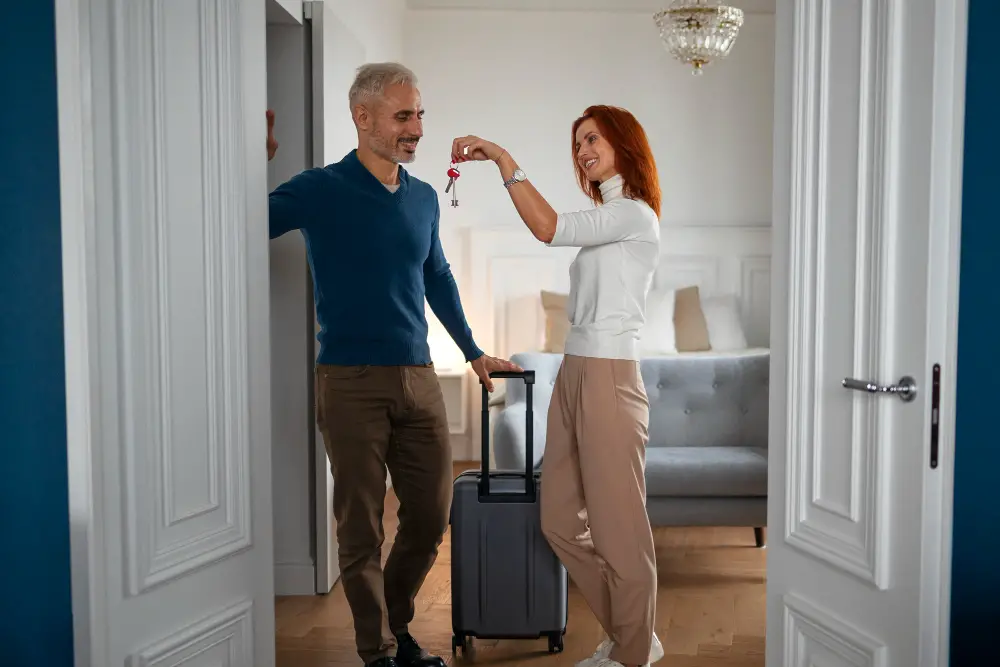
Most people think betrayal announces itself with noise. A scream. A confession. A slammed door that rattles the family photos. I used to believe that too.
The night my marriage ended, the loudest sound in our bedroom was the zipper on a suitcase. Calvin had set it open on our bed with the same reverence he used to reserve for expensive things and important moments. It was the black leather one he bought for our honeymoon in Santa Barbara, back when he still reached for my hand in parking lots and kissed the back of my neck while I cooked. Back when I still thought effort and love were basically the same thing. Now he was packing it for another woman.
He folded every shirt into neat rectangles. He rolled socks into tight pairs. He put his razor and cologne into a clear toiletry bag like he was traveling for business and needed to keep TSA moving. The precision of it got to me more than the lying. There was something almost insulting about how organized he was while disrespecting me.
“I’m taking a long weekend,” he said. He didn’t look up when he said it. He was smoothing the collar of a fitted black shirt he hadn’t worn in months, the one he used to save for anniversaries and upscale dinners and any occasion when he wanted to look like the polished version of himself.
I leaned against the doorframe and crossed my arms. “A long weekend with who?”
That was when he finally reached for honesty, or at least his version of it. “Rachel and I are doing that wellness retreat in Vermont,” he said. “The one I mentioned.”
Rachel. Not a coworker. Not a cousin. Not a trainer from his gym. Rachel Monroe, the woman whose name had started floating through our life six months earlier in careful little doses. Rachel from corporate. Rachel who understood his schedule. Rachel who laughed at his jokes. Rachel who seemed to exist in every story from the office except the ones I happened to hear in person.
He added a bottle of designer cologne to the suitcase, then the silk sleep shorts I had given him for Christmas. “Do they do cologne workshops at wellness retreats now?” I asked.
That made his hands pause, but only for a second. “A man likes to feel good about himself,” he said. “You wouldn’t understand.”
That would have been cruel enough on its own. But then his phone lit up on the nightstand, and the screen flashed a heart emoji, then a kiss. Rachel Monroe. I tilted my head toward it. “Is Rachel texting you about meditation?”
He grabbed the phone too fast and nearly knocked over the lamp. “Spam,” he said.
I let one eyebrow rise. “Spam that knows your full name?”
Then he turned and looked straight at me, and the thing I saw in his face was worse than guilt. Distance. Not shame. Not panic. Not even anger. Just the cold, finished expression of a man who had already left the marriage in his mind and was waiting for his body to catch up.
“If you’re going to make a problem out of me taking one weekend for myself,” he said, voice sharpening, “get a divorce.”
People describe heartbreak as a break, a split, a shattering. What happened in me was quieter. Something clicked. It felt like a lock sliding into place. I didn’t yell. I didn’t throw the lamp. I didn’t ask him whether he was serious, because men like Calvin hate anger less than they hate clarity. Anger gives them something to react to. Clarity takes away the stage.
So I stepped aside and let him finish packing. I stood in the kitchen window and watched his car back out of the driveway. The taillights disappeared at the end of the street, and the house went still in a way I had never heard before. Not empty. Not sad. Available.
I made coffee and forgot to drink it. Then I sat at the table with Calvin’s old laptop, the one he had started leaving at home after the company gave him a newer one. He had always assumed I wouldn’t touch his things. That was one of his central misunderstandings about me. He confused patience with blindness.
The laptop opened without a password prompt. His messages were synced to his phone. His email was already logged in. The first thing I found was the reservation. Maple Crest Inn, Stowe, Vermont. Not a rustic retreat center with yoga mats and herbal tea. A boutique hotel package for two. King suite. Couples massage. Champagne on arrival. Fireplace turn-down service. Late checkout. The total had been charged to our joint card.
I stared at the screen for a long time, not because I was shocked he had lied, but because there is a special kind of ugliness in watching betrayal itemized. It wasn’t abstract anymore. It had line items. Taxes. Gratuity. A room with my money on the receipt.
Then I opened the card history. January, a hotel in Hartford on a Wednesday night, the same Wednesday Calvin told me he was stuck at a quarterly planning dinner. March, diamond stud earrings from a jewelry store I had walked past with him once and joked was too expensive for our budget. April, two steakhouse charges on nights he said he was working late. And threaded between those charges were bank transfers. Not to our savings. Not to his checking account. To an account I had never seen before.
I clicked deeper. The account ended in 4438 and was under a separate login tied to Calvin’s personal email. He had been moving money into it for months. Pieces of his commission checks. Part of our tax refund. Small enough amounts to slip past notice if you were tired, trusting, or both.
My stomach finally dropped then, because the affair was a wound, but this was architecture. This was planning.
I kept reading. The messages with Rachel were somehow worse. She called me “the wife” like I was a category instead of a person. Calvin told her I was too practical to leave, that I liked stability too much, that I cared more about routine than passion. On Friday afternoon, ten minutes before he rolled the suitcase out of our bedroom, he had texted her: If she gets dramatic, I’ll tell her to get a divorce. She replied with a laughing emoji. There was another message after that. Once I’ve moved enough into the other account, I’m out clean.
I sat back so hard my chair scraped the tile.
My first instinct was grief. My second was embarrassment. How had I missed this? How many times had I explained away distance because work was stressful, because marriages go through seasons, because adults don’t get to be dramatic every time they feel lonely? My third instinct was the one that saved me. Action.
At eight-thirty the next morning, I called Nadia Ruiz, a family law attorney I knew through a former supervisor. Nadia had represented two women from my warehouse over the years, and both of them described her the same way: calm enough to terrify the person across from her. She got me into her office at ten. I brought screenshots, statements, printouts, and my laptop. I expected her to interrupt, but she let me talk all the way through the story. The suitcase. The phone. The text. The account.
When I was done, she took off her glasses and said, “You did exactly the right thing by not confronting him last night. Now we keep doing the right thing. We document everything, we protect what is yours, and we stop giving him the advantage of surprise.”
Because the house had come to me from my aunt Elena three years before Calvin and I married, it remained separate property in a way Calvin had clearly never bothered to understand. Nadia explained what I could do immediately and what I could not. I wasn’t going to clean out every account or throw his belongings onto the lawn like a reality show. But I could open a new account for my paycheck, move my lawful half of the liquid funds, revoke his access to the credit card attached to my personal line, and gather every record of dissipation of marital assets she needed for the filing.
The practical language helped. It gave shape to the humiliation. By noon I was at the bank. By two, my direct deposit was rerouted. By three, I had a manila folder thick with statements, screenshots, card histories, and a printout of the message where he wrote, I’m out clean.
I stopped at the office supply store on the way home and bought tabs, clips, and a new black pen. The cashier asked whether I was getting organized for tax season. “Something like that,” I said.
At home I packed Calvin’s things the way he had packed his own suitcase: neatly, methodically, without drama. That turned out to be the hardest part. Not because I wanted to spare him discomfort. Because every shirt I folded had a memory attached to it. The navy sweater he wore when we drove to Asheville for our anniversary. The gray T-shirt he slept in after long workdays. The cufflinks I bought him after his promotion. A marriage is not just a big promise. It is a thousand tiny physical archives, and I had to touch them all.
I found a hotel matchbook in the pocket of one blazer. A receipt from the jewelry store in another. I stood in the closet holding both and laughed once, sharply, because even his carelessness was arrogant. He had been counting on me not to look.
Saturday night, Calvin texted. Signal’s bad here. Don’t wait up. An hour later, another message came through with a photo attachment. Snow-dusted porch railing, two wine glasses catching the last of a winter sunset, the corner of what was clearly a very nice hotel blanket draped over someone’s lap. He had meant to send it to Rachel and sent it to me instead.
I looked at the photo for a moment. Then I forwarded it to Nadia with a single line: Exhibit added.
I put the phone down and went back to the closet.
Sunday passed quietly. I returned a library book. I cleaned the bathroom with the thoroughness of a person who has decided that the parts of life still within her control will be maintained with precision. I called my sister Dara, who lived forty minutes away and who I had been giving edited versions of my marriage to for the better part of a year, and I told her the unedited version. She was silent for a long time after I finished. Then she said she was sorry she hadn’t pushed harder when she suspected, and I told her that was not how it worked, that you can’t pull someone out of a marriage before they’re ready to leave it, and that I was ready now.
She asked if I needed her to come over.
I said not yet. But soon.
Calvin came home Monday afternoon, three hours earlier than expected, carrying the suitcase and a smell of someone else’s perfume that had probably been with him the whole drive back. He walked into the kitchen and stopped.
His things were stacked near the front door in four boxes and two duffel bags I had found in the garage, organized by category with the labels facing out the way he liked things organized, because I had learned after eight years that orderliness was the language that reached him. His toiletries were in a separate bag. His work files were in a flat box with a rubber band around it so nothing shifted. His coffee maker, which he had brought into the marriage and which I had never particularly liked, was bubble-wrapped and labeled in black marker.
He set the suitcase down.
“What is this?” he said.
“Your things,” I said. “Nadia Ruiz is filing this week. You’ll hear from her office by Wednesday.”
He blinked twice. “Who is Nadia Ruiz?”
“My attorney.”
The word attorney did something visible to his face. It moved through him the way cold water moves through a system, reaching things in sequence, and I watched each one register. The affair being known was one thing. The affair being documented and lawyered was another category entirely.
“You went to an attorney,” he said. Less a question than a recalibration.
“Thursday morning,” I said. “While you were enjoying the fireplace turn-down service.”
He opened his mouth. Closed it. Opened it again with something that was trying to become an explanation. “Olivia, I know this looks bad, but there are things you don’t understand about what’s been going on with Rachel. It’s complicated.”
“I read your messages,” I said.
He went still.
“I know what you called me in them,” I said. “I know what she called me. I know what you told her about the account ending in 4438. I have the transfer history going back eleven months.” I paused. “What I don’t have is any remaining interest in the complicated version.”
The thing about Calvin was that he had always been better at performance than at genuine response, which meant that when his performance library ran out of material, the silence underneath it was enormous. He stood in my kitchen holding his own suitcase with nothing left to reach for, and the silence was exactly as large as it looked.
“You went through my accounts,” he said finally. His voice had shifted into the register he used when he wanted to frame himself as the wronged party.
“You moved marital funds into a private account,” I said. “Nadia calls that dissipation of assets. The court has a different word for what happens to settlements when it appears.”
“You’re being cold,” he said.
That almost made me laugh. The man who had texted Rachel from our bedroom while I was twenty feet away in the kitchen, the man who had put our tax refund into an escape account while telling me he was thinking about our future, the man who had spent the better part of a year arranging his exit and was now standing in my doorway calling me cold because I had finished his packing for him.
“I’m being clear,” I said. “Those are not the same thing.”
He looked at the boxes near the door. At the bubble-wrapped coffee maker. At the flat file box with the rubber band. I had done it neatly, without theater, and I think the neatness disturbed him more than a dramatic confrontation would have. Drama would have given him a story to tell, a version where I was unstable and he was reasonable. Orderly packing gave him nothing to argue with except the fact of it.
“Where am I supposed to go?” he said.
“That seems like something to discuss with Rachel,” I said.
He left an hour later, the suitcase rolling behind him again, the boxes loaded into his car in three trips, the coffee maker in the passenger seat. I watched from the kitchen window the way I had watched him leave on Friday, and the taillights disappeared at the same corner of the same street, and the house went still in that same particular way, except this time the stillness had a different quality. On Friday it had felt like an exhale. Today it felt like an arrival.
I called Dara and told her he was gone.
She came over with soup and her overnight bag and we sat at the kitchen table until past midnight, and she let me talk about the eleven-month timeline and the line items and the messages and the photo he had sent me by mistake, and she held my hand through the parts where my voice went unsteady, and when I finally stopped talking she said, “What do you need tomorrow?”
I thought about it. “To go through the rest of the accounts with Nadia,” I said. “And to buy new sheets.”
She laughed. I laughed too, which surprised me. Not the empty kind of laughing that people do to manage their own discomfort. The real kind, that comes when something is genuinely absurd and your body decides honesty is more useful than dignity.
The new sheets were high-thread-count white cotton, the kind I had always wanted and Calvin had called impractical. I put them on Monday night after Dara left, and I slept in the center of the bed with all four pillows arranged however I wanted them.
In the days that followed, I learned things about grief that I had not known before, which is that it does not move in the direction you expect. I did not grieve the Calvin of the last two years, the one who had been leaving in increments while maintaining the scaffolding of a husband. I grieved the one from before that. The one with the fast-food fries going cold in the parking lot bag, the one who had called my sister by name the first time he met her and asked about her job with genuine interest, the one who had once driven forty minutes in a snowstorm because I texted him that I was scared to drive home from work.
That man had existed. I was not willing to pretend he hadn’t simply because the man he became made him easier to dispose of. Grief gets to be complicated. That was something I had to remind myself in the weeks when the complication made me feel like I was failing at leaving correctly.
Nadia filed the petition the following Wednesday. Calvin’s attorney contacted her office by Friday. The response was what Nadia had predicted, attempts to frame the financial transfers as pre-authorized discretionary savings and the Vermont expenses as legitimate business travel Calvin had simply failed to properly document. His attorney was thorough and slightly aggressive in tone, which Nadia said was a reasonable opening position that would not survive the paper trail I had assembled on my kitchen table with the new tabs and the black pen.
She was right. It took four months, but she was right.
The account ending in 4438 became central to the settlement. Calvin’s attempt to characterize it as personal savings was dismantled by the transfer dates, which mapped precisely onto the months following his first mention of Rachel and ran through to three days before he packed the black leather suitcase. His attorney eventually stopped contesting the dissipation claim and redirected energy toward minimizing it, which was a different argument and a losing one.
The house remained mine. The courts agreed with Nadia’s interpretation of the separate property statute, and Calvin’s attorney did not pursue it past the first exchange of filings, which suggested he had been advised it was not winnable. I had lived in that house for three years before Calvin and I married, had painted the kitchen the yellow I wanted and planted the rose bushes along the back fence and replaced the water heater when it failed the winter before our wedding, and the idea that any version of this proceeding could have resulted in losing it made something cold move through me each time I thought about it. It didn’t happen. But the possibility had been real, and I had Nadia and documentation and my aunt Elena’s original deed to thank for the fact that it remained a possibility rather than an outcome.
Calvin and I did not communicate directly during the proceedings. Everything went through attorneys, which Nadia recommended and which I was grateful for because direct communication with Calvin required managing his emotional responses in real time, and I had spent eight years doing that and was not interested in resuming it during a process that was already demanding enough.
Rachel’s name disappeared from the proceedings entirely, which Nadia told me was typical. Affairs become relevant in court to the extent that they involve marital funds, which these did, and beyond that they are legally tangential no matter how personally central they feel. I had to remind myself of this several times when the impulse arose to make the full story visible, to ensure that everyone who needed to understand understood exactly what had happened and in what order. That impulse is natural and it is also not particularly useful. Nadia redirected it every time I raised it. “The money tells the story better than the feelings do,” she said once. “Let the money talk.”
The settlement was finalized on a Thursday in October, in a conference room with a window that looked out over a parking structure and a strip of sky the color of old pewter. Calvin sat across the table in a jacket I didn’t recognize, with an attorney who was good at looking confident on behalf of clients who had limited grounds for confidence. I sat beside Nadia, who had the calm, focused quality she always had, alert without being tense, the way certain people are when they have done very hard work very well and are in the final stages of it.
Calvin looked at me twice during the signing. The first time was when the settlement amount was confirmed, and his expression had the particular flatness of someone absorbing a number they had hoped would be different. The second time was at the end, when the last page was signed and the attorneys were organizing their copies, and I happened to glance up and find him watching me with an expression I had not seen on his face in years.
Not the distance from the night with the suitcase. Not the calculation from the breakfast table when I had asked about Rachel’s texts. Something older than those, something that might have been the residue of what he had actually felt for me before he began the process of deciding I was too practical to leave. I looked at it for a moment and then I looked away, because whatever it was, it was not actionable and it was not mine to manage anymore.
We signed. The room cleared. Nadia and I took the elevator down together and she shook my hand in the lobby with the crisp satisfaction of someone who has concluded a difficult job correctly.
“You were extremely well-prepared,” she said. “That matters more than most people realize.”
Outside, the October air was cold and smelled of leaves and rain-dampened pavement and the coffee someone was carrying past me on the sidewalk. I stood for a moment and let myself feel the particular quality of that Thursday afternoon, the way the light was going gray-gold behind the parking structure and the city was moving around me in the ordinary way of cities at four o’clock, indifferent to whatever had just been finished in the conference room on the seventh floor.
I called Dara from the sidewalk.
“It’s done,” I said.
She said something I will not repeat here because it was the kind of thing sisters say when they have been waiting for a particular conclusion and it finally arrives and the relief is too large for formal language. I laughed. She laughed. I told her I would come for dinner on Saturday.
The drive home took twenty minutes through traffic that I did not mind. I parked in my own driveway, in front of my own house, under the oak tree that had been there since before my aunt bought the property and that had stood through every winter since, indifferent and reliable. The rose bushes along the back fence had gone to their late-season hips, small orange clusters, the last thing they do before the cold takes them down until spring.
Inside, the house was warm and quiet in the way it had been since the Monday Calvin left, the way I had been slowly learning to inhabit rather than fill. I had rearranged some things in the months since. The kitchen table was in a better position near the window where the morning light came in. The bookshelf in the living room was organized by subject now instead of by whatever accumulated over years of coexistence with someone whose reading habits and organizational instincts bore no relation to mine. The bedroom had the white cotton sheets and all four pillows arranged however I wanted.
I made tea. I sat at the kitchen table in the last of the afternoon light and let the day settle.
The black leather suitcase was in the garage, in the donation pile I had been building slowly since October. I had considered throwing it out but decided that was a waste of a functional object, that someone could use it, that allowing it to carry its particular associations into the rest of my life was a choice I did not have to make. It could be someone else’s honeymoon luggage. Someone else’s good memory. The associations belonged to me and I could set them down whenever I decided to.
I thought about what I had learned in the eleven months between the night of the suitcase and the afternoon in the conference room, turning it over the way you turn something solid in your hands to find its weight and shape. I had learned that patience is not the same as passivity, which I had confused for years. That clarity delivered without heat is the most disorienting thing you can offer a person who has built their power on the assumption that you will eventually become emotional enough to dismiss. That grief and practicality are not opposites, that you can feel the loss of something genuine and still open a bank account and buy folder tabs and write exhibits in black pen and mean all of it at the same time.
I had learned that the version of Calvin I had loved was real, or real enough, which made the betrayal not simpler but somehow less bewildering, because the bewildering version would have required believing that none of it had ever been true, and I was not willing to revise eight years of my own experience to make his behavior easier to categorize. He had been something, and then he had become something else, and the becoming was his responsibility and the documentation was mine, and both things could be true without resolving into a cleaner story than they were.
Dara called at seven to check in. My neighbor Margaret knocked at eight with a piece of the lemon cake she had been making since I moved in, because she made it whenever something significant happened in the neighborhood and had an uncanny sense of when things had been significant. I told her briefly what had been finalized and she nodded the way older women nod when they have seen many marriages and are not surprised by the ones that fail, and she said she was glad I had the house, and I said I was too.
After she left I sat with the last of the tea and looked at the kitchen around me, the yellow I had painted it in the second year I lived here, the rose-hip light coming through the window from the back fence, the new black pen still on the table next to the folder I would not need anymore.
It was, as kitchens go, a very ordinary kitchen. It smelled of the tea and the lemon cake and the particular smell of a house in October when the heat comes on for the first time in weeks, something warm and slightly metallic and familiar. The table was a good table. The window was a good window. The light at that hour was the kind of light that makes ordinary rooms look like they are worth staying in.
I had paid for this house with eleven months of documentation and four months of proceedings and eight years of being someone who confused patience with blindness until the night the confusion was no longer available to me. That seemed, sitting there with the tea, like a fair accounting of what it had cost and what it was worth.
I washed the mug. I put the folder in the file drawer. I turned off the kitchen light and left the house to its quietness.
In the morning I would call Dara about Saturday. I would check in with Nadia about a final item in the paperwork. I would water the plants on the windowsill and put the black leather suitcase in the car to drop at the donation center on my way to work.
The rose bushes would wait out the winter, as they always did, and come back in the spring without being asked.
The house would be here.
So would I.

Laura Bennett writes about complicated family dynamics, difficult conversations, and the quiet moments that change everything. Her stories focus on real-life tensions — inheritance disputes, strained marriages, loyalty tests — and the strength people find when they finally speak up. She believes the smallest decisions often carry the biggest consequences.