The Cousin
My name is Athena Sinclair. I am thirty-four years old, and I flew eighteen hours to attend my sister’s wedding. When I arrived at the venue, my own mother blocked the entrance and told me to leave.
“Only family is allowed,” she said. “You weren’t invited.”
I was standing in the dress I had picked out two months earlier in a boutique in Covent Garden. I was holding the gift I had wrapped on my hotel bed the night before. I had signed every vendor contract for that wedding. Every single one. My name, my credit card, my deposit paid months ago without a second thought.
Three days later, she called. Not to apologize. She called about a bill.
Let me take you back properly.
Last November, my sister Brooke announced her engagement on a Tuesday evening. I was in my London apartment with rain tapping the window when the FaceTime request came through. Brooke’s face filled the screen, glowing the way people glow when they have genuinely good news and cannot wait to say it. She had gotten engaged the night before at a vineyard. The Caldwell family — Garrett’s family, the largest auto dealership chain in three counties — had already offered their barn venue.
Behind Brooke I could see my mother Diane arranging something on the kitchen counter. When Brooke tilted the phone, Diane leaned into frame and smiled in the way she smiles when she is performing rather than feeling something.
“When’s the date?” I asked. “I’ll start looking at flights.”
There was a pause. Diane glanced at Brooke, then back at me. “Oh, don’t go spending a fortune on a plane ticket. It’s just a small wedding.”
“Mom, it’s Brooke’s wedding. I’m coming.”
“We’ll see,” she said, and then she straightened up and disappeared from the frame.
That should have been the moment I paid more attention to how hard she was working to keep me from coming home.
Two weeks later, Diane called me on a Wednesday morning her time. She had been thinking about it since she woke up. The venue required a credit card on file. Her credit wasn’t in great shape after a refinance. My father’s neither. Brooke had just graduated and didn’t have the history. Four vendor contracts total — venue, catering, florist, photographer. Would I be willing to put my name on the paperwork? It was just my name, just the credit. They would handle the payments after. She promised.
I had heard that promise before. I co-signed my father’s car loan at twenty-two and spent three years untangling it from my credit report. I wired Diane four thousand dollars at twenty-eight for a plumbing emergency that turned out to be Brooke’s tuition. But this was my sister’s wedding, and I was the older one, the one with the stable job and the London salary and the good credit score.
“Fine,” I said. “Send me the contracts.”
I signed every document that week. Total exposure: approximately forty-one thousand dollars, with thirty-five hundred due as deposits.
In the months that followed, the wedding took shape and I watched it happen from the outside. Brooke created a group chat called Caldwell Wedding Crew. I was not added. I found out about it when she accidentally forwarded me a message meant for the chat — a photo of bridesmaid dress options with a caption asking the ladies to vote. I was not one of the ladies.
I called Brooke twice to ask about dress code and whether she wanted a toast. The first time she said she’d get back to me. The second time she let it go to voicemail and texted an hour later: Super busy with planning. Talk soon. I called Diane to ask if there was anything else I could help with. She said everything was handled and I didn’t need to worry about a thing.
I never received an invitation. Not printed, not digital. I told myself that was normal. You don’t send your own sister an invitation. She’s family. She’s automatically included.
Then, two weeks before the wedding, Brooke posted a photo on Instagram from the rehearsal dinner. Brooke in a white sundress surrounded by bridesmaids. Diane beaming beside her. The caption: My whole family, my whole world. I stared at that photo for eleven minutes. I counted. I hadn’t been invited to the rehearsal dinner.
I almost called. Almost asked why. But I talked myself out of it. Maybe the rehearsal was just for the wedding party. Maybe they assumed I couldn’t make it early. Maybe I was overthinking it. I set my alarm for the next morning. I had a flight to catch.
My round-trip ticket — London to Chicago, Chicago to Nashville — cost fourteen hundred dollars. Four nights at the Magnolia Inn, the only decent place in Cedar Bluff, was six hundred and eighty. The gift, a premium knife set Brooke had mentioned wanting in passing on a FaceTime months earlier, was seven hundred and twenty. Two thousand eight hundred dollars before I touched Tennessee soil, plus the thirty-eight thousand in outstanding invoices still pending on my card.
On the first leg of the flight, somewhere over the Atlantic, I pulled out my phone and opened the Notes app. I had been drafting a toast for weeks. I wanted to tell the story of how Brooke used to make me play wedding with her stuffed animals when she was five, how she always assigned me the role of the priest, never the bride. I thought people would laugh. I practiced it twice with my headphones in.
When we landed in Chicago for the layover, I texted Diane: Just landed. One more flight. Can’t wait to see everyone.
No response for forty minutes. Then, just before boarding the Nashville connection: Okay, busy. See you tomorrow. Five words. No exclamation point. No safe travels. No we’re excited.
I almost screenshot it and sent it to my friend Leah in London with the caption Is this weird or am I crazy. I didn’t. I put my phone away, boarded the plane, and told myself everything would be fine once I got there.
I checked into the Magnolia Inn at 9:30 Friday night. The woman at the front desk smiled and asked if I was in town for the Caldwell-Sinclair wedding. I said yes. She said how lovely, I must be a friend of the family. I said something like that and went to my room.
I hung my dress in the closet. Set the wrapped knife set on the desk. Called Brooke — four rings, voicemail. Texted Diane asking what time I should arrive. An hour later: Ceremony 2 p.m. That was it. No come early. No let’s have breakfast. No your father wants to see you.
That night I did something I had been afraid to do for years. I added it all up. Not the money, though I added that too. The other thing. The calls that never came. The birthdays where Diane texted HBD at eleven p.m. or forgot entirely. The Christmas I FaceTimed and no one picked up because they were at the Hendersons’ holiday party and hadn’t thought to mention it. The graduation photos on Diane’s mantle — three of Brooke, zero of me. The grandmother’s funeral two years ago where someone asked Diane how many children she had, and Diane said just the one. I was standing six feet away holding a plate of potato salad.
I ironed my dress like I was preparing for a job interview, which in a way I was. I was auditioning to be part of my own family.
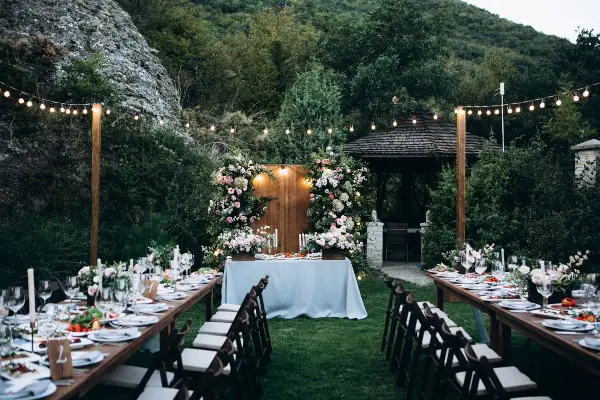
Saturday, 1:45 in the afternoon. Meadow Creek Barn sat on twelve acres of rolling pasture outside Cedar Bluff. White fences, fairy lights strung between oak trees, a gravel path lined with mason jars and wildflowers. Thirty or forty vehicles already in the lot. I smoothed my dress, picked up the gift box, and walked toward the entrance.
I spotted my father Frank first, near the barn’s double doors in a rented suit that didn’t quite fit his shoulders. When he looked up and saw me, his face changed — the polite smile dropped, his eyes went wide then narrow then down to his shoes. He turned and went inside without a word.
I kept walking.
The double doors opened from inside and my mother stepped out. Champagne silk, perfect hair, perfect makeup, jaw set like concrete. She stopped directly in my path, hands clasped in front of her. Not open. Not welcoming. A barricade.
“Athena.” Her voice was low, controlled.
“Hi, Mom. I made it.”
She didn’t hug me. She didn’t step aside.
“What are you doing here?”
“I’m here for Brooke’s wedding.”
“You need to leave now.”
The words landed like a physical thing. I blinked. The gift box felt very heavy. “I flew eighteen hours.”
“Lower your voice. People are watching.”
“Mom, I’m your daughter.”
She stepped closer, close enough that I could smell the Estée Lauder she had worn my entire life. Her voice dropped to a whisper that cut deeper than any shout.
“Only family is allowed inside. You weren’t invited.”
A couple in their sixties walked past, glancing at us. The woman smiled politely. Diane smiled back. The second they passed, her face reset to stone.
“Not invited,” I said. “I signed every contract for this wedding. I paid the deposit.”
“This isn’t about money. This is about what’s appropriate. Athena, please don’t make a scene.”
Through the half-open barn door I could see white chairs in rows, eucalyptus garlands draped from the rafters, a string quartet warming up near the altar. Everything I had funded.
Frank appeared in the doorway. He looked at Diane, then at me, then at the ground. He put his hands in his pockets and said absolutely nothing.
Then a woman’s voice from inside, warm and Southern and confident. “Diane, who’s that? Everything all right?”
Diane’s spine straightened. She pasted on a fresh smile and turned halfway toward the voice.
Margaret Caldwell stepped through the barn doors in a lavender dress and pearls — tall, silver-haired, the kind of woman who runs the church auction and the county fundraiser and has never once been embarrassed in public. She looked at me with an open, expectant expression.
Diane turned on like a switch, her voice going honey-warm. “Oh, it’s nothing, Margaret. Just a distant relative who got the wrong venue. Happens with these big events.”
Distant relative. She said it while looking right at me.
Margaret studied my face. “Oh, I thought you only had one daughter, Diane.”
The silence lasted maybe two seconds. It felt like twenty.
Diane laughed, a bright brittle sound. “I do. She’s a cousin from out of town. Just confused about the schedule.”
Margaret nodded slowly, glanced at me one more time, touched Diane’s arm, and said they should head inside. The ceremony started in ten minutes. The barn doors swung gently behind her.
I looked at my mother. She looked at me. In her eyes there was no guilt, no shame, no flicker of apology. Just fear — raw, cornered animal fear, the kind that comes when a lie you’ve been feeding for months is about to choke you.
“A cousin,” I said.
“Athena, please.”
“You told them you only have one daughter.”
“It’s complicated. You wouldn’t understand.”
“How long? How long have you been telling people I don’t exist?”
She didn’t answer. She glanced toward the parking lot, willing me to disappear.
That was when I understood. She hadn’t forgotten to invite me. She had erased me. And she had been doing it for years.
Every muscle in my body wanted to walk through those doors and announce myself in front of Margaret and Garrett and every guest in that barn. I didn’t. I looked at the barn, at the fairy lights, at the golden glow through the windows. I looked at my mother, still standing in my path like a sentry. I looked at my father’s shadow in the doorway, hands in his pockets, shoulders hunched.
I crouched down and set the gift box on the stone step gently. “Keep the gift. It’s for Brooke.”
Diane’s shoulders dropped half an inch. Relief. She thought it was over.
“Thank you, Athena. This is really—”
I held up one hand. “Don’t explain. Don’t justify. I heard you. I heard every word.”
I turned and walked back down the gravel path, past the mason jars, past the couple still arriving and laughing about the heat, to my rental car. I got in. I closed the door.
Then I cried — not the loud kind, the quiet kind, the kind where your chest shakes but your mouth stays shut because even alone in a parking lot, you have been trained not to make a scene.
Through the open windows I heard the string quartet begin Pachelbel’s Canon. The ceremony was starting. I started the engine and pulled out of the lot. In the rearview mirror, Meadow Creek Barn shrank to a speck of light.
I didn’t slam a single door. I didn’t raise my voice once. I just left. And for the first time, leaving felt like the strongest thing I had ever done.
Back at the Magnolia Inn, still in my dress, mascara smudged, I opened my laptop and read every vendor confirmation in full. Meadow Creek Barn, remaining balance fourteen thousand eight hundred dollars. Southern Comfort Catering, twelve thousand six hundred. Blue Bonnet Floral, six thousand two hundred. Whitaker Photography, four thousand four hundred. Total outstanding: thirty-eight thousand dollars. All due within five business days. All addressed to me. My name. My card number. My signature scanned and attached to each PDF.
I closed the laptop. Sat still. The barn was probably mid-reception by then, Diane hugging Brooke, Garrett spinning his bride on the dance floor, the Caldwells clinking glasses with their new in-laws. All of it happening under contracts signed by someone they had just called a cousin.
My phone rang at 9:47. Aunt Ruth. My mother’s older sister, sixty-two, retired school principal, the kind of woman who says exactly what she thinks and has never once apologized for it. I told her everything. The blocked entrance, the whisper, only family, the word cousin, Margaret’s question, Diane’s answer.
Silence on the line, the kind Ruth takes when she is deciding exactly how angry to be.
“She told them you don’t exist.” Her voice was flat, controlled, like a pot about to boil. “She said she only has one daughter.” A pause. “Athena. Those vendor contracts. Whose name are they under?”
“All of them.”
Ruth went quiet, and when she spoke again her voice had shifted — still angry, but with something harder underneath, something strategic. “Then listen to me, honey. Your mama told a room full of people you don’t exist. You don’t owe that room a single cent.”
Sunday morning I woke to Brooke’s wedding photos on Instagram. First image: the two of them at the altar, the barn glowing gold behind them. Second image: the family portrait. Frank, Diane, Brooke, Garrett, Margaret, and Richard Caldwell. Six people, two families joined, one family short a daughter. The caption: surrounded by everyone who matters.
I looked at the Instagram post. Then I looked at the invoices, already arriving overnight with their cheerful little barn logos and five-day deadlines.
Something shifted. Not a snap, not a burst of rage. Something quieter, like a lock turning, like a door that had been stuck for years finally clicking open.
I was the only person who paid for this wedding. I was the only person not in those photos. I was the only person receiving invoices for a party I had been thrown out of.
Something had to give. And it was not going to be me. Not this time.
Sunday night I sat on the Magnolia Inn bed with my laptop and searched long enough to understand what I needed to understand: the person whose name is on the contract holds the legal obligation, but also holds the authority. I could authorize payment. I could decline it. I could redirect the invoices to the party that received the services.
I picked up my phone and called Meadow Creek Barn.
“Hi. My name is Athena Sinclair. I’m the contract holder for the Caldwell-Sinclair event this past Saturday. I need to inform you that I will not be authorizing the final payment on this contract. I was not present at the event, and I’m formally requesting the outstanding balance be redirected to the event hosts.”
Four calls, twelve minutes total. I didn’t yell. I didn’t threaten. I didn’t explain why. I just said one word, politely and firmly, and I said it four times.
No.
When I was done, I closed my laptop, brushed my teeth, and slept through the night for the first time in two days.
Monday morning I changed my flight home. I packed in ten minutes and checked out before dawn. The same front-desk woman asked how the wedding was. “Memorable,” I said, and drove to Nashville.
On the way, I passed through Cedar Bluff one last time. Past the diner, the hardware store, the church where I was baptized at twelve. Past the house I grew up in, porch light still on. I could picture Diane at the kitchen table still glowing from the reception, Frank reading the paper, leftover wedding cake in the refrigerator, my name not mentioned once.
When I was ten, Diane told me: Athena, you’re the big sister. You have to be strong for Brooke. I’d been strong for twenty-four years. I turned onto the highway and did not look back.
Eighteen hours later I landed at Heathrow. Gray sky, drizzle, the most beautiful weather I had ever seen.
Tuesday at three in the afternoon London time, my phone rang. Mom on the screen. I let it ring three times.
“Athena, hi, honey.” Sweet, light, the voice she uses when she wants something. “How was your flight back?”
“Fine.”
“Good, good. I just got the strangest call from the venue. They said you removed your payment authorization. The bill is $38,000. How do we handle this?”
“We don’t handle it, Mom. You handle it.”
“Excuse me?”
“I removed my authorization because I’m not responsible for an event I wasn’t invited to.”
“Athena, don’t be dramatic. You know this was just a misunderstanding. We can talk about it.”
“You told Margaret Caldwell I was a distant relative. You told her you only have one daughter. That’s not a misunderstanding. That’s a choice.”
The sweetness evaporated.
“After everything I’ve done for you,” she said. “This is how you repay me?”
“You raised me. I’m grateful for that. But you also stood in front of your daughter and told a stranger she doesn’t exist. Those two things can both be true.”
“You’re blowing this out of proportion.”
“$38,000. That’s the proportion.”
She reached for the trump card, the one she always kept in reserve. My father’s health. His blood pressure. If something happened to him.
“Dad stood right there and said nothing,” I said. “He made his choice too.”
She went quiet.
“You said I wasn’t family,” I said. “So the family’s bill is the family’s responsibility.”
The line went dead. She hung up without saying goodbye. I set my phone on the kitchen counter and looked at it. My hands were steady. My heartbeat was normal. The apartment was quiet — really, genuinely quiet for the first time in months.
She called back forty minutes later, all sweetness gone.
“Do you know how humiliating it is to get invoices forwarded to my email with your name crossed out and mine written in?”
“I imagine it’s about as humiliating as being called a cousin at your own sister’s wedding.”
“That is not the same thing.”
“You’re right. Yours costs $38,000.”
She threatened to tell everyone what kind of daughter abandons her family over money. I said go ahead, I’d rather be the daughter she badmouthed than the daughter she pretended didn’t exist.
That stopped her. I heard her pull in a sharp breath.
“You don’t mean that,” she said, quieter.
“I do.”
She hung up again. This time I didn’t stare at the phone. I put the kettle on and made tea.
By Wednesday, the family phone tree was fully activated. Brooke called, crying the big theatrical kind, asking me to cover at least half the balance, promising she’d pay me back. The message was entirely about Brooke’s problems — Garrett’s anger, the loan, the apartment, the Caldwells’ cold shoulders. My pain wasn’t mentioned once. I wrote back carefully: I’m sorry you’re dealing with this. I really am. But I can’t help financially. The boundary I set isn’t about money. It’s about being treated like family. Real family. When you’re ready to talk about that and not invoices, I’m here.
Frank called that afternoon. My father almost never calls. When I heard his voice, it felt strange, like picking up an old tool I had forgotten I owned.
“Athena, your mother is very upset.”
“I know.”
“Can you be flexible on this for the family?”
“Dad, did you know she told people I’m not your daughter?”
A long exhale. Then, very quietly, a click. He hung up too.
Every single one of them hung up when the questions got real. A family that preferred silence to truth.
Aunt Ruth did not wait for permission — she never has. Thursday morning, the same day the invoices were due, Ruth picked up her phone and called Margaret Caldwell directly. She had kept the wedding program.
She told me about it afterward in full detail. She told Margaret there were two daughters, not one. That the older one had signed every vendor contract and then been turned away at the door and called a distant relative. She said the woman Diane had introduced as a cousin from out of town was her firstborn daughter, who had flown eighteen hours and paid the deposit out of her own pocket.
Ruth said the silence on Margaret’s end lasted a full ten seconds.
“Why would Diane do that?” Margaret asked.
Ruth said you’d have to ask her. But that the girl had flown eighteen hours, signed every check, and got turned away like a stranger at the door, and she still didn’t make a scene. More grace than my sister deserves.
Cedar Bluff is the kind of town where everyone knows your business by Tuesday and has an opinion by Wednesday. The story made its way through the Baptist church, the diner on Main Street, the PTA network, and the auto dealership waiting room. The details shifted slightly in each retelling, the way they always do, but the core stayed the same: Diane Sinclair hid her eldest daughter, turned her away at the wedding, and then sent her the bill.
Bev Henderson, Diane’s neighbor of nineteen years, stopped her in the church parking lot after Sunday service. “Diane, I had no idea you had two girls. How come I’ve never met your older daughter?”
Diane tried the script she had been rehearsing. Estranged, she said. Painful subject.
Bev nodded slowly. “Ruth tells it a bit different.”
Diane stopped attending that church. She switched to the Methodist one two towns over, where nobody knew the Sinclairs by name. Garrett confronted Brooke that evening. The newlyweds’ first real fight happened four days into the marriage, over a sister the groom didn’t know existed and a bill neither of them could afford.
Thursday afternoon I sat at my desk in London and systematically closed every open account. Four emails to four vendors, identical language, formally declining authorization and redirecting all outstanding invoices to the Sinclair family of Cedar Bluff, Tennessee. Four replies within the hour. Julie from Meadow Creek even wrote: Understood, Miss Sinclair. We’ve updated our records.
I called my bank next. I canceled the card linked to the contracts and ordered a replacement. The thirty-eight thousand in outstanding charges would now route directly to the people who had thrown the party. The deposits — thirty-five hundred dollars — were gone, non-refundable. I accepted that. Combined with my travel costs and the gift, I was out sixty-three hundred dollars.
I sat with that number. Sixty-three hundred dollars. The price of learning that I was never going to be enough for them. That no amount of signing, paying, flying, or showing up would earn me a seat at a table they had built without a chair for me.
Honestly, it was a bargain.
Friday morning, one last thing. An email to Diane, Frank, and Brooke. Drafted three times, cleaned of every adjective I didn’t need.
I have formally removed my payment authorization from all vendor contracts associated with Brooke’s wedding. The outstanding balance of $38,000 has been redirected to you as the event hosts. I will not be discussing this further. I wish Brooke and Garrett a wonderful marriage. Going forward, please do not contact me regarding financial matters. If any of you want a relationship with me, it starts with honesty, not invoices. Athena.
I read it four times, checked for typos, made sure there was nothing in it that could be called petty or cruel. There wasn’t. It was a boundary, clean as a line on a map.
I hit send, put the kettle on, and stood by the window.
My apartment overlooks a small courtyard with a plane tree that drops its leaves all over the neighbor’s bicycle. It is not much. But I pay the rent. I chose the curtains. Nobody here has ever told me I don’t belong.
Six months have passed. I got promoted — senior software engineer, my boss cited leadership under pressure in the review. She didn’t know the half of it. I started seeing a therapist, not because of the wedding but because of the thirty-four years before it. We have been unpacking what she calls functional over-responsibility: the belief that if I perform well enough, sacrifice enough, carry enough, the people I love will finally see me. It was the engine that powered every check I wrote, every flight I booked, every time I said fine when I meant this hurts.
Diane and Frank have paid twelve thousand of the thirty-eight. They used retirement savings. The rest is on the loan Brooke and Garrett took out. The monthly payments are a source of tension in the new marriage. Ruth says they’re in counseling. She says Garrett is a decent man trying, but the foundation cracked on day one and cracks like that don’t seal easily.
Diane hasn’t called, hasn’t emailed, hasn’t sent a text. Ruth says she refers to the situation as Athena’s tantrum. I suppose that is easier than calling it what it is.
Frank sent me an email a month after the wedding. It was the longest thing he had ever written to me. He said he knew he should have said something at the barn. He said he had stood there like a post while my mother handled it, and he had not opened his mouth. He said he had no good reason. He had been a coward, and that was the truth. He said he was sorry. He said he would carry that.
I read it five times. It didn’t fix anything. He didn’t confront Diane. He didn’t explain the decades of looking away. But it was the first honest thing anyone in my family had said to me since this started. A week later I wrote back: Thank you. That means more than you know. I’m not ready to come home or to pretend everything is fine, but I read your email and I’ll keep reading it.
I left the door open exactly one inch. Not wide enough to walk through, but not locked.
I video call Aunt Ruth every other Sunday. She makes coffee, I make tea, and we talk for an hour about everything and nothing. For the first time, someone in my family said out loud, what happened to you was wrong. That mattered more than she knows.
I don’t hate my mother. I have spent a lot of therapy hours making sure of that. But I have stopped pretending her version of love didn’t hurt. She is flawed and scared. She built an image of a perfect family because the real one felt like it wasn’t enough. And somewhere along the way I became the piece that didn’t fit the frame. That is not an excuse. It is just what happened.
For a long time I called what I was doing duty. I called it family. I called it being the bigger person. But every time I wrote a check, swallowed an insult, or pretended the empty chair at the table didn’t bother me, I lost a small piece of myself.
A boundary is not punishment. It is not revenge. It is the moment you say, I am worth more than this, and then you act like it.
Sixty-three hundred dollars. That is what my clarity cost.
And I don’t regret a single penny I didn’t pay.
I didn’t lose my family at Meadow Creek Barn.
I found myself.
And she was worth the wait.

Lila Hart is a dedicated Digital Archivist and Research Specialist with a keen eye for preserving and curating meaningful content. At TheArchivists, she specializes in organizing and managing digital archives, ensuring that valuable stories and historical moments are accessible for generations to come.
Lila earned her degree in History and Archival Studies from the University of Edinburgh, where she cultivated her passion for documenting the past and preserving cultural heritage. Her expertise lies in combining traditional archival techniques with modern digital tools, allowing her to create comprehensive and engaging collections that resonate with audiences worldwide.
At TheArchivists, Lila is known for her meticulous attention to detail and her ability to uncover hidden gems within extensive archives. Her work is praised for its depth, authenticity, and contribution to the preservation of knowledge in the digital age.
Driven by a commitment to preserving stories that matter, Lila is passionate about exploring the intersection of history and technology. Her goal is to ensure that every piece of content she handles reflects the richness of human experiences and remains a source of inspiration for years to come.