My husband took my camera on a Tuesday morning in April, wearing the same faded hoodie he’d had since before his back gave out. He leaned against the counter with that particular posture he’d developed over the years, the one that said he’d already decided the answer was yes and was just waiting for me to confirm it.
“Going out past Buckeye Lake,” he said. “Thought I’d try to get some bird shots. Practice.”
I looked at him then. Glenn Mercer, 52, smiling like charm was something you could keep using indefinitely regardless of its declining effectiveness. I had a retirement party shoot to edit and coffee that had gone slightly wrong in the machine and a whole morning of work ahead of me. The camera bag sat on the chair by the door where I always kept it.
“That’s my work camera,” I said.
“I know. I’ll be careful.”
I should have said no. What I said instead was that the batteries were charged and he should leave the settings alone. He gave me the grin that had once meant something and walked out the door. I heard the truck back out of the driveway and then I heard nothing except the house settling into its ordinary Tuesday morning quiet.
I went back to my desk in the spare bedroom, which I called my studio when I was being generous and which was technically just a spare bedroom with a monitor and a filing cabinet and seventeen years of accumulated equipment I’d bought piece by piece as the business grew. I was editing photos from Carl Reinhart’s retirement party. Sixty-five years old and finally done with a job he’d spent forty years tolerating, his wife grabbing his hand outside the banquet hall with an expression that told you everything about what they were both feeling. Those are the moments I’m good at catching. The ones that happen in the half-second before people remember the camera is there and compose themselves.
Around noon the laptop pinged. Adobe Cloud syncing. Glenn had the camera, so the files uploading made sense. I clicked over out of habit more than anything, the way you check your phone without deciding to.
First photo: Glenn, standing somewhere that was not Buckeye Lake.
Second photo: A wide shot of dirt and scrap metal and a chain-link fence with a warning sign I couldn’t fully read at the resolution.
Third photo: A pile of equipment. Not fishing gear. Something industrial, heavy, the kind of machinery you see in the background of farm country and don’t think about.
My stomach went tight before my brain caught up to why.
Fourth photo: A man kneeling with his hands pulled behind his back.
I said no out loud, quietly, to no one, the way you talk to yourself when your mind is trying to reject what your eyes are telling it. The word didn’t help. The photo didn’t change.
Fifth photo: Glenn holding a beer, smiling at the camera with the relaxed ease of a man at a cookout.
I sat with that one for longer than the others because the expression on his face was specific and important. It wasn’t fear. It wasn’t confusion or even guilt. He looked pleased with himself. He looked proud.
I kept clicking. Each image was worse than the last. Faces I didn’t know. License plates photographed at close range. Documentation that made no sense unless you were either very stupid or very confident you were never going to get caught. I heard myself telling myself I was overreacting. I heard myself say I didn’t know what I was looking at. I clicked through three more photos while I was saying these things.
That’s the thing about truth. You can narrate yourself away from it for a while, but the images keep being what they are.
I pushed back from the desk so hard my chair hit the wall. Grabbed the laptop. Grabbed my keys. Walked out the front door and stood in the driveway in the April air and almost turned around. Almost went back in and finished editing Carl’s retirement photos and waited for Glenn to come home and explain everything in that easy, dismissive way he’d explained things for fifteen years.
Something in my chest said no. I got in the car.
The drive downtown felt longer than the actual distance. Every red light held. My hands shook against the wheel and I kept tightening my grip as if grip were the issue. The Columbus Police station on South High Street smelled like burnt coffee and old paper when I walked in, and the officer at the desk gave me the look people give when they expect to be told something they’ll have to file politely and forget about.
“I need you to look at something,” I said.
He leaned forward when I opened the laptop. His expression changed as he scrolled. His shoulders came up and his voice went tight in the way of someone shifting from one gear into another.
He came back a minute later with a detective named Harris. Late fifties, plain clothes, the kind of face that had seen enough to stop showing most of what it was thinking. He looked at the screen. He looked at me.
“What’s your name?”
“Dana Mercer.”
“Who took these?”
“My husband.”
He studied the photo of Glenn with the beer. Then he looked at me for a long time, the way someone looks when they’re deciding how much to tell you.
“Mrs. Mercer,” he said slowly. “This isn’t just about your marriage anymore.”
They put me in an interview room that smelled like old carpet and something chemical. Harris sat across from me and listened to the whole thing without interrupting. When I mentioned Buckeye Lake he exchanged a look with the younger officer at the door. When I mentioned a name I’d seen on a receipt once, Ricky Sllo, tucked into Glenn’s jeans when I’d emptied them for the wash, something in Harris’s expression shifted. Not surprise. Recognition.
He told me they’d been looking into reports in Fairfield County. Missing farm equipment. Illegal dumping. Threats made to landowners who’d asked questions. The man kneeling in the photograph was someone they didn’t yet have a name for.
Then he asked whether Glenn knew the photos synced to my cloud automatically.
No. That answer came fast and certain, and I could hear how certain it was.
Harris said good. He said it like a door clicking into place.
They asked me about Glenn’s schedule and his habits and whether he kept a second phone. I thought about the garage freezer, the old coffee can behind the bag of frozen peas. I mentioned it. The younger officer shifted his weight.
Then Harris told me to go home and act normal. Don’t confront him. Let things continue long enough to build something solid.
I stared at him. “You want me to sit across from him at dinner,” I said. “Knowing what I know.”
“Men like your husband,” Harris said, “count on the people close to them either staying quiet forever or confronting them too soon. Either one gives him room to maneuver.”
He was right, and I hated that he was right because it meant Glenn had anticipated me. Had counted on me. Had spent fifteen years correctly predicting how I’d respond to things.
“Okay,” I said.
I drove home. I sat in the car in my own driveway for five minutes looking at the front door. Then I went inside.
The house smelled like fried food and Glenn was in the kitchen cracking open a beer. He turned around with that easy grin and told me about the bass the size of my arm he’d caught out at Buckeye. His hands were clean. No dirt under the fingernails, no smell of lake water. There was machine oil somewhere on him, faint but there, and underneath it something else. Cheap perfume, sweet and specific.
I nodded and said that sounded exciting. Inside my head I said something else entirely. He tried to close the distance between us and something in my face stopped him and he asked if I’d had a long day and I said yes and we slid back into the ordinary shape of ourselves, except now I knew the shape was a performance and I was the only one who knew I knew.
That night I lay in the dark listening to him breathe and counted my breaths and told myself over and over to stay still.
The next morning I went to see Marsha Klein.
I found her through a referral from a woman in my church circle who’d been through a different version of this story four years earlier and come out the other side. Marsha was maybe ten years older than me, sharp-eyed, the kind of woman who had seen every variety of this situation and understood exactly how each variety ended. She listened to what I told her without visible reaction, which was itself a form of steadiness.
Separate your accounts, she said. Secure your client records. Document ownership of every piece of equipment with serial numbers and original receipts if you have them. Don’t confront him. Don’t warn him.
Men like this, she said, looking at me directly, rely on women being too overwhelmed to think clearly.
I’m not overwhelmed, I told her.
She gave a small, knowing smile. Good. Then you’re ahead of most.
I spent the rest of that day building the walls that should have been there already. New business account. New passwords on everything, email and cloud storage and invoicing software, passwords he’d never guess because I used names and dates that meant something to me from before I knew him. Each one felt like recovering something. That afternoon I drove to my sister Karen’s place in Westerville with two camera bodies and three lenses in a bag.
She opened the door, looked at my face, and didn’t ask questions.
Store these, I told her. Don’t mention it.
You’re scaring me, she said.
Good, I said. That means I’m finally paying attention.
Two days later I found the flyer on the kitchen counter, tucked under a stack of mail. Spring Sportsman’s Banquet. Fundraiser, community event, local vendors and sponsors listed in clean print. And there, listed like it was something he owned: Dana Mercer Photography, Supporting Sponsor.
I sat down.
I sat there for a long time with that flyer in my hands.
He hadn’t just lied. He hadn’t just cheated. He had put my name on his life like it was a shirt he could wear. He had used the reputation I’d spent fifteen years building, the name that meant something to the families I’d photographed and the churches I’d worked with and the retirement parties where I’d caught the moments that mattered, and he’d attached it to whatever he was doing out there in Fairfield County with men kneeling in the dirt.
I called Detective Harris.
The banquet hall was one of those multi-purpose rooms outside Columbus that hosts everything from wedding receptions to fundraiser breakfasts. I’d photographed there before and I knew exactly how the light hit the walls at six in the evening, soft and yellow and forgiving in a way that made everything look more wholesome than it sometimes was.
I sat in the parking lot for a while before I went in. My hands were on the wheel but they weren’t shaking. That was new. I’d been shaking since Tuesday morning and now, at the moment that should have been the most frightening, my hands were steady.
Navy blazer. Simple earrings. Lipstick but not too much. I looked like myself. A slightly more deliberate version of myself, maybe.
You don’t have to make a scene, I said to the woman in the rearview mirror. You just have to tell the truth.
Inside the hall smelled like community event coffee from the big silver urns and something fried and the cleaning solution that every facility like this one uses in such quantity that it becomes part of the air. Rows of folding chairs and round tables with plastic centerpieces. Men in pressed flannel shirts trying to look official. Women with their small-town radar running at full frequency, taking in everything without appearing to.
Glenn stood near the front in a button-down shirt I hadn’t seen in months, clean and tucked in, telling some story that had his listener laughing. Trina was there too, half a step behind him in a puffy vest and tight jeans, her hair lacquered into place. She had the look of someone who doesn’t quite know where she belongs but has decided proximity to Glenn was the best available answer.
I walked over. Glenn spotted me and waved with that broad smile of his.
“There she is,” he said. “Wouldn’t miss it.” As if he’d told me about this and I’d said I’d come.
Trina gave me a smile so tight it could have cracked.
Glenn put his hand on my shoulder, heavier than necessary.
“Told everyone you’d be here. Big supporter tonight.”
I glanced at the printed program on the table. My name. His claim.
“That’s what you told them?” I asked.
He didn’t catch the tone or chose not to.
We sat. The room filled in around us and the event began with the usual announcements and thank-yous and a man near the podium talking about community and hard work in the way of someone who practiced it in a mirror. Then Glenn stood up and walked to the front like a man stepping onto a stage he’d built himself and told the room about hard work and second chances and doing right by your neighbors, and people nodded and someone toward the back clapped when he finished.
Then the organizer began listing the sponsors. The hardware store. The feed supplier. Dana Mercer Photography.
I stood up.
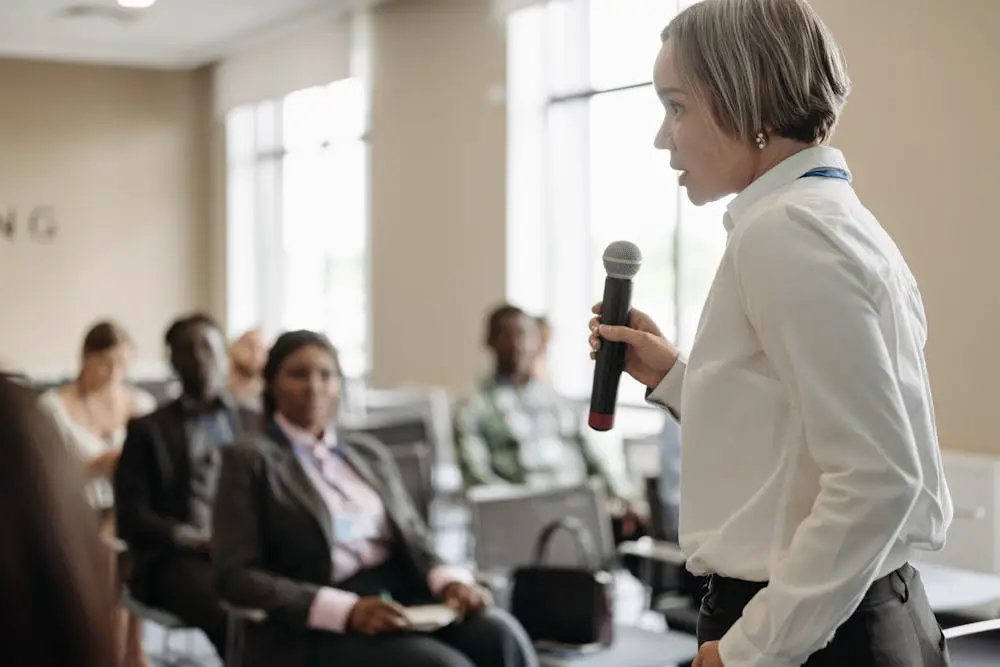
Every movement was deliberate. I walked to the front and took the microphone from the organizer, who smiled expecting a thank-you speech.
The room looked back at me. My name on the program. Glenn’s arm around my identity for years, wearing it like something he’d found.
I told them my name. I told them I ran a photography business in Columbus and that some of them had probably seen my work at church events and family occasions. A few people nodded. I said I was proud to support causes that helped real people, and that tonight I wanted to share something that showed just how hard my husband had been working for this community.
The pause was small. Maybe two seconds. I heard Glenn shift behind me.
Someone at the projector table looked uncertain and then glanced toward the doors, where I could see two officers standing, waiting, the way Harris had said they would be.
The screen came to life.
First photo: Glenn, not at a lake.
Second: the yard, the chain-link fence, the industrial equipment.
A murmur started in the room like something waking up.
Third photo: the man on his knees.
Someone said what the hell.
Fourth: Glenn with his beer, pleased with himself in the afternoon light.
A man near the front recognized something in the background and said that was his neighbor’s tractor. People were talking now, voices layering over each other, turning toward Glenn, turning toward me, turning toward each other.
Glenn stepped forward with his hands raised.
“These are just insurance photos,” he said.
A man near the front asked why you’d hold a beer for an insurance photo.
A few people laughed. The sharp kind.
“You don’t understand,” Glenn said. His voice had lost its carrying quality. It was smaller than I’d heard it in a long time.
“No,” I said into the microphone. Quiet. Steady. “They do.”
The room went still.
The officers moved from the back, walking up the aisle with the unhurried confidence of people who have all the time they need. Glenn turned and saw them and for the first time in the fifteen years I’d known him I saw something on his face that wasn’t performance. Something real and unguarded and afraid.
“Dana,” he said. Like my name could undo it.
I looked at him and didn’t look away.
“Don’t,” I said.
The handcuffs made a sound that cut through everything else in the room.
They led him past me close enough that I could see the sweat on his forehead and the way his eyes kept moving, still looking for the angle, still trying to find the thing to say that would reframe this. There was nothing. He’d used my name to cover himself, and my name had been the thing that brought him here.
I stood at the front of that room with the microphone still in my hand and the image of him still on the screen and I said the only thing that felt true and necessary.
“Don’t ever use my name to hide what you are.”
The room was very quiet.
Then it wasn’t, because that’s what rooms do.
The house was different the next morning. Not peaceful, exactly. Just emptied of a particular kind of noise I hadn’t realized I’d been living inside. The television wasn’t on for no reason. No half-finished sentences drifting in from another room. The fridge hummed and the clock ticked over the stove and my own footsteps on the hardwood sounded different when there was no one else to absorb them.
I made coffee in the same Keurig that still tasted wrong and drank it standing at the counter where the flyer had been.
Detective Harris called around nine.
You all right? he asked.
I thought about it honestly. Yeah, I said. I think so.
He told me the photos had helped more than I probably realized. He said it would take time, interviews and charges and the slow machinery of consequence. He said I’d done my part.
Done your part. I turned that phrase over for a while after I hung up.
Because my part, for so long, had been the other thing. Keeping the peace. Smoothing the edges. Making the version of events that let everyone stay comfortable, including me, hold together a little longer. This felt entirely different from that.
I walked through the house slowly that morning, room by room. Not looking for traces of him. Looking at what was mine. The dining table I’d found on sale in 2012 and driven home with Karen because we couldn’t fit it in either of our cars without the back seats folded down. The couch we’d argued over for a week before agreeing on it. The framed prints on the walls, families I’d photographed over the years, smiling into futures they believed in.
I went into the laundry room, closed the door, and let myself cry. Not loudly. Just the tired kind, the kind that comes from holding everything in for longer than it was meant to be held. It didn’t last long. Nothing does.
By early afternoon I was back at my desk. Emails. Invoices. A message from a church client that asked if I was still on for Saturday given everything they’d heard. I stared at it for a moment.
Then I wrote back: I’ll be there.
Because that’s the thing about life. It doesn’t wait for you to feel ready. It shifts and you shift with it or you don’t, and the only real choice is which direction you shift.
Karen came by with groceries I hadn’t asked for. She looked around the house and didn’t say anything dramatic, which was the right call. We spent an hour boxing up Glenn’s things. His clothes and his boots and that old hoodie that had been on his back more or less continuously for three years. I folded everything neatly, not out of tenderness but because neatness felt like control, felt like decisions made deliberately rather than frantically.
Karen held up a shirt at one point and asked if I wanted to keep anything for the memories.
I don’t need more of those, I told her.
The lawyer filed the paperwork later that week. Accounts properly separated, not in concept but on paper, documented and real. I gathered everything tied to the business. Contracts. Receipts. Serial numbers for every piece of equipment, the cameras and the lenses and the lighting rigs and the drives. Things I should have organized years ago but hadn’t, because organizing them would have required acknowledging that they needed protection, and acknowledging that would have meant seeing things I’d found it easier not to see.
People talked. Neighbors dropped their voices when I came into range. There were looks at the grocery store. One woman at church touched my arm before the service and said, honey, everybody knows who the fool was, and I smiled because she was right and because there was a particular freedom in not having to explain anything.
A week after the banquet, Harris called to say I could pick up the camera from the station. The memory card had to stay with them as evidence, which I understood. I drove over and collected it and sat in the car afterward holding it in both hands. It was heavier than I remembered, or I was different enough that the weight registered differently.
I drove out to a park near Westerville the following Saturday morning. Nothing special about it. A patch of grass, a small pond, a few benches. A grandfather was there teaching a little girl to fish. He wasn’t doing it well, from what I could observe. The line kept tangling. The girl kept laughing about it, which seemed to be entirely the point.
I watched them for a few minutes from a bench nearby. Real and simple. No performance. Nobody trying to be anything other than what they were.
I reached into my bag and took out the new memory card I’d bought the day before, still in its packaging. Slid it into the camera. Held the camera for a moment. Then I pressed the button to format the card. The screen asked me to confirm and I confirmed. Clean. Empty. Ready.
I lifted the camera and found them in the frame. The grandfather shaking his head at the tangled line. The girl with her whole face open and laughing, not at the failure but at the whole business of being here, trying something, it going wrong in a harmless way.
I pressed the shutter.
The sound was clean.
Just that one sound, and then the world continuing.
I lowered the camera and looked at the little girl dragging the line out of the water and holding up something I couldn’t see from where I sat, lifting it for her grandfather to inspect with the seriousness of someone who has just discovered something remarkable about the world. He leaned down to look.
I didn’t get my old life back. I understand now that this wasn’t a loss. The old life had been built around a fundamental misunderstanding, which was that keeping things intact was the same thing as keeping things true. I had been very good at intact. I had been so good at it that I had spent fifteen years telling myself the cracks weren’t cracks, they were just the natural texture of a life.
The crack in Glenn’s coffee can in the garage freezer. The crack in the explanations that never quite added up. The crack in his voice when he said things like you’re still messing around with those picture jobs, that small corrosive thing he’d said for years in doorways while I was working, as if the work that paid for a significant portion of our shared life was a hobby I’d never quite outgrown.
What I had now instead was simpler and harder and entirely mine. The house that was actually my house, documented and filed. The business that was actually my business, protected and organized. The name that was actually my name, no longer on loan to someone else’s story.
Karen called that evening to check on me. We talked for a while about nothing specific, the way you talk when the specific things are still too large to hold all at once and the ordinary conversation is itself a kind of comfort. Before she hung up she said she was proud of me. I said thank you and meant it and then I said goodnight and set the phone on the counter.
The house was quiet. The fridge hummed. The clock above the stove kept its own time.
I made dinner for one and ate it at the dining table I’d driven home with Karen years ago, back when I could not have told you what I was protecting it from. I ate slowly and looked at the framed photos on the opposite wall, a family from a Christmas shoot three years ago, everyone slightly blurry because the youngest one had started running toward me at the exact moment I pressed the shutter and everyone else had turned to watch. It had turned out to be the best photo from the session. The blurry one. The unexpected one.
Some things only resolve right when they stop being controlled.
I washed the dishes and left them to dry and turned off the kitchen light and walked through the quiet house to bed. The sheets were clean. The room was mine in the way rooms become yours when you’ve cleared them of everything that doesn’t belong.
I lay there in the dark and thought about the grandfather and the girl and the tangled line and the thing she’d held up to show him that I hadn’t been able to see from the bench. I thought about pressing the shutter and the sound it made. Clean and without history. Just that moment, and the one that came after.
I closed my eyes.
Outside, somewhere down the street, a car passed and its headlights moved across the ceiling and kept moving.
The house was quiet.
It was mine.

Laura Bennett writes about complicated family dynamics, difficult conversations, and the quiet moments that change everything. Her stories focus on real-life tensions — inheritance disputes, strained marriages, loyalty tests — and the strength people find when they finally speak up. She believes the smallest decisions often carry the biggest consequences.