The day of Daniel’s funeral, I wore the dress he had liked on me most: plain black, modest at the collar, ending just below the knee. I had chosen it without thinking, which told me everything about the state I was in. Grief does that. It reduces you to muscle memory, to the choices your hands make before your mind can interfere.
Noah wore a suit that was slightly too large for him. I had bought it in a rush the day before and had not noticed until we were already in the car. He did not complain. He sat beside me in the back seat, looking out the window at the gray morning sky, and said nothing. He had not said much since the night the police came to our door. He was eight years old and he had held my hand while the officer spoke, and when the officer left, Noah had gone to his room and sat on his bed in the dark until I came in and lay down next to him. We had stayed like that for a long time, both of us staring at the ceiling, neither of us able to speak the thing that was sitting in the room with us.
His father was gone. The center of our small, warm world had simply stopped existing, and nothing else had the right language for it.
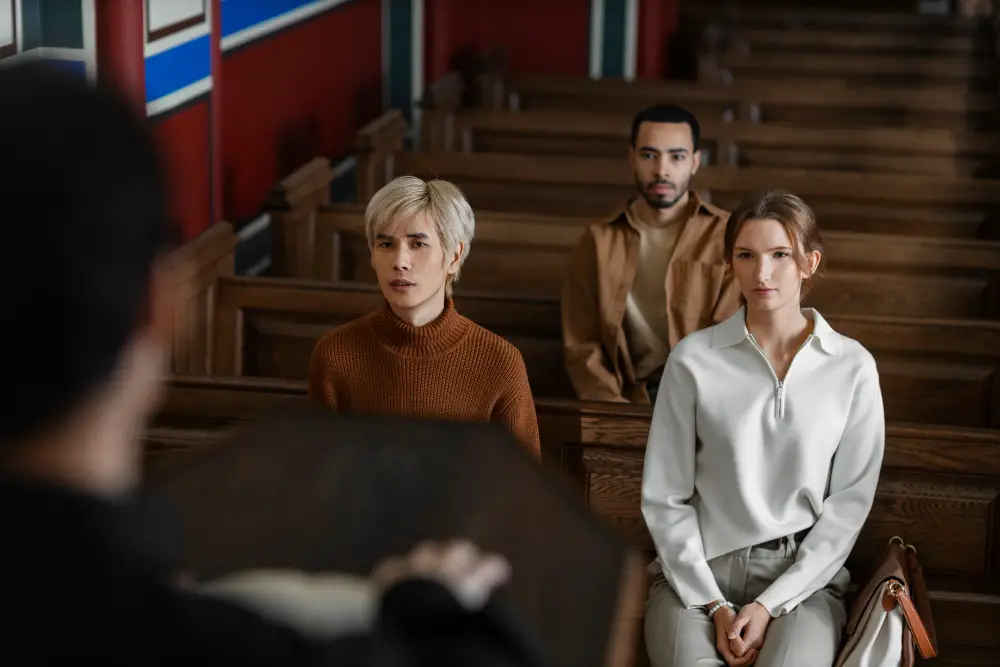
The chapel was already full when we arrived. I recognized most of the faces. Daniel’s extended family had come from three states, the kind of people who only gathered for weddings and funerals and always managed to make both feel the same. His colleagues filled the back rows, good people who had sent food to the house and then, wisely, left us alone. There were neighbors. Old friends. A handful of people I had never seen before, which I thought was a strange and lovely thing about a person’s life, that they always touched more of it than you knew.
Vivian was near the casket when we walked in.
She saw me and did not look away. That was always how she operated: the sustained stare, the refusal to blink first. In twenty-one years of knowing her, I had never once won that particular contest, and I had long since decided it was not one worth playing. I guided Noah to the front pew and sat down and folded my hands in my lap and looked forward at my husband’s casket, at the navy tie I had chosen for our anniversary dinner three weeks before the accident. He had tugged at it all through dinner, complained that it was strangling him, and then left it on every time I asked him to take it off because he knew it made me laugh.
I had not laughed since.
Vivian waited until the pastor finished the opening prayer. She had a sense for silence, for the exact moment when it could be broken to maximum effect. She stepped slightly forward, positioned herself so that her voice would carry without appearing to try, and said, in a tone of absolute composure, “Better he is gone now than forced to live with the embarrassment she brought him.”
The words landed the way she intended them to. Like stones dropped into still water, sending ripples outward through the pews.
Aunt Marlene, who had never once looked at me without suspicion, dipped her head. Two of Daniel’s cousins exchanged a glance. Someone in the third row, a man I recognized as an old golfing friend of Daniel’s father, whispered something I could not hear but did not need to.
Noah’s hand tightened slightly on the armrest between us.
I breathed.
Vivian was wearing pearls. She always wore pearls at important occasions, as if grief were a performance that required costuming. Her dark dress was pressed and perfectly fitted, her hair immaculate despite everything. She held a handkerchief she had not yet used. It was a prop, like all of her.
“She came into this family with nothing,” Vivian continued, and now her voice had the quality of something rehearsed, fluid and certain. “Daniel gave her a home, a name, a life. And how did she repay him? Secrets. Shame. Humiliation.”
Grant was standing just behind her, arms folded across his chest. He wore solemnity like a costume that did not quite fit. He had called me five days after Daniel’s death to ask about the life insurance policy, phrasing the question in the language of concern, talking about financial arrangements and next steps as if we were discussing a business matter that had become inconveniently entangled with emotion. I had told him I did not know the details yet and that I would be in touch, and I had ended the call and stood in my kitchen for a very long time, holding the phone.
Now he stood behind his mother and watched me with the particular expression of a man who believes he has already won.
Vivian’s eyes found mine across the chapel. She wanted something from me. A flinch, a trembling lip, tears I could not contain. She wanted me to shatter publicly and completely, so that every person in that room would see it and carry the image home with them. She wanted to bury me alongside Daniel without requiring a grave.
I gave her nothing.
That was its own small victory, though I took no pleasure in it.
“You should be grateful,” she said, lower now, pitched for the front rows, “that we are allowing you to sit with the family.”
I heard Noah move beside me.
I thought at first that he was shifting in his seat, the way children do when they have been still for too long. But when I glanced at him, I saw that he was not fidgeting. He was holding something. His father’s phone, gripped in both small hands, his knuckles whitening slightly from the effort of keeping it steady. His face was still the face of a child, soft and round at the jaw, and his eyes were dark and calm in the way that Daniel’s had been dark and calm when he was thinking something through.
“Noah,” I said quietly.
He stood up.
The entire chapel turned to look at him. He was small in his too-large suit, standing in the front pew of his father’s funeral, and he was looking directly at his grandmother with an expression I had not seen on his face before.
“Grandma,” he said, and his voice did not waver, “do you want me to play the recording Dad made about you last week?”
The silence that followed was the completest silence I have ever heard in a room full of people.
Vivian’s composure did not hold. I watched it collapse in real time, the color leaving her face in a single wave, her mouth parting and then closing, her hand moving instinctively to her pearls. Beside her, Grant’s jaw went rigid.
Vivian recovered herself with the speed of a person who has spent decades managing appearances. She stretched her expression into something soft and reached toward Noah with the careful patience of a woman addressing a confused child.
“Noah, sweetheart,” she said, drawing his name out gently, “sit down. This is not the time for games.”
“It is not a game,” Noah said.
Grant moved. He stepped around his mother, arm extended, reaching for the phone.
I stood before he could get to my son.
One step was enough. Grant stopped.
He had always believed I was without backbone. I was the woman who let Daniel handle his family dinners, who smiled at Vivian’s comments about my cooking and my accent and my education, who never raised her voice, who never argued, who seemed, from the outside, to accept everything. He had mistaken my patience for weakness, which was a very common mistake made by people who had never had to be patient about anything important.
“No one touches my son,” I said.
The words were quiet. They were also, somehow, final.
Vivian’s eyes narrowed. “Careful, Elena. You have already caused enough damage.”
Damage. It was their preferred word for me, the one they had been using for two months in every conversation I was not present for. They had told Daniel’s relatives that I had been unfaithful and that Daniel had discovered it and that the discovery had broken something in him, driven him reckless, sent him speeding on a wet road in the dark. They had told neighbors that I had been moving money. They had called someone at his company and raised questions about whether I could be trusted with documents related to his estate.
What they had not accounted for was Daniel.
He had come home six days before he died. He came in through the back door instead of the front, which was unusual, and he set a folder down on the kitchen table and stood there for a moment just looking at me, and I could see from the color of his face that something was seriously wrong.
He sat down and told me everything.
Loans in his name that he had never applied for. Forged signatures. A shell company that Grant had incorporated using Daniel’s personal and financial information, structured so that if anyone looked closely enough, the liability would travel upward, past Grant, to Daniel himself. And past Daniel, because Daniel was beyond blame in the version they were building, the liability would land on his wife. The foreigner. The outsider. The woman who had married into a family she did not deserve.
I remembered sitting across from him at that kitchen table and feeling something strange move through me. Not fear exactly, though fear was present. Something older and colder, the feeling of recognizing a shape you had always sensed in the dark without ever being able to name it.
“They chose you because you are the outsider,” Daniel said. “Because if this falls apart, no one will look too hard for another explanation.”
He went to see a lawyer the next morning.
Her name was Claire Donovan, and she was thorough and unhurried and she had seen this particular configuration of dishonesty before, which was both reassuring and depressing. Daniel spent four hours with her. He came home and ate dinner with us and helped Noah with a school project about the solar system and put him to bed and then sat up with me in the kitchen until past midnight going through everything. He was calm in the way he always was when he had made a decision he was sure of.
Three days later, he was dead.
Brake failure on a wet road. The police had been thorough and had found no evidence of interference. I had no reason to believe they were wrong. I had also, in the weeks since, developed a relationship with uncertainty that I had not had before, a new awareness of how much space exists between what cannot be proven and what is actually true.
I did not say any of this in the chapel. I did not need to say it yet.
What I said was, “Uglier than stealing from your dead brother?”
Grant’s face went white and then red in the space of a breath.
Vivian said, sharply, “You have no idea what you are talking about.”
“I am a forensic accountant, Vivian.”
The rain had started while we were inside. I could hear it now, light and steady against the stained-glass windows, filling the space where conversation had been.
Most of Daniel’s family knew I worked in finance. They knew it the way people know peripheral facts about relatives they have decided not to be interested in: as a category, a general classification, something that meant I worked with numbers and was therefore probably boring at dinner parties. No one had ever asked me what I actually did. Vivian had certainly never asked. She had constructed a version of me in which asking would have been beside the point. Her version of me did not have a career that mattered. Her version of me was a problem that Daniel had imported into the family.
The truth was that for eleven years I had worked in fraud investigation. Banks retained me. Estate attorneys retained me. Corporate litigation teams retained me. I had spent more than a decade learning to read financial documents the way other people read faces: for what they revealed despite themselves, for the places where the story had been edited and the edits had not quite closed over cleanly.
When Daniel showed me the folder that night at the kitchen table, I had understood what I was looking at before he finished his first sentence.
“I know exactly what I am talking about,” I said.
Grant laughed, a short and ugly sound. “This is insane.”
“Three business loans in Daniel’s name, none of which he applied for. Wire transfers moved through a charitable foundation that Grant incorporated eighteen months ago. Emails requesting that Daniel absorb the debt temporarily while alternative arrangements were made. And beneficiary forms on two of Daniel’s accounts that were updated without his knowledge eight months before his death.”
Vivian’s hand flew to her pearls.
Aunt Marlene said, in a voice that was barely a voice, “Vivian?”
“Be quiet,” Vivian said.
It was a single command and she delivered it without thinking, reflexively, because Marlene had always been someone who could be commanded and Vivian had always been someone who commanded. But the room heard it. The room heard the mask drop in that one unguarded moment, the grief and the pearls and the handkerchief all falling away to reveal the woman underneath, and the woman underneath was not someone in mourning. She was someone managing a situation.
Then Daniel’s phone buzzed in my hand.
I looked down at it. The screen showed a scheduled message notification, timestamped for this morning, this hour, almost this exact minute, as if he had known.
For Elena. If they try it at the funeral, play this.
My throat closed around something I did not have words for.
Even in death, he had known them better than I did.
I pressed play. I held the phone up and I pressed play, and Daniel’s voice came out of that small speaker and filled the chapel from the front pew to the back wall, and every person in that room went absolutely still.
His voice was tired. It was the voice of a man who had not been sleeping well, which he had not been, in those last days. But it was also, unmistakably, his voice, and hearing it was like a door opening onto something that had been sealed shut for two months.
“If you are hearing this,” Daniel said, “then my mother decided grief was not enough and went ahead and tried to destroy Elena while standing next to my casket. Which means she has not changed at all, and I was right not to expect that she would.”
A sound moved through the chapel. Not a gasp exactly. Something quieter and more complicated.
“I know about the loans,” Daniel continued. “I know about Grant’s gambling situation and the amounts involved. I know that you used my company login credentials while I was traveling in Denver last spring. I know that you forged Elena’s name on a transfer authorization because you calculated that if the whole arrangement collapsed, everyone would believe she was the one who was greedy. She is the outsider. That was always the logic.”
Grant moved. Two of Daniel’s colleagues from the back of the chapel moved faster and positioned themselves before he could reach me, and Grant stopped, his face a color I had not seen on a person before.
“I met with Attorney Claire Donovan,” the recording continued. “She has copies of everything. The bank’s fraud investigation unit has copies. Detective Harris has copies. Elena does not need to prove anything at this point. I have already done it. She just needs to stay standing long enough for the right people to arrive.”
Vivian said, “Turn it off.” Her voice had lost all its shape.
I did not turn it off.
There was a pause in the recording, a breath, and then Daniel’s voice softened into something that was addressed only to us, that existed in that room for Noah and me and no one else, though everyone heard it.
“Elena, I am sorry it took me too long to see what was happening. I should have protected you better and I did not and I am sorry for that. Noah, if you are there, hold your mom’s hand. She is stronger than all of them. I need you both to know that.”
Noah put his hand in mine.
That was the moment I came closest to breaking entirely. I held his small hand and I breathed and I did not look at anyone except the floor.
Vivian spoke into the silence that followed.
“She made this,” she said. “She fabricated this. She had access to his devices and she has spent two months building a case against us because she knew we were close to the truth about her.”
The chapel doors opened.
Claire Donovan walked in wearing a black coat, her expression neutral and professional in the way of someone who had seen a great many rooms that looked like this one. Detective Harris was beside her. Behind them, two uniformed officers waited near the entrance, making no particular effort to be inconspicuous.
Claire stopped near the front pew. She glanced briefly at the casket. Then she looked at Vivian.
“Mrs. Whitmore,” she said. “Grant. I would strongly advise both of you not to say anything further without an attorney present.”
Grant said, with what remained of his composure, “At my brother’s funeral? You are doing this at my brother’s funeral?”
Detective Harris looked at Daniel’s casket for a moment before he answered. “That is the only reason we waited outside as long as we did.”
I opened the folder from the safe. It was the same folder Daniel had brought home that evening, organized in the precise way that Daniel organized everything: chronologically, clearly labeled, nothing ambiguous or out of place. I handed it to Claire and she began to read from it, not all of it, but enough, her voice carrying through the chapel with the flat authority of someone reading a legal document, which was what it was.
The loan applications with Daniel’s signature, compared against the signature on file with his bank. The wire transfer records. The emails, including one from Grant to Daniel that read, in part, that Elena was perfect for this because no one would question a woman who married above her station suddenly having access to money she felt entitled to. A series of messages between Grant and Vivian discussing the beneficiary changes, discussing timelines, discussing what they called contingencies.
Aunt Marlene had her hand over her mouth.
Grant’s wife, who had been sitting three pews back, stood up quietly and walked out of the chapel without looking at anyone.
Vivian had been standing very still throughout all of this, the kind of stillness that precedes a certain kind of collapse. When she finally spoke, it was with the desperate clarity of someone who has run out of strategies.
“We did this for the family,” she said. “Everything we did was for this family.”
“You did it because Daniel stopped paying your debts,” I said. “And because you thought I was the easiest person in his life to make disappear.”
Detective Harris stepped forward. He was a careful, quiet man who had been thoughtful with me in the weeks following Daniel’s death, professional in a way that had cost him something. He read them their rights in the language required by law and then the handcuffs appeared and the sounds they made were the only sounds in the room.
Vivian screamed. Not from pain. From the specific indignation of a person who had arranged their entire life so that consequences would always fall on someone else, and who found themselves, at the end of that arrangement, standing in their son’s funeral holding the weight of everything they had built.
Grant said my name as they led him out, said it like a curse, and then the doors closed and the chapel was quiet again and everyone who remained was either very still or very carefully not looking at anyone else.
Outside, the rain had stopped.
Three months later, Daniel’s estate was settled. The house and his shares in trust went to Noah and me, exactly as he had intended. Vivian was removed from every relevant document after the evidentiary review was complete. Grant accepted a plea deal that involved a number of years of his life and a debt he would be paying for longer than that. Vivian refused to accept a deal and chose instead to litigate, which cost her what remained of her resources and did not change the outcome. The judge sentenced her to a term that surprised even me with its length, and ordered restitution, and froze her accounts, and the charity dissolved and the house she had loved more than anything in it was sold to cover what she owed.
Her friends did not write to her. The relatives who had nodded at her words in the chapel did not visit. The pearls were sold with everything else.
I did not feel the satisfaction I had thought I might feel when all of it was finished. What I felt was something more like the absence of weight, the unfamiliar lightness of a body that has been braced against something for so long that it has forgotten what it is like to simply stand.
Noah and I moved in late autumn, to a smaller house closer to the coast. The mornings there smelled of salt and something clean that I did not have a name for. Noah started at a new school and made a friend within the first week, a boy named Marcus who shared his interest in building things. They spent their afternoons in the backyard constructing increasingly complicated structures out of wood and whatever else they could find, and I would watch them through the kitchen window while I made dinner and feel something that was not quite happiness yet but was moving in that direction.
On Daniel’s birthday, Noah and I drove to the shore in the early morning, before the beach was crowded. The sky was the pale grey-pink of something beginning, and the water was flat and dark and endless, and the sand was cold beneath our bare feet. Noah was carrying something he had made in his woodworking class at school, a small boat he had shaped from a single piece of pine, painted blue, with a name written along the hull in careful letters that I had to lean in to read.
He waded into the shallow water and set it down on the surface and let it go.
We watched it move away from us, caught by something subtle in the current, drifting outward until it was small and then smaller and then gone.
Noah was quiet for a long time. The waves came in around our ankles and retreated, came in and retreated.
“Do you think he saw?” he asked.
I looked out at the place where the boat had been.
I thought about the night Daniel had come home with the folder and sat across from me at the kitchen table. I thought about how he had looked at me then, the steadiness in his face that was not the steadiness of a man who was not afraid but the steadiness of a man who had decided what mattered more than fear. I thought about a voice coming out of a small phone speaker in a chapel full of people, tired and certain and full of something that sounded, even then, like love.
I squeezed Noah’s hand.
“Yes,” I said. “And I think he is proud of you.”
Noah did not say anything. But after a moment, he leaned slightly into my side the way he used to do when he was very small, and I put my arm around him, and we stood there together at the edge of the water while the sun came up behind us and the waves erased our footprints and the morning opened ahead of us, wide and clear and entirely our own.

Lila Hart is a dedicated Digital Archivist and Research Specialist with a keen eye for preserving and curating meaningful content. At TheArchivists, she specializes in organizing and managing digital archives, ensuring that valuable stories and historical moments are accessible for generations to come.
Lila earned her degree in History and Archival Studies from the University of Edinburgh, where she cultivated her passion for documenting the past and preserving cultural heritage. Her expertise lies in combining traditional archival techniques with modern digital tools, allowing her to create comprehensive and engaging collections that resonate with audiences worldwide.
At TheArchivists, Lila is known for her meticulous attention to detail and her ability to uncover hidden gems within extensive archives. Her work is praised for its depth, authenticity, and contribution to the preservation of knowledge in the digital age.
Driven by a commitment to preserving stories that matter, Lila is passionate about exploring the intersection of history and technology. Her goal is to ensure that every piece of content she handles reflects the richness of human experiences and remains a source of inspiration for years to come.