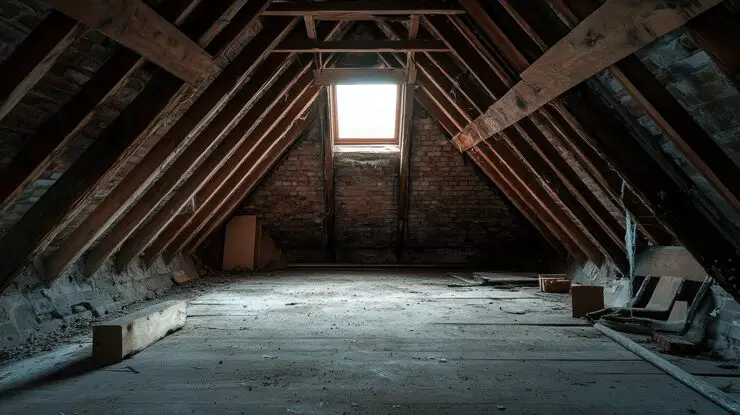
The Attic
My sister called at 12:08 in the morning.
I almost let it go to voicemail.
Caleb was asleep beside me in our house just outside Arlington, Virginia. Rain moved steadily against the bedroom windows, and the baby monitor on my nightstand glowed green from Noah’s empty nursery. Our son was spending the weekend with Caleb’s parents, which was the only reason I had managed to sleep at all. Noah was four, and when he was in the house the nights were lighter, shorter, full of the small sounds of a child adjusting in his sleep that I had learned to track without fully waking. Without him, I had slept deeply for the first time in weeks.
I was groggy when the screen lit up. Then I saw the name.
Mara.
My sister worked for the FBI. She was three years older than me, methodical and careful, the kind of person who chose her words the way a jeweler chooses settings — nothing wasted, nothing misplaced. She had called me late before, but only twice, and both times it had been because someone we loved had died. When I saw her name at midnight on a rainy Friday, I pushed myself upright before I was fully awake.
“Mara?”
Her voice was tight and controlled in the specific way it gets when she is working — not frightened, but held in very close. “Listen carefully,” she said. “Turn everything off. Your phone, the lights, everything. Go to the attic, lock the door, and don’t tell Caleb.”
A cold current moved through me. “What?”
“Now, Elise.”
I looked at my husband. He lay facing the wall, breathing slow and even, one hand loose beneath the pillow the way he always slept. I had slept beside that breathing for six years. I knew its rhythms the way I knew the sound of Noah’s through the monitor.
“You’re scaring me,” I whispered.
Mara’s voice broke through its control. “Just do it.”
I was out of bed before I understood I had decided to move. I grabbed my phone charger without thinking — pure reflex, the way you grab your keys — and slipped into the hallway in bare feet. Behind me, the mattress shifted.
“Elise?” Caleb’s voice, soft and still half-asleep.
I stopped. “Getting water,” I said.
He didn’t answer again.
I moved through the house turning off every light I passed. The hallway, the kitchen, the living room lamp Caleb always left on because he said it kept the house from feeling empty at night. My hands were shaking badly enough that I nearly dropped my phone. Mara stayed on the line, silent except for her breathing, which I tracked the way I tracked Noah’s in the dark.
At the bottom of the attic stairs she whispered, “Do not hang up.”
The steps creaked under my feet, each one sounding louder than it had any right to in the quiet house. The attic smelled of dust and insulation and the cardboard boxes we had packed up from our old apartment when we moved in, labeled in my handwriting with things like winter coats and grad school — the archaeology of a life I had thought I was building. I pulled the door shut behind me and slid the small latch.
“Lock it,” Mara said.
“Done.”
“Stay away from the window.”
Then the call dropped.
I stood in the dark and waited, not breathing properly, not thinking in any orderly way, just listening. For one long awful minute, nothing happened.
Then Caleb’s voice reached me from downstairs.
Not sleepy anymore. Not calling my name. Calm and conversational, the tone he used with clients over the phone.
“Lights are off,” he said.
Another voice answered from inside my house.
“Then she knows.”
I put my hand over my mouth.
Through a narrow gap between two floorboards I could see a slice of the hallway below. Caleb stood in his sweatpants with my laptop tucked under one arm — my laptop, the one I used for the freelance bookkeeping I had been doing since Noah was born. Beside him stood a man I had never seen before, wearing a black raincoat, water still on his shoulders.
The man handed Caleb a small case.
Caleb opened it. Inside were three passports. He flipped through them in the low light. His photo in one. In another, a face I recognized even from the narrow angle of the floorboards, smaller and softer — Noah. The third had my face.
None of them had our names.
I crouched lower behind a stack of storage bins and tried to remember how to breathe.
The man in the raincoat said, “The Bureau moved faster than expected.”
Caleb’s jaw tightened. “How close?”
“Close enough that your wife’s sister may already know.”
I held my phone against my chest and watched the screen, praying for Mara to call back and praying harder that the phone would not make any sound if she did.
Caleb set the passports on the hallway table and turned my laptop over in his hands with a kind of casual familiarity that told me he had done this before, handling it in the dark in a house where his wife was supposed to be asleep. “She never checks anything,” he said. “Even if she saw something, she wouldn’t understand it.”
The stranger laughed quietly. “You chose well.”
Caleb didn’t smile. “That wasn’t part of the plan,” he said, and for one moment, one disorienting second, I almost heard something like regret in his voice.
Then he added, “But the kid complicates things.”
My vision blurred.
The stranger said, “Your parents are already moving him.”
Not his parents. I thought of the people I had trusted my son with, the people I had let Noah spend weekends with, whose refrigerator had crayon drawings stuck to it with magnets, who kept a bin of toys specifically for Noah’s visits. I thought of all the dinners I had eaten at their kitchen table and called it family.
Caleb nodded. “Good. Once we cross into Canada, everything resets.”
My phone vibrated. I nearly screamed. Mara’s message appeared on the screen.
FBI and local police are two minutes out. Stay hidden. Do not make noise. Noah is safe. We intercepted him.
I shut my eyes. Tears ran down my face in the dark and I did not wipe them.
Safe.
Below me, Caleb’s phone rang. He answered sharply: “Mom?” His expression changed. “What do you mean they took him?”
The stranger stepped closer. “What happened?”
“Noah’s gone. Police stopped them on the highway.”
The man in the raincoat cursed. Then Caleb looked up. Not directly at the attic — he couldn’t see me — but in that direction, the way you look at a door when you’re deciding whether to open it.
“Where’s Elise?” he said.
He began moving down the hallway, checking rooms one by one. “Elise?” His voice had gone smooth again, the voice I knew, the voice he used when he was being patient with me. “Baby, where are you?”
I pressed myself behind the storage bins.
The attic steps creaked.
Once.
Twice.
Then sirens split the night open. Red and blue light pulsed through the small vent above me, washing the attic in color. Caleb stopped moving. The front door shook with hard knocking, the kind that has authority behind it.
“FBI! Open the door!”
The man in the raincoat ran for the back of the house.
Caleb didn’t run. He stood at the bottom of the attic stairs, perfectly still, looking up into the dark where he knew I was hiding. For the first time in six years of marriage, I saw what was behind his face when nothing was being performed for it.
He smiled.
“Your sister should have stayed out of this,” he said.
Then the door below burst open, and the house filled with voices and light, and that smile was the last thing I saw through the floorboards before I pressed my back against the storage bins and held completely still and waited to be told it was over.
They led him out before sunrise.
His name wasn’t Caleb Morrison.
It was Owen Price.
He had been under investigation for laundering money through a network of small logistics companies connected to stolen medical equipment and falsified export records. My laptop — the one I used every day for routine bookkeeping, client invoices, account reconciliations — had been quietly used to move files and authorize financial accounts in my name. I hadn’t been his wife in any sense he had ever intended to maintain. I had been a clean identity. A paper person with a real face.
Mara told me everything in a conference room at the field office while I sat wrapped in a gray blanket, staring at a cup of coffee I never touched. She was in her work clothes, which told me she had been awake since before the call, that whatever had happened that night had been in motion for longer than a single midnight phone call.
“We didn’t realize how close he was to leaving until last night,” she said. “When we intercepted his mother’s car with Noah inside, we had to move immediately.”
I asked about his parents.
Mara’s voice was careful. “Not his parents. Associates. They raised him after his biological father went to prison. We’ve known about them for months.”
That sentence emptied out what little remained of me. The people I had handed my son to. The refrigerator with the crayon drawings. The bin of toys kept specifically for his visits. All of it — not family, not even warmth, just cover, maintained so carefully over years that I had never once felt the edge of it.
Noah was brought to me at 6:40 in the morning. He was sleepy and confused, wearing his dinosaur pajamas, clutching a stuffed fox with a price tag still on it that Mara had bought for him at a gas station on the highway when the agents intercepted the car. He was warm and solid when I pulled him against me, and he smelled like himself, like the specific blend of soap and child-smell that I would recognize in a dark room, and I held him so tightly he said, “Mommy, too squishy,” in a voice of mild formal complaint.
I laughed and cried at the same time, and neither one felt like enough.
The case lasted over a year. Owen pleaded guilty to conspiracy, identity fraud, money laundering, and custodial interference. Victor Hale, the man in the raincoat, received a longer sentence for coordinating the escape. I was cleared after investigators documented how my accounts had been accessed — the timestamps, the IP addresses, the file transfers that happened while I was at the grocery store or picking up Noah from daycare or sleeping beside the man who was doing it.
Being cleared did not make it easy.
For months I checked every lock three times before I could sleep. I jumped when the phone rang after dark, every time, my body making the association between late calls and danger before my mind could interrupt it. I installed a second deadbolt on every exterior door of the house, and then a third on the bedroom. I slept with the lights on for six weeks, which Noah thought was an adventure and which I could not explain to him in any way that was honest.
He asked why Daddy couldn’t come home.
He asked more than once.
I learned there is no gentle way to answer that question when the true answer is that the man in the wedding photographs, the man who packed school lunches and kissed my forehead before work and sat across from me at dinner every night, was a character. A constructed person, held together by practice and patience, worn until the moment came to put it down.
Mara stayed with me for six weeks. She slept on the couch, took Noah to the park in the mornings when I could not make myself leave the house, made pancakes that were genuinely terrible in a way that became a joke between us, and reminded me every morning with characteristic economy that I was alive because I had listened.
I did not always believe her at first. There were nights when the thing I felt most clearly was not relief but something harder to name — grief, maybe, for the version of my life I had believed was real. The wedding. The house. The routines we had built together over six years, the small domestic architecture of a marriage: who made coffee, who handled the bills, who got up first with Noah on the weekends. All of it had been built on something false, and yet it had felt completely real while I was living inside it. Knowing it was false did not make the grief of losing it any less real.
That is the part people don’t ask about. They ask when I realized he was dangerous, and I tell them the truth: I didn’t. Not until my sister called. That’s what frightens me most, even now — not what happened in that house on that rainy night, but all the ordinary nights before it. The way he smiled in photographs. The way he was patient with Noah when Noah was tired and difficult. The way he had learned to be a husband so thoroughly that I never looked for the seams.
Eventually, Noah and I moved to a smaller house in Richmond. I filed everything under my maiden name, Elise Harper. It was a quiet street with old trees and a neighbor who kept a garden and waved when she saw us. I chose the house deliberately for two things: it had good windows, and it had no attic.
Noah is seven now. He has Mara’s stubbornness and my habit of reading the same book three times before moving on. He does not remember much about that night — he remembers the stuffed fox and the gas station, which he talks about with great pride, and he has some version of a story he has constructed about why we moved, which is age-appropriate and imprecise and which I will have to revise as he gets older.
There is a version of that night in which I do not answer Mara’s call.
Or I answer but don’t go to the attic.
Or I go to the attic but make a sound coming up the stairs.
Or I am slower, or less quiet, or more confused than I was.
I have thought about all of these versions. I have thought about them late at night when I cannot sleep and the house is quiet and I can hear Noah breathing through the monitor I still keep even though he is old enough not to need it.
My sister called me at midnight on a rainy night and told me to go somewhere dark and stay quiet and trust her.
I did.
That is the whole story, and it is the part I come back to.
Not the house or the passports or the name that wasn’t his name. Not the handcuffs in the hallway before sunrise or the year of court proceedings or the work of explaining to a four-year-old why some things change permanently and without warning.
Just that: my sister’s voice at midnight, tight with something she wasn’t saying, and the decision I made before I understood what I was deciding.
I listened.
We walked out of that house under our real names.

Lila Hart is a dedicated Digital Archivist and Research Specialist with a keen eye for preserving and curating meaningful content. At TheArchivists, she specializes in organizing and managing digital archives, ensuring that valuable stories and historical moments are accessible for generations to come.
Lila earned her degree in History and Archival Studies from the University of Edinburgh, where she cultivated her passion for documenting the past and preserving cultural heritage. Her expertise lies in combining traditional archival techniques with modern digital tools, allowing her to create comprehensive and engaging collections that resonate with audiences worldwide.
At TheArchivists, Lila is known for her meticulous attention to detail and her ability to uncover hidden gems within extensive archives. Her work is praised for its depth, authenticity, and contribution to the preservation of knowledge in the digital age.
Driven by a commitment to preserving stories that matter, Lila is passionate about exploring the intersection of history and technology. Her goal is to ensure that every piece of content she handles reflects the richness of human experiences and remains a source of inspiration for years to come.