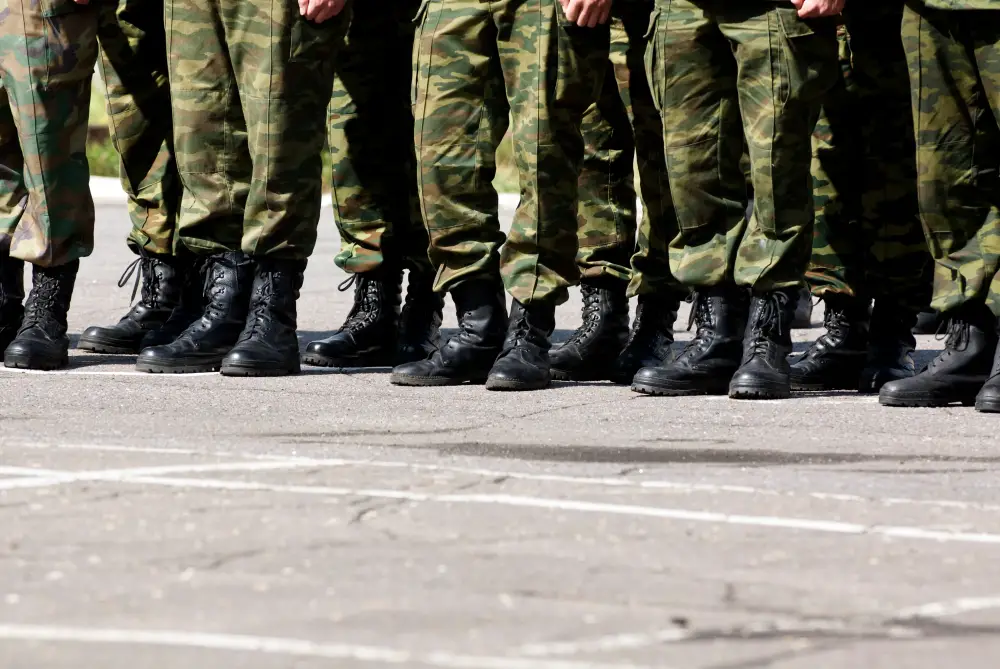
By the time Olivia Mitchell’s truck rattled through the gates of Fort Raventon, the morning formation had already turned the parade ground into a wall of polished boots and pressed uniforms. Her pickup looked like it had crossed three states on stubbornness alone. When she stepped out with a faded backpack and a duffel whose zipper had been repaired with wire, several cadets smiled the way people do when they think they have already measured someone.
Fort Raventon specialized in making young soldiers feel chosen. The candidates there were the sons and daughters of officers, scholarship standouts, decorated reserve transfers, and loud, perfect overachievers who carried themselves like the country was already lucky to have them. Olivia, with her weathered boots and quiet eyes, looked less like a future standout and more like a clerical mix-up.
Lance Morrison made sure everyone noticed it. As he brushed past her near intake, he drove his shoulder into hers hard enough to knock her off balance. Madison Cole, standing nearby with a grin sharpened by boredom, let out a laugh before Olivia had fully steadied herself.
Olivia did not snap back. She did not even glare. She pulled her bag strap higher and kept walking toward the barracks, and that was all the invitation the others needed.
Silence has a dangerous reputation in places built on noise. At Raventon, if you did not defend yourself loudly, people assumed you could not defend yourself at all. By lunch, gravy had been spilled across the front of Olivia’s shirt. By the afternoon endurance run, someone clipped her heel and sent her into wet clay on the edge of the trail. During navigation drills the next morning, her issued map came back torn at the fold, her compass was swapped for one with a sticking needle, and her canteen felt suspiciously light when she lifted it.
She never accused anyone. That unsettled people more than tears would have. Olivia moved through humiliation with a calm that made mockery feel childish, and childish people hate nothing more than being made to look small.
Sergeant Caleb Boone noticed her before most of the others did. He was the range instructor, broad-shouldered, silver at the temples, and old enough to recognize the difference between raw talent and old training. During rifle breakdown practice, the best cadets at the table were still fighting springs and pins when Olivia’s hands moved with smooth, unhurried precision. Forty-eight seconds after she started, her rifle was laid out in a clean row of parts.
Boone checked the stopwatch, then checked her face. No smile. No performance. No flare of pride at all. He had seen young hotshots finish quickly before; they always looked around to make sure someone had seen it. Olivia finished like someone tying a boot she had tied a thousand times.
The range shifted the mood even harder. The exercise was five shots at four hundred yards with no adjustment between rounds. Madison clipped the outer ring and swore under her breath. Lance came close, but one miss low and left ruined the set. Olivia took the rifle as though it belonged in her hands, settled into position, let a breath out slowly, and fired five times. The steel markers came back with five clean center hits.
When Boone inspected the weapon afterward, his expression tightened. The sight was off just enough to throw an average shooter wide. Olivia had compensated without asking for another rifle and without saying a single word.
By dinner, the laughter in the mess hall had gone thin. No one wanted to say aloud what had begun to bother them. The girl they had treated like dead weight was moving through each exercise with the strange economy of someone who had been taught for stakes higher than points and rankings.
The next morning’s land-navigation drill made it worse. Half the candidates came back late and flustered, blaming terrain, heat, or bad bearings. Olivia returned first, dust on her shins, her ripped map folded neatly in her back pocket as if the damage had merely annoyed her.
Lance watched all of it with growing resentment. He was the kind of cadet who could survive almost anything except being ignored. Every quiet success Olivia had felt to him like a public insult. So when hand-to-hand combat day arrived, he decided to fix it.
The recruits circled the padded room while instructors paired them off. Before the signal was even called, Lance lunged. He closed both hands in Olivia’s shirt, drove her backward, and slammed her against the wall hard enough to make several cadets flinch. The room burst into noise. Fabric tore under his grip. The seam at Olivia’s shoulder split and ripped down across her back.
Madison, who had her phone half-raised for what she thought would be easy entertainment, laughed first. Then the torn cloth slipped lower.
Everything in the room changed.
The mark across Olivia’s back was black and sharp and unmistakable: a viper coiled around a shattered skull, inked with the severe precision of a military emblem rather than the vanity of decoration. Even the recruits who did not know what it meant understood instantly that it meant something.
At the far end of the courtyard entrance, Colonel Adrian Pierce had been observing the session with his arms folded. The moment his eyes landed on the tattoo, all the color left his face. He crossed the floor so quickly that authority gave way to something far less controlled.
Fear.
He stopped in front of Olivia and stared at the mark as if he had seen a ghost step out of a grave. “Who gave you the right to wear that mark?”
The room was so quiet that the distant buzz of the range lights could be heard through the open door.
Olivia lifted her chin. “Major Elias Mitchell,” she said. “The man your report buried.”
For one second, Colonel Pierce looked old. Then his jaw hardened. He ordered the room cleared, told Madison to lower her phone, and demanded that Olivia follow him to the command building. Sergeant Boone went with them without being asked. Lance stayed rooted to the mat, breathing hard, while Madison stared after the group with her screen gone dark in her hand.
Pierce did not speak until the office door shut behind them. Then he rounded on Olivia with the brittle fury of a man whose control had been touched in exactly the wrong place. “You stole that symbol,” he said. “Mitchell died eighteen years ago. Every member of Viper Recon is dead.”
Olivia set her backpack on the desk, opened the front pocket, and pulled out a pair of worn dog tags, their edges rubbed smooth by years of handling. Beneath them came a black mission coin etched with the same skull-and-viper insignia now half-hidden beneath the tear in her shirt.
Boone’s face changed first. He recognized the coin before Pierce could stop looking at it.
“My father died three months ago,” Olivia said. “Not eighteen years ago. Not in Black Narrows. Not the way your paperwork said.”
Pierce’s nostrils flared. “You are lying.”
But Olivia had heard that tone before. Not from him. From men who needed the world to stay arranged around their version of it. She had grown up with a father who woke up reaching for a weapon that was never by his bed. She had grown up in a weather-beaten cabin outside Helena, Montana, where winter got into the windows and silence had a weight to it.
Elias Mitchell had taught her to read wind from the bend of dry grass, to spot movement inside tree lines, to field-strip a rifle blindfolded, and to stay calm when other people were trying to make panic contagious. He had also taught her never to waste words on people who had not earned the truth.
The boots everyone laughed at that morning had been his. So had the old truck. So had the rule that shaped nearly every expression on her face: never explain your strength to people committed to misunderstanding it.
But some nights, when pain climbed high enough through the scar tissue in his ribs and back, Elias broke his own rule. He would sit at the kitchen table with his jaw tight, one hand pressed against old injuries, and let fragments out in the dark. A canyon. A schoolhouse. Smoke. A helicopter rising before all the men were aboard. He never said Colonel Pierce’s name until the end.
When the doctors finally stopped pretending there was time, Elias asked Olivia to bring him the metal case he kept hidden beneath the floorboards. It was scarred, water-marked, and locked with a combination he had never shared before. Inside were a recorder, an acetate map browned at the edges, copies of old transmission logs, a sealed letter, and the dog tags Olivia had just placed on Pierce’s desk.
“If you ever go to Raventon,” he had told her, “go during inspection week. Pierce won’t expect witnesses. And if he sees the mark, he’ll know the dead did not stay quiet.”
Back in the office, Pierce’s gaze dropped to the metal case still inside Olivia’s bag. His hand twitched. “You don’t understand what you’re carrying,” he said.
Olivia’s eyes did not leave his. “I understand my father spent eighteen years being called a traitor because he refused to let civilians burn under your timeline.”
The words hit Boone like a slap. He looked from Olivia to Pierce, then back again, pieces shifting behind his eyes. Boone had not been on the Black Narrows insertion team, but he had handled range certification and post-mission paperwork back then. Like everyone else below Pierce’s rank, he had been told Viper Recon broke formation, missed extraction, and caused its own loss. He had signed forms on the strength of that story.
A knock struck the office door, sharp and impatient. Before Pierce could answer, Brigadier General Helen Ward stepped inside with Judge Advocate Major Elena Ruiz beside her. Ward had arrived that morning for a command review, and one glance at Pierce’s face told her enough to cancel politeness. Her attention moved to Olivia’s shoulder, to the torn shirt, to the dark emblem visible beneath it, and finally to the coin on the desk. Ward stopped cold. Not with Pierce’s fear, but with the shock of recognition.
“Conference room,” she said. “Now.”
The hearing was not formal at first, only urgent. Ward, Ruiz, Boone, Pierce, and Olivia sat around an oval table that smelled faintly of coffee and dry-erase markers. Through the glass wall, aides moved past without looking in, sensing enough tension to keep walking.
Olivia opened the metal case carefully, as though roughness would insult the man who had trusted her with it. She set each item on the table one by one. The recorder. The map. The mission coin. The dog tags. The sealed letter with Elias Mitchell’s name written in a hand made jagged by pain.
Boone picked up the map and exhaled softly. “This stock hasn’t been used in over a decade. Maybe longer.”
Ruiz leaned in. “Could it be duplicated?”
“Not like this,” Boone said. He pointed to a smeared line at the lower corner. “That grease-pencil notation style was Pierce’s. He always dragged the last digit down when he wrote under pressure.”
Pierce’s face darkened. “That proves nothing.”
Ward said nothing yet. She only looked at Olivia. “Show us the recorder.”
Olivia slid it across the table. The casing was scratched, but Boone found the port and connected it to a speaker unit after a tense minute of trial and error. Static filled the room first. Then rotor noise. Then a younger voice, strained but steady.
Elias Mitchell.
“Confirm visual on noncombatants,” the recording said. “Repeat, there are civilians inside the eastern structure. Request strike hold and extraction delay.”
Static answered him. Then another voice came through, clipped and colder, though age and distortion had not erased its identity.
Adrian Pierce.
“Negative on delay. Window stands.”
Elias again, louder now, with gunfire somewhere behind him. “If you keep the window, you’ll hit the schoolhouse.”
A pause. Breathing. Then Pierce’s voice, flatter than fear should ever sound. “Objective takes priority. Get your team out or be counted with the loss.”
The rest came in fragments: shouting, a woman’s voice screaming for a medic, rotor wash, coordinates, the sickening thunder of an explosion too close to the microphone. Then Elias one last time, raw with effort and disbelief. “You moved extraction.”
The recording ended in static.
Nobody in the room spoke for several seconds. Even Pierce seemed to understand that silence had changed shape around him.
“Audio can be manipulated,” he said.
Ruiz was already scanning the transmission log. “These timestamps match archived signal traffic from the date of Black Narrows. And the reroute request is coded with your field authorization.”
Pierce leaned back hard in his chair. “That operation was classified above your clearance at the time.”
Ward’s eyes sharpened. “Not above mine.” She went to the wall terminal and called up the archived command summary Ruiz had requested from secure records. When the file appeared, the room chilled all over again. The extraction window had been moved eleven minutes earlier. The amendment was logged under Pierce’s authorization stamp. The official casualty declaration for Elias Mitchell had been filed fourteen minutes after the strike, before any ground confirmation could have been made.
Ward turned from the screen slowly. “You declared him dead before anyone reached the site.”
Pierce said nothing.
Olivia reached for the sealed letter and opened it with both hands. The paper had been folded and unfolded so many times the creases looked ready to break. When she spoke, her voice did not tremble, but the effort of holding it steady showed in the tight line of her throat.
“My father wrote this when he understood he wasn’t going to outlive what happened there.”
She read.
He wrote that Black Narrows was supposed to be a recovery mission. He wrote that when Viper Recon arrived, they found the target cache hidden beside a schoolhouse being used as shelter by families trapped between front lines. He wrote that Captain Clara Sloane was hit while moving two children out through a rear window. He wrote that he called for a delay, then for medevac, then for anything that resembled mercy. He wrote that Pierce never asked how many civilians were inside. He only asked whether the objective could still be recovered.
Olivia lowered the letter long enough to breathe. Nobody stopped her. Nobody could.
“He wrote that he saw the helicopter door close while Clara was still bleeding on the ground,” Olivia said. “He wrote that he watched Colonel Pierce look straight past him and choose the cargo over the team.”
Pierce surged forward. “That is not what happened.”
For the first time, Olivia’s composure flashed with something hotter. “Then tell them what did.”
Ward did not take her eyes off Pierce. “You may.”
He lasted three more questions. Ruiz asked why the strike was not aborted after civilian presence was confirmed. Pierce said the objective involved a weapons-guidance package that could not be allowed to disappear. Boone asked why Clara Sloane had been listed as unaccounted for when the recording placed her wounded beside the schoolhouse. Pierce said battlefield chaos made certainty impossible. Then Ward asked the one question that stripped the last defense from him.
“Why was Mitchell named deserter in the final report if you believed he died obeying orders?”
Pierce opened his mouth and stopped.
Because there was no answer that could live inside honor.
What came out of him instead was not a confession in clean language. It was something uglier and more revealing, an exhausted, furious justification built from years of believing rank could sanctify choice. “You don’t understand what was at stake,” he said. “That package was tied to a program that would have collapsed if the site was exposed. One village, one team, one field decision. Do you think wars are won by saving everyone? I preserved the mission. I preserved the command.”
The room went still again, but now the stillness had a verdict inside it.
Ward’s voice was quiet when she finally spoke. “Sergeant Boone, please remain as a witness. Major Ruiz, I want a full transcript of this session sent to JAG by end of day.” She looked at Pierce without expression. “Colonel, you will surrender your credentials to Major Ruiz and remain on base pending a formal review. If you leave the grounds, I will treat that as a confession.”
Pierce looked at Olivia one last time with something that had started as contempt and arrived somewhere closer to bewilderment. He had built a career inside a story, and the story had not broken the way stories were supposed to: quietly, with the last witness already in the ground. Instead it had walked through his gates in worn boots and a repaired duffel, and it had sat across his table and read him his own choices in his own voice.
He stood without another word and followed Ruiz out. The door closed behind them.
Boone let out a breath he had been holding since the recording ended. He picked up the mission coin from the table and turned it in his fingers, running his thumb over the viper and the skull the way you do when something familiar arrives from a direction you never anticipated.
“How long did he survive out there?” Boone asked. “After Black Narrows.”
“He made it to the exfil point on foot,” Olivia said. “A village elder hid him for eleven days. By the time he crossed back, Pierce’s report was already filed. He came home to a dishonorable declaration and no benefits. He couldn’t contest it without exposing the mission. So he didn’t.”
“He just lived with it.”
“He lived around it,” Olivia said. “There’s a difference. He built something small and kept it. He taught me everything that mattered. He just couldn’t ever use his own name for the things he knew how to do.”
Boone set the coin back on the table gently, like he was returning something to its rightful place. “That tattoo,” he said. “He put it on you himself?”
“When I was nineteen. He said if the unit ever got its name back, I should be able to prove I came from it.” She pulled the torn fabric back across her shoulder. “He didn’t know if that would ever happen. He just wanted someone to still be carrying it.”
Ward had been quiet during this, standing at the window with her back half-turned, looking out at the parade ground where cadets were beginning to move toward the afternoon schedule as if nothing had altered the shape of the day. She turned now, and her expression held something between authority and a grief she was not going to perform in front of witnesses.
“Your father’s record will be reviewed under emergency posthumous correction,” she said. “I cannot promise how long the process takes. I can promise it will be opened today, and that I will be the one who opens it.” She paused. “He was Viper Recon?”
“Team lead,” Olivia said.
Ward nodded once, as though confirming something to herself. “Then he deserved better than a hole in a field report. So did Clara Sloane. So did the rest of them.” She picked up the sealed letter from the table and handed it back to Olivia. “This belongs with your family record, not in a case file. We have the recording and the logs. That is sufficient.”
Olivia took the letter and folded it carefully along the lines her father’s hands had worn into it.
Outside the window, Boone could see Lance Morrison doing push-ups under an instructor’s supervision, which meant someone had reported the unprovoked contact in the training room. Madison Cole sat on a bench near the barracks with her arms crossed and her phone confiscated. The ordinary machinery of consequence was already turning for both of them, slow and impersonal, the way it tended to operate when it operated at all.
Boone looked at Olivia. “You knew what was going to happen when Pierce saw the tattoo.”
“I knew he would react,” she said. “I didn’t know who else would be here. General Ward was unexpected.”
“But you came anyway.”
Olivia was quiet for a moment. Through the window, a formation of third-week candidates was crossing the parade ground in the thin afternoon light, their steps still finding their rhythm, their faces carrying the mix of ambition and uncertainty that every soldier wore before the work got real.
“My father came home to nothing,” she said. “He spent eighteen years training me in a cabin in Montana so that none of it would disappear when he did. The least I could do was walk it through the front gate.”
Boone looked at the dog tags still on the table. He picked them up and held them out to her. Olivia took them and pressed them once against her palm before tucking them into her front pocket, close, the way you carry something that has been waiting a long time to be returned to the light.
In the weeks that followed, the Black Narrows review moved through the Judge Advocate system with the kind of momentum that accumulates when recorded evidence is unambiguous and the officer at the center of it stops defending himself. Pierce’s authorization stamps were on every critical document. His voice was on the recording. The transmission logs did not require interpretation.
Clara Sloane, it emerged, had survived Black Narrows by thirty-one hours. She had been extracted by villagers and had died in a field clinic not from her wound but from the absence of the medevac that Pierce had declined to authorize. Her family had been told she was missing in action. They had been waiting for a different answer for eighteen years.
Elias Mitchell’s record was corrected in full. The dishonorable declaration was expunged. His benefits were restored posthumously to his estate, which meant to Olivia, since she was all that remained of the cabin outside Helena and everything in it.
She did not stay at Fort Raventon for the full selection period. Ward offered her a direct placement review given the circumstances, which Olivia politely declined. She said she had not come to Raventon for a shortcut. She had come to finish what her father started, and finishing it meant going through the same doors as everyone else.
She went back to the barracks. She ran the same trails. She sat in the same mess hall where gravy had once been spilled across her shirt, and she ate her meals quietly while the candidates around her recalibrated the silent calculations they made about who deserved to be there.
Lance Morrison did not speak to her again. Whatever he had expected to find at the bottom of his contempt, it had not been a name that made colonels go pale and generals call emergency hearings. He finished the selection period and was assigned to a logistics post, which suited the size of his courage.
Madison Cole surprised everyone, including herself. She sought Olivia out near the end of the third week and stood in front of her for a moment without the grin that usually preceded her words. “I didn’t know what I was laughing at,” she said finally. It was not quite an apology, but it was honest, and Olivia accepted it as the thing it actually was.
Sergeant Boone recommended Olivia for the advanced reconnaissance track before the final assessments were scored. He did not tell anyone why, because the reason was the same as it always had been: she was good, and the good ones should go where the work is hardest.
On her last night before posting, Olivia sat on the steps outside the barracks with the dog tags in her hand and the moon doing what it does over Montana and everywhere else, rising without asking permission. She thought about her father at the kitchen table in the dark, jaw tight, one hand against old wounds, letting fragments out in pieces because some truths are too heavy to carry all at once but too important to set down entirely.
She thought about the way he had shown her the metal case, the combination he had kept for eighteen years under floorboards that knew his step, the specific weight of what he was handing her. Not a mission. Not a revenge. A record. A refusal to let the silence be the last word.
She pressed the dog tags once against the inside of her wrist, where the pulse is easiest to find, and held them there for a moment before tucking them away.
She had walked through the gate with his boots on her feet and his coin in her pocket and his name still carrying weight it had never stopped deserving. The rest was paperwork and time and the long institutional work of setting a record straight, all of it necessary, none of it the point.
The point was simpler than the machinery that surrounded it. Her father had refused to let civilians burn. He had called for a delay, then for mercy, then for anything. He had come home to silence and built a life inside it and taught her everything he knew so that when the time came, someone would still be there to say: this is what happened, and it mattered, and the men and women who chose correctly should not end up buried in the wrong column of someone else’s report.
She had said it. It had been heard.
It was enough to have done it. It was enough to keep going.
In the morning, she laced up her father’s boots, shouldered her repaired duffel, and walked toward whatever came next.

Ethan Blake is a skilled Creative Content Specialist with a talent for crafting engaging and thought-provoking narratives. With a strong background in storytelling and digital content creation, Ethan brings a unique perspective to his role at TheArchivists, where he curates and produces captivating content for a global audience.
Ethan holds a degree in Communications from Zurich University, where he developed his expertise in storytelling, media strategy, and audience engagement. Known for his ability to blend creativity with analytical precision, he excels at creating content that not only entertains but also connects deeply with readers.
At TheArchivists, Ethan specializes in uncovering compelling stories that reflect a wide range of human experiences. His work is celebrated for its authenticity, creativity, and ability to spark meaningful conversations, earning him recognition among peers and readers alike.
Passionate about the art of storytelling, Ethan enjoys exploring themes of culture, history, and personal growth, aiming to inspire and inform with every piece he creates. Dedicated to making a lasting impact, Ethan continues to push boundaries in the ever-evolving world of digital content.