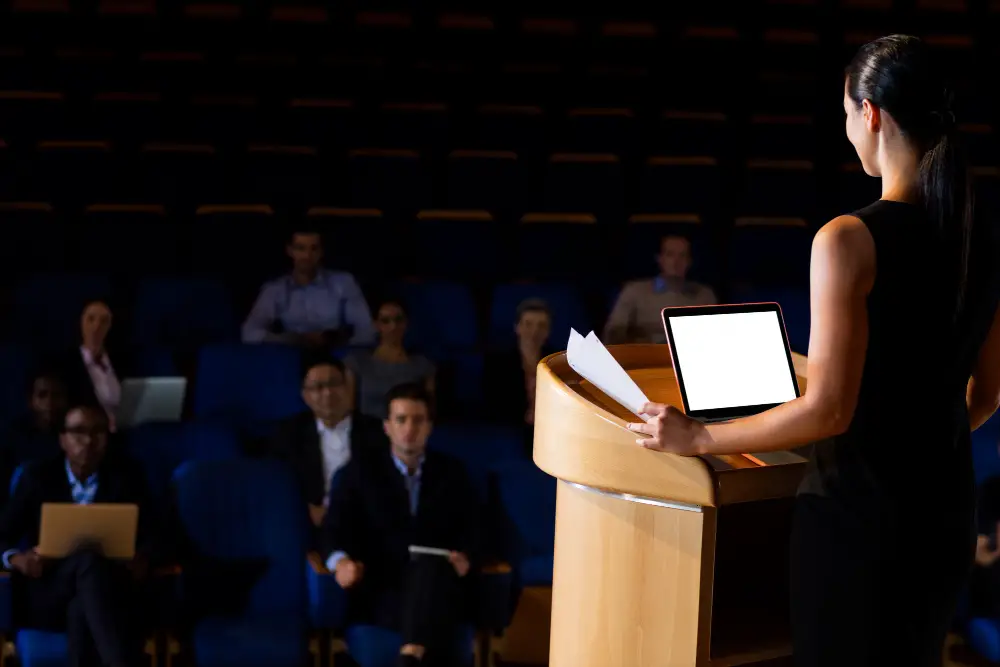
My father told me to stand up for my sister while the whole auditorium was already clapping for her. He did not say it quietly. He said it with the kind of proud, carrying voice that assumes the room will agree with him before it even understands what is happening. “Sarah. Stand up. Show your sister some support.”
I stayed where I was, near the back wall beneath a row of framed flags and soft yellow sconces that made everything look gentler than it was. On stage, Jessica smiled into the light like she had been born knowing exactly where a microphone should be placed and how long to pause before gratitude started sounding noble. The host had just called her a symbol of courage. The band had played a formal little flourish. My mother was in the front row with tears in her eyes before Jessica had even opened her mouth.
I knew every beat of the speech before she gave it. I knew where she would lower her voice. I knew where she would place her hand over her heart. I knew the sentence that would make older men in dress jackets nod and younger ones sit straighter.
I also knew which parts weren’t hers.
When Jessica said, “That night, I just kept talking until I got them home,” applause broke out again in the middle of the story. My father clapped hard enough to sting his own hands. My mother smiled the way people smile when the world confirms something they already wanted to believe. I slipped my hand into my coat pocket and closed it around the small flash drive I had been carrying for eight days. It was warm from my palm. Almost absurdly light for something that held enough truth to knock the air out of a room.
When the ceremony ended, people crowded toward Jessica with congratulations. I did what I always did when the performance was over. I found the nearest exit. Outside, the night smelled like cold pavement, damp wool, and idling cars. My phone buzzed before I reached the curb. My mother’s text was waiting: Jessica was incredible tonight. No question mark. No mention that I had stood in the back and not clapped. No curiosity about why I had left before the reception line. Just a polished little summary of what everyone had apparently decided was true.
I stared at the message until the screen dimmed, then locked my phone and slid it away.
Because there was still another event to survive.
The anniversary reception was two hours later at the Officers Club across town. Private guest list. Press table. Donors. Local officials. Thick cream-colored programs with gold lettering. Jessica was scheduled as the keynote again, this time in front of the people who could turn a story into a grant, a board seat, a magazine feature, a career.
The thing about family myths is that they do not stay inside the family. If you feed them long enough, they learn how to dress themselves up and walk into public life. Jessica had always understood that better than I did. When we were kids, she could retell a simple afternoon and make it sound like a movie someone ought to thank her for starring in. She was not born cruel. That would have been easier to name. She was born fluent in attention. She could charm teachers out of consequences, neighbors into favors, strangers into confessions. My parents called it confidence. I called it weather. You did not argue with it. You waited for it to pass, and if it turned in your direction, you hoped you were standing under something sturdy.
I was the opposite. Quieter. Slower to speak. Better with patterns than people. I liked instructions that meant what they said and rooms that did not require performance. The older we got, the more that difference hardened into a family script. Jessica walked in and everyone noticed. I walked in and people assumed I preferred it that way.
When I joined the Army National Guard, my father shook my hand like I had made a respectable, practical choice. When Jessica joined three years later through public affairs, my mother cried and told everyone both her daughters had chosen service. The truth was that Jessica had chosen a part of service where storytelling mattered as much as accuracy, and I had chosen one where accuracy mattered because people could pay for mistakes in ways that never made the paper. I worked communications. Radios, maps, field links, backup channels, timing. The stuff no one frames on a wall unless it fails.
Jessica understood uniforms as symbols before she understood them as responsibilities. She ironed creases perfectly. She photographed well. She knew how to stand with her shoulders back and her chin lifted just enough to suggest resolve. I do not say that to be petty. I say it because the lie that later grew around her did not appear from nowhere. It grew in a place that had already made room for it.
The night everything changed was during Operation Harbor Light, five years earlier, after a coastal storm knocked out power across half the county and turned roads into black, moving mirrors. Our unit had been rotating through evacuation support for almost eighteen hours. Everyone was wet. Everyone was tired. Everyone had started speaking in clipped fragments because there was too much to do and not enough time left for softness.
I was in the mobile communications trailer with three screens in front of me, a county map spread open under one elbow, and a headset pressed so long to my ear that my skin hurt. Rain kept rattling the roof hard enough to blur thought. The network was dropping in and out. Calls were backing up. People kept asking for the fastest route to somewhere that no longer looked like the map.
At 9:14 p.m., a twelve-member convoy was assigned to evacuate Greenbriar Assisted Living on the east side of the county. They were routed toward Old Mercer Bridge because an outdated overlay had been attached to the dispatch packet. On the screen it looked clean and ordinary. On the county emergency feed, it was already wrong. Mercer had been compromised forty minutes earlier. Barricades were up at the south approach, but rising water had pushed around the shoulder and the service lane. In daylight you might have seen it soon enough to turn around. At night, in rain, with exhausted drivers following printed coordinates, you could get trapped before anyone admitted the map had lied.
I heard the convoy call in their marker and felt my whole body sharpen. The numbers did not match where they should have been. Not by much. Just enough. That is the danger with disaster work. Catastrophe rarely announces itself as catastrophe. Sometimes it sounds like one tired voice saying a mile marker you were not expecting.
I checked the county feed, then the paper map, then the drone still that had just loaded in grainy and gray. The bridge access was worse than I thought. Water had spread across the approach in a slick black sheet that hid the edge. Our senior communications NCO was across the lot dealing with a power transfer. The operations desk was buried in requests. Nobody had time for a careful chain of permission.
So I keyed the channel myself. “Convoy Two, this is Miller on tactical. Do not take Mercer. Repeat, do not take Mercer. Break left at the feed store, continue along the service road by the rail line, and stay on my voice.”
There was a half-second of static. Then someone came back with, “Copy, Miller. We don’t have signage. Talk us through it.”
So I did. For the next forty-three minutes, I stayed on that channel and walked twelve service members through roads that had stopped behaving like roads. I tracked county updates, rerouted them twice, got Public Works to clear a gate, then talked them around a washout that did not show on any of the official packets. I could hear the strain in their replies. I could hear water slapping metal on open mics. I could hear how close exhaustion sits to panic when people are trying hard not to give either one a name.
Jessica was not on that channel. She came into the trailer once, near the end, damp hair pulled into a neat knot, media badge clipped cleanly to her chest. She asked if anyone could summarize the convoy situation because a local affiliate wanted an update package. I looked at her with my hand still on the transmit button and said, “Not now.” She rolled her eyes, waited thirty seconds, then left.
At 10:07 p.m., the last vehicle checked in from the alternate route. They had Greenbriar’s residents with them. All twelve members were clear. The release that went through me was so sudden it made me shake. I took off my headset and realized my fingers had cramped around the pen I had been using to mark the map. My left sleeve was smeared with ink. My throat felt scraped raw.
That should have been the end of it.
But the part that becomes history is rarely the part that actually happens. It is the part somebody tells first, cleanest, and to the right audience.
During the debrief, I gave my notes to the operations desk and went outside to breathe. Jessica found me there near the loading area under a sheet of rainwater pouring off the awning. She asked what happened with the convoy. I said I rerouted them and kept comms until they cleared the bridge zone. She nodded like she was only half listening.
The next morning, a local station aired a piece about the storm response. Jessica appeared on camera in crisp uniform, speaking about the long night, the convoy, the evacuees, and the pressure of keeping people calm when routes collapsed. She used we at first. Then she used I.
When my mother forwarded me the clip, she added heart emojis and wrote, Your sister is amazing. I called her and said, “Mom, that wasn’t Jessica’s operation. She wasn’t the one on radio.” My mother sighed the way people sigh when they think you are about to turn something happy into something difficult. “You were both there,” she said. “It doesn’t have to be a competition.”
That sentence settled over the next five years of my life like dust.
Every time Jessica told the story again, the details sharpened around her. A podcast host called her the steady voice that guided twelve troops to safety. A veterans charity invited her to speak about leadership under pressure. An article described her as the woman who refused to let a convoy disappear into storm-dark roads. Sometimes she included me vaguely. My sister was in communications that night. Sometimes she did not.
I corrected her once, in private, at my parents’ kitchen table after she referred to the reroute as “the call I made.” She looked at me over her wineglass and said, “Sarah, please. You hate all this anyway.” As if my discomfort with being watched had signed over ownership.
At some point, the story became so polished that even official paperwork bent toward it. A recognition packet was assembled from public affairs summaries and interview transcripts. Lieutenant Colonel Vance signed it. Jessica received a formal commendation for decisive action during Harbor Light. I was copied nowhere.
People always ask why I did not fight then. The answer is not noble. I was tired. I was angry in a way that had no elegant shape. I had started having trouble sleeping. Loud rain made my chest tighten. My last year in uniform felt like walking through rooms where a version of my own life was already being explained to other people by someone better dressed for the task.
So I left. Jessica did not. She kept speaking. Kept networking. Kept becoming the face of a story that opened doors for her. My parents framed a photo of her at one awards luncheon and put it above the piano. No one framed the duty log.
Eight days before the anniversary reception, Lieutenant Colonel Vance called me from a number I almost did not answer. His voice was measured, formal, and just strained enough to make me listen harder. He said he had been reviewing archive materials with the unit historian for the anniversary exhibit. They had pulled original radio traffic, handwritten logs, after-action statements, and old dispatch packets to build a timeline of Harbor Light. He said my name three times in the first minute.
Then he said something I had not expected to hear from anyone connected to that record. “I signed off on a recognition packet that credited the wrong person. That failure is mine.”
I sat down at my kitchen table because my knees had gone light. He told me the archived channel still existed. He had listened to it that morning. He had also called the twelve convoy members he could locate. Every single one of them identified my voice. Several still had copies of their own statements from the original debrief, statements that named me clearly before later summaries sanded the truth into something more marketable.
The anniversary reception, he said, was the cleanest place to correct the record because the original false recognition had been turned into public identity. The correction needed witnesses.
I asked him one question. “Will they be there?”
He knew who I meant. “All twelve who could make it have agreed,” he said.
That was when I said yes.
I spent the next week digging through old email chains, downloading copies of the archive Vance sent, and loading everything onto a flash drive of my own. Years of being ignored had taught me not to arrive anywhere with only one version of the truth.
At the Officers Club, the guard at the entrance checked the guest list and told me he did not see my name. I had opened my mouth to answer when I heard Vance behind me say, “She’s with us.”
Twelve service members stepped forward beside me in dress uniform. Some I had not seen in years. Ruiz. Callahan. Mercer. Dodd. Faces older, fuller, tired in different ways, but instantly familiar. The kind of familiar you carry in your nervous system.
The rope came aside.
Conversations thinned as we moved through the room. A donor couple near the bar turned so obviously that the woman nearly spilled her drink. Nobody asked what was happening. Everyone felt it.
Inside, Jessica was already at the podium. She had the room exactly where she liked it, half laughing, half leaning in. She was telling the softened version of Harbor Light, the one with tidy pauses and clean heroism and no room for misassigned credit. Then the projection behind her changed.
It was not dramatic. That is what made it worse. No one shouted. No one rushed the stage. Her slideshow simply disappeared, replaced by a dark background and a clean timeline labeled with dates, route markers, dispatch notes, and unit photos from the night of the storm.
Jessica turned, blinked once, and then looked back at the audience with a smile that had suddenly become work.
Vance stepped onto the stage. He asked for the microphone. Jessica hesitated just long enough for everyone to notice before letting go of it.
“Before we continue,” he said, “I need to correct an official record.”
The room changed shape around that sentence.
He did not rush. He explained that a prior recognition tied to Operation Harbor Light had been based on incomplete summaries and had credited the wrong individual for the communications actions that rerouted Convoy Two and guided the team to safety. He said the archived transmissions, original incident log, and witness statements had now been reviewed in full. Then he looked toward the back of the room.
“Sarah Miller, please come forward.”
I walked up the center aisle with every eye in the room on me. My mother’s program slid out of her lap and hit the floor. My father did not pick it up. He was staring at me like he had misplaced something years earlier and only just realized what it was.
When I reached the stage, Jessica leaned toward me and said out of the side of her mouth, “What are you doing?”
I did not answer her. Not because I was punishing her with silence. Because there was nothing left to explain that the room was not already hearing.
Vance read two paragraphs from the archived channel transcript. He read them into the microphone in the same measured voice he had used to call me eight days earlier, and the words sat in the room differently than Jessica’s had, not because they were more dramatic but because they were specific. Grid references. Call signs. Real time notations. The kind of language that cannot be borrowed retroactively because it was never built for an audience.
Then he asked the convoy members to stand.
All eight who had made it there rose in their seats. Ruiz was near the aisle, closest to the stage. He had been the one who came back on the radio and said, “Copy, Miller. We don’t have signage. Talk us through it.” When he stood, I had to look somewhere else for a moment, because the sight of him standing on my behalf after five years of the world deciding he had been guided by someone else was something my chest was not entirely ready for.
Vance handed me a corrected citation on paper, signed and dated. He did not make a speech about it. He only said, “This should have been yours five years ago. I’m sorry it took this long.”
I took the paper with both hands. My fingers were steadier than they had any right to be.
Beside me on the stage, Jessica had gone very still. She was not crying. She was doing the thing she had always been gifted at, which was calculating her next position, scanning the room, trying to find the angle from which this could be managed. But the room was not offering one. The donors were looking at their programs. The press table had gone quiet. The local official in the second row had the careful expression of a man who had shaken a lot of hands at a lot of events and was now quietly reassessing which ones he was glad he had shaken.
There was a reception line afterward. Not the kind Jessica had been expecting, where the room flowed toward her. People came to where I was standing near the edge of the stage and introduced themselves, said things I needed time to absorb, shook my hand or said they were glad to know the full story. An older woman whose organization had been considering Jessica for a board position told me she appreciated the transparency. She said it the way people say things when they mean something more specific than the words they are using.
My parents found me near the end.
My father came first, alone, which surprised me. He looked the way he had on the stage of my middle school graduation when he realized I had given the address speech and not just attended the ceremony, that brief pause when the story he had already told himself caught up with what was actually in front of him.
He did not speak for a moment. Then he said, “How long have you had that recording?”
“The unit historian retrieved it,” I said. “Vance sent me copies eight days ago.”
He nodded slowly. “And before that?”
“Before that I told you. At mom’s kitchen table. You said it didn’t have to be a competition.”
He absorbed this without flinching, which was new. My father had always been a man who distributed credit the way he distributed money, toward the most visible return. But something about seeing twelve people stand up in a room because my voice was the one they remembered had gotten past whatever defense he usually kept in place.
“I should have listened to you,” he said.
It was a small sentence for a large failure, but I had learned in the previous few years that men like my father offer what they can manage, and that demanding the size of apology that fits the size of the wrong often just ends the conversation. I accepted it as what it was. The beginning of something, not the end.
My mother took longer. She stood near the program table with her hands folded and her eyes making a small inventory of the room that I recognized as her way of locating herself when the map had changed. She had spent five years as the proud mother of one daughter’s courage, and the realization that the courage had been another daughter’s entire time was going to require something more extensive than a single evening to process.
She came to me finally and put her hand on my arm. “I didn’t know,” she said.
“I told you,” I said, not cruelly, just factually. “You told me it didn’t have to be a competition.”
She pressed her lips together. “I thought you were jealous.”
“I know,” I said.
We stood there for a moment with the gap between what she had assumed about me and what I had actually been doing for five years laid out between us in plain sight. I did not rush to close it. Some gaps need to stay open for a while before they can honestly be crossed.
Jessica did not seek me out that night. She stayed on the other side of the room for the remainder of the reception, working the space the way she always had, but with a different quality to the effort, something more deliberate and a little less fluid. People were polite to her. Politeness, when it replaces warmth without explanation, communicates its own message.
I heard later that she told someone the timeline had been misunderstood and that she intended to clarify her role in the original debrief. I heard that she called our mother that same night and said I had always resented her success. I heard both of these things from my mother, who told me in the same tone of voice she had used for thirty years when she was trying to stay balanced between us, and I said, “That’s her right,” and left it there.
Because the thing I had not expected about being believed was how little it changed what I needed from the people who had failed to believe me. I had wanted the record corrected for five years, and the record was now corrected, officially and publicly, in front of exactly the people whose witness mattered most. What I had not wanted, though I had told myself I did, was for my parents to suddenly see me clearly after a lifetime of looking slightly past me. That kind of change does not happen in a room because a microphone is passed to someone who was never offered one before.
It happens slowly, in kitchens, in phone calls, in the accumulation of small moments where someone chooses to pay attention instead of assuming they already know.
I drove home that night through streets that had been wet from rain two hours earlier and were now going dry under cold wind. I had the flash drive still in my coat pocket. I had the corrected citation in my bag. I had the particular exhaustion that comes not from doing something hard but from doing something long, years long, and finally reaching the end of it.
When I got home I put the citation on the kitchen counter and left it there without framing it or doing anything particularly ceremonial, because it was never about ceremony. It was about accuracy, about whether the record of what happened on a rainy night five years ago would contain my name or not. It would now. That was enough for that night.
I made tea and sat at the kitchen table and let the silence be whatever it was, which was ordinary, unremarkable, mine.
Ruiz had said something to me near the exit of the Officers Club before he left for the parking lot. He had stopped, shook my hand the way people shake hands when the gesture carries something that words would make smaller, and said, “You got us through. Every one of us knew it. We just thought you knew we knew.”
I had not known.
But I knew now, and there are worse things to carry home at the end of a long evening than the knowledge that the twelve people you guided through dark water on a map that had stopped telling the truth had always understood who was on the other end of that radio.
I had been there. I had stayed on the channel. I had talked them through.
Whatever else was still unresolved, that part was finished.

Laura Bennett writes about complicated family dynamics, difficult conversations, and the quiet moments that change everything. Her stories focus on real-life tensions — inheritance disputes, strained marriages, loyalty tests — and the strength people find when they finally speak up. She believes the smallest decisions often carry the biggest consequences.