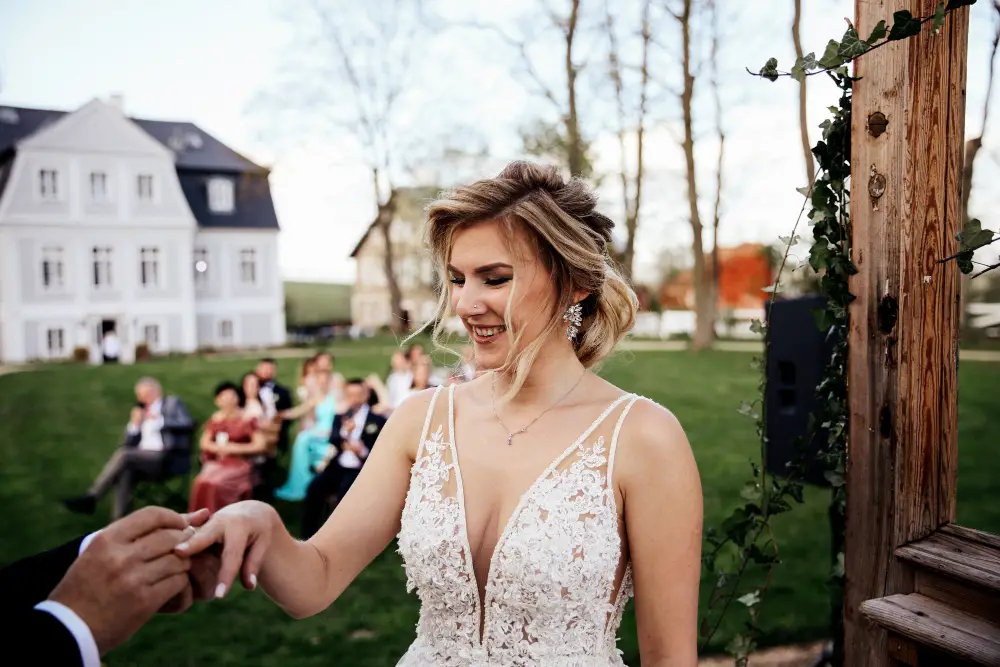
My sister pushed me into the mud on my wedding day, and for one second I actually thought the worst part was the ruined dress.
I was wrong.
The worst part was the silence after I fell.
The venue had looked perfect only minutes before. White chairs lined the lawn in neat rows. String lights hung between old oak trees whose bark was dark from an afternoon rain that had cleared just in time. The rented dance floor glowed under a soft evening sky, and the air smelled like roses and champagne and wet grass still warm from the day. Daniel and I had paid for nearly everything ourselves. We were not rich, but we had saved for almost a year, choosing cheaper dinners, skipping trips, saying no to anything that did not matter because we wanted one day that felt completely ours. I had imagined walking through that garden as his wife and feeling whole. I had imagined it often during the planning year, not in a vague, romantic way, but specifically, deliberately, the way you hold onto an image when the spreadsheets and the seating chart revisions and the vendor calls make you lose sight of what you are actually building toward. One day on that lawn. That was what all of it was for.
Instead I hit the ground face-first.
The sound was thick and humiliating. Not dramatic. Not the kind of sound that turns into a story you laugh about later. Just a wet, ugly splat that seemed to echo louder than the music. For half a breath, nobody moved. Then the gasps came. Then the little nervous laughs. Then Vanessa.
“Oh my God,” my sister shrieked, her voice slicing through the garden. “Look at you, Claire. You’re disgusting.”
I lifted my head just enough to breathe. Mud stuck to my cheek, my chin, my eyelashes. My veil had slipped sideways, half-submerged beside my shoulder. Cold water seeped through the lace of my gown and into my skin. My hands sank when I tried to push up. The train of my dress clung to the ground like it had grown roots.
For a terrible moment, I could not move.
Across from me, Vanessa stood at the edge of the dance floor in a red dress that clung to her body like she had meant to compete with the bride. Her champagne glass was still in her hand. Her hair was perfect. Her lipstick was untouched. And she was laughing. Not startled laughing. Not the kind of laugh people produce when they panic and do not know how to react. She was laughing with satisfaction, the specific pleasure of someone who has accomplished exactly what they set out to do.
Behind her stood my mother, Margaret. Her arms were folded. Her mouth was tight. She did not look horrified. She looked inconvenienced, as if my fall had disrupted the polished version of the afternoon she had wanted people to remember.
That expression hurt more than the mud.
Because I knew it. I had seen it my whole life. When Vanessa broke my things, Mom said I was sensitive. When Vanessa mocked my body, Mom said sisters teased each other. When Vanessa ruined my college graduation dinner by announcing fake tears over a breakup she had been considering for months, Mom said I should be gracious because Vanessa needed support. I was always expected to absorb the blow and make less noise about the bruise. Even on my wedding day. Especially on my wedding day.
Someone said my name. It sounded far away.
Then footsteps struck the wooden platform behind me, fast and heavy. The crowd shifted. I heard someone whisper, “Oh no.” I knew that walk before I saw him.
Daniel.
My husband.
He crossed the dance floor without hesitation, his face not red, his voice not raised. That somehow made the whole garden seem to tighten around him, the way a room goes quieter before someone says something important.
“He’s going to lose it,” someone murmured.
But Daniel did not lose it. He went straight to Vanessa. For the first time, my sister’s smile twitched.
“Relax,” she said, lifting her glass. “It was just a joke.”
Daniel caught her wrist. Not violently, but firmly enough that champagne spilled over her hand and dripped onto the floorboards.
“What the hell?” Vanessa snapped, her laugh suddenly thin.
“You touch my wife again,” Daniel said quietly, “and I will not care who is standing here.”
The sentence landed harder because he did not yell it. Vanessa tried to pull free.
“Are you serious right now? She fell in mud. She’ll survive.”
Daniel stepped closer. The laughter died completely.
“You think this is funny?” he asked.
Vanessa looked around, searching for an audience, but the audience had changed. Phones were still up. Mouths were still open. But nobody was laughing with her anymore.
I tried again to get up. My arms trembled under me. The mud had soaked through my bodice and the weight of the dress dragged against my legs. “Daniel,” I whispered. He heard me instantly. His head turned, and when his eyes found mine, something in his expression shifted. He let Vanessa go. She stumbled into a chair with a sharp gasp, but he was already moving toward me.
He stepped straight into the mud.
His polished shoes sank. The knees of his expensive suit darkened when he knelt beside me. He reached for my face with such careful hands that the gentleness nearly broke me.
“Hey,” he said. “Look at me.”
“My dress,” I choked.
“I don’t care about the dress.” His thumbs brushed mud from my cheek. “I care about you.”
“She did it in front of everyone.”
“I know.”
The calm in his voice made my own pain rise to the surface. “I feel so stupid.”
“No.” His tone sharpened, but not at me. “Do not call yourself that because someone else chose to be cruel.”
His eyes moved over my shoulder. I knew what he was looking at before I turned. My mother had not moved. Vanessa was rubbing her wrist and glaring as if she were the injured party. The guests stood frozen in little clusters under the string lights, suddenly unsure whether this was still a wedding or something much uglier.
Daniel stood slowly, and that was somehow worse than if he had shouted. Because it meant he was done reacting. He had arrived at something.
He turned toward Vanessa.
“Say it again,” he said.
She blinked. “What?”
“What you said when she was on the ground. Say it again.”
Vanessa gave a brittle laugh. “Daniel, come on. It was a joke. Everyone is being so dramatic.”
“I did not ask whether it was a joke.”
The DJ had lowered the music until only the faint beat remained. Vanessa looked at my mother. My mother’s eyes narrowed slightly, and I recognized the old silent command passing between them. Hold your ground. Do not give Claire the satisfaction.
“She’s fine,” Vanessa muttered.
Daniel walked forward and brought her up from the chair by her wrist. “Daniel!” my mother snapped at last. “Stop this right now. She is your sister-in-law.”
He did not look at her. He looked at Vanessa. “Apologize,” he said.
“For what?” Vanessa said, though her voice shook now. “She tripped.”
Daniel leaned closer. His next words were too low for the garden to hear, but Vanessa heard them. Her face drained of color. Her lips parted. “You wouldn’t,” she whispered.
Daniel released her and stepped back.
Then he turned toward the guests.
“Who here thinks what just happened to my wife was acceptable?” he asked.
No one answered. A woman near the gift table lowered her phone. One of Vanessa’s friends looked at the ground. My mother shifted, her expression tightening with embarrassment rather than remorse, the expression of a woman concerned about how this looked rather than what it was.
Daniel nodded once, as though he had expected exactly that silence, as though he understood the kind of people who preferred comfort over courage and had made peace with being one of the few exceptions.
Then he looked at me. “Come here,” he said softly.
I reached for him because I could not think of anything else to do. He lifted me carefully, mud and dress and shaking body all together, and held me against him as if I weighed nothing worth measuring.
Vanessa stared at us. My mother stared too, but her face had changed in a way I did not understand yet.
Daniel turned with me still in his arms.
“This wedding is not over,” he said.
The garden went still.
“But it is about to change.”
Then he looked directly at my mother. Margaret’s face went pale. “Because before we continue,” Daniel said, “I think everyone should hear what you and Vanessa said in the bridal suite.”
The silence that followed did not feel shocked. It felt dangerous.
My mother’s mouth opened slightly. “Daniel, this is not the time.”
“That is funny,” he said. “Because pushing my wife into the mud seemed perfectly timed.”
Vanessa shook her head quickly. “I don’t know what you’re talking about.”
Daniel looked at her with a kind of quiet pity that made her flinch. “You really want to do that?” he asked.
No one moved. I felt his heartbeat beneath my hand, steady and hard.
“Daniel,” I whispered, confused and frightened now. “What are you talking about?”
His expression softened when he looked at me. “I am sorry you have to hear it like this. But you deserve to hear it with witnesses.”
My stomach twisted.
With one arm still around me, he reached into the inside pocket of his jacket and pulled out his phone. My mother took a step forward. “Do not.”
That was when I knew. There was something to hear.
Daniel tapped the screen.
At first, only muffled sound. A door closing. Fabric rustling. Then Vanessa’s voice, irritated and sharp.
“She looks ridiculous in that dress anyway.”
A small sound escaped me.
My mother’s voice followed, calm and tired. “Keep your voice down.”
“I’m serious,” Vanessa said on the recording. “Everyone is acting like Claire is suddenly special because she found some guy willing to marry her.”
My body went cold. Daniel’s arm tightened around me.
Then my mother spoke again. “She is not special. She is convenient. Daniel has money, and she needs to remember she is still part of this family.”
A ripple moved through the guests. My uncle stood up slowly from his chair. “Margaret,” he said, stunned.
My mother’s face turned hard. “That is taken out of context.”
Daniel did not respond. He let the recording continue.
Vanessa laughed in the audio. “So what do you want me to do? Spill wine on her?”
My mother sighed. “I want her embarrassed enough to stop acting above us. She has been impossible since Daniel came along. She thinks she does not need us.”
“She never needed us,” Vanessa snapped. “She just needed someone to feel sorry for her.”
Then came my mother’s voice, low and unmistakable. “Just do something before the reception gets too perfect. Nothing serious. Enough to remind her where she came from.”
The recording ended.
No one breathed.
I stared at my mother. For years I had made excuses for her. I had told myself she was overwhelmed. That Vanessa demanded more energy. That I was the stronger one and therefore expected to need less. But there it was. Not misunderstanding. Not family tension that could be attributed to grief or stress or the accumulated friction of living inside a complicated dynamic. A plan. My mother had wanted me humiliated on my wedding day. And my sister had happily agreed to be the instrument of it.
“Claire,” my mother said quickly, her voice shifting into the soft public register she used when she wanted people to think she was reasonable. “Sweetheart, you know how conversations can sound when they are clipped together.”
I almost laughed. Sweetheart. She had not called me that once while I was on the ground.
“The recording is unedited,” Daniel said. “It started because Vanessa bumped my jacket when she came into the bridal suite and my phone began recording a voice memo. I found it when I came back upstairs for Claire’s vows.”
Vanessa’s eyes widened. “You knew?”
“I suspected. I was hoping I was wrong.”
My mother’s face flushed dark. “You had no right to record us.”
“You had no right to destroy your daughter’s wedding day.”
The words went through the garden the way cold air enters a room. For the first time, my mother had no instant answer.
I looked at Vanessa. “You pushed me because Mom told you to?”
Vanessa’s mouth twisted. “Oh, stop acting like a victim. You always do this. You get everyone on your side by looking pathetic.”
Something inside me went quiet. Not broken. Quiet. For most of my life I had answered Vanessa with tears, apologies, explanations. I had tried to convince her I was not her enemy. Standing there in Daniel’s arms, muddy and shaking, I finally understood she had never needed convincing. She had needed me small. And I was done shrinking.
“Put me down,” I said softly.
Daniel looked at me. “Are you sure?”
I nodded. He lowered me carefully, keeping one hand at my back until I found my balance. Mud slipped from my dress to the grass. My knees trembled, but I stayed upright.
The garden blurred at the edges, all those faces watching, but I focused only on my mother and sister.
“You both need to leave,” I said.
My mother blinked. “Excuse me?”
“You heard me.”
Her eyes flashed. “Claire, do not embarrass yourself further.”
For once, the sentence did not land inside me the way it always had. It fell between us and died there.
“I am not the embarrassment here.”
Someone in the crowd murmured, “Good for her.”
Vanessa scoffed, but the sound was weak now, the bravado of someone who has used up all her audience and discovered nobody is left to perform for.
“You’re really kicking out your own family?”
“No,” I said. “I am removing two people who decided my pain was entertainment.”
My mother stared at me as if I had spoken a language she had never believed I could learn. Then Daniel stepped beside me. “She asked you to leave,” he said. “I will make sure that happens.”
His father Robert stood from the front row. He was a quiet man, the kind who rarely involved himself in drama, but when he moved, people noticed. “I’ll walk them out,” Robert said.
My mother’s composure began to crack at the edges, where pride met the specific humiliation of being publicly walked out of her daughter’s wedding. “Claire, after everything I have done for you?”
The old guilt rose by reflex. The birthdays she arrived to late and blamed on traffic. The rides she gave while reminding me Vanessa would have appreciated them more. The money she once lent me and mentioned at every family dinner for seven years afterward. I looked at her and finally saw the hook beneath every favor. Every kindness had been an installment in a debt she was always planning to collect.
“You did not raise me to be loved,” I said. “You raised me to be useful.”
Her expression hardened.
Vanessa grabbed her purse from a nearby chair. “This is insane. You’re going to regret this when he gets tired of playing hero.”
Daniel’s voice went cold. “You do not get to speak to her anymore.”
Vanessa looked around for support. No one gave it to her. That was the moment her face truly changed, the second she understood that charm only works when the audience has not yet seen what it is covering.
Robert and Ethan walked them toward the garden gate. My mother maintained her chin and her heels all the way to the stone path, the composure of a woman who has been publicly corrected but refuses to let it show on her face, which is its own kind of admission. Vanessa wiped at her eyes with angry fingers, not sad enough to look sorry, not proud enough to look victorious, just diminished in the specific way of people who have discovered that a crowd they expected to be on their side has become a witness instead.
At the gate, my mother turned back one last time. “This family will remember what you did tonight,” she called.
The words were aimed at me, but they landed differently than they would have six months ago, or six years ago. They landed outside me rather than inside.
I felt Daniel’s hand find mine. I looked at my ruined dress, at the mud drying on my arms, at the guests standing under the lights in stunned, expectant silence. Then I looked back at her.
“So will I,” I said.
The gate closed.
For a moment nobody spoke. The whole evening hung suspended between disaster and decision, waiting for someone to determine what it meant. That was the moment I understood something: the meaning was mine to assign. It had always been mine. I had just been handing it over for so long that I had forgotten I could keep it.
Daniel turned to me. His eyes were wet now, though his voice stayed steady. “Claire, we can leave right now. We can go home. We can order pizza and forget every person standing here.”
A laugh broke out of me, small and cracked and almost painful. I looked down at the dress I had loved that morning. It was ruined beyond any practical repair. The lace was stained a dark brown at the hem. One sleeve had torn at the seam when I fell. The train was waterlogged and heavy.
But Daniel was still here. My friends were crying quietly near the front row. His mother had both hands pressed to her mouth. My uncle looked ashamed, and I noticed that shame and let it be what it was: not my fault, not my burden to manage.
The day was damaged. But it was not theirs anymore.
“No,” I said.
Daniel searched my face.
I squeezed his hand. “I want to stay married to you in front of everyone who just saw exactly why I chose you.”
His breath caught. His expression did something complicated and then settled into something simple. The officiant stepped forward. “We can continue whenever you are ready.”
I wiped my face with the back of my muddy hand and laughed again, a little stronger. “I’m ready.”
Daniel looked at me like I had just become the bravest person he knew.
We did not fix the dress. There was no way to fix it. His mother helped remove my torn veil. My maid of honor wrapped a cream shawl around my shoulders, pulling me gently into a hug that lasted longer than it needed to and said everything that could not be said in that moment. Someone brought towels from a supply closet. Someone else produced a pair of flat sandals from the emergency basket near the restrooms that every good wedding venue keeps somewhere discreet for exactly the crises that weddings find ways to produce.
The photos from the rest of the evening are not perfect. In every single one, my dress is stained. Daniel’s suit is muddy at the knees. My eyes are red and slightly swollen in half the pictures, and my hair had done whatever it wanted to do from the moment I hit the ground. The formal photographer, to her credit, shot everything and sent it all without apology or omission. She included a handwritten note with the files that said simply: I have never photographed anything so honest.
When I look at those photos now, I do not see humiliation.
I see proof. I see the exact moment my life divided into before and after, and I see what the after looks like in the faces of the people who stayed. I see my uncle’s expression shifting from stunned to decided over the course of a single image sequence. I see Daniel’s face in the moment his eyes found mine when I was on the ground, and the expression in it is the most important photograph I own. It is not heroic. It is not dramatic. It is just a man who has clearly decided where he stands and is moving toward it without calculating the cost first.
Before, I thought love meant tolerating cruelty so that nobody else felt uncomfortable. Before, I thought being the reasonable one was the price of belonging. Before, I thought if you absorbed enough and asked for enough and apologized gracefully enough, eventually the people who were supposed to love you would understand that you had always deserved it.
After, I understood that some people already know that and are choosing something else.
Whether Daniel should have played the recording in front of everyone is something people who were not there still debate. Some say private cruelty deserves a private response. Others say public humiliation deserves public truth. I have stopped arguing either side, because I was there, and I know what would have happened without it. My mother and sister would have rewritten that evening before the cake was cut. By the next morning it would have been a story about the dramatic bride who could not take a joke, who overreacted and ruined her own reception. That narrative was already being assembled. The recording made it impossible. For the first time in my life, they did not get to decide what my pain meant or how I would be remembered inside it.
When Daniel said his vows, his voice shook.
“I promise,” he said, holding both my muddy hands in his, “that no matter where you are, no matter how low someone tries to make you feel, I will meet you there. And I will stand with you until you remember you are not alone.”
There were no dry eyes after that. Not even mine.
Three months later, my mother sent one text. It did not say she was sorry. It said, You have made this very difficult for the family. I stared at it for a long time, waiting to feel something that would tell me what to do with it. The guilt arrived by reflex, the way it always had, and for a moment I could feel the old instinct to respond, to explain, to soften the distance with words that would make her feel heard without requiring her to change anything.
Then I deleted it.
Vanessa sent nothing. I heard from a cousin that she told people I had staged the whole scene for attention. Maybe some people believed her. Maybe some wanted to, because believing the truth would require them to admit how long they had been watching it happen and choosing to look elsewhere. I have stopped spending time in that particular accounting. The people who watched and understood what they saw are still in my life. The people who found a way to reinterpret it are not. That division happened naturally, and I let it.
That part still hurts sometimes. But not as much as staying would have.
The wedding was not ruined the way Vanessa wanted it to be. She wanted me small, ashamed, frozen forever in the image of the muddy bride. Instead, everyone who was there saw what happened after. They saw who laughed and who stayed silent and who stepped straight into the mud without pausing to weigh the social cost.
Whether Daniel should have played the recording in front of everyone is something people who were not there still debate. Some say private cruelty deserves a private response. Others say public humiliation deserves public truth. I have stopped arguing either side, because I was there, and I know what would have happened without it. My mother and sister would have rewritten that evening before the cake was cut. By morning it would have been a story about the sensitive bride who could not take a joke, who overreacted, who ruined her own wedding with drama. That was the version they had already begun constructing. The recording made it impossible.
For the first time in my life, they did not get to decide what my pain meant.
I used to think the most painful thing would be losing my family. I had been afraid of that consequence for so long that the fear itself had shaped my behavior, the way a river is shaped by the banks it cannot cross. I had absorbed and adjusted and made myself smaller for years specifically because the alternative, the being cut off or condemned or labeled the difficult one, seemed like more loss than I could survive.
Now I think the most painful thing was realizing how long I had been begging for scraps from people who knew exactly what they were withholding and had made a deliberate decision about it. Not because they did not understand what love looked like. They understood precisely. They had just decided that I was not worth that much of it. And I had kept sending the bill to myself.
Owen was born eleven months after the wedding. Daniel held him in the delivery room and cried in the specific, helpless way of a person encountering something too large to contain, and I thought about what I wanted to give this child that I had never been given. Not freedom from pain. You cannot protect anyone from that, and the attempt produces its own particular damage. But the knowledge that when you are down, there are people who will come into the mud with you without calculating the cost first. People who will reach for you before they reach for composure. People who will choose you so completely and so visibly that the people who wanted to use your pain as entertainment will not be able to rewrite what happened.
That is what love is.
I know, because I have seen what it is not.
The empty seats in the front row of those wedding photographs are the truest thing in them. They are also, strange as this still sounds, the most generous gift my mother and sister ever gave me. They showed me the shape of what had always been there. And they showed me what I was choosing when I turned and walked in a different direction.
It was not nothing. It cost something real to lose them. But I would pay it again without hesitation, and that tells me everything I need to know about whether I made the right choice.
For what it is worth, the wedding cake was excellent. We ate it anyway, mud and all, with the people who stayed. The music came back on. Someone laughed. Then more people laughed. The night became, improbably, beautiful.

Sophia Rivers is an experienced News Content Editor with a sharp eye for detail and a passion for delivering accurate and engaging news stories. At TheArchivists, she specializes in curating, editing, and presenting news content that informs and resonates with a global audience.
Sophia holds a degree in Journalism from the University of Toronto, where she developed her skills in news reporting, media ethics, and digital journalism. Her expertise lies in identifying key stories, crafting compelling narratives, and ensuring journalistic integrity in every piece she edits.
Known for her precision and dedication to the truth, Sophia thrives in the fast-paced world of news editing. At TheArchivists, she focuses on producing high-quality news content that keeps readers informed while maintaining a balanced and insightful perspective.
With a commitment to delivering impactful journalism, Sophia is passionate about bringing clarity to complex issues and amplifying voices that matter. Her work reflects her belief in the power of news to shape conversations and inspire change.