What Others Dismiss as Worthless
I turned thirty in a Brooklyn studio apartment with a single candle stuck in a grocery store cake, and that was when the lawyer called.
His voice was the particular kind of flat that professionals use when they are delivering information they have delivered many times and have decided is not their job to soften. My parents had died in a car accident three weeks earlier, and I had not yet finished processing what that meant. I was still in the phase where I expected to hear my mother’s voice when I opened certain apps on my phone, where I reached for my phone to call her when something small happened and had to catch the impulse before it completed.
The lawyer did not give me time for that. He told me the will had been filed and it was time for the reading. Then he told me the basics, which he said he thought I should hear from him rather than in the formal setting.
My sister Savannah was receiving the family house in Westchester County. Appraised value: seven hundred and fifty thousand dollars. Plus the majority of liquid assets.
I was receiving a parcel of land and a cabin structure in Talkeetna, Alaska.
There was a pause after he said this. I think he expected something from me. I didn’t give him anything. I thanked him and hung up and sat on the edge of my bed with the phone in my lap.
Talkeetna, Alaska. I had been there once. I was eighteen and had spent a summer with my grandfather Elias while Savannah went to art camp with her friends. He had been the person I called my grandfather, though the relationship was more complicated than that, a great-uncle who had become something larger in my life by being present when the people with more obvious claims were not.
My fiancé Derek was sitting at the kitchen table with his laptop. He was a banker, always impeccably dressed even at home, always doing some version of calculating. He saw my face and I told him what the lawyer had said.
He pulled his engagement ring off and set it on the kitchen table. It bounced once between the salt shaker and a stack of bills I hadn’t opened yet.
Then he left, and the door shut with the particular finality of someone who is making a point.
I want to say something about Derek that isn’t just contempt, because contempt is easy and I spent a long time after that night trying to understand how I had gotten there. He was not a bad person in the complete sense. He was a person who had organized his entire life around certain assumptions about value and status and what a future was supposed to look like, and I had become, in his calculation, a liability rather than an asset. I am not sure he ever loved me in a way that could survive that kind of arithmetic. I had told myself otherwise for three years. I was done telling myself otherwise.
I sat alone in the apartment looking at the ring.
What I felt was not primarily grief, though grief was there. It was something more like the strange clarity that arrives when several things you have been half-knowing become simultaneously, unavoidably true. I had been the wrong daughter. I had been the wrong fiancée. I had been given the wrong half of the inheritance. All three of these things were probably related.
I opened the envelope the lawyer had said would be coming and found three things inside: a rusted key, a land deed with my grandfather’s name on it, Elias Mercer, Talkeetna, Alaska, and a small slip of paper in my mother’s handwriting. Six words.
You will know why it had to be you.
I folded the paper and put it back in the envelope and went to bed, where I did not sleep.
To understand what those six words meant, you need to understand what my family was.
My father, Richard Collins, was a civil engineer who had built his identity around measurable outcomes. He loved spreadsheets and early mornings and the kind of success that could be converted into a clear number, something quantifiable and visible, something you could point to. He was not unkind exactly. He was simply a person whose attention went where the returns were impressive, and Savannah’s returns were impressive in the specific way he knew how to measure. She was beautiful and socially magnetic and won competitions that produced trophies and certificates and photographs, which was the kind of evidence Richard Collins knew how to be proud of. He was proud of her in the way you can be proud of something that is performing exactly as you hoped it would.
My mother, Elaine, was a high school librarian who was gentler by nature and had learned, over twenty years of marriage to my father, to organize herself around his certainties. She deferred not out of weakness, I think, but out of a calculation she had made early in the marriage and never fully revisited. She had depths that rarely surfaced in public. I knew they were there because of certain moments: the way she would sometimes look at me with an expression I could not decode, something warmer than a smile and more private, as if she were keeping something in reserve, saving it for a moment that had not yet arrived.
Savannah was the child my parents had expected to have. She was born with the specific combination of beauty and confidence and social ease that moves smoothly through the world, collecting what it needs without appearing to work at it. She became prom queen without appearing to campaign for it. She won debate competitions with arguments that were not always the strongest but that she delivered with a certainty that made people believe them. She made my parents beam with a particular unreserved happiness that I watched carefully because I was always watching carefully.
I was the child they had not expected to need a different strategy for. I was quiet where she was loud, internal where she was external, interested in things that did not produce visible results quickly. I wrote essays that my teachers called exceptional and my parents smiled at politely and set aside. I read books my mother gave me and could tell she had read them too but we never quite found the right moment to talk about them properly because there was always some other thing happening that required the room’s attention. I sat at football games with finished work in my hands, hoping someone would notice, and watched instead as everyone noticed Savannah performing on the sideline.
At sixteen, I started working. Tables at a diner, then a coffee shop, sometimes both simultaneously. I saved for my own school supplies and books and the occasional piece of clothing I actually needed. Savannah received a car with a bow on it for her sixteenth birthday. I want to be precise about this: I did not resent the car in itself. What I felt was something more specific, which was the difference in the premise. She was given things. I was expected to build them. That difference was not named or explained. It was simply the way the household organized itself, and the household expected me to understand.
I learned to be quiet about what I needed. I learned to understate what I had accomplished. I learned that announcing my achievements produced less warmth than I expected and so I stopped announcing them, and this was probably a mistake, but it was a reasonable adaptation to the environment I was living in.
The summer I spent in Alaska with my grandfather Elias changed something in me that I did not have words for at the time.
He was in his late seventies then, lean and weathered and quiet in the way of people who have lived for decades in places where noise does not serve you. He had built his cabin himself, decades earlier, and knew every inch of the land around it the way you know a person you have lived with for a long time: their habits, their changes, the parts of them you trust. He talked about the land with a combination of love and obligation that I found easier to understand than most of what I was hearing at home.
We took long walks along the Susitna River. The cold was something you had to make peace with rather than fight. He showed me how to move through the forest without disturbing it unnecessarily, how to read weather from the color of the light, how to judge the soundness of old wood. He told me stories about the early years of building the cabin, about the winters when the only question was whether you had prepared well enough, about the ways Alaska rewarded patience and punished impatience.
One afternoon he picked up a piece of driftwood from the riverbank and turned it in his hands. The river had been working on it for years, rounding its edges, finding its final shape.
“Never underestimate what others dismiss as worthless,” he said. “Sometimes that’s where the real treasure is.”
I thought he was making a general philosophical point. I filed it away in the place I kept things adults said that seemed to be about me but might be about something else. He had more such observations than most people, and they had a quality of being both true and incomplete, like they were pointing at something just past what they said.
He died when I was twenty-six. I flew out for the service. My parents came. Savannah sent flowers. We stood at the grave in cold that moved through everything, and I felt the specific loss of someone who had looked at me directly, who had seemed to understand that what I was might eventually be worth something even if it was not worth something yet.
The will reading happened in a conference room in Midtown Manhattan that was designed to communicate exactly one thing, which was that money had been present in this space for a long time. Abstract art on the walls. Leather chairs. The kind of quiet that costs a lot to maintain.
Savannah arrived in a designer coat with perfect makeup, looking as though she were attending something she had been invited to rather than required to be at. She smiled at the receptionist with the particular warmth of someone who has learned that charm is an investment and makes it constantly. She sat across from me and opened her phone and waited.
The lawyer, Mr. Lavine, read the will in the formal way. Westchester house, seven hundred and fifty thousand dollars, liquid assets, Savannah Collins. Alaska cabin and land, Maya Collins.
Savannah made a small pleased sound. “The trees in Westchester are gorgeous,” she said. “Perfect for the brand.”
Mr. Lavine slid an envelope across to me. Inside were the key, the deed, and my mother’s note.
When we left the building, Savannah pressed the button for the elevator and said, “Don’t be too sad. Everyone has their path.” The elevator closed.
I stood on the sidewalk for a long time.
I went home and spent two days looking at the note. You will know why it had to be you. I had no idea what it meant. I was not sure I wanted to know. What I knew was that I had two choices: sell whatever the Alaska property was worth to whoever would buy it without seeing it, or go and find out what my mother meant.
My grandfather’s voice was loud in my memory. Never underestimate what others dismiss as worthless.
I booked a one-way ticket to Anchorage.
The flight was long and I spent most of it looking out the window at clouds, then coastline, then the specific vast emptiness of Alaska that is unlike any emptiness anywhere else. It does not feel empty the way other empty places feel empty. It feels like something large is happening that does not require your awareness of it.
I landed in Anchorage and bought cold-weather gear at REI, the serious kind, the kind rated for temperatures that mattered. A woman at the store looked at my purchase and the address I showed her on my phone and said, “Good luck out there,” in a way that sounded like she meant it.
I hired a driver named Tom who had the unhurried quality of someone who had been driving these roads for forty years and had seen every version of the person sitting in his passenger seat. We drove through forest so thick with snow it looked like it had been arranged. Frozen rivers. Small cabins appearing and disappearing in the distance.
He dropped me at a snow-covered trailhead a mile from the cabin’s coordinates. “Can’t go farther,” he said. I thanked him and walked.
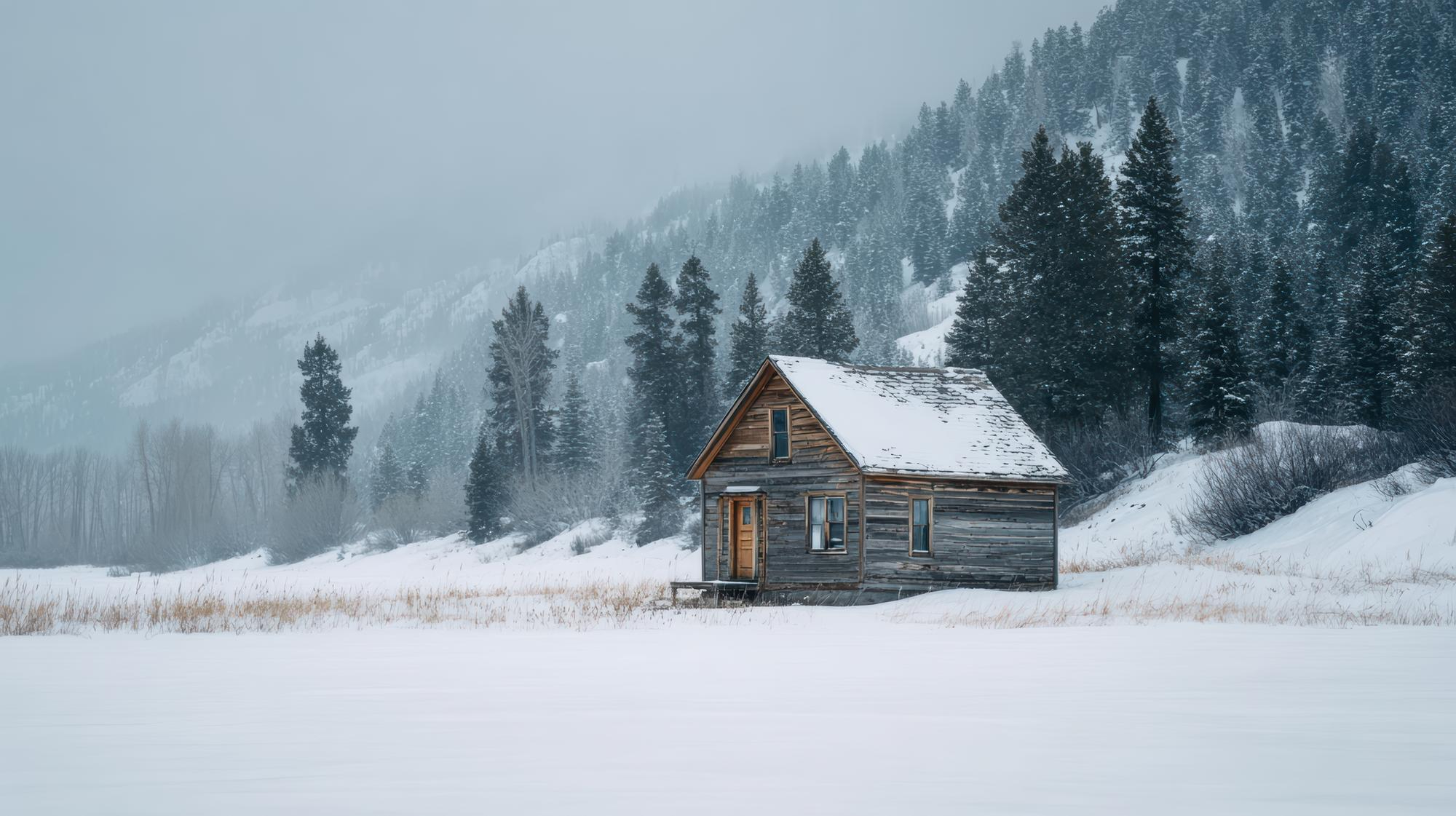
The cabin appeared through the trees as a dark shape against the white landscape. When I got close enough to see it clearly, my heart sank in the specific way that confirmed what I had already been afraid of.
The roof was crooked and visibly rotted. One window had been completely shattered and replaced with nothing, just an empty frame. Deep claw marks scored the front door. The porch steps groaned under my weight with the sounds of things about to fail.
Inside was worse. Mold, rot, the ruins of furniture that mice had finished, a fireplace that had rusted through. I stood in the middle of the room and tried to locate the thing inside me that had made me book the ticket. It was still there. Small, but there.
I unrolled my sleeping bag in the corner where the wind came through least and made a fire with materials I had brought, and I lay there in the dark listening to the wind outside while every voice I had been trying to outrun found me in the silence. My father’s tone when he moved past my essays. Derek’s ring bouncing on the kitchen table. Savannah’s polite condescension, always wrapped in language that sounded generous.
Then my grandfather’s voice. What others throw away might be what lasts longest. Never let anyone else decide your worth.
I had been eighteen when he said that. I had filed it under things adults say. Now, lying in a rotting cabin in Alaska, I understood he might have meant something specific.
I slept badly and woke to gray light coming through the broken window.
My first instinct was to call a realtor, take whatever anyone would offer for the land, and go home. My second instinct was to open my notebook and start writing down what I saw.
I chose the notebook.
I spent the morning cleaning. Not because it was rational, not because I thought sweeping a ruined floor was going to solve anything, but because it was the only thing I could control and control was what I needed. I swept, I stacked, I cleared. I worked until sweat was soaking through my layers.
By late afternoon, the cabin had not transformed into anything. But I felt different inside it.
On the third day, I was cleaning the living room floor when I noticed something.
Most of the planks were gray with age and moisture, consistent with decades of neglect. But in the center of the room was one board that was different. Darker wood. Grain running opposite to the others. Fixed in place with old hand-forged nails instead of the industrial ones holding everything else.
I knelt and knocked on it with my knuckle.
Hollow.
I pulled back the handwoven rug that covered part of the floor, got my fingers under the edge of the different board, found a rusted iron ring I had missed, and pulled.
The board came up with a crack of resistance. Dust rose into the air.
Wooden stairs led down into darkness.
I tested the first step. It held. I went down slowly, flashlight in one hand, other hand on the rough wall.
The cellar was larger than I expected. Stone walls, low ceiling, cold enough that my breath made clouds. My flashlight moved across the space and found wooden crates stacked in one corner, each stenciled with faded letters: Mercer Co. Beside them were metal chests with rusted locks.
I opened a crate.
Gold coins, stacked in cloth bags tied with rope. I picked one up. The weight of it was unexpected, the specific heaviness of real precious metal that I had no prior reference for. I opened another bag. Silver bars. A bag of cut stones set in antique jewelry. I stood there for what was probably a long time.
At the far end of the cellar was a larger chest, separate from the others, its leather covering cracked with age.
I forced it open.
Inside were ledgers. Leather-bound, thick, the pages yellowed and fragile at the edges. I opened the first one.
Elias Mercer’s handwriting, precise and clear. Page after page documenting timber rights across thousands of acres of Alaskan forest surrounding Talkeetna. Maps with exact legal boundaries. Everything annotated with dates and signatures.
The second ledger held lease contracts for mineral extraction. Lithium. Antimony. Rare earth elements. Signed decades ago, all with annexes showing annual royalty payments and renewal clauses that were still operative.
A third covered pipeline rights-of-way across Mercer land. Long-term contracts with fixed fees, still generating payments.
The probate documents at the back of the chest confirmed the chain of title through generations.
And now to me.
I sat on the cold stone floor for a very long time with the ledgers in my lap and my back against the stone wall. The flashlight was propped up on a crate, casting the space in a flat white light that made everything look clinical. I worked through the numbers methodically. I am not an accountant by training, but I have a precise relationship with numbers because precision was one of the few things I had learned from my father that was actually useful.
The physical assets in the cellar: several million dollars at conservative estimation, based on current gold and silver prices I looked up on my phone, which had just enough signal in the cellar to return results. The ongoing contracts and rights: a different order of magnitude. Timber rights across thousands of acres of Alaskan forest, still generating fees. Mineral extraction leases for lithium and rare earth elements, which had been worth relatively little when Elias signed them and were now worth considerably more. Pipeline rights-of-way with fixed fees and automatic renewal clauses that had been renewing quietly for decades.
The number that kept appearing on my phone screen, when I added everything together and checked my arithmetic and then checked it again, was somewhere above eighty million dollars.
I put the phone face down on the stone floor.
I looked at the crates and chests and ledgers arranged around me in the cold underground room.
My entire life I had been handed the message that I was the lesser daughter, the one who got the consolation version of everything, the one who understood that the best things had already been given to someone else before she arrived. I had absorbed this so completely that I had applied it to myself without question. Of course I got the cabin. Of course Savannah got the mansion. The assignment matched my assigned position in the family.
But my mother had seen something different. She had seen what I was actually capable of, in the specific way that requires watching quietly for a long time. She had seen that I was someone who could sit in a cold rotting cabin for three days and decide to stay. Someone who would clean before she assessed. Someone who would notice the different board in the floor instead of walking over it. Someone who, when she found something this significant, would document it carefully and move slowly and tell no one until she had legal protection in place.
She was not wrong about Savannah. Savannah would have posted the gold coins on Instagram within the hour. Not from malice. Simply from the natural impulse of someone who has always shared her life publicly and for whom the value of an experience partly consists in other people knowing about it. That was not a character flaw. It was simply who she was, and who she was would have been catastrophic for this particular inheritance.
I found my mother’s letter tucked against the back cover of the last ledger. She had placed it there knowing I would reach the last ledger last, that I would have read everything else before I read her words, that by the time I found the letter I would already understand what she was telling me.
She wrote that my father had not been blind. That he saw in Savannah the sparkle that easily convinces the world and opens doors quickly. That he saw in me endurance and patience and the kind of strength that does not need to announce itself to be real.
We didn’t choose who we thought needed this most, she wrote. We chose who we thought could protect it.
She wrote that she hoped I had not spent my life believing that their silence meant indifference. She wrote that sometimes faith looks like silence from the outside.
I pressed the letter to my chest. The cold came up from the stone floor and the cold came down from the ceiling and I sat in the middle of it and allowed myself to feel everything that the letter contained.
My parents had watched both of their daughters carefully for thirty years. They had made a deliberate, considered choice. They had not given me the lesser inheritance. They had given me the one that required me to be exactly who I was.
That understanding did not erase the years of feeling invisible. It did not make the football games where my essays went under the pizza box into something other than what they were. It did not transform my father’s distracted nods into the full attention I had wanted from him. The past was still the past, and the past contained real losses.
But it added something that the past had not previously contained, which was the evidence that I had been seen. Not always, not by everyone, not in the ways I had needed. But finally, completely, by the people whose seeing mattered most.
I had spent my entire life believing I was the overlooked daughter. That I was the one who got the leftovers, the consolation, the polite smile. And all along there had been this. Not just the money, not just the gold and the contracts and the decades of accumulated rights. But the choice. The deliberate, considered choice of two people who had watched both of their daughters carefully and decided which one could be trusted with something that required patience to protect.
I worked for three more days before I left.
I reinforced the trapdoor. I selected a small number of portable items to take to a bank safe deposit box in Anchorage. I photographed and scanned every ledger page, every contract, every map, and saved everything encrypted on an external drive. I made an asset journal with photographs and rough valuations and my own notes, because I had learned from years of working that documentation is what protects you when someone later tries to rewrite what happened.
Then I covered the trapdoor with the rug, made everything look exactly as it had looked when I arrived, and called a lawyer in Anchorage whose name I had found in one of the ledger pages as a referenced contact for Elias Mercer’s estate work. He answered on the third ring and I told him who I was.
His voice changed immediately. “I’ve been hoping you would call,” he said.
When I turned my phone back on fully for the first time since arriving, there were messages from Savannah asking how the glamping was going. There was a message from Derek saying he thought we had reacted too quickly and that he missed me.
I read his message twice. I recognized the calculation behind it, the way someone recalibrates when information they missed becomes available. He did not miss me. He had picked up a signal about Alaska from something, some mention of Elias Mercer’s name or some other fragment, and had decided to keep his options open.
I understood that I was looking at the person he had always been. I had simply not allowed myself to see it clearly before.
I did not respond to either message.
I locked my phone and put it face down on the table and looked out the window at the snow moving through the trees. The cabin was still rotting. The roof still leaked in two places. The window I had boarded up with scavenged wood was not properly sealed.
But I felt more at home in it than I had felt anywhere in a long time.
I flew back to New York carrying an encrypted hard drive, a safe deposit box key, and the sense that the shape of my life had changed in the way that does not feel dramatic when it is happening but that you understand completely when you look back. I retained Priya Shah, who had been recommended to me by the Anchorage attorney, and over the following months we worked through the legal process of establishing my full claim to the estate: the land, the physical assets, the ongoing contracts, all of it.
I did not call Savannah. I did not call Derek. I did not post anything. I understood, without needing to think about it carefully, that silence was the tool. It had always been the tool. I had just never understood before that I could choose it rather than have it imposed on me.
Savannah found out eventually. Not from me. From a cousin who had heard something from a neighbor of a lawyer in Westchester. She called me and the conversation was brief. She wanted to know if there was anything she could do. I told her there was not. She said that she thought the whole thing was handled in a very strange way. I agreed with her that it was unusual, said goodbye, and hung up.
I did not feel vindicated exactly. Vindication implies that someone was wrong to overlook you, and maybe they were, but vindication requires you to have been waiting for the correction, and I had stopped waiting for anything from any of them.
What I felt was something quieter and more stable than vindication. I felt accurate. I felt like I was finally standing in a place that corresponded to what I actually was, rather than what other people had decided I was for their own convenience.
My grandfather used to pick up pieces of driftwood from the riverbank and turn them over in his hands. He would find the ones that had been shaped by years in the water into something no one had designed. He kept a few in the cabin. I found them when I was cleaning and put them on the windowsill where the light hit them in the afternoon.
When the renovation is complete, I plan to keep them there.
Not because they are worth anything in particular.
Because he was right. What others dismiss as worthless is sometimes exactly where the real thing is.
And because I want to remember, every day that I sit in that room and look at them, that he saw it in me before I could see it in myself.
Specialty: Emotional Turning Points
Rachel Monroe writes character-driven stories about betrayal, second chances, and unexpected resilience. Her work highlights the emotional side of family conflict — the silences, the misunderstandings, and the moments when someone quietly decides they’ve had enough.