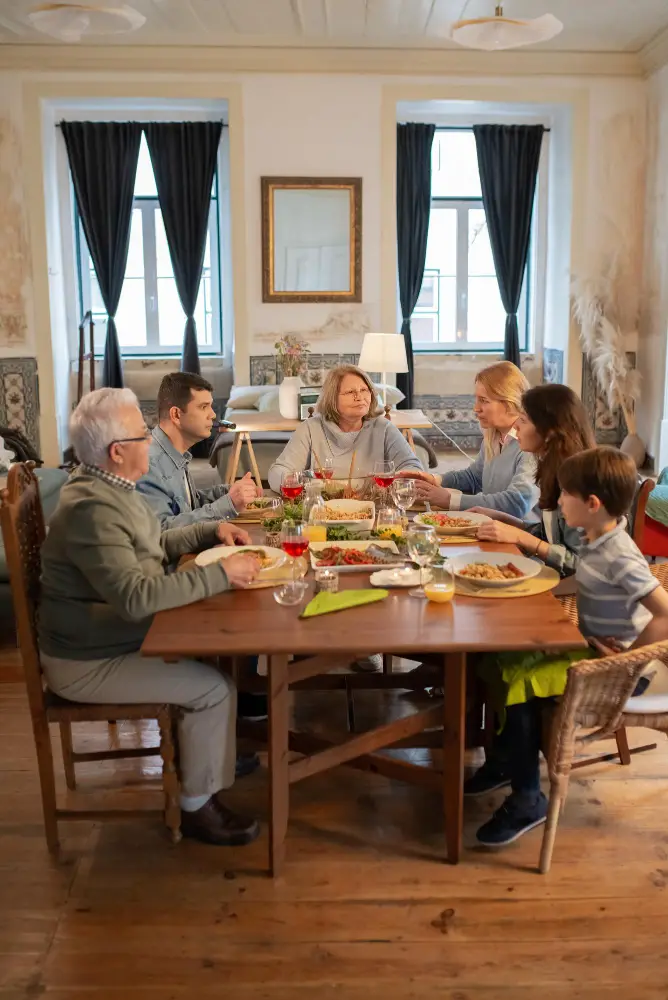
My aunt Sylvia looked across a table full of roast chicken, glazed carrots, and butter rolls and said, “You know, some families count their blessings. Yours counted its children and came up one too many.”
My cousin Becca made the small, satisfied sound she always made when cruelty landed in a room and someone else absorbed it.
My mother reached for her water glass and did not drink from it.
My brother Patrick, who had driven six hours from Portland that morning, went very still at the end of the table.
I set down my fork.
“Sylvia,” I said, “this is my house. I’d like you to leave it.”
The dining room went quiet enough that I could hear the ice maker in the kitchen.
A month earlier I would not have believed I had that sentence in me. But I had spent the last four years learning something that took me too long to understand: that the people who teach us to be silent about our own pain are not neutral parties. They are beneficiaries of our silence. And they count on it being infinite.
I am thirty-one years old. The youngest of two by six years. My brother Patrick got out early: college in Portland, a job that kept him there, a life he built at a comfortable remove from our mother’s side of the family. He came back for holidays and major occasions, which required him to be in the same room as Sylvia approximately twice a year. He had long ago developed the expression of a man eating around a bad piece of food, identifying it quickly and otherwise getting on with his meal.
I stayed close to home because I told myself that was what you did when your parents were aging and your brother was far away and the family pulled on you with the particular gravity of families that need a person to pull on. I spent my twenties cycling through that logic without examining it.
Sylvia was my mother’s older sister by eight years. She had spent those eight years establishing seniority as a permanent condition rather than a chronological accident. She had opinions about everything my mother did: how she cooked, how she raised children, how she decorated, how much she had spent on the house, whether the house itself had been a wise purchase. She offered these opinions as service. She had never been invited to offer them, but she had never required an invitation.
When I was small, I assumed this was how aunts worked. I assumed it was affection expressed as criticism, which was something people said, and I had heard it said enough times that I nearly believed it for twenty years. What changed was the summer my mother got sick, two years ago, and I watched Sylvia’s behavior during that period not as performance but as function. She was not afraid of losing her sister. She was afraid of losing her audience.
The illness was not severe. A diagnosis that required monitoring, medication adjustment, and a period of reduced activity. My mother handled it with characteristic practicality. She reorganized her schedule, attended her appointments, read what the doctor gave her, and asked good questions. She was fine within a few months. But Sylvia had a use for that period that had nothing to do with my mother’s health.
She told family members my mother was worse than the doctors were saying. She implied that Patrick and I were not doing enough. She positioned herself as the one who was truly present, truly concerned, truly stepping up, at a moment when my mother needed managing rather than help.
I had evidence of this only because Ruth, my mother’s neighbor, told me. Ruth is seventy and has no interest in softening things unnecessarily. She said, “Your aunt has been telling people your mother is failing. I thought you should know, because she isn’t, and it seems like something you’d want to stop.”
I confronted Sylvia once. I told her calmly that my mother was well and that characterizing her illness as more serious than it was caused unnecessary worry and distress for people who loved her. Sylvia looked at me with the expression of someone genuinely confused by an objection.
“I was trying to make sure people took it seriously,” she said.
“They would have taken it seriously without you making it worse,” I said.
She told my mother I had been aggressive toward her.
My mother called me to discuss whether I might consider apologizing.
That was when I understood the full architecture of the system I was living in.
I did not apologize. I did not call Sylvia. But I also did not push further, because I could see that the path forward required my mother to choose something she was not yet ready to choose. You cannot protect people from relationships they are not willing to leave. You can only decide what you will tolerate in your own space.
Which brings me to the reunion.
The family gathering had been my parents’ tradition for twenty years: an annual summer dinner, their backyard, thirty or so people covering three generations. My father had died four years ago, and the tradition had continued because my mother found comfort in its continuity, in the fact that something her husband had valued was still happening. I understood that. I wanted to honor it.
This year, my mother’s arthritis had made the planning painful in the literal sense. She could not stand for the hours required to cook for a crowd. She could not carry platters or run between the kitchen and the yard without her hands seizing. She told me in April that she thought she might have to cancel.
I told her I could host it at my house.
She hesitated in the way she hesitated about things she wanted but was not sure she deserved.
“It’s too much work,” she said.
“I want to do it,” I said. “Let me host.”
The hesitation was also because she knew what it would mean for Sylvia to come to my house rather than hers. In my mother’s backyard, Sylvia could critique the vegetable garden and the patio furniture and comment on the state of the fence. In my house, she would have to redirect those impulses. We both knew she would manage.
I had bought my house three years ago. It had been, at the time, more than I could comfortably afford, which was why I had done it anyway: because I had watched what happened to people who waited until they were comfortable, and they waited for a long time. It was a 1940s craftsman in a quiet neighborhood with original woodwork and a kitchen that needed replacing and a yard that needed attention and two bedrooms that had ceilings I’d repaired myself with guides I found online and more patience than aptitude.
I was a freelance technical writer with enough consistent clients that the irregular income had become, over time, fairly regular. I had spent my twenties building that slowly, without announcing it to family members who had opinions about the stability of freelance work. My brother knew. My mother knew in the general sense. Sylvia knew I was “doing something with computers,” which was her way of describing work she did not recognize as real.
The house was mine. That was the part that mattered on the day of the reunion.
I spent the week before cooking and cleaning and buying extra folding chairs. My mother came over the day before to arrange flowers and hover helpfully near the kitchen asking if I needed anything while I was doing things I did not need help with, which is one of the ways people express love, and so I told her I needed her to sit down and tell me about something she had read recently, and she did, and the afternoon was good.
Sylvia and Becca arrived exactly fifteen minutes early, which Sylvia did at events she wanted to inspect before guests arrived to dilute her access. She wore an expression of neutral assessment, the face of someone taking inventory.
“This is sweet,” she said, which was the register she used for things she found less impressive than expected.
Becca walked through to the living room and said, “It’s actually really cute in here,” with the surprised emphasis of someone paying a compliment that cost her something.
My mother arrived shortly after, and then Patrick, and then the rest of the family in waves. The table had been extended with a borrowed leaf. The windows were open. The light in the late afternoon was the specific gold of summer evenings that makes everything look like a decision somebody made with care.
For the first hour, things were ordinary. People drank lemonade on the porch. Becca’s children chased each other in the yard. The older relatives settled into chairs and talked about weather and travel and the general condition of their various joints. Patrick stood near the drinks and talked to our cousin Wes about hockey with the comfortable body language of men who have found each other at a family event and collectively decided this was the conversation they were having.
Then we sat down to eat, and Sylvia began.
It was gradual, because it always was. She asked whether I had made the rolls or bought them in a way that made either answer slightly suspect. She mentioned that the chairs did not quite match, which was true, they were a mix of what I owned and what I had borrowed. She told my mother that the tablecloth she recognized was very sentimental to use for a large gathering where things might spill, which was a way of implying I was using my mother’s things carelessly.
My mother said, “I brought it because I wanted it here.”
Sylvia moved on. She asked about Patrick’s drive. She asked about my work in the specific way that meant she was about to use whatever I said to demonstrate something. I said things were going well. She nodded slowly, which meant she did not believe me but was allowing it.
Then she turned the conversation toward my mother’s house.
She said that someone should probably start thinking about what would happen with it long-term, given my mother’s health situation. She said this as though my mother were not sitting three feet away. She said that these decisions were better made before they became urgent, and that she herself had some thoughts about what would make sense.
My mother’s expression closed slightly, the way it did when she was deciding whether to speak.
Patrick set down his fork. “Mom is right here,” he said. “If you want to have a conversation about her house, you could start by talking to her.”
Sylvia gave him the patient smile she used with people who didn’t understand the full picture.
“I’m talking to the whole table,” she said.
“About my mother’s property,” Patrick said. “While she’s sitting at the table.”
“I was simply raising a practical, ”
“Sylvia.” My mother’s voice was quiet. “I’ll decide what happens with my house.”
Sylvia absorbed this, regrouped, and shifted.
She talked for a while about Becca’s new apartment and how well Becca had settled and how proud she was of how Becca had managed after her difficult year. Becca’s difficult year had involved a lease dispute and a job change, which were legitimate stresses, but Sylvia narrated them as a survival story that required ongoing acknowledgment. Becca accepted this with the comfort of someone who had been centered in her mother’s stories for so long she had stopped noticing it as a choice.
Then, with the ease of someone arriving at a prepared destination, Sylvia turned to me.
“You know,” she said, “Becca has really come into her own. It’s lovely to watch. Some people take longer. Some people need the whole journey to figure out where they fit.”
She smiled at me.
“You’re still on that journey, aren’t you? But you’ll get there.”
I looked at her.
“I’m thirty-one,” I said. “I’m not on a journey. I live here. I own this house. I have a career. I hosted this dinner. I’m not becoming anything, Sylvia. I’m already something.”
She laughed, pleasantly. “Of course you are, sweetheart. I didn’t mean, ”
“And then my aunt Sylvia looked across a table full of roast chicken,” I said, “and told me I was still figuring out where I fit.”
I kept my voice level. “In my house.”
The table was quiet.
Sylvia’s smile held but her eyes changed. “I was paying you a compliment.”
“You were telling me I hadn’t arrived yet,” I said. “In my own dining room. At a dinner I cooked. You were telling me I was still on my way to being something. You’ve been telling me versions of that my whole life, and I’d like you to stop.”
Becca made a small sound.
Patrick looked at his plate and then at me, and the look on his face was not surprise. It was recognition.
My mother set down her napkin.
“She’s right,” my mother said.
I looked at her.
She looked at Sylvia. “You’ve been telling her that for thirty years. Different words. Same meaning. And I let you, because keeping you comfortable was easier than protecting her, and I am ashamed of that.”
The room was very still.
Sylvia straightened. “Carol. I have been nothing but supportive of this family.”
“You’ve been critical of this family,” my mother said, “and when anyone objected, you called it support so we’d feel ungrateful for pushing back. I know how it worked because I let it work on me for forty years.”
Becca looked at her mother. “Mom, maybe we should, ”
“I am not finished,” my mother said, and the firmness in her voice was new enough that Becca stopped.
“I called you last winter,” my mother said to Sylvia, “when my arthritis was bad and I was scared, and you spent twenty minutes telling me about a woman you knew who had gotten much worse and couldn’t manage her own affairs. You called it being realistic. But you knew I was frightened. And you made it worse. Because frightened people need managing, and managing people is where you’re most comfortable.”
Sylvia’s face had shifted through several expressions and settled somewhere between wounded and calculating.
“This is completely unfair,” she said. “I have been here for this family through everything. The funeral. The illness. All of it.”
“You were present,” my mother said. “That’s not the same as being here.”
Patrick leaned forward. “Sylvia, do you remember what you said to me at Dad’s funeral? You pulled me aside and told me I needed to come home more because I wasn’t doing my share. At Dad’s funeral. He had been dead for four hours.”
Sylvia blinked. “I was concerned about your mother.”
“You were concerned about assigning blame,” Patrick said. “There’s a difference, and you know it.”
I looked at Sylvia. Something in me had stopped waiting for her to be different.
“I want you to leave,” I said. “Not because I’m angry. Because this is my house and I don’t want this conversation happening in it. If you’d like to talk later, when things are calmer, I’m open to that. But not here, not today.”
Sylvia looked around the table for an ally.
Becca looked at her lap.
The older relatives had gone very quiet with the particular stillness of people who have witnessed something they expected and dreaded.
“Fine,” Sylvia said. She placed her napkin on the table with a precision that communicated injury. “If this is how we’re doing things.”
She stood. Becca stood after a half-second, caught between loyalty and discomfort.
At the door, Sylvia turned. I had expected a final line, something sharp and retreating. Instead she looked at my mother with an expression that was almost grief.
“I was only trying to keep this family together,” she said.
My mother looked at her steadily. “You were keeping yourself at the center of it. There’s a difference. I think you know that, Sylvia. I hope someday you do something about it.”
The door closed.
The dining room felt larger.
Someone’s child was still playing in the yard, and I could hear them through the open window, running and laughing with the total absorption of children who are not yet available to adult weather.
My mother sat back down. Her hands were in her lap.
Patrick said, “I’ll get more wine,” and went to the kitchen with the matter-of-fact energy of a man who wants to give a room thirty seconds to breathe.
One of the older relatives, my great-uncle Mort, cleared his throat and said, “The carrots are excellent,” and the table laughed in the way people laugh when relief needs an exit.
I sat down.
The food was still warm. The light through the windows had shifted to that deeper gold of early evening. The tablecloth, my mother’s, lay flat and slightly wrinkled from people leaning on it, and I thought: this is what a dinner table is supposed to look like when people have been at it long enough to be honest.
Patrick came back with the wine. He refilled glasses without asking. He sat down, looked at me, and said, “You good?”
“Yeah,” I said.
“You knew this was going to happen eventually.”
“I thought I’d be more scared.”
He considered this. “Were you?”
“No,” I said. “That’s the weird part.”
My mother reached across and put her hand over mine. Her fingers were warm.
“I’m sorry it took me this long,” she said.
“I know.”
“That’s not enough, but it’s true.”
“I know that too,” I said. “We can keep talking about it. Just not tonight.”
She nodded, and something settled in her expression, not peace exactly, but the beginning of it.
We finished dinner. People drifted to the porch as the sky went pink. Someone brought out the dessert I had made the night before, a strawberry cake that came out slightly lopsided because I had pulled it out of the oven seven minutes early in the chaos of final preparations and it had not fully set in the middle. Mort cut himself a large slice and pronounced it the best thing he’d eaten in a year, which was probably not true but was exactly the right thing to say. Becca’s children ate two pieces each and got frosting on everything, including the tablecloth and each other, and nobody minded. It felt like a dinner where people were actually eating rather than performing eating, which was different from how reunions had usually gone.
Patrick helped me wash dishes later, after most people had gone. He had stayed later than he planned, and I had not asked him to. He simply was still there at nine o clock when the last relatives left, refilling the dish rack without commentary, which was the most useful thing anyone had done all day. We stood at the sink in the good silence of siblings who have known each other so long that conversation is optional and presence is the more important thing.
“She’ll call Mom tomorrow,” he said. “Tell her I was confrontational and you were rude and she was the one trying to hold things together.”
“Probably,” I said.
“What’s Mom going to do?”
I thought about what my mother had said at the table, about forty years, about the difference between being present and being here.
“I don’t know,” I said. “But I think she’s decided something.”
Patrick dried a bowl and set it on the counter.
“She has,” he said. “I could see it.”
Two days later, my mother called to tell me that Sylvia had indeed called, and that the call had gone much as Patrick predicted. She said she had listened for about five minutes, and then she had done something she had not done in four decades of this relationship. She told Sylvia she needed some time before they spoke again. She said she delivered this calmly, without explanation or justification, and then ended the call.
Sylvia had said that was very disappointing.
My mother said she could understand that.
Then she had hung up.
She told me this on the phone with the specific quality of someone reporting a thing they are still surprised they did and also entirely committed to.
“How did it feel?” I asked.
She was quiet for a moment.
“Like putting down something very heavy,” she said. “And also like I should have done it a long time ago.”
“Probably both,” I said.
“Probably.”
I was in my kitchen when we talked, standing at the window that looks out over the backyard. The light was morning light, the flat clear kind that shows you things as they actually are.
I had spent a long time in this family as the person who absorbed what it needed not to examine. That is a particular position, the youngest one, the quiet one, the one who manages the atmosphere by removing themselves as a source of friction. It is useful to the people around you and it costs you something invisible and accumulating.
What I had learned, standing in my own dining room with my own tablecloth and my own dishes and my own food getting cold while my aunt explained to me that I was still becoming something: the cost had never been small. I had just been very practiced at not adding it up.
I was adding it up now.
Not with bitterness, exactly. More with the focused attention of someone who has realized they have been carrying a weight they were told was not there, and who is setting it down deliberately, with both hands, in full view.
My house felt different after that Sunday. Not because anything structural had changed. Because I had said, in a room full of people, that it was mine. And for the first time, I had not immediately followed that statement with an apology.
That turned out to matter more than I expected. Not immediately, and not in ways anyone else would notice. But inside the house, in the rooms I had built and painted and repaired, something had shifted from provisional to permanent.
The following week, my cousin Wes texted me. He said, “For what it’s worth, a lot of us have seen this for years. Nobody knew how to say anything. I’m glad somebody finally did.” I thanked him and left it at that.
Becca did not reach out. I did not expect her to. She was managing her own relationship with her mother, which was its own complicated thing, and I had no interest in making it harder by demanding something from her.
The work of repair is slow and it does not always end in resolution. Some people are not going to change. Some relationships are going to remain exactly what they have been, which means they have to be held at a specific distance and greeted with specific expectations. That is not failure. That is accuracy.
What I had been doing for most of my life was treating accuracy as cruelty. Naming what was true and insisting on it felt dangerous, so I had avoided it, and I had called that flexibility, when really it was just quiet participation in my own diminishment.
I am done with that.
This is my house. I built a life in it, slowly and without announcement, which is the only way I know how to build things. I did not need anyone’s recognition to make it real. But I also stopped pretending that recognition did not matter, or that the people who withheld it were neutral parties.
They were not.
They knew what they were doing.
And the biggest shift I made, standing up from that table, was not in what I said to my aunt.
It was in deciding, finally and without apology, that I was done being flexible about what I deserved.

Laura Bennett writes about complicated family dynamics, difficult conversations, and the quiet moments that change everything. Her stories focus on real-life tensions — inheritance disputes, strained marriages, loyalty tests — and the strength people find when they finally speak up. She believes the smallest decisions often carry the biggest consequences.