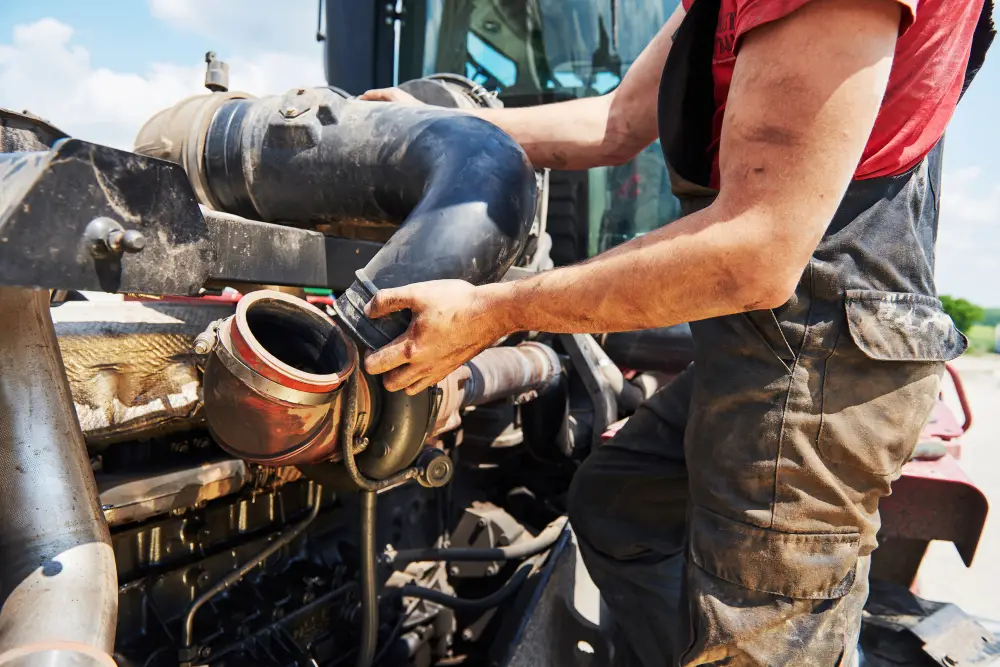
The first person to see the John Deere 4020 creeping down State Highway 19 at three in the morning was a trucker named Bobby Raines, hauling frozen chicken from Wichita to Des Moines. Bobby had driven that stretch of Kansas blacktop for fifteen years. He knew every grain elevator, every leaning fence post. He knew tractors.
He had never seen anything like that.
The tractor was an old 4020, green paint faded to the color of dry sage, yellow wheels rusted at the rims, one fender bent like it had been kicked by a mule. It moved barely twelve miles an hour, hazard lights blinking weakly, muffler coughing smoke like an old man clearing his throat.
Bobby eased off the gas. “Lord have mercy,” he said into his empty cab.
Behind the wheel sat Clay Mercer.
Everyone in Harrow knew Clay Mercer, though most folks did not know what to make of him anymore. Forty-one, broad through the shoulders, quiet in the way men get quiet when life keeps taking swings at them. His family farm sat twelve miles west of town, three generations of Mercer land between Miller Creek and the abandoned co-op road.
And that tractor had belonged to his father.
Everyone also knew it was dead. Not needs-a-battery dead. Not bad-fuel dead. Dead like funeral-home dead. Duke Harlan, the best-known mechanic in three counties, had said so himself. Cracked block, bad pump, seized internals, not worth the wrench grease. He had told Clay in front of six men at Harlan Repair on Tuesday afternoon.
Now, two nights later, that dead tractor was rolling east on State Highway 19 at three in the morning.
By sunrise, half the county would be asking why. By noon, everyone would know. By sunset, Duke Harlan would no longer be the most trusted mechanic in Harrow County.
Clay Mercer did not set out to make a spectacle of himself.
That fall had tested him harder than any season he could remember. The soybeans were late. The corn was too wet. The bank had changed loan officers, and the new one, a clean-shirt man named Trevor Bell, looked at Clay’s farm like a bad asset on a spreadsheet. Then Duke Harlan refused to fix the 4020.
That tractor was not Clay’s biggest machine. It had no air conditioning, GPS, heated seats. But it could run an auger, pull wagons, rake hay, handle every odd job that kept a small farm stitched together. Without it, Clay was stuck. His newer tractor had blown a hydraulic line. The part was delayed. Every day lost meant more beans sitting under clouds ready to split.
Clay had taken the 4020 to Harlan Repair because that was what people did.
Duke was fifty-eight, thick-necked, silver-haired, always smiling like he knew the punchline before anyone else heard the joke. He sponsored Little League, donated to the church barbecue, kept peppermint candies on the shop counter for kids. He gave folks credit when they were short and reminded them of it for years afterward.
Clay’s father, Wade Mercer, had never liked him. “Duke knows machines,” Wade used to say. “But he loves leverage more.”
Duke had looked at the 4020 for fifteen minutes before declaring it finished. When Clay asked about tearing it down to confirm, Duke had laughed. “Clay, you don’t have tear-down money.” The men around the coffee machine went quiet. Duke could insult a man and make it sound like practical advice.
Then Duke mentioned buyers west of Miller Creek. Cash buyers interested in Mercer land.
“My land isn’t for sale,” Clay said.
“Everything’s for sale when the note comes due.”
Clay left without another word. That evening he borrowed a chain from his neighbor Earl Pritchard, a seventy-three-year-old man with arthritis bad enough that he winced getting down from a truck, and dragged the 4020 home. When they reached the farm, Earl sat on the tractor seat a long moment.
“Your daddy would haunt you if you scrapped this machine,” Earl said.
“I’m not scrapping it.”
Earl spat into the dirt. “Duke said a lot of things over the years. You ought to look twice before you believe a man who profits when you quit.”
Clay did not sleep that night. The farmhouse felt too big without his father in it. Wade had died the previous winter, slipping on ice outside the cattle lot. Clay had found him at dawn. After the funeral, neighbors brought casseroles and money tucked in envelopes. For two weeks, people said he was not alone. Then spring came, and everyone went back to their own problems.
At midnight, Clay went out to the machine shed.
He climbed onto the 4020 and rested one hand on the cracked steering wheel. He was eight years old again, riding on the fender while his father cultivated soybeans. “You listen to a machine,” Wade had told him. “It talks before it breaks.” Then, only a month before he died: “If that 4020 ever quits in a way that don’t make sense, don’t let Duke touch it without you standing there.”
Clay climbed down and opened the hood.
He worked by flashlight. Oil was clean. Coolant low but not empty. No obvious crack. When he opened the fuel line at the sediment bowl, nothing came through. He worked backward along the line until he found a bend near the tank outlet. There, tucked where nobody would notice unless they were looking, was a small brass shutoff valve.
Closed.
The 4020 had not come from the factory with that valve.
He turned it open. Fuel ran.
For the next two hours, Clay moved like a man afraid the truth would vanish if he blinked. He bled the lines, pulled the side cover, found two injector lines loosened just enough to suck air, found the throttle linkage slipped off and rewired wrong. None of it was accidental. None of it was a cracked block.
At 2:11 a.m., he hit the starter.
The engine turned. Coughed. Turned again. A puff of black smoke shot from the stack. Then the old 4020 fired.
Clay stepped back, breathing hard. The tractor shook under the hanging bulb, rattling like a coffee can full of bolts, but it ran. The sound filled the shed and bounced off the empty farmhouse.
Then he saw a pickup stopped on the road beyond the tree line. Headlights off. A big black Dodge with running lights across the roof.
Duke Harlan’s truck.
Ten seconds, neither man moved. Then the truck started and rolled away.
Clay stood with the tractor running behind him and understood something bigger than sabotage had revealed itself. Duke had not simply misdiagnosed the machine. He had expected it to stay dead.
Clay shut the 4020 down and went inside. In the dark, he thought through every conversation of the past month. Trevor Bell suggesting refinancing would be difficult unless Clay considered “liquidity options.” Duke mentioning buyers west of Miller Creek. County Commissioner Reed Talbot asking casual questions at the diner about Clay’s acreage. Survey stakes near the south pasture that nobody admitted putting there.
His father’s words: Duke loves leverage.
He went to Wade’s room, untouched except for dust, and searched the old rolltop desk until he found a cigar box labeled 4020. Inside were repair receipts going back decades, and at the bottom, an envelope with Clay’s name in Wade’s block letters.
Clay,
If you’re reading this, I’m either dead or too mad to explain gentle. Duke Harlan has had his eye on our ground since the railroad spur deal started. He and Talbot have been talking with outside buyers. I don’t have proof enough to hang a man, but I have enough to know they’ll come after farmers who owe money.
Do not sell in a panic. Do not let Duke declare equipment worthless. And if you need proof that he lies, take the 4020 to Rachel Voss at Voss Implement in Colby. She knows these old Deeres better than Duke ever did.
One more thing. I put copies of the Miller Creek easement papers in the tractor manual tube under the seat. Talbot thinks I lost them. I didn’t.
Hold the line.
Dad
Clay read it twice, then read the easement part a third time.
The manual tube was still there, rusted at one end. Inside a plastic sleeve, yellowed but dry, were the papers. He spread them on the workbench.
The Miller Creek spur access road, the one the new grain facility needed for expansion, crossed a strip of Mercer land. A permanent easement had been discussed but never signed. Without Clay’s signature, the buyers could not build the secondary route they wanted.
That was why his land mattered. That was why the pressure had grown. That was why Duke wanted him desperate.
Clay checked the clock. 2:38 a.m.
Rachel Voss was not in Colby anymore. She had opened an independent inspection service in Harrow, working out of an old service bay behind the closed Sinclair station. Her office opened at seven. The bank meeting was at nine. Trevor Bell had given Clay until Friday morning to present collateral documentation or begin default proceedings.
Clay had planned to bring repair records and beg for time. Now he had a running tractor, evidence of sabotage, and papers proving his land was being targeted. But he needed Rachel to inspect the 4020 before Duke could claim Clay had tampered with it himself.
He needed witnesses.
He needed the tractor in town.
His pickup would not make the trip. Earl was seventy-three and Clay would not wake him to drag a tractor that could run on its own. So Clay did the one thing that made no sense unless you understood everything.
He filled the 4020 with fuel, checked the lights, and at 3:02 a.m. drove his father’s dead tractor down the gravel lane and onto State Highway 19.
Twelve miles to Harrow.
The night was colder than he expected. No cab, just open air and vibration. Wind slid under his collar and bit at his ears. The old diesel rattled beneath him, uneven but determined. He kept to the shoulder. Fields lay black on both sides, stubble shining with frost.
At mile two, Bobby Raines nearly put his rig in the ditch.
At mile three, Mrs. Landry’s porch light came on. She was eighty and slept badly. By 3:20, she had called her sister.
At mile four, a sheriff’s deputy named Mason Kline spotted the blinking hazard and pulled behind Clay with blue lights flashing. Mason was thirty, had played football with Clay’s cousin. He approached slowly, then stopped when he recognized the driver.
“Clay?”
“Mason.”
“You know it’s three in the morning? You know you’re driving a tractor on a state highway with one headlight?”
“I do.”
“You got a reason?”
Clay looked at him. He could have explained everything, but not on the shoulder. Not where a radio call could spread before he reached town.
“I need to get this machine to Rachel Voss before seven.”
Mason looked at the tractor. “Thought Duke said this thing was dead.”
“So did I.”
Something shifted in the deputy’s eyes. In a small county, lawmen heard more than they repeated. Mason had heard something about Duke, maybe not enough to act on, but enough to wonder.
“Is it safe?” he asked.
“No,” Clay said honestly. “But it’s moving.”
Mason sighed at the empty highway. “Stay on the shoulder. I’ll follow with lights until town.”
So the dead 4020 kept going, now escorted by a sheriff’s cruiser, blue lights washing the frost-white ditches. By 4:05, phones were buzzing on nightstands across the county.
Duke Harlan got the news from his nephew at the grain elevator.
Duke was already awake. He had been awake since he saw the tractor running in Clay’s shed. He sat in his kitchen with one lamp on, staring at his phone. His wife Marlene stood in the doorway wearing a robe.
“What’s going on?” she said.
“Nothing.”
“Don’t nothing me. You left at midnight and came back looking like you saw Jesus in the ditch.”
His phone buzzed. Reed Talbot. Duke answered.
“Tell me it isn’t true,” Reed said.
“It’s true.”
“How is it running?”
“How the hell should I know?”
“You told Bell it was finished.”
“It was supposed to be.”
Silence. Duke realized too late what he had said.
Reed’s voice dropped. “Fix this.”
Duke had not planned all of it. That was what he told himself. He had simply helped things along. A loose line here. A bad estimate there. A word to the bank. A word to a buyer. Men like Clay were always one storm from losing anyway. Duke only made the storm arrive on schedule.
He grabbed his keys. Marlene watched from the doorway. “Whatever you’re going to do,” she said, “don’t make it worse.”
“It’s already worse.”
At mile eight, the 4020 began knocking. Hard, metallic, under load. Clay eased the throttle. Mason pulled alongside.
“You good?”
“No.”
“How bad?”
“Bad enough. But I’m not stopping.”
The engine temperature climbed. Clay’s fingers ached from gripping the wheel. Twice he smelled hot oil. The old machine did not want to go to town. But he kept thinking of his father’s letter.
Hold the line.
At mile ten, Duke appeared. His black Dodge came up fast, swung into the opposite lane, and stopped sideways across the shoulder half a mile ahead. Mason’s cruiser moved out and stopped between Duke and the tractor.
Duke got out, walked toward Clay. “That tractor ain’t road safe!”
Mason blocked him with one arm. “Back up.”
Duke looked at the deputy like he could not believe a younger man had touched him. “This is county business.”
“This is a traffic stop. And you’re obstructing it.”
Duke’s eyes moved over the engine, the fuel lines, the open side panel. He saw that Clay had found the valve. For one second, fear showed through his anger. Then he stepped closer.
“Clay. You bring accusations into town, you better be ready to prove them.”
“I am.”
Mason told Duke to move the truck. Duke stood still long enough to make it clear he was choosing to obey, not being forced. Then he got into the Dodge and pulled away.
They reached Harrow at 4:54 a.m.
The tractor died thirty feet from Rachel’s bay door. Not shut off. Died. It coughed twice, shuddered, and stopped.
Clay sat still, hands on the wheel. Then he laughed, tired and cracked but real. The 4020 had made it twelve miles and quit at the door.
Mason steered while Clay leaned into the rear wheel, and they pushed it the last few feet by hand.
At 5:10, Rachel Voss arrived in a blue Chevy with a dented tailgate and a thermos. She stopped when she saw them. Dark hair braided under a knit cap, grease permanently shadowed around her fingernails, the expression of someone whose morning has just become very complicated.
Clay handed her Wade’s letter. Rachel read it under the bay light. Her face changed when she reached her own name.
“I knew your dad,” she said quietly. “He came by last fall asking about appraisal standards.”
“He thought something was coming.”
“Wade usually did.”
Clay showed her the easement papers. Then he told her everything Duke had said.
For the next hour, Rachel worked without wasting words. She photographed everything before touching it: the added shutoff valve, the loosened injector lines, the wrongly wired throttle linkage, marks on the fittings. She checked fluids, compression, block surfaces. By 6:20, she had enough. By 6:45, she had a written inspection statement.
No visible evidence of cracked engine block. Fuel delivery intentionally restricted by non-factory valve. Injector lines loosened. Throttle linkage improperly secured. Tractor disabled by external interference, not catastrophic mechanical failure.
Clay read it twice, hands shaking.
“This isn’t the whole war,” Rachel said. “It’s the first shot.”
Outside, cars had begun slowing. Harrow was waking up.
Earl Pritchard arrived at 7:12 in overalls over pajama pants. He stared at the tractor, then at Clay.
“You drove it? All the way?”
“Yeah.”
Earl grinned. “Wade would’ve laughed himself sick.” Then he saw Clay’s face, took the inspection statement, and read slowly. His mouth hardened. “That son of a gun,” he whispered.
By 7:30, six more farmers had gathered. By 8:00, there were twenty. Some came for gossip. Some came with unfinished business. Some had lost land or machinery and never quite understood how the ground had disappeared beneath their feet.
Pete Galloway stepped forward. “Duke told me my combine hydrostat was gone. Offered me eight thousand as salvage. Sold it two months later to a man in Salina.”
“Mine too,” said Linda Carver. “Round baler. He said fire damage. There was no fire.”
“My brother lost eighty acres after Duke appraised his equipment low for Bell.”
The stories did not prove a conspiracy by themselves. But together, they formed a shape.
At 8:25, Clay walked across town to Harrow First Bank. He did not go alone. Earl went with him. Rachel went with him. Deputy Kline walked beside them, not as escort now but as a witness who had seen Duke block the highway. Behind them came farmers in work jackets, seed caps, chore boots, and Sunday coats thrown on in a hurry. Nobody carried signs. Nobody shouted. They simply walked.
Trevor Bell was waiting in the lobby, pale in a navy suit. Duke Harlan stood beside him. So did Reed Talbot.
Clay placed Rachel’s inspection statement on the desk.
“No,” Clay said, to Trevor’s claim that all this was unnecessary. “It seems late.”
Duke picked up the statement. “This is nonsense. She looked at it for an hour.”
Rachel stepped forward. “Long enough to see you lied.”
The lobby went silent.
“Careful,” Duke said.
“I was careful in the report. In person, I’ll say it plain. That tractor was disabled. Not dead. Not cracked. Disabled.”
Reed Talbot raised his hands. “Let’s all take a breath.”
Earl barked a laugh. “Reed, you ain’t had a breath of honesty since 1998.”
Clay placed the easement papers beside Rachel’s statement. “This is why you wanted my land. My father kept copies. The spur road never had a signed easement. You need my ground for the expansion route. You pressured my loan. Duke killed my tractor. Then he suggested buyers.”
Duke slammed a hand on the desk. “You can’t prove that.”
Mason spoke from the back. “I can prove you blocked him on the highway and tried to stop him bringing that tractor in.”
Duke turned. “Stay out of this, boy.”
Mason’s face went cold. “Don’t call me boy.”
Trevor tried again. “Mr. Mercer, the bank has procedures, ”
“The bank has exposure,” Rachel said. “If your collateral decisions relied on fraudulent mechanical appraisals, you have a problem.”
That word changed the room. Fraudulent. It hung in the air like smoke.
Duke laughed. Not his usual shop laugh. Bitter, sharp, ugly. “You people. You think farms survive on sentiment? Old tractors? Handshake deals? Half of you are underwater and too proud to admit it. I didn’t make the world change.”
“No,” Clay said. “You just helped push.”
Duke pointed at him. “Your daddy was a stubborn fool. He died broke and scared, and you’re headed the same way.”
Clay stepped closer before he could stop himself. Earl caught his arm. Duke saw it and smiled.
For a second, Clay was back in the frozen cattle lot, kneeling beside his father. He felt the old helplessness rise. Then he looked through the bank window at the 4020, dead again, parked crooked in front of Rachel’s shop.
It had done what his father needed it to do.
It had talked.
“My father died owing money,” Clay said. “But he didn’t die for sale.”
Duke’s smile faded.
Outside, someone started clapping. Linda Carver. Then Pete Galloway. Then others. The sound grew, not cheerful, not celebratory, but steady. A hard, measured applause that filled Main Street and pressed against the bank windows.
Trevor Bell loosened his tie. Reed Talbot backed toward the side door.
Mason noticed and moved first. “Commissioner, you should stay.”
By noon, the story had left Harrow. By two, state investigators called Rachel Voss. By four, Trevor Bell was on administrative leave. By six, Duke Harlan’s Repair had three sheriff’s vehicles outside and a line of farmers waiting to give statements.
The investigation took months. Duke had not acted alone. He had provided false estimates and low appraisals that helped pressure struggling farmers into selling equipment and land below value. Reed Talbot had fed information to developers. Trevor Bell had steered vulnerable loans toward friendly buyers. Not every failed farm in Harrow County was their fault. Weather still ruined men. Markets still broke backs. But enough damage had been helped along by human hands, and human hands could be held accountable.
The 4020 became briefly famous. People came to see it. Rachel put a hand-lettered sign on the steering wheel: NOT DEAD. JUST TIRED.
The bank paused Clay’s default proceedings and restructured his loan. The developers withdrew. Reed Talbot resigned. Trevor Bell moved away before Christmas. Duke fought everything, claimed misunderstanding, claimed politics, claimed Clay had staged the sabotage. But too many farmers came forward, too many invoices failed to match parts ordered, too many machines had been scrapped and quietly resold. The day Duke’s sign came down from the shop, half the town pretended not to watch.
Clay watched. Not with satisfaction exactly. More like relief mixed with sadness. Duke had been right about one thing: the world had changed. Farming was harder. Small towns were thinner. Old ways did not protect a man simply because he loved them. But love was not useless. Love made Wade Mercer keep papers. Love made Earl Pritchard answer his phone at dawn. Love made Rachel Voss tell the truth even when Duke could have made business difficult.
Love made a tired man climb onto a broken tractor at three in the morning and drive twelve miles through the cold, because quitting would have been easier.
Winter came early. The first snow fell the week before Thanksgiving. Clay stood in the machine shed watching flakes drift past the open door, coffee mug in hand.
The 4020 sat inside, hood up. Rachel had helped him tear it down properly. The engine needed real work. Years of use had worn it thin. But the block was not cracked. The tractor was not beyond saving.
Earl walked in carrying a cardboard box.
“What’s that?” Clay asked.
“Parts.”
“I didn’t order parts.”
“I know.” Earl set the box on the workbench. “Pete had a pump. Linda had filters. Voss found used injectors. I had gaskets.”
Clay looked at him.
Earl shrugged. “Folks wanted to help.”
They stood beside the old tractor. After a while, Earl said, “You know why everybody cares about this thing?”
Clay ran his hand over the faded green hood.
“Because it made Duke look bad?”
“That helped.” Earl smiled. “But no. They care because every one of us has something people told us was dead. A farm. A marriage. A town. A machine. A promise. Most times, folks believe it because they’re too tired not to.”
Clay looked at the 4020.
“And sometimes?”
“Sometimes some fool drives it down the highway at three in the morning and proves everybody wrong.”
In spring, the 4020 ran again.
Not perfectly. It smoked on cold starts and leaked from places Clay had not yet found. The fender still had its bend. The paint was still faded. But when Clay turned the key, the engine caught.
He drove it out of the shed into morning sunlight.
He stopped at the lane where it met State Highway 19 and saw that night again: the frost, the weak headlight, Mason’s blue lights, Duke’s truck across the shoulder, the dark road opening ahead.
Then he looked at the seat beside him. His father’s old seed corn cap rested there. Clay picked it up, brushed dust from the brim, and put it on.
“Come on, Dad,” he said. “Let’s hold the line.”
He eased the tractor into gear.
The 4020 rolled forward, not toward town this time, but toward the field.
And in Harrow County, whenever someone said a thing was finished, too old, too broke, too far gone to save, somebody would eventually bring up Clay Mercer and that dead 4020, and remember how everyone laughed until they learned why, and remember what it left behind.
Sometimes dead things are only waiting for one stubborn person to believe they can still move.

Laura Bennett writes about complicated family dynamics, difficult conversations, and the quiet moments that change everything. Her stories focus on real-life tensions — inheritance disputes, strained marriages, loyalty tests — and the strength people find when they finally speak up. She believes the smallest decisions often carry the biggest consequences.