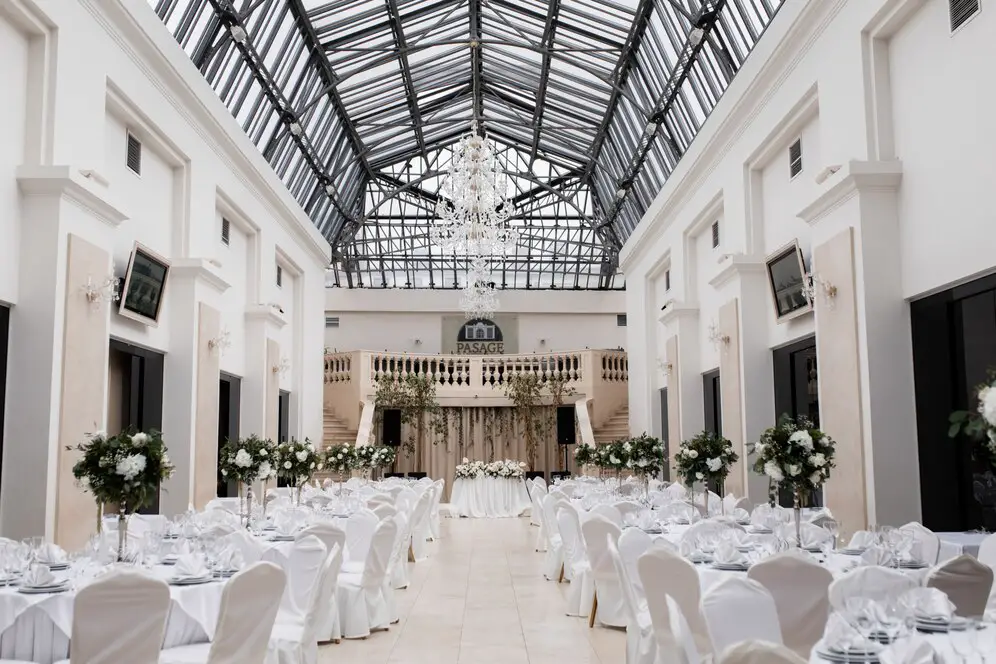
I was standing in my wedding gown only minutes before walking down the aisle when the man I loved erased our future with one sentence.
The chapel bells were already ringing. Two hundred guests filled the pews behind those heavy oak doors, dressed in their finest, whispering about flower arrangements and seating charts, waiting for the music to shift into something processional and sacred. I had been standing in the antechamber for eleven minutes, holding my bouquet so tightly the stems had begun to leave marks on my palms, when Adrian Vale appeared in the doorway.
I knew something was wrong immediately. Not from his expression, which was carefully arranged, but from the way he held his body. Rigid. Apologetic. The posture of a man who has already made a decision and is now simply delivering the news.
“Clara.” He said my name like a warning.
Behind him stood his mother, rigid and regal like a queen carved from ice, pearls shining against her throat. His father stood slightly apart, adjusting his gold cufflinks with the bored impatience of a man who considers other people’s emotions an inconvenience. They had positioned themselves deliberately, I realized. This was a presentation. Choreographed.
Adrian looked into my eyes and said quietly, “I’m sorry, but I can’t marry you. My parents are categorically against such a poor daughter-in-law.”
For one suspended moment, the entire world went silent.
I had spent six months planning this wedding. Six months choosing flowers and tasting cakes and addressing envelopes by hand. I had sewn my mother’s old lace into the bodice of my gown with my own hands, needle and thread at midnight, the fabric soft and slightly yellowed from decades in tissue paper. My mother had worn it at her own wedding in a small church in a town nobody remembers. She had given it to me like a inheritance, like the most valuable thing she owned, because it was.
Mrs. Vale stepped forward. “Don’t make this more unpleasant than necessary. We’ll reimburse the dress.”
That humiliation hit harder than the betrayal itself.
Mr. Vale smiled thinly. “You’re young. You’ll recover. Women like you always do.”
Women like me. He said it the way people say it when they mean something specific and ugly. Poor. Quiet. Grateful for whatever scraps landed near them. That was all they had ever seen when they looked at me. Not a person. A category. An unfortunate temporary detour in their son’s otherwise acceptable life.
I had been to their home thirty-seven times over two years. I had sat at their dinner table and answered questions about my work with careful modesty, knowing instinctively that ambition made Mrs. Vale uncomfortable when she saw it in women who hadn’t inherited it. I had attended their charity functions and stood in receiving lines and smiled at people whose names I memorized because I understood it mattered to Adrian that I fit. I had folded myself small in every room they occupied.
And standing there in my mother’s lace, bouquet crushing in my hands, I understood that none of it had mattered. I had never been a person to them. I had been a problem they were finally solving.
I inhaled slowly until my shaking hands became steady.
Then I smiled.
Adrian visibly flinched.
“Thank you,” I said calmly.
His mother narrowed her eyes. “For what?”
“For telling me before I walked down the aisle.”
I turned before they could see the crack forming beneath my composure.
Outside the antechamber, my maid of honor June rushed toward me, her face already arranging itself into the particular expression of someone bracing for catastrophe. “Clara? What happened?”
I kept moving. “Call the car.”
“Are you crying?”
“No.”
I was. Just not where anyone could see it. I had learned that early, in a childhood where crying in front of people only ever made things worse. You saved it for private places. Bathrooms. Cars. The space between one breath and the next where nobody was watching.
As we passed the open chapel doors, the whispers spread through the guests like something dropped in water. I kept my eyes forward. Adrian’s cousins smirked openly from their pew. His business associates stared. Somewhere behind me, someone actually laughed, a short sharp sound that I filed away carefully.
Mrs. Vale’s voice followed me down the aisle I never walked. “Good girl. At least she knows her place.”
I stopped for exactly one second.
Then I kept walking, chin lifted, white silk trailing across the red carpet like a battle flag carried out of a war that hadn’t gone the way the other side expected.
Inside the car, June grabbed my hand so hard it hurt. “Tell me what you need me to do.”
I stared through the window as the chapel shrank behind us, growing smaller and more ordinary with every block until it was just another building.
Inside my purse, beneath my lipstick and the folded vows I had written myself and would now burn, rested a sealed envelope from the Securities Commission. Next to it sat a flash drive labeled Vale Holdings: Internal Transfers.
I had loved Adrian deeply. Genuinely. The kind of love you build slowly over shared meals and late conversations and the accumulation of small kindnesses. I had loved the way he laughed at his own jokes half a second before the punchline. I had loved his hands and his terrible taste in films and the earnest way he talked about wanting to do something meaningful with his family’s money someday.
But I had also audited his family. That was my job, my actual job, not the modest office-girl version I had allowed the Vales to believe. And what I had found in those accounts had been sitting in an envelope for three weeks while I decided what to do with it.
They had just made that decision very easy.
By sunset, the canceled wedding had become a public scandal. By midnight, the Vale family had transformed it into entertainment.
Mrs. Vale released a statement claiming I had misrepresented my background and that their family had protected Adrian from an unfortunate alliance. The language was careful and legally reviewed and utterly devastating in the way that only rich people’s publicists know how to be. Mr. Vale assured investors the wedding ended because of personal incompatibility, as if a broken engagement were a quarterly earnings miss. Adrian posted nothing at all, which somehow felt worse than the lies. His silence was its own kind of verdict.
The next morning my phone flooded. Gold digger. Trailer bride. You should have known your level. Someone found an old photograph of my mother’s apartment building and posted it with a comment about marrying above your station.
June sat across from me in my kitchen, pacing in the small space between the refrigerator and the table. “Clara, they are destroying you.”
I sat quietly, still wearing the diamond earrings Adrian had given me for my last birthday. They were fake. I had discovered that three months earlier, taken them to a jeweler for cleaning and watched his face go carefully neutral as he examined them. I had put them back in and worn them anyway because I wanted to understand the kind of man who gives a woman fake diamonds and watches her believe they’re real.
Now I understood completely.
“Let them talk,” I said.
June froze mid-pace. “That’s your strategy?”
“No.” I opened my laptop. “That’s their confession warming up.”
The Vales had never bothered to ask what kind of accounting work I actually did. To them I was a low-paid office girl who wore modest dresses and took the bus. The word forensic had never entered their thinking when they thought about me, if they thought about me at all beyond the problem I represented.
They didn’t know the Securities Commission had hired my firm eight months earlier to quietly investigate Vale Holdings after three separate whistleblower complaints had been filed and then mysteriously withdrawn. They didn’t know I had been the lead analyst on that investigation for six of the seven months I had been engaged to their son. They didn’t know that Adrian, trying to include me in his family, had brought me into dinners and conversations and moments of unguarded confidence that had filled in every gap the financial documents left open.
And they absolutely did not know I had a recording of Mrs. Vale, at a dinner party I had attended as her future daughter-in-law, laughing about moving dead money through the charity accounts. She had thought I was in the kitchen. I had been standing just outside the door.
At noon, Adrian called. I answered on speakerphone and let June listen.
“Clara,” he said, his voice carrying that particular softness he used when he wanted something. “My mother crossed a line.”
“Did she?”
“You know how she is.”
“Yes,” I said. “Criminally careless.”
A silence that lasted long enough to mean something. Then: “What does that mean?”
“It means you should stop talking.”
“Are you threatening me?”
“No, Adrian. I loved you. That was my weakness. Threats are for amateurs.”
He ended the call. June looked at me across the table with an expression I had never seen on her face before.
Good. Fear makes arrogant people careless. It makes them move too fast, decide too quickly, reach for the wrong tools. I needed them scared and I needed them moving.
Two days later, Mrs. Vale summoned me to the penthouse. June begged me not to go. I wore black and took the elevator to the forty-third floor.
The penthouse was everything their public reputation claimed to be. Marble floors and floor-to-ceiling windows and art chosen by someone paid to make wealth look like taste. Mrs. Vale sat beneath a chandelier whose cost could have funded a year of the medical charity that bore her name. Adrian stood pale and silent by the windows, looking out at the city like a man hoping it will offer him an exit. Mr. Vale had already poured himself whiskey, which told me everything about how he expected this meeting to go.
“Name your price,” he said.
I smiled faintly. “For what?”
“For your silence,” Mrs. Vale said. “Don’t pretend you aren’t enjoying the attention.”
I looked slowly around the room. The art. The chandelier. The whiskey glass. “You think this is about a broken engagement?”
“Isn’t marriage always the goal for girls like you?”
I placed the folder on the table.
Mr. Vale opened it. The color left his face in a way that was almost interesting to watch, a visible draining, like something had been pulled from underneath him. Inside were copies of wire transfers moving between Vale Holdings and seven shell corporations registered across four countries. Shell corporation ownership maps drawn in my own careful hand. Falsified charity ledgers showing donations received and disbursements made that didn’t add up by eleven million dollars over four years.
His grip tightened around the whiskey glass until I expected it to break.
Mrs. Vale’s smile was gone so completely it was as if it had never existed.
Adrian said my name quietly, the way you say something when you already know the answer but need a moment before it becomes real.
I stood. “You chose the wrong poor girl to humiliate.”
I walked out before they could pivot to negotiation, before they could try to make this a transaction. My heartbreak was not for sale. My evidence certainly wasn’t.
What happened next was almost mechanical. The Vales, frightened and used to intimidation as a first resort, made every wrong move available to them. They contacted my employer with vague allegations about professional misconduct. They hired lawyers who sent threatening letters full of words like defamation and tortious interference. They retained a private investigator who followed me for six days and documented nothing more interesting than my coffee order. Mrs. Vale arranged for a gossip site to publish a piece accusing me of stealing confidential family documents.
Each move was a gift. Every lie they put in writing came with a timestamp. Every threat had witnesses. Every desperate action was evidence of consciousness of guilt, which is a legal concept that juries understand intuitively even when they’ve never heard the term.
I documented everything and added it to the file.
Then Vale Holdings announced its annual charity gala. The invitation went out on heavy cream stock with embossed lettering. Black tie. The Ritz. The theme, with a straight face, was Integrity in Giving. Mrs. Vale appeared on a morning program to discuss the foundation’s work, speaking about transparency and compassion with the practiced ease of someone who has confused performance with character for so long the distinction no longer registers.
I watched it from my office.
Then I sent the complete evidence package, organized into four separate binders with a detailed index, to the Securities Commission investigator assigned to the Vale Holdings case, to the tax authority’s fraud division, and to one investigative journalist I had watched dismantle three other corporate reputations with nothing but documents and patience.
The subject line: The Vale Family Foundation Is a Laundromat.
The gala opened with champagne and a string quartet. It ended in handcuffs.
I arrived midway through Mrs. Vale’s keynote address, which was about stewardship. The midnight-blue dress was June’s idea and she had been right about it. The room noticed me before I had taken ten steps inside. Cameras came up. Whispers moved through the crowd in a wave I could see from across the ballroom. Adrian saw me from the head table and the expression on his face was one I had never seen there before. Not love. Not guilt. Just the particular blankness of a man watching something he had convinced himself wasn’t coming arrive exactly on schedule.
Mrs. Vale tightened her grip on the podium. “Security.”
“No need.” The voice came from the back of the room, and the two federal investigators walked in with the particular unhurried confidence of people who know they are the most important people in any room they enter. The journalist was behind them, phone up, already livestreaming.
Mr. Vale rose slowly from his seat. “What exactly is the meaning of this?”
The lead investigator showed his credentials. “Daniel Vale, Elise Vale, we have a warrant authorizing the seizure of financial records connected to Vale Holdings and the Vale Family Foundation.”
The ballroom erupted. Eight hundred people, all of them donors or board members or civic figures with reputations tied to the Vale name, all of them suddenly understanding they had been in a room with a fraud.
Mrs. Vale pointed at me. “She did this. She stole from us.”
I laughed once. Softly. Just enough to carry.
“No, Elise,” I said. “I documented what you stole.”
June had been at the AV booth for forty minutes. The ballroom screen came alive.
Mrs. Vale’s own voice filled the room. The charity accounts are perfect. Nobody audits sympathy. Then her husband. Move it before quarter close. Keep Adrian’s name completely out of it. Then Adrian, quieter, at a dinner table I had sat at myself. Clara won’t understand. She’s just happy to be included.
The room went completely silent.
Adrian looked as though his skeleton had been removed. His mother lunged for the control booth and the journalist simply stepped in front of the camera and kept filming.
“Mrs. Vale, would you care to comment on allegations that your foundation diverted medical relief donations into offshore accounts?”
A donor in the third row stood up. “My company gave three million dollars to that foundation.”
Another voice from across the room. “My wife chaired a hospital fundraiser that ran through your accounts.”
Mr. Vale moved toward the exit. An investigator was already there.
Mrs. Vale turned to me with everything stripped away, all the performance and pearl-wearing and careful social architecture, and what was underneath was just rage. “You ungrateful little parasite. We were going to let you walk away.”
I stepped closer to her. “No,” I said quietly. “You were going to bury me.”
Adrian came toward me then, tears on his face, and I looked at him the way you look at something you once loved and now simply recognize. The man I almost married. Attractive and weak and expensive and hollow.
“Clara, please. I didn’t know everything.”
“You knew enough to leave me at the altar.”
“My parents pressured me.”
“And you folded.”
That landed differently than an argument would have. He lowered his eyes. He had nothing to say to it because it was simply true, and he knew it, and we both knew he would fold again tomorrow under the right pressure because that was who he was and who he had chosen to remain.
The investigators took Mr. Vale first. Then Mrs. Vale, who fought the arrest with everything she had, screaming about lawyers and family legacy and the people who would hear about this. The pearls snapped somewhere in the struggle, scattering across the marble floor in a wide arc, catching the chandelier light as they rolled.
Nobody bent down to help her collect them.
Three months later Vale Holdings filed for bankruptcy protection. The foundation was dissolved by court order. Donors filed a class action. Four board members resigned in a single week. Mr. Vale was indicted on eleven counts of fraud and money laundering. Mrs. Vale sold the jewelry that remained, piece by piece, to pay legal fees for attorneys who eventually began taking longer to return her calls, and then stopped returning them at all.
Adrian sent me one letter. I recognized his handwriting on the envelope and placed it directly into the kitchen sink and lit a match. I watched it burn completely before I washed the ash away.
One year later I stood at the window of my new office, partner at the firm, looking out over the river in the afternoon light. My mother’s lace hung framed behind my desk, rescued from the wedding gown before I donated everything else. Not as a monument to grief. As a reminder that some things survive what they were put through and come out the other side still worth keeping.
June came in with coffee and sat on the edge of my desk and grinned at me the way she had been grinning since the night of the gala, like someone who got to watch the right ending.
“Any regrets?”
I watched the light move on the water.
I had thought, in those first weeks, that I wanted fire. I had imagined it burning and dramatic, the satisfaction of a single moment where everything reversed and everyone saw. I had lain awake composing speeches I never delivered and imagining expressions I would never actually witness.
But real justice wasn’t a moment. It was a process. Patient and quiet and built from evidence rather than emotion. It was every morning I had chosen precision over panic. Every document preserved and every timestamp noted and every desperate lie they told that I had simply let sit on the record, undisturbed, growing heavier with each passing day.
It was sleeping without the weight of someone else’s opinion of my worth pressing down on my chest. It was cashing a paycheck that reflected what I actually knew and what I had actually built. It was watching people who had called me poor discover that they could not afford the thing that mattered most to them, which was the truth staying buried.
I smiled. “None.”

Specialty: Legal & Financial Drama
Michael Carter covers stories where money, power, and personal history collide. His writing often explores courtroom battles, business conflicts, and the subtle strategies people use when pushed into a corner. He focuses on grounded, realistic storytelling with attention to detail and believable motivations.