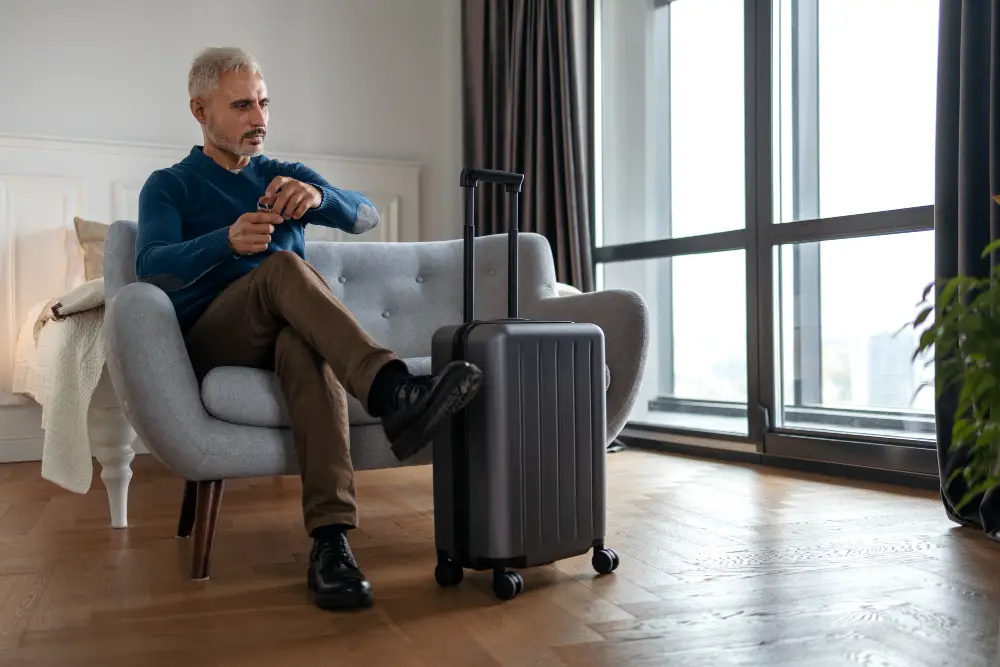
I was dragging my suitcase to the front door on my thirtieth birthday when I realized something did not add up.
Evelyn had never given me anything worth more than twenty dollars. Birthdays, holidays, promotions, she showed up with candles, mugs, maybe a scarf if she was feeling generous. So when she handed me a glossy envelope three days earlier, I thought it was a joke.
It was not.
A seven-day Caribbean cruise. All-inclusive. Ocean-view cabin.
I checked the fine print twice, then a third time. Everything was paid for. No strings attached, at least none I could see. That should have been my first problem.
Evelyn stood by the door now, arms crossed, watching me struggle with my zipper like she was enjoying the show.
“You packed like you’re moving,” she said.
“I don’t trust cruise laundry.”
She laughed, but it did not reach her eyes. It never really did. Then she stepped forward and hugged me.
That alone was enough to put me on alert. Evelyn was not the hugging type unless there was an audience or a purpose.
“You work too hard,” she said softly, right into my ear. “Military life, all that stress. Just disconnect for once. No emails. No work. Just be a normal person.”
“I’ll try,” I said.
“Promise me,” she pressed.
“I promise.”
That was the lie she wanted.
I believed her for exactly fifteen minutes. That was how long it took to roll my suitcase down the driveway and step through the front gate.
Mrs. Galloway was watering her plants across the street. Seventy years old, sharp-eyed, never missing anything that happened on our quiet block. She had watched me grow up, watched me leave for the military, and apparently watched everything in between.
I nodded at her out of habit.
She did not nod back.
She set the hose down and walked straight toward me. Not slow, not casual. Direct. She got close, closer than normal conversation distance, and did not even pretend to smile.
“Pretend you’re leaving,” she whispered.
I did not react.
“But don’t go. Lock your basement door. Stay in the dark.”
No explanation. No small talk. Just instructions.
Most people would have asked questions. I did not, because I do not get paid to ignore warnings. I get paid to survive them.
I gave her the smallest nod, just enough to acknowledge her, then turned and kept walking like nothing had happened. I drove off as expected, made a few turns, kept going until I was out of sight. Then I parked, killed the engine, switched my phone to airplane mode, and powered it off completely.
That was all I needed to decide.
I stepped out, locked the car, and cut through the narrow strip of trees behind the neighborhood. I had used that path as a kid to sneak out. Turns out it still worked in reverse.
I moved quietly. When I reached the back of my property, I paused and scanned the windows. No movement. No shadows. Good.
I circled around to the basement entrance, opened it slowly, and slipped inside without a sound.
Dark. Cool. Safe for now.
I locked the door, moved through the basement without lights, and settled into position near the base of the stairs. Back against the wall, listening, waiting.
Exactly forty minutes after I left, I heard the front door. A faint click, then another. Footsteps. Two sets.
Evelyn walked in first. I could tell by the rhythm. Confident, no hesitation. Vance followed. Heavier steps, less control. They did not come in like guests. They came in like owners.
“What took you so long?” Evelyn asked.
“Traffic,” Vance muttered. “Relax. She’s gone.”
“Good,” she said.
I shifted toward the small security monitor I had installed in the basement years ago, out of habit, never really needing it until now. The feed flickered to life.
There they were. Evelyn dropped her purse on the couch like she belonged there. Vance walked straight to the front door and locked it behind them. Then he brought in equipment. Two hard-shell cases, black with reinforced edges. The kind you do not carry unless you know exactly what you are doing. He set them on my dining table and opened them.
Compact servers. Cables. Portable drives. Signal tools. Not amateur gear. Not even close.
Evelyn walked around the room slowly, looking at everything like she was taking inventory. Then she smiled. Not the fake one she used on neighbors. A real one, sharp and cold.
“We have exactly seven days,” she said. “Before that idiot realizes her military accounts in this house are no longer hers.”
I did not feel anger. Anger is loud. It gets you hurt. What I felt was clarity. Clean. Focused.
I watched as Vance started connecting devices, setting up a workstation right there in my living room. They were not here to take things. They were here to use them. My house. My network. My identity.
Evelyn poured herself a glass of my wine like she was celebrating.
From above, through the crawl-space access behind the storage wall, I had a second angle I had never told anyone about. Not even on paper. I eased the panel open and powered up the internal feed. Three cameras came online. Living room, kitchen, hallway. All mine. Installed years ago. Never mentioned. Never shared.
Vance did not know they existed. That was his first mistake.
I watched him crouch next to my router. No trial and error. Straight to the ports, straight to the wiring. He knew exactly what he was doing. Within minutes he had a parallel system running through my router, a shadow network, isolated, encrypted, and pointed somewhere far outside anything civilian.
Then he inserted a small rectangular device into the reader connected to his rig. My chest tightened just a fraction.
CAC emulator.
That was not something you bought casually. That was something you either stole or built using stolen credentials.
“Connection’s live,” Vance said.
“To where?” Evelyn asked, like she did not care enough to understand.
He smirked. “Let’s just say your sister’s job just became very profitable.”
He was using my IP address. My identity. My clearance. He was knocking on a door he had no right to even look at, wearing my name.
“Your company still that bad?” Evelyn asked, stretching her legs across my coffee table.
“Worse,” he said. “We’re bleeding contracts. No new bids. No leverage.”
“So this fixes it.”
“It fixes everything. Internal bid data, competitor pricing, upcoming contracts. I sell that once, we’re out of the hole. I sell it twice, we’re ahead.”
“And Beatrice?”
He did not even look up.
“She’ll take the fall. Simple. Clean. Disposable.”
Evelyn nodded like that made perfect sense, like I was just a line item in their plan.
She picked up her phone and called my mother on speaker.
Helen answered on the second ring. “Hi, sweetheart.” Her voice was calm, like this was just a casual check-in.
“Their setup is running,” Evelyn said. “Everything’s working.”
My father’s voice cut in from somewhere in the background. “Any issues?”
“No,” Vance said. “We’re in. No flags yet.”
A pause. Then my mother spoke again.
“Just be careful. Beatrice is not stupid.”
I almost smiled at that. Almost.
“She won’t be back for a week,” Evelyn said. “She’s probably already halfway to the Bahamas.”
“She’s going to be angry when she finds out,” my father added.
“She’ll be upset for a while,” my mother said, her tone soft and reasonable. “But when Vance’s company recovers, she’ll understand. Family has to make sacrifices.”
I did not feel anything at first. No shock. No disbelief. Just silence. Because that sentence explained everything. They did not think they were betraying me. They thought they were using me. There is a difference. And it is worse.
The call ended. Evelyn set her phone down and took another sip of wine. “See? Everyone’s on the same page.” Vance grinned. “That makes things easier.”
Yes, it did.
I moved quietly back down into the basement and crossed to the locked cabinet near the far wall. Inside was my laptop. Encrypted. Hardened. Isolated. The kind of machine you do not use unless the situation already went sideways.
They thought they were hacking a captain, accessing her network, using her identity.
They did not know every keystroke, every packet, every move was already being recorded.
And they definitely did not know that the person they were trying to frame was sitting ten feet below them, building the cage they were about to lock themselves into.
My hands moved across the keyboard, steady and precise. I started with the router, then the shadow network Vance had built, then the endpoints he was trying to reach. I did not shut him down. That would have been easy. Instead, I let him in. I just changed where it actually led.
Line by line, I rewrote the path. Redirects, mirrors, dead ends disguised as access points. He thought he was reaching into a secure defense network. What he was really doing was walking into a controlled environment built specifically for him. A box. Sealed. Monitored. Documented.
Because this was not about stopping them. It was about making sure every step they took buried them deeper.
For the next three days, I did not leave the house. I just stopped living in it the way they expected. Day one, I stayed in the basement. Day two, I moved between the basement and the attic. Day three, I barely slept.
The cameras stayed live the entire time. Vance barely moved from his setup. He ate at my table, drank my coffee, and used my network like it belonged to him. Evelyn walked around barefoot, opened my cabinets, complained about my food choices. At one point, she changed the thermostat. That annoyed me more than it should have. I stayed quiet.
I built the sandbox layer by layer on top of the system Vance thought he controlled. From his perspective, everything looked clean. Files available. Directories mapped. What he was actually downloading was curated garbage. Pre-tagged honeypot data. Fake structure. Just enough truth to pass inspection, just enough poison to mark him permanently.
I did not block him. I did not slow him down. I made sure he got everything he wanted. That is how you trap someone like Vance. You do not fight him. You let him win.
Three days in, he got comfortable. That was his second mistake.
He stopped checking for anomalies and started making moves outside the network. I picked it up through a secondary trace. Financial routing, encrypted but not enough. He was moving money. A lot of it.
I followed the trail. Loan structures. Asset leverage. Legal authorization files.
Power of attorney. My name. My signature. Fake, but good enough to pass through a lazy system. Filed two days before the cruise, claiming I was deployed overseas, giving him temporary authority over my assets, including the house.
He did not just plan to use my network. He planned to erase me from it.
The house had already been processed through a fast-track mortgage. Four hundred fifty thousand dollars pending transfer. I followed the destination account. Offshore. Layered. Personal. Not tied to his company.
That was the detail that mattered. This was not about saving a failing business. It was about gambling debts, from what I could see in the secondary traces. High-risk patterns. Short-term spikes. Rapid losses. He was not trying to fix anything. He was trying to escape. And he was planning to leave Evelyn behind, holding the fallout.
I glanced at the live feed. She was on the couch, smiling at her phone. Probably at me.
Every few hours, my mirrored system pushed preloaded images to Evelyn’s phone. Me on a cruise deck, drink in hand, ocean in the background. Timestamped. Geotagged. Clean. Her reply came through seconds later.
A heart emoji. Told you you needed this. Enjoy it, sis.
I closed the feed. Evelyn did not matter right now. Vance was the priority, and Vance had just handed me everything I needed.
I opened the routing layer and rewrote the destination path of the pending transfer. Same account. Same confirmation. Same timeline. The only difference was where the money would actually land. Not offshore. Not in his control. Straight into a secured account tied to the Criminal Investigation Division. Frozen the moment it hit. Traceable. Documented. Permanent.
On day five, I looped my commanding officer in through a secure channel. I had been holding the connection since day two. I sent the data clean and structured, no panic, no noise. His response was simple.
Proceed.
I activated the trigger sequence. A soft escalation, a controlled signal, just enough to make Vance think someone upstream had noticed something. Not a real breach alarm. Not something that would shut the system down. Just enough to change his posture.
It took him forty-three seconds.
His shoulders stiffened. His typing slowed, then stopped.
“What is it?” Evelyn asked without looking up.
Vance stared at the screen like it had insulted him. “That’s not right.”
He started typing again, faster, more aggressive. He was trying to reauthenticate, confirm access layers, figure out if what he was seeing was real.
It was. Just not in the way he thought.
I had already shifted the system into read-only mode. From his side, everything still looked interactive, but nothing he did changed the system. Every file he opened, every command he ran, every attempt to alter or delete anything was just recording him trying.
He tried to delete a directory. The command executed. The confirmation popped up. The files stayed exactly where they were.
He frowned. Ran it again. Same result.
Then he started opening logs, checking system responses, looking for discrepancies. That was when he saw the timestamps. Every move he had made over the past five days, lined up clean and clear.
“No,” he said under his breath. Then louder: “This isn’t possible.”
“Vance, you’re not explaining anything.”
He turned to her, eyes wide, and for the first time since he had walked into my house, he looked unsure. “We’re not alone in this system. Someone’s been watching this the whole time. Logging everything.”
Evelyn sat up. “We need to stop. Just shut it down and leave.”
“We can’t just leave,” he snapped.
“They’ll trace it back here,” he said.
Silence. That landed.
“Then we need to make sure it doesn’t lead to us,” Evelyn said.
She did not hesitate. “We put it on Beatrice.”
Of course.
“Her name. Her credentials. Her house. We just push it in that direction.”
Vance stared at her, thinking, calculating. Then he nodded. “FBI tip line. Anonymous submission.”
“Perfect.”
I did not move, did not interfere, did not stop them. This was exactly what I wanted. I pulled up the mirrored feed and watched every word.
Detailed. Specific. Accusatory. He laid it out like a clean report. Captain Beatrice. Unauthorized access. Selling classified data. Financial motive tied to mortgage debt. He even included the timestamps, thinking they made it more convincing.
What they actually did was tie him directly to the activity. Digitally. Legally. Permanently.
He clicked send and sat back, exhaled, and for a moment he looked relieved. Like he had just saved himself.
I opened a secure channel on my laptop and typed a single message.
Fish took the bait. Start the pull.
I hit send. No hesitation. No second thought.
I parked in my garage two days later and killed the engine without rushing. Seven days. That was how long they thought they had. I sat there for a moment, letting the silence settle before I stepped back into the house I had never really left.
I unlocked the door and stepped inside.
The lights snapped on instantly.
“Surprise!”
All four of them were standing there like a staged photo. Arthur by the table, holding a glass of wine like he owned the place. Helen next to him, smiling too wide. Evelyn front and center. Vance slightly behind her, watching me instead of performing.
Evelyn stepped forward, arms already open. “Happy birthday, sis. Welcome back. How was the cruise?”
“Relaxing,” I said.
Not a lie. Just not in the way she thought.
Helen clapped her hands. “We wanted to do something special. You’ve been working so hard.”
Arthur raised his glass. “To family.”
I almost laughed. Instead I set my suitcase down by the wall.
Vance offered a handshake. “Good trip?”
“Productive,” I said.
He smiled. Small. Confident. He thought he had time. That part was almost impressive.
I took the seat they had set for me. Same spot as always. Like nothing had changed. Like I had not spent the last week ten feet below them watching everything they did. I picked up the glass in front of me and held it without drinking.
“Looks like you all made yourselves comfortable,” I said.
Helen laughed. “We didn’t want the house to feel empty while you were gone.”
Evelyn leaned in. “Did you really stay offline the whole time?”
“Mostly,” I said.
“You didn’t check your work email?”
I looked at her for a second longer than necessary. Then I smiled. Not wide, not warm. Just enough.
“I didn’t check my email,” I said. Relief flashed across her face before she could stop it. “But I did check my router.”
That landed hard.
The room shifted without anyone moving.
“While I was supposedly in the middle of the ocean,” I continued, calm and steady, “someone in my living room downloaded forty-two classified files.”
Silence. No one spoke.
Evelyn’s smile froze. Arthur lowered his glass slowly. Vance did not move. That was the tell. He did not look surprised. He looked caught.
Evelyn laughed, too quick, too forced. “You’re joking.”
“No.”
She looked at Vance. Just for a second.
I reached down and pulled my suitcase closer, unzipped it slowly. The sound cut through the room.
Inside were four navy-blue folders, thick and sealed. I set them on the table one by one.
“Timeline,” I said, opening the first. “Day one through day five. Every access point. Every command. Every connection made through my network.”
I turned a page. “Day one. Nineteen forty-three hours. External hardware connected to my router. Unauthorized network bridge established. Source device registered under your system, Vance.”
He did not look at me.
“Day two. Authentication attempts using a CAC emulator. Multiple access requests directed toward defense network endpoints. Logged. Verified.”
Helen shook her head. “This doesn’t make any sense.”
“It makes perfect sense,” I replied. “You just don’t like it.”
I opened the second folder. “Financial records.”
Arthur straightened. Vance finally looked at me.
“Two days before I left, a power of attorney was filed under my name. It claimed I was deployed overseas. It authorized full control over my assets.” I slid the document across the table. “Mortgage leverage. Fast-track approval. House collateralized. Four hundred fifty thousand dollars pending transfer.”
Helen’s hand moved to her mouth.
“You knew,” I said, looking directly at my parents.
They did not answer. That was answer enough.
“We were trying to help,” Arthur said finally. “You don’t understand the pressure they’re under.”
“I understand exactly what they’re under,” I said. “Debt.”
I opened the third folder. “Four hundred fifty thousand dollars, pending transfer, routed offshore.”
Evelyn looked up sharply. “Offshore?”
Vance shifted. Just slightly, but it was enough.
I saw it. So did she.
“It’s part of the plan,” Vance said quickly. “Temporary holding.”
“No,” I said. I closed the third folder and looked straight at Evelyn. “Open the last one.”
I slid it across the table. She stared at it for a moment, then opened it. Page one. Page two. Then page three.
Her eyes stopped moving. Locked. Focused.
She looked up. Not at me. At Vance.
“What is this?”
He did not answer.
“Vance. What is this?”
“Flight confirmation,” I said. “One-way ticket. Switzerland. Departure tonight. No return. No second seat. Just him.”
She shook her head. “No. That’s not—”
“You said we were leaving together,” she said, her voice fracturing.
He stayed quiet. Wrong move.
“You said this was for us,” she pressed.
Still nothing.
“He leveraged my house,” I said. “Took four hundred fifty thousand dollars. Planned to run. Leave you here.”
Evelyn stepped back like the words had knocked the air out of her. Then Vance did what people like him always do when they run out of options. He turned.
Not to me. To my parents.
“This wasn’t just me,” he snapped. “You were all in on this.”
Arthur froze. Helen shook her head immediately.
“You knew,” Vance pushed. “This was Evelyn’s idea. Using her house, her system. You said she wouldn’t check anything.”
“That’s not true,” Evelyn yelled.
Their voices overlapped. Sharp. Loud. Desperate. Blame shifting in every direction.
I did not move. I did not interrupt. I did not need to.
They were doing the work for me.
Vance stepped back, scanning for an exit, and found the front door. He turned and moved fast, too fast for anyone else to react. His hand reached the handle, wrapped around it, started to pull.
A red targeting dot appeared on his chest. Sharp. Steady. Unmistakable.
Everyone froze.
“Go ahead,” I said calmly. “Open it.”
The dot did not shake. Outside, the first flash of blue and red light cut through the curtains. Then another, then a full sweep across the walls.
The door swung inward before Vance could make the choice. Federal agents. They did not need to repeat themselves. The room filled in seconds. FBI first, CID right behind them. Two agents went straight to Vance. One secured his arm. The other guided him to the floor with controlled force.
Another pair moved to Evelyn. She froze for half a second, then backed away.
“Hands where I can see them.”
She lifted them slowly, shaking. “I didn’t. This isn’t—”
Cold metal clicked around her wrists.
Helen gasped. Arthur stepped forward. “Hold on. There’s been a mistake.”
An agent turned toward him. “Stay where you are, sir.”
Evelyn turned, moving fast, straight toward me. She grabbed my arm like it was the only thing keeping her upright.
“Beatrice, please. Tell them I didn’t know. Tell them I was forced into this.”
I looked down at her hand on my sleeve, then back at her face. Real tears this time. Fear does that.
“It was him,” she said quickly. “He made me do it. I didn’t understand what was happening.”
I pulled my arm free. Not hard. Just enough. Then I adjusted my sleeve, deliberate and slow.
“There’s no exemption for family in federal charges,” I said, my voice even. “Not for fraud. Not for what you just did.”
She shook her head. “No. You don’t mean that.”
“I do.”
An agent stepped in and pulled her back. She did not fight anymore.
Vance was pulled to his feet. One of the agents read him his rights, clear, steady, no emotion. He nodded once. Did not say a word.
Evelyn was not as quiet.
“She set us up,” she shouted, her voice cracking.
I looked at her. “You walked in,” I said. “You made the choices.”
She opened her mouth, then closed it.
The room emptied as quickly as it had filled.
Then my commanding officer stepped forward. Uniform clean. Posture sharp. He stopped a few feet away and raised his hand in a formal salute.
“Good work, Captain.”
I returned it. “Thank you, sir.”
“We’ve been tracking this data leak for eight months. Your case gave us everything we needed to close it.”
He glanced toward the door. “Clean execution.”
“Yes, sir.”
“Take the night,” he said. “We’ll follow up in the morning.”
He turned and walked out. No ceremony. No lingering. That is how it works.
The door closed. The lights outside faded. Red. Blue. Gone.
Silence came back. Real silence this time.
I looked at the table, at the broken plate on the floor, at my two parents still sitting there without a word. Then I picked up my suitcase and walked past them without another word.
Two months later, everything settled exactly where it was supposed to.
Vance did not negotiate his way out. His company collapsed within three weeks. No contracts, no backing, no reputation left to protect. Once the investigation went public, every partner he had distanced themselves fast. Nobody wants their name tied to someone who tried to pull classified defense data through a civilian network. He was looking at fifteen years. Federal minimum. He looked smaller in the courtroom photos. People always do when the system they tried to outsmart finally looks back at them.
Evelyn was not in prison, not yet, but still under investigation, still trying to argue she had not known what was happening. That angle does not hold when your messages, your voice, and your choices are all documented. She moved back into our parents’ basement.
Arthur and Helen were not charged. But financial liability does not care about intention. Their names were tied to transactions, to approvals, to silence. Lawyers. Debt. The slow erosion of everything they thought they were protecting. Turns out family sacrifice comes with interest.
As for me, life did not change much on the surface. Same house. Same job. Same routine. Just quieter. Cleaner. No extra noise. No extra people.
That morning I stood on the front porch with a cup of coffee, watching the street like I always did before heading out.
Mrs. Galloway walked past with her hose, heading toward her garden. Same pace. Same routine. She stopped when she saw me. Did not look surprised. Did not ask questions.
I stepped down from the porch. “Thanks,” I said.
She tilted her head slightly. “For what?”
“The warning. That day.”
She looked at me for a second, then back at her plants. “I didn’t warn you. I just told you what I saw.”
“People think being family gives them permission,” she said. “Permission to take. To lie. To hurt. They think it won’t cost them anything. Because you’re supposed to forgive it.” She glanced at me. “I didn’t like the way they looked at you. Like you weren’t there.”
I took a sip of coffee. “They thought I wasn’t.”
She nodded once. “Most people don’t realize who’s watching.”
No smile. No lesson. Just a fact.
She turned back to her plants.
My phone rang as I crossed into the living room.
Unknown number, but I already knew. Federal facility. Inbound call. Evelyn.
I looked at the screen, watched it vibrate in my hand. I did not decline it. I did not answer either. I just let it ring once. Twice. Three times.
Until it stopped on its own.
No message left. No second attempt.
Just silence again.
I set the phone down on the table and stood there for a moment. Not thinking about her, not thinking about any of them, because there was nothing left to process. Everything had already played out. Every choice. Every consequence. Every outcome.
People like to say family is everything. They say it like it is automatic. Like it is guaranteed.
It is not.
Family is not who shares your last name. It is who stands still when it matters. Who tells you the truth when it is inconvenient. Who does not need you gone to feel safe.
There was one thing I knew for sure as I walked toward the hallway.
They thought I would panic when I saw what they were doing. They thought I would react, make mistakes, lose control.
They did not understand something simple.
I do not panic in the dark. I operate in it.
And when everything goes quiet, that is when I do my best work.
I reached back and closed the front door behind me. The lock clicked. Clean. Final. I walked away and let the silence stay exactly where it belonged.

Lila Hart is a dedicated Digital Archivist and Research Specialist with a keen eye for preserving and curating meaningful content. At TheArchivists, she specializes in organizing and managing digital archives, ensuring that valuable stories and historical moments are accessible for generations to come.
Lila earned her degree in History and Archival Studies from the University of Edinburgh, where she cultivated her passion for documenting the past and preserving cultural heritage. Her expertise lies in combining traditional archival techniques with modern digital tools, allowing her to create comprehensive and engaging collections that resonate with audiences worldwide.
At TheArchivists, Lila is known for her meticulous attention to detail and her ability to uncover hidden gems within extensive archives. Her work is praised for its depth, authenticity, and contribution to the preservation of knowledge in the digital age.
Driven by a commitment to preserving stories that matter, Lila is passionate about exploring the intersection of history and technology. Her goal is to ensure that every piece of content she handles reflects the richness of human experiences and remains a source of inspiration for years to come.