I’m Sarah Wilson, twenty-seven years old, the invisible middle child of what everyone called our picture-perfect family. Fifteen years ago, my sister Lauren’s accident changed everything. I say her accident because that is what my parents decided to call it. The truth was something else entirely, and the X-rays eventually said so when no one else would.
Growing up in our affluent Boston suburb, my family appeared flawless from the outside. My father, Dr. Thomas Wilson, was a renowned neurosurgeon at Massachusetts General Hospital. His steady hands saved countless lives, and his name appeared regularly in medical journals. My mother, Diane Wilson, organized charity galas that attracted Boston’s elite while serving on multiple community boards. Our Tudor-style home with its manicured lawn featured regularly in local lifestyle magazines.
Then there were us three Wilson children, each with assigned roles. Lauren, two years my senior, was the golden child. Straight-A record from kindergarten onward, captain of the debate team and the swim team, violin played at near-professional level. Her college applications boasted volunteer work and summer internships at my father’s hospital. Tyler, three years younger than me, was the charming troublemaker. When he set off the school fire alarm in third grade, my parents laughed it off as boys being boys. When he crashed my father’s car at sixteen, they bought him a newer model.
And then there was me. Sarah. The forgotten middle child.
I wasn’t failing, but I wasn’t exceptional either. My solid B-plus average earned brief nods at dinner discussions dominated by Lauren’s achievements. My position on the yearbook committee didn’t compare to leadership roles. I wasn’t ugly or beautiful, just average height, average brown hair, average features that didn’t stand out in family photos.
Those Sunday dinners epitomized everything wrong with us. Mother spent hours preparing Instagram-worthy meals. Father sat at the head of the table, mother at the foot, Lauren and Tyler on one side, forgettable me on the other. We rehearsed acceptable topics. We performed harmony. “Yes, we’re blessed to have such a close-knit family,” Lauren would recite to admiring neighbors. “My parents really support all our individual interests,” I’d echo, though I couldn’t name a single time they’d attended my school art show.
I discovered photography in eighth grade when my art teacher loaned me an old Nikon. Through that viewfinder, I found something my family never offered. Control over what was visible and what stayed hidden. I photographed abandoned buildings, rusted playground equipment, cracked sidewalks. Beauty in imperfection. Everything that would never be allowed in the Wilson family narrative.
As Lauren entered her senior year, her perfectionism intensified. I’d hear her pacing at night, watch her meticulously rewriting notes until her handwriting achieved flawlessness. She calculated and recalculated her GPA, obsessing over valedictorian status. Swimming practices extended by hours. “Yale has been the Wilson family school for generations,” Father reminded her constantly.
The crack started when I won a local arts council photography contest. My series of black and white images capturing negative space, the gap between buildings, the empty chair at a dinner table, earned me first place and a small newspaper feature. For one dinner, conversation centered on me. Father mentioned a client whose daughter attended a prestigious art program. Mother suggested hosting a reception to display my work.
Lauren pushed food around her plate. “It’s just a local contest,” she finally said. “Not exactly Yale material. Photography is a hobby, not a career. Sarah needs to focus on academics if she wants to succeed.”
Just like that, my moment evaporated. Father agreed about practicality. Mother pivoted to Lauren’s upcoming swim meet. I retreated back to invisibility, but not before catching Lauren’s expression. Not triumph. Relief. That was the first time I glimpsed how fragile her perfection truly was, and how threatened she felt by any diversion of attention from her carefully constructed narrative.
Two years later, as Lauren’s senior year pressed toward her Yale application deadline, I was sixteen and finally developing an identity of my own. My friendship with Mia Castillo, the daughter of Mexican immigrants who ran a local restaurant, gave me something my family never had: honesty. My parents predictably disapproved. “Genuine doesn’t get you into Ivy League schools,” Father said. “Connections do.”
Lauren was deteriorating. Dark circles had made permanent homes under her eyes. Her typically perfect appearance showed subtle signs of cracking. Chipped nail polish, hair pulled back instead of styled. During swim meets, her usually flawless technique grew sloppy.
One evening I overheard an intense argument from Father’s study. I lingered outside the partially open door.
“A ninety-two on the physics midterm is unacceptable, Lauren.” Father’s voice carried the cold disappointment reserved for major transgressions. “Yale doesn’t accept students who can’t maintain perfect grades.”
“I’ve been studying constantly.” Lauren’s voice sounded desperate. “I barely sleep anymore.”
“Sarah mentioned seeing you at the mall with friends last weekend,” Mother added.
I froze in the hallway. I hadn’t mentioned seeing Lauren. I’d been at Mia’s house that entire weekend. My parents were using me as a surveillance tool against my own sister, fabricating evidence to maintain pressure.
The next morning, I passed the bathroom as Lauren exited. A small orange prescription bottle disappeared into her pocket when she noticed me. Her eyes, bloodshot and circled, narrowed slightly.
“Did you tell mom and dad you saw me at the mall?”
“No. I was at Mia’s all weekend.”
Lauren studied my face. Something had changed in her expression. A hardness. Calculation replacing confidence. “They’re turning us against each other,” I ventured, trying to form an alliance.
“Stay out of my business, Sarah. Focus on your little pictures and leave me alone.”
Two weeks later came the first physical incident. I was carrying laundry down to the basement when Lauren appeared at the top of the stairs. I barely registered her presence before feeling a hard shove against my back. The world tilted as I tumbled down the wooden steps, landing in a heap on the concrete floor, pain shooting through my wrist.
“Oh my god, Sarah.” Lauren rushed down, face contorted with what looked like concern. “You’re so clumsy.”
My parents appeared at the top of the stairs. “Sarah tripped on the laundry basket,” Lauren explained before I could speak. “I tried to catch her but couldn’t reach in time.”
I opened my mouth to contradict her, but stopped when I saw Lauren’s expression. A silent warning that made my blood run cold. “I guess I wasn’t watching my step,” I mumbled instead.
I began noticing Lauren watching me with strange assessment in her eyes, as if calculating something. Fear grew in my stomach each time I caught that look. I tried convincing myself I had imagined the push, but doubt lingered. When I confided in Mia, she didn’t dismiss me.
“Competitive siblings can get intense,” she said as we sat in her family’s restaurant after closing. “But physical violence crosses every line. Has she always been jealous of you?”
“Jealous of me? She’s the golden child. I’m nobody in our family.”
“Maybe that’s changing,” Mia said. “Maybe your photography is threatening her perfect daughter status. Sometimes the person with everything fears losing it more than the person with nothing fears not gaining it.”
I dismissed the theory until the morning I found my photography portfolio destroyed. The custom folder containing prints for my school application lay on my bed, water damage warping the photos beyond repair. My memory card containing digital backups was missing from my desk drawer.
“Did you do this?” I demanded, barging into Lauren’s room and holding up the ruined folder.
Lauren looked up from her laptop, Yale application essays displayed on the screen. Her expression shifted from irritated to something colder. “Do what?”
“My portfolio is ruined. Someone poured water on all my prints and stole my memory card. This was my future, Lauren.”
She closed her laptop and stood, suddenly seeming taller. “You think anyone cares about your stupid pictures? You’re nothing in this family. I’m the one with real talent, real potential.”
Her words struck with precision, targeting insecurities she’d observed over years of living alongside me while never truly seeing me. I backed toward the door. “Mom and dad will hear about this.”
“Tell them,” Lauren shrugged with supreme confidence. “They’ll assume you left water too close to your precious pictures. Careless Sarah, always daydreaming instead of paying attention.”
She was right, and we both knew it. My word against Lauren’s had never been a fair contest in our household.
I climbed out my bedroom window onto the small section of roof that had become my secret refuge over the years. The crisp October air bit through my thin sweater. I sat there hugging my knees until I heard Lauren’s voice behind me.
She stood at my window, one leg already through. “Can we talk?”
Her expression appeared contrite in a way I hadn’t seen before. Lauren never apologized. She justified or redirected blame. Something was wrong with this performance.
“I’m sorry about your pictures,” she offered, voice soft. “I was stressed and took it out on you.” She pulled a small orange bottle from her pocket. “I need these just to keep up with expectations.”
I leaned forward and read the prescription label. Adderall. Prescribed to someone named Jennifer Morris, not Lauren Wilson.
“You’re taking someone else’s prescription drugs. Lauren, that’s dangerous and illegal.”
“Everyone just judges instead of understanding,” she snapped, the mask of contrition slipping.
“I’m trying to understand. But this isn’t healthy. We should tell mom and dad.”
“Tell them what?” Lauren laughed bitterly. “That their perfect daughter is actually a fraud? That I can’t handle their expectations without chemical assistance?”
“Maybe that’s what needs to happen. Maybe they need to see the real consequences of the pressure they put on us.”
“Easy for you to say,” Lauren’s voice hardened as she stood. “They barely have expectations for you. I’m the one carrying this family’s legacy. I’ve worked too hard to let anything threaten my future. I’m going to Yale. I’m going to be successful, and nothing will stand in my way.”
Something in her tone sent warning signals through my body. I shifted subtly, creating more distance between us on the narrow roof section.
“Lauren, you’re scaring me.”
“I’m scaring myself,” she admitted, with an unsettling calm replacing her previous agitation. She stepped closer as I instinctively moved back. “But I figured it out. The problem isn’t the pills or the pressure. It’s the distractions. Like your sudden interest in art school and everyone making such a big deal about your photography.”
My back pressed against the dormer window. Retreat was impossible. Lauren stood between me and the open window I’d climbed through.
“What are you saying?” I asked, though something primal in me already recognized the danger.
“I’m saying that sometimes problems require permanent solutions.”
Her movement was swift and precise. Hands connecting with my shoulders in a powerful push that left no doubt about intent. There was a suspended moment where I teetered on the edge, arms windmilling desperately for balance. Lauren’s expression contained no anger, only cold resolution.
Then gravity claimed me.
The fall lasted both an eternity and an instant. The scrape of roof tiles against my grasping fingers. The startled expression of our neighbor walking her dog. The blue October sky spinning overhead. Then impact. My body connecting with the stone patio two stories below. Pain exploded everywhere at once, then receded into strange numbness.
Through tunnel vision, I saw Lauren’s panicked face peering from the roof, genuine horror replacing her previous determination. Then she disappeared.
Consciousness came in waves. Father’s clinical voice, possible pneumothorax, definite pelvic fracture. Mother’s wailing, “What will people think? What will we tell everyone?” Lauren’s rehearsed story to the paramedics: “She was taking photos on the roof. I tried to warn her about getting too close to the edge.”
The last thing I remember before surrendering to darkness was Father’s voice, detached and professional. “My daughter had a photography accident. Yes, the middle one. Sarah.”
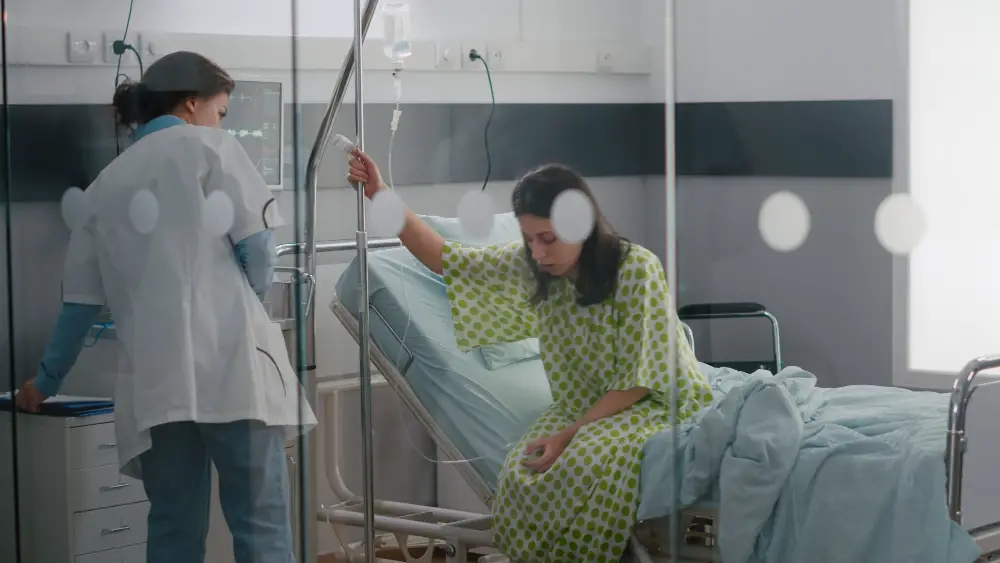
I woke in a hospital room to the rhythmic beeping of monitors. Inventory of injuries: broken ribs, punctured lung, fractured pelvis, concussion, countless contusions. My body broken and betrayed, not just by the fall, but by the hands that caused it. Mother and father flanked my bed like sentinels of narrative control. Their story was already prepared. Sarah slipped while taking photos. A tragic accident born of carelessness rather than deliberate action.
A young police officer arrived to take a routine statement. Father explained smoothly before I could speak. Mother quickly interjected when I opened my mouth: “She’s heavily sedated. The doctors say confusion is normal with concussion. She doesn’t remember the fall.” The officer left with a fabricated account.
Later that evening, after mother stepped out, Father closed the hospital room door and sat beside my bed. His expression wasn’t concerned or loving. Just coldly pragmatic.
“Lauren’s future can’t be ruined by your carelessness. Yale wouldn’t accept her with this hanging over her.”
“She tried to kill me,” I managed through cracked lips.
“Don’t be dramatic. Lauren lost her temper and you were injured. Regrettable, but not criminal. We’ll handle this privately as a family.”
“She tried to kill me.”
“Lauren has her Yale interview next week. Your recovery will take approximately the same time. Everyone gets what they need.”
“What about justice? What about my safety?”
Father sighed and checked his watch. “What would pressing charges accomplish? Lauren would lose her Yale acceptance. Our family name would be tarnished. Your mother’s position in the community would be compromised. My patients might question my judgment.” He stood and straightened his designer tie. “Consider this a painful life lesson. Perhaps reconsider your college plans. Premed at Boston University would keep you close to home during recovery.”
Mia sneaked into my hospital room during a rare period when both parents were absent. “Your mother tried to block my visits,” she said, placing a small gift bag on my bedside table. “Said you needed family-only support during recovery.”
She removed a familiar object from the bag. My camera, miraculously intact. “I found this in the bushes near where you fell. Memory card still inside.”
Before leaving, Mia mentioned a hospital social worker named Mrs. Patel who kept appearing in the waiting room, rescheduled twice by my parents but persistent. “She said she needs to speak with you alone as part of discharge protocol.”
When Mrs. Patel finally gained access to my room, her quiet competence immediately distinguished her from other professionals who deferred to my father’s authority.
“I notice you haven’t said much during family discussions about your accident. I’d like to hear your perspective if you’re comfortable sharing.”
The gentle invitation nearly broke my carefully maintained composure. After days of having my reality invalidated, someone was actually asking.
“I fell,” I repeated the official story. Voice hollow.
Mrs. Patel neither accepted nor challenged this. She placed her business card on my bedside table before leaving. “My direct line is on the back. Completely confidential.”
That small card became a lifeline.
Two months after the accident, I found myself essentially imprisoned in our family home. Lauren had departed for Yale immediately after receiving her early acceptance, conveniently removing herself from the scene. My parents continued reinforcing their version of reality through subtle and overt pressure. Mother redecorated my bedroom while I was hospitalized, removing photography posters and art supplies, replacing them with medical reference books and premed brochures.
My only act of rebellion was secret documentation. When alone, I used my phone to photograph my healing body, the yellowing bruises, surgical scars, physical therapy progress. I recorded voice notes about inconsistencies in my parents’ story. Each digital record created evidence contradicting the official narrative.
In January, during my parents’ annual charity gala, I searched Lauren’s room. After thirty minutes of careful searching, I located a false bottom in her desk drawer containing not one but three prescription bottles, each with different names and prescribing doctors. All performance-enhancement drugs. The golden child’s achievements were as artificially constructed as our family’s perfect image. I photographed the bottles and returned them exactly as found.
College application season approached. My last chance to create a future outside the path my parents had designated. I secretly applied to art schools with Mia’s help, using her address for correspondence.
The facade cracked when April decision letters arrived. Mother casually mentioned the financial aid forms for BU premed were complete. “What about RISD and other art programs?” I asked carefully. Her brief hesitation confirmed my suspicion. “Those applications weren’t submitted. Your father and I decided against encouraging unrealistic career paths during your recovery.”
They hadn’t just pressured me toward their preferred future. They’d actively eliminated alternatives without my knowledge or consent.
The breaking point arrived during Lauren’s spring break visit. While my parents hosted a welcome home dinner, I searched her room again, and found something far more damning. Her journal, carelessly left in her weekend bag. Among descriptions of Yale courses, one entry from shortly after the accident stopped my breath.
Problem solved, with S’s parents completely on board with the accident story. Yale interviewer actually sympathized about my traumatic experience witnessing my sister’s fall. Turned potential disaster into compelling personal essay material. Sometimes solutions require decisive action when too much is at stake.
The clinical description of nearly killing me as “problem solved” triggered an immediate panic attack. I stumbled from her room clutching the journal, gasping for breath. Mother found me collapsed in the hallway and assumed it was a physical recovery setback. The resulting emergency room visit introduced a new doctor to my case, Dr. Rivera, an attending physician unfamiliar with my father’s influence network.
“Your symptoms suggest an anxiety attack rather than physical regression,” she said after initial assessment. “But I’d like updated X-rays to ensure no complications with your healing fractures.”
As technicians positioned me for fresh images, Dr. Rivera reviewed my medical file with increasing focus on the original injury documentation. Something in her expression suggested professional concern beyond routine follow-up.
“I’d like to discuss these results privately,” she announced, glancing pointedly at my mother, who had maintained her position beside the exam table.
Once alone, Dr. Rivera positioned the X-ray films side by side on the lightboard.
“Sarah, I’m going to speak directly. These injuries don’t match a simple fall. The angle of impact suggests you were pushed.”
The professional validation of reality I’d been denied for months broke something inside me. Tears came without warning. Months of suppressed truth seeking release.
Through broken sentences and occasional sobs, I revealed everything. Lauren’s escalating behavior, the roof confrontation, the deliberate push, my parents’ orchestrated cover-up. As my account unfolded, Dr. Rivera took careful notes without judgment or disbelief.
“This explains the discrepancies in your initial treatment notes,” she confirmed. “The fracture patterns and impact trauma never aligned with an accidental fall narrative.”
I reached into my bag and withdrew the evidence I’d been gathering for months. Lauren’s journal entry, carefully photographed. The photo from my camera’s memory card showing Lauren’s expression just before the push. My documented recovery photos showing injuries inconsistent with the reported accident.
“I’m not confused,” I stated, voice steadier than I’d thought possible. “Lauren pushed me because I threatened to reveal her prescription drug abuse. You covered it up to protect her Yale admission and your reputations. Everything I’ve said is true. And now the X-rays prove it.”
Father’s authoritative voice erupted in the hallway, demanding access, invoking professional courtesy and parental rights. When my parents were eventually allowed in, Father immediately recognized the X-rays on the display board and the threat they posed.
“Dr. Rivera,” he addressed her with forced collegiality. “Sarah’s case is being managed by our family physician.”
“These images clarify rather than confuse,” she replied professionally. “They demonstrate injury patterns inconsistent with an accidental fall and highly consistent with applied force. Hospital administration has been notified, and as required by law, I’ve contacted authorities to investigate.”
“This is outrageous,” Father’s voice lowered dangerously. “You’re overstepping professional boundaries based on incomplete information.”
Mother employed her gentlest tone. “Sarah, you’re confused again, mixing up bad dreams with reality. We were there. We know what happened.”
For a moment, lifetime conditioning nearly reasserted itself. The impulse to accept their reality, to doubt my own experience. Then I remembered Lauren’s journal. Problem solved.
“I’m not confused,” I said, and my voice held.
The hospital room door opened to admit hospital security, a police detective, and a family services representative. The formal investigation had begun, setting in motion consequences my family had never anticipated when constructing their perfect facade.
Father delivered a final threat disguised as concern as they were escorted from the room. “Think carefully about your next steps, Sarah. Family should protect each other, not destroy each other.”
The family services representative, a calm woman named Ms. Winters, explained I wouldn’t be returning home while the investigation proceeded. “Is there someone you’d feel comfortable staying with temporarily?”
Mia’s family came to mind immediately. Their warm, modest apartment above their restaurant, the honesty of their household contrasting sharply with the perfectly arranged emptiness of my own.
The legal aftermath unfolded with consequences my parents had desperately tried to prevent. Lauren received probation and mandatory psychiatric treatment rather than prison time. Yale rescinded her admission upon learning the full circumstances, destroying the future my parents had prioritized above my safety. My parents faced charges for obstruction and failure to report. Father’s hospital privileges underwent review. Mother’s social standing collapsed as former friends distanced themselves from the scandal.
The family that had valued appearance above all now experienced exactly what they had most feared: public exposure of their dysfunction.
The investigation uncovered my parents’ deliberate sabotage of my art school applications, but Mrs. Patel connected me with advocacy resources that helped secure a scholarship to the Rhode Island School of Design’s photography program. My portfolio, rebuilt from scratch after Lauren’s destruction, now featured documentary-style images chronicling recovery and resilience.
Tyler, initially confused and angry about revelations concerning his idealized older sister, eventually reached out after three months of silence. At fourteen, he demonstrated remarkable maturity.
“I miss having a sister who doesn’t lie to me,” he admitted during our first meeting at a coffee shop supervised by our grandparents. “Lauren keeps saying everything was a misunderstanding and mom and dad won’t talk about it at all. I just want someone to tell me the truth.”
Our rebuilt relationship became one of genuine connection rather than performed family unity. Weekly video calls and monthly in-person meetings allowed us to create a sibling bond based on honesty instead of hierarchy.
My parents eventually attempted reconciliation on their terms. Private acknowledgment of wrongdoing, but public maintenance of a modified accident narrative. Financial support contingent on family loyalty moving forward.
“We’ve all made mistakes,” Father offered during a mediated meeting. “It’s time to rebuild as a family unit.”
“Some things aren’t mistakes,” I countered. “They’re choices. You chose Lauren’s future over my safety. You chose reputation over truth. You chose appearance over reality. Those weren’t errors in judgment. They were deliberate value decisions.”
Mother’s tears, once so effective at manipulating my compliance, now seemed performative rather than genuine. “We only wanted what was best for everyone.”
“You wanted what looked best to everyone,” I said quietly. “There’s a difference.”
I declined their conditional reconciliation, establishing instead my own terms for limited contact: acknowledgment of full reality without minimization, respect for my independence, and abandonment of the perfect family pretense in favor of an authentic, flawed relationship. “I don’t need a perfect family,” I explained. “I need an honest one. When you’re ready for that, we can try again.”
After six months of court-mandated therapy, Lauren requested contact through her treatment program. Initially reluctant, I eventually agreed to supervised communication with my therapist’s support. Her first letter acknowledged responsibility without excuses.
I thought I was protecting my future by eliminating obstacles, but I was actually destroying everything that matters. No college acceptance or parental approval could ever justify what I did to you.
While not immediately forgiving, I recognized the value of this accountability for both our healing. Our carefully boundaried communication evolved slowly through letters to eventual video calls, each rebuilding basic trust without erasing consequences.
As my first year of college progressed, my photography evolved beyond documentation of trauma. My images examine the spaces between public presentation and private truth, not just in families but in institutions, communities, and cultural narratives. My faculty adviser noted the maturity in my perspective: “You’re not creating voyeuristic trauma art. You’re developing a visual language for authenticity in a world that often rewards performance over truth.”
When offered the opportunity to teach a weekend photography workshop for young trauma survivors through a local advocacy center, I found unexpected healing in helping others find their visual voice. One seventeen-year-old, whose father’s abuse had been similarly concealed by family denial, captured particularly powerful images of locked doors and broken keys.
“Before taking pictures, I couldn’t explain what happened without crying,” he said during our final session. “Now I can show people instead of just telling them.”
His words crystallized something I had been circling for months. Photography isn’t just artistic expression. It’s evidence creation, reality validation when verbal testimony might be dismissed or disbelieved. The X-rays had spoken for me when words failed. Now my camera spoke for others facing similar silencing.
Looking back, I can see the painful irony of my family’s obsession with perfect appearance. In trying to maintain a flawless external image, they created internal brokenness far more damaging than any public imperfection might have been. Their fear of looking bad ultimately created the very public exposure they desperately sought to avoid.
My healing journey continues. Physical scars faded, emotional recovery ongoing. Some days still bring flashbacks, momentary doubts about reality when memories conflict with years of programmed family narrative. But these moments no longer define my future or determine my worth.
The truth remains simple yet profound. Silence protects the wrong people. Speaking the truth, however painful, creates the only path to genuine healing. The X-rays revealed not just my broken bones but something harder to break.
Today, my camera lens focuses on both shadow and light, capturing complete human experience rather than carefully curated highlights. In this approach I’ve discovered not just artistic vision, but life philosophy. Genuine connection requires vulnerability, and true strength emerges not from appearing flawless but from surviving brokenness and choosing honesty over the performance of perfection.
The family I’ve created through chosen relationships provides what my biological family couldn’t. Acceptance without performance requirements. Love without conditional approval. Truth without image management.
I never understood why I was the one hospitalized after Lauren’s accident until those X-rays revealed what everyone tried to hide. The truth always finds a way to surface, even when buried under perfect family portraits and practiced smiles.
It just sometimes takes a doctor willing to look at the actual bones.
Laura Bennett writes about complicated family dynamics, difficult conversations, and the quiet moments that change everything. Her stories focus on real-life tensions — inheritance disputes, strained marriages, loyalty tests — and the strength people find when they finally speak up. She believes the smallest decisions often carry the biggest consequences.