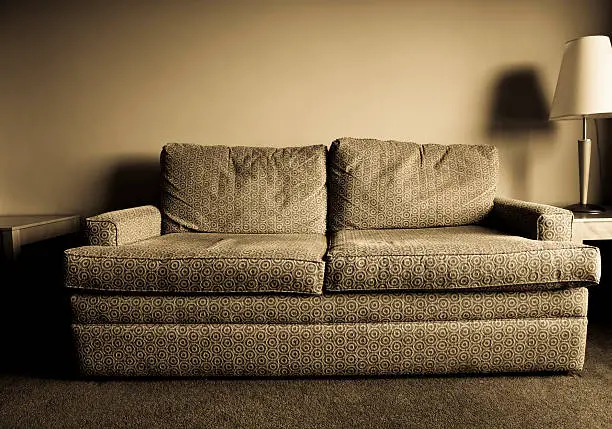
I had spent a long time choosing a new sofa.
It sounds like the kind of decision that shouldn’t require much deliberation, but I am the sort of person who overthinks purchases, especially large ones that are meant to last. My living room is the room I actually live in, the place where I eat dinner when I don’t feel like sitting at the table, where I read on weekend mornings with coffee going cold on the side table, where Jerry and I spend the evenings after his walk with whatever is on television. I wanted to get it right. I visited shops over three consecutive weekends, sat on more sofas than I could count, pressed my palms into the cushions and imagined myself lying across them at the end of a long day. Too soft, too firm, too low, wrong color, wrong dimensions for the corner where the old one had been.
Then I found it, in a small shop on a side street I didn’t usually walk down. Deep grey upholstered fabric, clean lines, solid legs, a firmness that felt supportive without being uncomfortable. I sat on it for several minutes in the shop and felt that particular satisfaction of finding the thing you were looking for. The price was more than reasonable. Significantly more than reasonable, which in retrospect was a detail I should have examined more carefully, but at the time I interpreted it simply as luck.
I paid, arranged delivery for two days later, and walked home feeling pleased with myself in the way you feel when a search that has been taking up mental space finally resolves.
It was only reading the receipt more carefully that evening that I noticed the shop described itself as specializing in refurbished second-hand furniture. On the outside, the sofa had looked completely new. The fabric was clean and evenly stretched, the stitching precise, no visible wear on any surface. I told myself it didn’t matter. Refurbished meant restored. Someone had done careful work and I had gotten a good price because of it. I set the receipt down and didn’t think about it again.
The delivery came on a Tuesday morning. Two men carried it up the stairs with professional efficiency, positioned it in the corner I indicated, accepted my tip, and left. I stood in the living room doorway and looked at it for a while. It looked exactly right. The room felt settled and complete in a way it hadn’t before the old sofa had finally given out and I had spent three weeks sitting on a folding chair while I searched for the replacement.
Jerry came in from the hallway a few minutes later.
I need to tell you something about Jerry before I explain what happened next, because his reaction is the whole story and it won’t make sense without understanding what kind of dog he is. Jerry is four years old, a mixed breed of indeterminate origin, medium-sized with brown and white coloring and ears that can’t decide whether they want to stand up or fold over. He has lived with me since he was eight weeks old and I know his personality as well as I know my own. He is calm. That is the word that everyone who meets him uses. Calm, and quiet, and steady. He greets me when I come home with genuine but measured enthusiasm, wags his tail and presses his head against my hand and then goes back to whatever he was doing. He doesn’t bark at sounds from outside or get anxious when the weather changes or pace the apartment when I am gone. He is, as the woman at the shelter described him when I first went to look at puppies, an easy dog. The kind of dog that fits into a life without disrupting it.
He walked into the living room and stopped in the doorway.
Just stopped. Stood there looking at the new sofa with his body slightly tense and his head low, not moving toward me the way he normally would when I was in a room. Something in his posture was wrong in a way I noticed immediately but couldn’t immediately name. It was the quality of his attention. Focused in a way I had not seen before.
He walked toward the sofa slowly. Head down, moving with the deliberate careful steps of an animal tracking something rather than exploring something. He sniffed the legs first, working around the base in a systematic way that reminded me of something purposeful rather than casual investigation. Then the seat cushions, then the back. Then he came around to the right side, to the armrest, and stopped.
He sniffed it once. Then twice. Then he raised his front paws and began scratching at the fabric with an urgency that made me put down what I was holding and cross the room toward him.
“Did you find your new favorite spot?” I asked, laughing slightly, expecting him to look up at me and abandon it the way he usually does when I engage him.
He didn’t look up. He kept scratching, and then he started barking, short sharp focused barks aimed directly at the armrest, and then he dropped his nose back to the fabric and inhaled deeply and started scratching again. The sequence repeated. Scratch, bark, sniff, scratch. Over and over, with a focus and intensity I had genuinely never seen from him before.
I tried his favorite toy. I held it directly in front of his face and shook it and made the sounds he normally responds to immediately. He ignored it completely, turning his head away and going straight back to the armrest. I tried treats, the small meat-flavored ones that he will do essentially anything for under normal circumstances. He sniffed one, dropped it on the floor, and returned to scratching. I tried physically moving him away from the sofa, gently but firmly, walking him to the other side of the room. He waited until I released him and then walked directly back to the right armrest and started again.
This went on for two hours.
I kept checking the time, genuinely hoping I would look up and realize it had been twenty minutes and I had simply lost track. But it was two hours. In that time he occasionally lay down near the sofa with his chin resting on his front paws and his eyes fixed on the armrest, and I would think he had finally let it go, and then something would pull him back and he would be up and scratching and barking again.
I know Jerry. Three years of living alone with a dog means you know that dog in the way you know a person you are close to. You know the difference between attention-seeking behavior and genuine agitation. You know when something is a performance and when it is not. Jerry is not a dramatic animal. He does not manufacture distress to get responses from me. He had never in three years of living with me fixated on anything the way he was fixating on that armrest, and the longer it continued the harder it became to ignore what that meant.
Unpleasant thoughts began assembling themselves in the back of my mind.
I tried to dismiss them with reasonable explanations. A smell from the shop, perhaps, some cleaning product or treatment chemical that had been used in the refurbishment process. Animals are sensitive to things humans can’t detect. Whatever it was would fade. He would adjust. I tried to hold onto these explanations but they grew less convincing the longer he kept going, the longer he refused every distraction I offered, the longer his entire being remained locked onto that one specific spot on the right armrest of a sofa I had owned for approximately four hours.
Eventually I stopped trying to convince myself there was nothing to find.
I went to the kitchen and got a knife. A small one, with a short blade. I stood in front of the armrest with it for longer than I want to admit, feeling the particular resistance of someone about to do something that cannot be reversed. The fabric was clean and even and I had liked the way the sofa looked in the room. I had spent three weekends finding it.
Then I thought about the two hours. And I cut into the fabric.
It opened cleanly, revealing yellow foam padding underneath. I cut further, deeper, pulling the fabric back from the underlying structure. The padding, then the springs, then the old wooden frame that had been inside this sofa for however long it had existed before it came to me.
And then I saw something black against the interior.
I pulled the fabric further open and leaned closer without thinking, and then registered what I was looking at and stepped back sharply. Coiled in the space between the padding and the wooden frame of the armrest, pressed into the dark interior of the furniture I had been sitting near for the past four hours, was a snake. Long and dark, coiled tightly on itself in the way snakes coil when they are resting or dead. It was dead. It had been dead for some time. The smell that had been sealed inside the upholstery came out the moment the fabric opened, hitting me in a wave that made me move across the room in several quick steps. A dense concentrated smell that explained the faint unpleasant odor I had been noticing since the sofa arrived and had attributed to fabric treatment chemicals or the closed air of wherever it had been stored. It had not been chemicals.
Jerry moved forward to the opening I had made, growled once, low and steady, and then sat back and looked at me.
I disposed of the armrest that evening, carrying the whole section of the sofa out to the building’s waste area wrapped in garbage bags, handling it as minimally as possible. The smell lingered in the apartment for the rest of the night despite the windows being open.
The following morning I called a professional disinfection service. The technician who came was matter-of-fact about it in the way that people who deal with unpleasant things professionally learn to be. He said the snake had most likely entered the sofa during a period of storage, possibly in a warehouse, possibly somewhere outdoor or semi-outdoor, and died inside. Snakes will seek enclosed dark spaces, particularly when they are cold or unwell, and the interior of a piece of furniture in an unheated storage facility would be exactly the kind of space a snake might push its way into through a gap in the fabric or the frame. If that gap was then sealed during the reupholstering process, or if the snake entered after the work was done and the gap closed behind it, the animal would die inside and remain there undiscovered. A surface-level inspection and cleaning would make the exterior look new without revealing anything about the interior.
The sofa had been refurbished. The outside had been made to look brand new. Nobody had opened it up before selling it to me.
He treated the sofa thoroughly and the surrounding area and told me it was clean, and I paid him and thanked him and he left. I sat down on the treated sofa and tried to feel normal about it and mostly succeeded, though I will admit that for several weeks afterward I was more aware of sitting on it than I had been before. That awareness has largely faded now. What happened was unpleasant and strange but it was also finished, cleaned, resolved. Life continued.
I no longer buy second-hand furniture. I understand the appeal of it and I am not passing judgment on people who do. The prices are better, the environmental argument is sound, and the vast majority of second-hand furniture contains exactly what it appears to contain, which is old cushioning and old wood and nothing else. But the shop that sold me that sofa could not tell me what was inside it, because nobody had looked. I could not know what I was bringing into my home. That uncertainty is now something I cannot set aside the way I once could, and so I have simply stopped.
Jerry sleeps on the floor now. He has not gotten onto any soft furniture since that Tuesday, not voluntarily, not once. He makes his circle of the room when he is ready to sleep and lies down on the bare floorboards and stays there through the night. He seems perfectly content with this arrangement. He has made his assessment of furniture and revised his position accordingly, and no amount of encouragement from me has changed it.
I understand him. I understood him two hours before I finally listened to him, which is the part of this story I think about most.
He came into the room and knew immediately that something was wrong. He spent two hours trying to communicate that clearly through every means available to him, and I spent two hours offering him toys and treats and gentle redirection, trying to convince him that his own clear and consistent signal was mistaken. I was so committed to the sofa being fine, to the purchase being a good one, to the room finally looking the way I wanted it to look, that I kept finding new ways to explain away the evidence directly in front of me.
He was right from the first moment he walked through the door. He was right for the entire two hours. And when I finally stopped explaining and started listening, I found exactly what he had been trying to show me.
He’s a good dog. Better than I deserve, probably. The kind of easy, calm, steady animal who tells you the truth without drama and without stopping, and waits for you to catch up.
The floor suits him fine, and I don’t blame him for preferring it.

Sophia Rivers is an experienced News Content Editor with a sharp eye for detail and a passion for delivering accurate and engaging news stories. At TheArchivists, she specializes in curating, editing, and presenting news content that informs and resonates with a global audience.
Sophia holds a degree in Journalism from the University of Toronto, where she developed her skills in news reporting, media ethics, and digital journalism. Her expertise lies in identifying key stories, crafting compelling narratives, and ensuring journalistic integrity in every piece she edits.
Known for her precision and dedication to the truth, Sophia thrives in the fast-paced world of news editing. At TheArchivists, she focuses on producing high-quality news content that keeps readers informed while maintaining a balanced and insightful perspective.
With a commitment to delivering impactful journalism, Sophia is passionate about bringing clarity to complex issues and amplifying voices that matter. Her work reflects her belief in the power of news to shape conversations and inspire change.