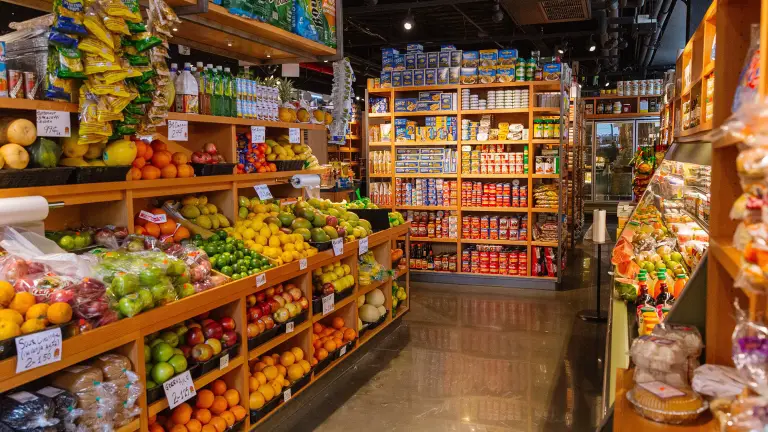
I was already in a bad mood before we even reached the checkout line.
My cramps had been grinding since morning, the kind that wrap around your lower back and don’t let go, the kind that make you walk a little carefully and stand a little still and breathe through your nose in the produce section while your husband drops a family-size bag of chips into the cart without checking the price. I had spent the entire grocery trip managing my face, which is its own kind of exhausting on top of everything else.
By the time we reached the register I wanted nothing except sweatpants and a heating pad and the specific mercy of my couch.
That’s when I discovered my wallet wasn’t in my purse.
I went through the bag once. Lip balm, keys, receipts from last week, the little notebook I always intend to use and never do. No wallet. I tried again, slower, with more hope. Still nothing.
The cashier was already scanning. Ashton was standing beside me doing something on his phone that I can tell you with certainty was not anything urgent.
I picked up the pack of pads I had put in the cart and set them on the conveyor belt separately. Then I leaned toward him and kept my voice low.
“Can you cover these? I left my wallet.”
Ashton looked down at the price tag. Six dollars.
“Seriously?” he said. Not low. “I’m not paying for your little wants. You’re a grown woman. Handle your own stuff.”
The cashier stopped scanning.
The woman behind us, who had been minding her business in the way of a person who has seen a great deal and knows when to pay attention, raised her eyebrows so high they disappeared into her bangs.
I stood there for a moment.
I thought about the eight months the previous year when Ashton was between jobs. I thought about rent, utilities, groceries, his gas, his phone bill, and the interview shoes I bought him because the soles of his old ones had actually separated from the uppers and he needed to look like someone who had things together. I had paid for all of it without tallying anything. Not once had I stood in a checkout line and told him his needs were little wants.
I asked the cashier to remove the pads from the order.
The ride home was quiet.
Ashton drummed his fingers on the steering wheel and seemed to feel that the situation was resolved. I stared out the window and decided what I was going to do about it.
The moment we got home and the groceries were on the counter, he leaned back against the sink with the posture of a man about to say something he considers reasonable.
“You know what, from now on we should split everything 50/50. Fair is fair.”
I looked past him at the laundry basket sitting beside the dryer. At the sink. At the evidence of the dinner I had made three nights running because he forgot it was his turn.
“Deal,” I said.
He grinned.
He thought I was agreeing with him.
The next few days were genuinely interesting to observe. I paid exactly half the rent. I cooked enough food for one person and put my name on the containers in the refrigerator. I washed my own dishes and my own laundry. I bought groceries for myself.
Three days in, Ashton opened the cabinet and found no coffee.
“Where’s the coffee?”
“I paid for my half,” I said. “Yours is probably still at the store.”
He laughed, because he thought I was joking.
I was not joking.
By week two his side of the bedroom chair had developed a structural laundry situation that had taken on architectural qualities. My side remained exactly as I kept it. He came home one evening, opened the refrigerator, and stood in front of it looking at labeled containers.
“You’re seriously still doing this?”
“You wanted 50/50.”
“That’s not what I meant.”
“It sounded pretty clear to me.”
What I was waiting for was for him to understand what the problem actually was. Not that we had different systems for managing household expenses. The problem was that he had stood in a public checkout line and told me that a basic menstrual product was a little want, as if periods were a lifestyle choice I could manage better if I simply applied myself, while being someone who had accepted eight months of my support without once calling his groceries little wants.
What I got instead, two weeks in, was: “Are you still mad about the pads? You’re hilarious. Honestly, I’ve really spoiled you if you thought you could ask me to buy you anything.”
So he hadn’t understood. He thought it was funny. He thought I was oversensitive. He had found a way to frame my reaction as evidence of my own excessive expectations rather than evidence of his.
Fine.
His birthday was coming up.
I offered to throw him a party, and I meant it sincerely in the sense that the party itself was going to be real. I cleaned the apartment. I ordered catered food. I hung black balloons. I invited his coworkers, his friends, his boss Derrick, everyone he would want there. By eight thirty the apartment was full and Ashton was making the rounds with his arm around my waist saying things like see, this is why I married you.
I smiled every time he said it.
Around eight thirty, Mia, who was married to one of his work friends, helped me carry out the cake.
It was a good cake. Chocolate frosting, gold candles, bakery quality. Ashton clapped his hands when he saw it.
“Now THAT is a birthday cake.”
“You have to cut it,” I said. “There’s a surprise inside.”
He picked up the knife with the confidence of a man who has never once had cause to be suspicious of a birthday cake. The room gathered around.
He cut into the center.
And stopped.
The smile left his face in stages.
Inside the cake, sitting in a nest of frosting, was a small plastic package. A Lammily Doll Period Party Kit: a miniature educational toy designed to teach children about menstruation, complete with a doll, tiny reusable pads, little sticker liners, and a folded educational pamphlet.
One full second passed where nobody moved.
Then Mia put her hand over her mouth.
Another woman turned away from the table.
Ashton stared down at his cake.
“What is this?”
“Open it,” I said.
Greg, who had been holding a beer and had now clocked the situation entirely, said quietly, “Ashton,” in the voice of a man trying to signal a warning.
Ashton, who was already annoyed, ignored him. He reached into the frosting, retrieved the box, and opened it.
Inside: the doll, the tiny pads, the liner stickers, and the pamphlet.
He opened the pamphlet.
His ears went red first. Then his neck. Then his whole face.
He closed the pamphlet.
“What is this supposed to mean?”
I turned to the room.
“I’m sorry about the confusion, everybody, but I needed to get my husband a gift that would actually be useful for him.” I paused. “Since Ashton believes that women’s periods are something we choose to have and that don’t concern him.”
The women laughed immediately.
The men shifted with the energy of people who would very much like to discuss something else.
“Babe—” Ashton started.
“Oh no,” I said. “We’re doing the full presentation.”
“What presentation?”
I picked up the remote and pressed play.
On the TV, in seventy inches of high definition, the same pamphlet appeared. The room came apart. Mia doubled over. Greg nearly dropped his beer. Derrick took off his glasses because he was laughing too hard to see through them.
The video I had made began. A cheerful narrator explained periods in the patient, educational tone you use when teaching a concept to someone encountering it for the first time. On screen, a child carefully placed a small reusable pad into the doll’s underwear. The narrator explained absorbency. A sticker chart appeared tracking cycle days. The narrator explained that tracking your cycle helps you understand your body.
Ashton sat down on the couch as if his knees had reached their limit.
Someone near the kitchen laughed hard enough to need the counter for support.
“Wait till the guys learn cramps can make your back feel like it’s breaking,” one woman said.
“My ex thought women could just hold it until they got home,” Mia said.
And then, the way these things sometimes go, the room shifted. Everyone had a story. A woman whose boyfriend thought washing pads carefully would make them last indefinitely. A woman whose husband asked if tampons worked like wireless earbuds. Some of the men started laughing at themselves, at the specific absurdity of what they had not known and not thought to ask.
Ashton sat very still with the small doll in his lap.
I paused the video and looked at him.
“I hope you enjoyed the gift,” I said. “And I hope my little wants will never be an issue again.”
He rubbed his face with both hands.
“Okay,” he said. “Yeah. I deserved that.”
“You think?” Mia said.
After that the party divided along predictable lines. The women came to the kitchen. The men stayed near the television with the muted football game and talked among themselves in voices that occasionally drifted through.
“Wait, cramps can last for days?”
“Apparently.”
“That’s brutal.”
“Yeah. Honestly, we might have been the problem this whole time.”
I nearly choked on my drink.
Mia leaned against my counter.
“This story is going through the office Monday morning.”
“Ashton knows,” I said.
From the living room: “I can still hear you.”
“That’s part of the experience,” someone called back.
People left still laughing. Greg pointed at Ashton on his way out. “You’re never recovering from this, man.” A woman clapped Ashton on the shoulder at the door. “Buy the pads next time.”
When the last guest left, the apartment went quiet.
I started on dishes. Ashton moved around picking up cups without saying anything. A few minutes passed.
Then he came into the kitchen.
“I’m sorry, babe,” he said.
I kept washing a plate.
“I mean it.”
I turned around.
He wasn’t defensive. He wasn’t performing contrition for an audience. He just looked embarrassed, the genuine kind.
“I didn’t realize how awful I sounded,” he said. “Not until tonight.”
I leaned against the counter.
“It was never about the six dollars.”
“I know.”
He rubbed the back of his neck.
“I think somewhere along the way I started treating everything like a transaction instead of a partnership.”
That was the most self-aware thing I had heard from him in a while.
“And the 50/50 thing,” he added. “That’s done.”
The next afternoon he came home with a pharmacy bag. He set it on the kitchen counter without announcement.
Inside were the exact pads from the grocery store. Also chocolate. Also heating patches. Also three different snacks he had apparently panic-selected from the aisle.
I stared at the pile.
“I panicked,” he said. “I bought everything that looked supportive.”
I laughed until my eyes watered.
Things actually got better after that. Not in a dramatic, sudden way, but in the small cumulative way that indicates a change in approach rather than a change in performance. He started helping around the apartment without the energy of someone expecting acknowledgment for basic tasks. He stopped keeping score of things that had never been meant as a ledger.
Messages started coming in from some of the women who had been at the party.
Mia texted first: You started a revolution. Greg bought his wife flowers and pain relief stuff yesterday.
Another woman told me her husband had asked genuine questions about periods for the first time in ten years of marriage.
One text said simply: Thank you for saying what a lot of us never knew how to say.
I read that one a few times.
As for Ashton, the routine that developed was not something I designed. It emerged on its own. Every month now, he comes through the door after work and asks: “You need anything from the store?”
Every time I smile before I answer.
“Depends. Are my little wants covered?”
He groans.
But he grabs his keys.
Specialty: Emotional Turning Points
Rachel Monroe writes character-driven stories about betrayal, second chances, and unexpected resilience. Her work highlights the emotional side of family conflict — the silences, the misunderstandings, and the moments when someone quietly decides they’ve had enough.