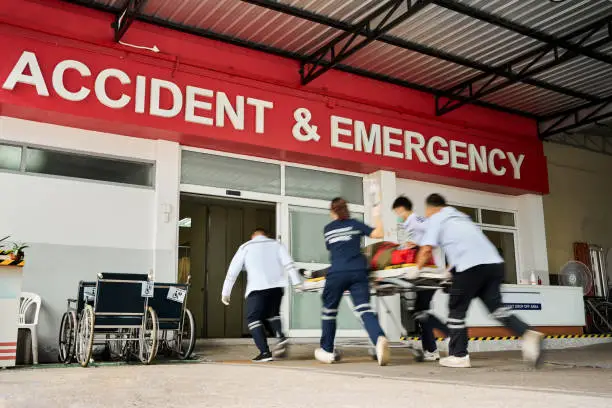
The fluorescent lights above the lobby of Northbridge Medical Center hummed with the tired electric sound of midnight in an American hospital.
Emily Carter stood at the granite security counter with her hospital badge in her hand. She was not clocking in. She was turning it over.
The little plastic card still carried her photo, her name, and the letters RN beneath it, but the way the security guard looked at her made it feel like evidence from a trial she had already lost.
Her fingers trembled once before she forced them still.
Behind her, rain dragged silver lines down the glass doors. Beyond those doors, the ambulance bay glowed under sodium lights, slick with water, empty for one long second.
Then three black SUVs with government plates screamed into view.
They hit the curb so hard the tires smoked.
Inside the emergency department, every monitor seemed to shriek at once. Lights flickered. A lockdown tone cut through the building, sharp enough to make nurses turn in place and patients lift their heads from pillows.
This was not a drill. This was not a bad transformer.
Someone had just cut emergency power to ICU Three.
At the end of the hall, Chief of Staff Harold Voss was shouting into his phone. The hospital security director had one hand under his jacket. Doctors froze. Nurses looked toward the doors. Families clutched plastic coffee cups and waited for someone important to explain what was happening.
Emily Carter, the nurse they had just fired for insubordination, was the only person in the building who understood the pattern.
She had seen it before.
Not in Ohio. Not in a hospital with polished floors and visitor badges and a gift shop selling balloons.
She had seen it in Kandahar, in a field hospital that no longer existed on any official record.
And if she walked out now because they told her to, people inside Northbridge would be gone before anyone understood what had been done to them.
Sixteen months earlier, Emily had arrived at Northbridge with a neat résumé, quiet eyes, and references that said she was competent under pressure. Nobody noticed the missing years. Nobody asked why a nurse in her thirties flinched at certain alarms but not at others. Nobody asked why she could start an IV in the dark or why she always sat with her back to the wall in the cafeteria.
They only noticed that she did not fight back.
Not when Dr. Miles Greenfield raised his voice in front of a patient’s family because she questioned a dosage that looked wrong. Not when charge nurse Diane Russo put her on the night shift three weeks in a row because someone has to do it, Carter, and you don’t complain. Not when Harold Voss called her into his glass-walled office and told her she was creating friction by filing incident reports every time a physician skipped basic safety procedures.
Emily had nodded, accepted the write-ups, and gone back to work.
People mistook silence for weakness.
That had always been their first mistake.
Emily absorbed things. Details. Timelines. Changes in breathing. The pause a doctor made before choosing the wrong order. The way a frightened patient looked at a door before admitting someone had hurt them. The way administrators smiled before burying a problem. She collected those things the way other people collected receipts.
She waited. Waiting had kept her alive.
At 11:47 on a wet Wednesday, Diane found her restocking a crash cart outside the emergency department.
“Voss wants to see you,” Diane said.
“Now?”
“Now.”
“I’m in the middle of—”
“Now, Carter.”
The administrative wing was quieter than the patient floors. Thick carpet swallowed footsteps. The walls were hung with framed donor photos and plaques honoring board members who visited twice a year and called it service.
Harold Voss sat behind a desk too large for the room. His tie was loosened. A manila folder lay in front of him. He did not look up when Emily entered.
“Close the door.”
She did.
He tapped a pen against the folder.
“You’ve been here sixteen months.”
“Yes, sir.”
“In that time, you’ve filed fourteen incident reports. Twelve involving attending physicians. Two involving me.”
Emily said nothing.
Voss leaned back and studied her the way he might study a budget line before cutting it.
“You know what that tells me?”
“That I document safety issues?”
“It tells me you don’t understand how things work here.” He leaned forward slightly. “Northbridge is not some field clinic where you get to play hero. We have hierarchy. We have protocols. You are a nurse. You follow orders. You don’t second-guess doctors. You don’t file paperwork every time someone forgets to wash their hands. You stay in your lane.”
“My job is patient safety.”
Voss smiled without warmth.
“Your job is whatever I say it is.”
He slid the folder across the desk.
“This is your termination notice. Effective immediately. Collect your things. Turn in your badge.”
For a few seconds, only the air conditioning spoke.
Emily stared at the folder. She did not open it.
“You’re firing me for doing my job.”
“I’m firing you for being a liability.”
“To whom?”
Voss stood.
“We’re done here.”
Emily did not move. Her hands rested on the desk now, steady.
“If I walk out of here tonight and something preventable happens, you’re going to wish you had listened.”
His smile thinned.
“Is that a threat?”
“No,” Emily said. “It’s a prediction.”
“Get out.”
She turned and left.
She made it as far as the security counter before the lockdown tone began.
The ER doors sealed with a hydraulic hiss. Diane stood at the nurse’s station with a phone pressed to her ear, her face pale.
“I don’t know,” Diane was saying. “They just told us to lock everything down. No one in. No one out.”
Outside, the SUVs were already spilling men into the rain.
They wore dark tactical vests with no clear markings, rifles held low and ready. Their movement was silent, disciplined, and exact.
Emily’s pulse rose.
She knew that silence.
Marcus, a young ER nurse with tired eyes and a badge still too clean to have learned much about fear, stared through the glass.
“What is this?” he whispered.
“Step back from the window,” Emily said.
He turned to her. “Why?”
“Because glass doesn’t care who’s innocent.”
The automatic doors opened just long enough for a gurney to come through, pushed hard by two men in unmarked fatigues. The patient was male, mid-thirties, unconscious, gray with shock. Blood soaked a pressure bandage on his side. His breath came shallow and uneven.
Dr. Greenfield appeared from trauma, irritation crossing his face before fear had time to.
“We didn’t get a call.”
One of the escorts stepped into his path.
“This patient is classified. You treat him. You don’t ask questions.”
Greenfield bristled. “I don’t take orders from—”
“You do now.”
The words were calm, and that made them worse.
Emily moved before anyone told her to. Diane caught her by the arm.
“You’re not on the floor anymore. Voss just—”
“I know.”
“Then what are you doing?”
Emily pulled free.
“My job.”
Inside Trauma Two, the monitors were already screaming. Heart rate one-forty and climbing. Blood pressure falling. Greenfield barked orders, but his hands shook as he tried to place a line.
“Someone get me IV access.”
Emily stepped in, found the vein, slid the catheter in, locked it, flushed it, and taped it down.
Three seconds.
Greenfield stared.
“I didn’t tell you—”
“You needed a line. You have one.”
One of the escorts watched her carefully.
“Who are you?”
“Emily Carter. RN.”
“You always work that fast?”
“Only when it matters.”
The patient’s pressure dropped again. The monitor shrieked. Greenfield fumbled with the defibrillator pads. Emily’s eyes moved from the monitor to the patient’s chest to the IV bag hanging slightly wrong.
The line was kinked.
She straightened the tubing. Fluid began to flow. The pressure steadied.
Greenfield exhaled.
Emily did not.
She was looking at the patient’s hands. Callused palms. Scarred knuckles. A pale tan line where a tactical watch had been removed.
Operator. Not a politician, not a donor, not a random VIP. An operator who had been brought bleeding into a civilian ER with no notice and too much security.
Someone had tried to erase him.
Someone with access.
Harold Voss appeared in the doorway.
“Doctor, a word.”
Greenfield hesitated, then stepped into the hall. Through the glass, Emily watched Voss speaking fast, pointing once toward administration, once toward the trauma bay. Greenfield shook his head. Voss’s mouth hardened.
One escort leaned close to Emily.
“You good here?”
“For now.”
“Keep him stable. Transport is inbound. Fifteen minutes.”
“He won’t make fifteen minutes if that internal bleed keeps going.”
The man’s jaw tightened.
“Then stop it.”
“I’m a nurse, not a surgeon.”
“You’re whatever you need to be.”
Emily looked at the patient’s abdomen. Rigid. Distended. Bleeding inside.
There are moments when the rules existed because people had time. This was not one of those moments.
She grabbed a scalpel.
Greenfield came back into the room, face white.
“Carter, what are you doing?”
“Step back.”
“You can’t just—”
“I said step back.”
She made the incision small and controlled. Blood welled dark and fast. She suctioned, located the bleeder, clamped it.
Two minutes.
The monitor quieted.
The patient’s pressure began to climb.
Greenfield stood frozen.
One escort tilted his head.
“Where did you learn to do that?”
Emily stripped off her gloves and dropped them into the bin.
Before she could answer, the hallway filled with boots and radios. The door opened, and a man in a dark uniform stepped inside. No name tape at first. No insignia anyone in the room could read. Just cold assessing eyes that swept the room and landed on Emily.
He went still.
“Carter.”
Emily’s breath caught.
She knew that voice.
The man stepped closer.
“We were told you were dead.”
The room fell silent. Diane stared. Marcus stared. Greenfield looked as though someone had rewritten the laws of medicine in front of him.
The officer’s hand moved to his radio.
“Command, this is Apex One. I need immediate confirmation on Sergeant Emily Carter, service number 44729.”
Static answered.
“She’s standing in front of me.”
A voice cracked through the radio, sharp with disbelief.
“Say again.”
“Emily Carter is alive at Northbridge Medical.”
A pause.
Then: “Lock down the building. No one in. No one out. We’re inbound.”
Captain Briggs looked at Emily with something close to respect.
“Ma’am, we thought you were KIA two years ago.”
Emily felt the room closing around her.
“I’m not,” she said quietly. “Obviously.”
“The report said you were caught in an IED strike outside Kandahar. Medevac never made it out. No remains recovered.”
“The report was wrong.”
“Reports like that don’t get filed by accident.”
Emily’s jaw tightened.
Not here. Not now. Not with a dying man on the table and Voss somewhere in the building.
“We can talk about my service record later,” she said. “Right now you need to tell me why a classified operative just arrived in a civilian ER with no advance coordination.”
“That’s need-to-know.”
“I just saved his life. I need to know.”
Briggs hesitated, then lowered his voice.
“He was supposed to be in a safe house twenty miles from here. Someone leaked his location. Ambush went bad. He took two rounds before his team extracted him. Closest secure facility is three hours out. This was the only option.”
“Who leaked it?”
“That’s what we’re trying to find out.”
Emily glanced toward the hall, where Voss had vanished.
“How many people knew he was being moved?”
“Classified.”
“If someone inside this hospital is involved, your classification just became a liability.”
Briggs did not answer.
Emily gestured toward the locked-down corridors.
“From where I’m standing, you brought a compromised target into a building full of civilians and then sealed the exits while the person who wants him dead may still be inside.”
Something flickered in Briggs’s eyes.
“Stay with the patient. No one enters this room unless they’re cleared by me.”
He left.
Diane stepped close, voice low.
“What the hell was that?”
“Exactly what it sounded like.”
“You were military?”
“Combat medic.”
“You didn’t think to mention that when you applied?”
“It didn’t come up.”
Diane’s voice shook. “They thought you were dead, Emily.”
Emily looked at her, and whatever Diane saw made her stop.
“I need you to trust me,” Emily said. “Can you do that?”
Diane swallowed, then nodded.
“Go to the nurse’s station. Pull access logs for the last seventy-two hours. ICU, pharmacy, records, server room. Print them if you can. Memorize them if you can’t.”
“Why?”
“Because someone in this building knew that patient was coming.”
Diane’s face went pale.
“And I think they’re going to try again.”
Diane left without another word.
Emily turned back to the patient. He was breathing easier now. She had bought him time. Maybe an hour. Maybe less.
Then the overhead lights flickered.
The escorts at the door stiffened.
“Backup generator,” one said. “It’s fine.”
Emily moved to the window. The streets beyond the parking lot were too dark. Not a block outage. Too selective.
“We need to move him,” she said.
“Our orders are to hold.”
“Your orders are behind the threat.”
The lights went out.
Emergency red washed over the room.
Both escorts moved into the hall.
“Don’t,” Emily said.
They went anyway.
She was alone.
She unlocked the gurney wheels, then heard footsteps from the stairwell. Not boots. Softer. Measured.
She looked through the cracked door.
A figure moved down the corridor in the red light. A syringe glinted in one hand.
Emily locked the door and positioned herself between the patient and the entrance.
The handle rattled. The lock clicked.
Harold Voss stepped inside.
He held the syringe as calmly as a man holding a pen.
“Step away from the patient, Emily.”
“What’s in it?”
“Potassium chloride.”
“You’re going to kill him.”
“I’m going to finish what should have been finished before he reached my hospital.”
“Why?”
Voss sighed, almost disappointed.
“Because he knows things certain people prefer buried. I facilitate introductions. I move information to the right buyers. I make sure useful doors open.”
“You sold his location.”
“I sold information. What happened after that was business.”
Emily raised the scalpel.
“One more step.”
Voss smiled.
“You won’t. You’re a nurse. You save lives.”
“You’d be surprised what I remember how to do.”
For the first time, doubt crossed his face.
“Who are you?”
“Someone you should have left alone.”
He lunged.
Emily did not move toward him. She moved toward the crash cart, snatched the defibrillator paddles, powered them, and struck the metal IV pole.
The electric crack split the room. The lights surged and died. Voss stumbled in the dark. The syringe hit the floor and rolled.
Emily was already moving.
She shoved the gurney into the hall, but the stairs stopped her. Too heavy. Too slow.
There are moments when the body refuses and the will continues anyway.
She hauled the unconscious operative off the gurney and lifted him across her shoulders in a fireman’s carry.
Two hundred pounds of dead weight.
Her knees nearly folded.
She moved down the stairs anyway.
Above her, the door slammed open. Footsteps followed.
She reached the ground floor, stumbled into the hallway, and ran toward the exit. A hand grabbed her shoulder. She let the patient slide to the floor, spun, and struck hard. The man went down. She hit him again and swept his leg before he could recover.
Then a voice cut through the red light.
“Emily, stop.”
Captain Briggs stood at the end of the hall with armed soldiers behind him.
“Put him down.”
“Voss tried to kill him.”
“I know.”
“Then why are you stopping me?”
“Because we need you exactly where you are.”
The corridor filled with agents. In the middle of them, handcuffed and pale, stood Harold Voss.
For the first time since Emily had met him, he looked afraid.
Briggs crouched beside her after she lowered the patient to the floor.
“You saved his life,” he said. “Again.”
“What happens now?”
“Now we clean this up, and you explain how a dead woman spent sixteen months working in a civilian hospital.”
Emily closed her eyes.
“It’s a long story.”
An agent approached with a tablet.
“Captain. You need to see this.”
Briggs looked at the screen, and his face went cold.
“What is it?” Emily asked.
“Voss wasn’t working alone.”
He turned the tablet toward her.
On the screen was a photograph of Major Daniel Cross.
Emily’s former commanding officer.
The man who had pinned a medal to her uniform in a bunker while mortar fire shook dust from the ceiling. The man who had signed the report that said she died in Kandahar. The man who had visited her hospital bed three days before she disappeared and told her the only way she would survive was to stay dead.
Emily’s hands went numb.
“No,” she whispered.
Briggs watched her carefully.
“You know him.”
“I knew him.”
“Past tense?”
“Dead people don’t get phone calls.”
Briggs told her Cross had spent eighteen months building a network that sold classified intelligence, moved illegal assets through civilian systems, and used people like Voss to make inconvenient patients vanish. The operative on the table was Lieutenant Marcus Hail, embedded inside Cross’s operation. Hail had escaped with evidence: names, payments, communication logs, the whole structure.
That was why they wanted him dead.
That was why Northbridge had become a battlefield.
Diane’s access logs gave Emily the next piece.
Voss. Greenfield. Aaron Webb from IT.
All three had entered restricted areas outside normal rotation.
Emily went to the basement server room alone because some habits were harder to break than fear. The room was cold, humming, blue-lit. She had barely stepped inside before Aaron Webb grabbed her from behind and slammed her into a rack of equipment.
“I told them you’d be a problem,” he hissed.
“Who?”
“Cross.”
The syringe in his hand told her enough.
Emily went slack, let him think she was giving up, then drove her forehead into his nose. Bone cracked. He staggered. She swung a keyboard like a club and dropped him to the floor. By the time she zip-tied his wrists, Greenfield was standing in the doorway with two armed contractors.
His face was pale. He looked less like a villain than a man who had already surrendered six months ago and only now realized the cost.
“Step back inside,” he said.
“You’re with them.”
“I didn’t have a choice.”
“Everyone has a choice.”
“They threatened my daughter.”
Emily saw it then. Not greed, not loyalty, but fear. Cross had found the soft place in him and pressed until it broke.
One contractor raised a suppressed pistol.
The basement lights died.
Emily moved in the dark.
She took one man down in the maintenance office, broke his grip, seized his weapon, and fired only when the second contractor raised his gun under the red emergency glow.
Briggs arrived seconds later with agents. He took in the contractor bleeding from the shoulder, Greenfield frozen by the wall, Webb zip-tied inside the server room, and Emily holding a Glock she had no business holding.
“You discharged a weapon during a federal operation,” Briggs said.
“He was going to shoot me.”
“I know. I’m just saying there’s going to be paperwork.”
For the first time that night, Emily almost smiled.
Hail woke an hour later and asked for her.
He was pale, bruised, stitched, and guarded by men who looked ready to shoot anyone who breathed wrong.
“You’re the one who saved me,” he said.
“Twice.”
“Then I owe you twice.”
“Repay me by telling me where the drive is.”
He studied her.
“I don’t know you.”
“You asked for me.”
“I asked for the nurse who carried me out of a firefight. That doesn’t mean I trust you with classified intel.”
Emily leaned close.
“Cross sent people to kill you tonight. If we don’t find that drive before he does, everything you risked your life for disappears. So either play spy games until you bleed out, or help us finish this.”
Hail’s smile came slowly.
“Cross said you were the best combat medic he ever trained.”
“He lied.”
“About you being the best or about you being dead?”
“Both. I was never the best. Just the one who didn’t quit.”
Hail gave her the location: a locker at Union Station. Bay 247. Combination 8592.
Union Station was nearly empty when Emily and Briggs arrived. Rain tapped against the high glass ceiling. A few commuters slept on benches with backpacks under their heads. The lockers stood along the east wall in gray rows.
Emily reached Bay 247 and entered the code.
Inside was a black external drive no bigger than a deck of cards.
She touched it.
The lights went out.
A familiar voice came from the shadows.
“Hello, Emily.”
Major Daniel Cross stepped into view with six armed men.
He looked older, but not weaker. His eyes were the same: cold, proud, certain he had already won.
“I have to admit,” he said, “I really thought you were dead.”
“I keep disappointing people tonight.”
Cross smiled.
“You were my best work.”
“I was never yours.”
“I trained you. Shaped you. Turned a scared kid with a first-aid kit into a soldier who could save a man while mortars fell twenty feet away.”
“You sold out your own people.”
“I adapted. Wars change. Money changes. Loyalty is just a word poor men use before rich men spend them.”
Briggs stepped forward.
“You’re surrounded.”
Cross laughed softly.
“Captain, I have better numbers, better angles, and a clear shot at the woman holding my property.”
Emily looked at the drive, then held it out.
“You want it? Take it. Let everyone else walk away.”
“Emily, don’t,” Briggs said.
Cross watched her for a long moment.
“Still smart.”
One of his men took the drive. Cross pocketed it.
“Try to stay dead this time.”
He disappeared into the rain.
Briggs turned on her the second Cross was gone.
“What was that?”
Emily raised her phone. A notification glowed on the screen.
File upload complete.
“You copied it,” Briggs said.
“While I opened the locker. Took eight seconds. The drive he took is corrupted. It’ll slow him down.”
Briggs stared, then laughed once under his breath.
“You conned a career intelligence officer.”
“I learned from the best.”
Then Briggs’s phone rang.
He listened, and the humor left his face.
“Hail is gone.”
Emily understood before he finished.
Cross had walked away too easily because the locker was never the true target.
He already had Hail.
The next hours became a blur of rain, engines, radios, and bad choices made quickly because slow choices would get people killed. Emily and Briggs traced Cross through old safe houses and false leads and the one pressure point even Cross could not ignore: his daughter, Rebecca.
They did not threaten her. Emily refused to become that. But they let Cross believe they knew where she was. It forced him to answer.
Pier 19. Industrial dock. One hour.
Emily walked into the rain with the real files on a clean USB stick and a borrowed Glock hidden at her back.
Pier 19 smelled of diesel, salt, and rust. Floodlights cut white wounds through the rain. Cross stood in the center of them, hands loose at his sides. Two men dragged Hail from an SUV and dropped him at Cross’s feet.
Hail was alive. Barely.
“You said he’d be unharmed,” Emily said.
“I said I’d bring him.”
“Let him go first.”
Red laser dots appeared on her chest.
“Careful,” Cross said.
“Let him go.”
Cross nodded. Hail stumbled toward her, blood soaking through his shirt. Emily caught him before he fell.
“Can you stand?” she whispered.
“Maybe ten seconds.”
“That’s enough.”
She tossed the USB stick. Cross caught it.
Then a shot cracked through the rain.
Pain hit Emily’s shoulder like a hammer. She went down. Hail collapsed beside her, struck again. Cross climbed into his SUV while the red dots vanished from her chest.
Briggs’s voice crackled in her ear, distant and frantic.
Emily tried to answer, but darkness folded over her.
She woke eighteen hours later in a secure hospital room with her shoulder bandaged and Briggs sitting beside her, unshaven and hollow-eyed.
“Hail?” she asked.
“In surgery. Alive.”
“Cross?”
“Gone.”
Emily closed her eyes.
“I failed.”
“No,” Briggs said. “You kept Hail breathing long enough for us to get him back.”
But Cross had not won either.
Video from the pier captured one of his men: Jason Webb, Aaron’s older brother, former military intelligence, dishonorably discharged for selling information. His property outside the city led them to Rebecca Cross, tied to a chair, terrified, alive.
She told them masked men had taken her father.
Cross’s own network had turned on him.
The safe house on Fifth became an ambush. Special Agent Marcus Reeves, Briggs’s superior, had sent federal agents into it to bury the last evidence. Emily bluffed him over the phone, claiming Hail had given her access codes to files he did not even know she lacked.
Reeves believed her.
He called off the ambush.
Then he turned himself in.
For a few hours, it looked like the net had finally closed.
Reeves confessed. Cross was extracted alive. Hail survived surgery. The files were recovered from a hidden server and began unraveling the network name by name, payment by payment, lie by lie.
Then Cross asked to speak with her.
He sat handcuffed in a secure room, bruised and bloodied, but still sharp enough to cut.
“You won,” he said. “You got the files. You got the arrests. Congratulations.”
“What do you want?”
“To tell you you’re not safe.”
Emily said nothing.
“My network was not only domestic. There were international partners. One of them is very unhappy with you.”
“You’re lying.”
“Check your phone.”
A new message waited there. A photo of Emily walking into the hospital, taken from across the street twenty minutes earlier. Below it were four words.
We’ll be in touch.
The name Cross gave her was Volkov.
A ghost. A broker. A man with money in three countries and blood on more than one continent.
But ghosts left footprints if you knew where to look.
Emily, Briggs, and an exhausted analyst named Torres traced surveillance photos and spoofed phones and rental cars and shell companies to a private security contractor named Michael Santos, watching Emily for someone else. She broke into his apartment before he could reach his weapon, restrained him, and used fear without crossing the final line.
He gave them only fragments. Phase two. A broker. Encrypted reports. A false story about Volkov that did not quite hold together.
Then came the first real fracture.
A message from Briggs’s own number appeared on Emily’s phone.
Volkov doesn’t exist the way you think.
Someone had cloned Briggs’s bureau phone. Someone with inside access.
Reeves.
He had confessed too easily. Surrendered too neatly. Given up Cross just in time to look cooperative while burying his own deeper network.
Emily went dark. No phone. No official backup. No permission.
She used an old contact from her years overseas, a favor bought with a silver coin she had carried since Syria. Two hours later, a storage locker yielded the truth: Reeves and Volkov photographed together in Kandahar years earlier. Bank records tied to Santos and the Webbs. Travel logs. Hidden properties. Payments.
Cross had been the visible traitor. Reeves had been the architect.
Emily reached federal headquarters before Reeves could disappear into transfer. She slipped past security under the cover of a fire alarm and found him in a holding cell, calm and waiting.
“I wondered when you’d figure it out,” he said.
She raised the Glock.
“Stand up.”
“You going to shoot me in a federal building?”
“I’ve done bolder.”
Before she could decide whether she meant it, Briggs arrived with agents.
“Put the gun down, Emily.”
“He orchestrated everything.”
“I know.”
Torres had cracked the encryption. The messages traced back to Reeves’s server.
Reeves smiled even as they took him.
“Careful, Carter. I know what happened in Kandahar. The civilians. The cover-up. Cross protected you once. He won’t protect you now.”
The words hit harder than any bullet.
Emily walked out of the building and made it three blocks before she sat down on a bench in the rain.
Briggs found her there.
For the first time, she told the truth.
In Kandahar, under fire, she had made a call while trying to save a wounded soldier. The wrong call. Three civilians died. Cross covered it up, called them hostile combatants, told her he was protecting her. When someone tried to kill her later, Cross faked her death and told her to disappear.
So she did.
She became a nurse in an Ohio hospital. She took night shifts. She filed reports. She swallowed disrespect. She lived small because small felt safe.
Until the past came through the ER doors bleeding.
Briggs listened without interrupting.
“What happened there was a tragedy,” he said. “It doesn’t make you a monster.”
“It makes me responsible.”
“It makes you human.”
Before Emily could answer, Briggs’s phone rang.
Reeves was dead. A supposed heart attack in transport.
At the morgue, Emily found the puncture mark near his carotid artery. Dr. Patel confirmed what Emily already knew: likely potassium chloride. The same method Voss had intended for Hail.
The cleaner was Agent Rivera, transferred into the bureau six months earlier by Reeves himself. Rivera’s apartment had been emptied in a hurry, but one wall remained covered in surveillance photos. Not of Emily. Of Briggs. Briggs leaving headquarters. Briggs at a coffee shop. Briggs with his daughter in a park.
Reeves had needed leverage over him too.
In the background of one photo stood a man from the Kandahar file.
Volkov was real.
And he was in the city.
Metadata from Santos’s uploads led them to an abandoned factory in the industrial district. Briggs wanted a tactical team. Emily wanted a surgical approach.
In the end, they used both.
Emily entered first through a gap in the fence, moving through rusted machinery and broken light. Her shoulder still hurt. Her hands were steady anyway.
Volkov waited above in the old foreman’s office, backlit by early morning sun. He was older than the photograph. Gray at the temples. Scarred. Controlled.
“Sergeant Carter,” he said. “I’ve been expecting you.”
“Where’s Rivera?”
“Gone.”
“Then you’ll do.”
He smiled.
“Will you arrest me? Kill me? I have spent years watching people like you. You believe pain makes you righteous. It does not. It only makes you easier to steer.”
Emily kept the Glock trained on him.
“You don’t know me.”
“I know you carry three graves in your chest. I know you think if you save enough people, the dead will become quiet.”
Her hand trembled.
“They never do,” he said. “The dead stay dead, Emily. And you stay broken.”
Every part of her wanted the trigger.
Not for justice. For silence.
That was how she knew she could not pull it.
She lowered the gun.
Volkov smiled.
“Smart choice.”
Behind her, boots struck metal.
Briggs and a tactical team emerged with weapons raised.
“You’re not going anywhere,” Briggs said.
Volkov lifted his chin.
“Diplomatic immunity.”
“Revoked,” Briggs said, holding up the order. “Your government decided you’re an embarrassment. You’re being extradited on charges in six countries.”
For the first time, Volkov’s composure cracked.
Emily looked at him.
“You built a network on fear. It collapsed the second people stopped being afraid.”
As agents cuffed him, Volkov looked back.
“You’re still broken.”
Emily nodded.
“Yeah,” she said. “But I’m working on it.”
Three weeks later, Emily returned to Northbridge Medical Center to collect her things.
The hospital looked different in daylight. Less like a battlefield. More like a place where people came scared and hoped to leave alive.
Diane waited at the nurse’s station.
“I heard you were coming,” she said. “Thought I’d say goodbye.”
“I’m not good at goodbyes.”
“Me neither. But you deserve one.”
She handed Emily a folder.
Inside was a formal apology from the new administrator, an offer of reinstatement, back pay, full benefits, and a position as head of emergency trauma services.
Emily read it twice.
Diane shrugged.
“Turns out saving a federal operative and exposing a criminal network looks good on a hospital résumé.”
Emily folded the letter carefully.
“I don’t know if I can come back.”
“I know. But now it’s your choice.”
That mattered more than the offer.
Outside, Briggs waited beside his car. He had been reinstated and promoted, though he looked too tired to celebrate.
“What now?” he asked.
Emily looked at the morning sky.
“I don’t know. Maybe I figure out who I am when I’m not running.”
“That sounds healthy.”
“It sounds terrifying.”
He smiled.
“You’ll figure it out.”
Six months later, Emily Carter stood before a classroom at the Federal Law Enforcement Training Center. Twenty-five recruits tried to look brave and mostly succeeded.
“My name is Emily Carter,” she said, “and I’m here to teach you how to stay alive when everything goes wrong.”
The first slide showed a field hospital under fire.
“Combat medicine is not about being perfect. It’s about making the best choice you can with the information you have, in the time you have, knowing you might be wrong.”
A recruit raised a hand.
“How do you live with being wrong?”
Emily was quiet for a moment.
“At first, you don’t. Then you learn that carrying the weight doesn’t mean letting it crush you. You let it make you sharper. More careful. Kinder, if you can manage it. And then you save the next person. And the next. One day you realize you’ve saved more than you lost, and that has to be enough.”
After class, a message waited on her phone from Rebecca Cross.
My father’s trial starts next week. I know you may testify. Thank you for keeping your promise and letting me remember him as something other than a monster.
Emily stared at the message for a long time.
Then she typed back:
He was not a monster. He was a man who made terrible choices. We all have to choose what we do after the worst one.
That evening, Emily drove to a cemetery outside the city.
There was a headstone there with her own name on it. Sergeant Emily Carter. Killed in action. A grave for a woman who had never really died, only vanished.
But she did not stop there.
She walked to three other graves. Three names she had carried for two years. Three people who never got to decide how their story ended.
She placed a flower at each marker.
“I can’t bring you back,” she said quietly. “I can’t make it right. But I’m trying. Every day, I’m trying.”
The wind moved through the trees. Somewhere beyond the cemetery fence, traffic whispered along a wet American road, ordinary and alive.
Emily stood, brushed dirt from her knees, and returned to her car.
She had work tomorrow. Recruits to teach. Lives to protect. Mistakes to warn them about before they became scars.
It was not redemption. Redemption sounded too clean.
The past did not disappear. It did not forgive simply because you learned to speak its name.
But you could carry it differently.
You could stop using it as a prison and start using it as a compass.
As rain began to fall over the city, Emily Carter drove home. For the first time in two years, she felt like she could breathe, not because the weight was gone, but because she had finally learned how to carry it.
And that made all the difference.

Sophia Rivers is an experienced News Content Editor with a sharp eye for detail and a passion for delivering accurate and engaging news stories. At TheArchivists, she specializes in curating, editing, and presenting news content that informs and resonates with a global audience.
Sophia holds a degree in Journalism from the University of Toronto, where she developed her skills in news reporting, media ethics, and digital journalism. Her expertise lies in identifying key stories, crafting compelling narratives, and ensuring journalistic integrity in every piece she edits.
Known for her precision and dedication to the truth, Sophia thrives in the fast-paced world of news editing. At TheArchivists, she focuses on producing high-quality news content that keeps readers informed while maintaining a balanced and insightful perspective.
With a commitment to delivering impactful journalism, Sophia is passionate about bringing clarity to complex issues and amplifying voices that matter. Her work reflects her belief in the power of news to shape conversations and inspire change.