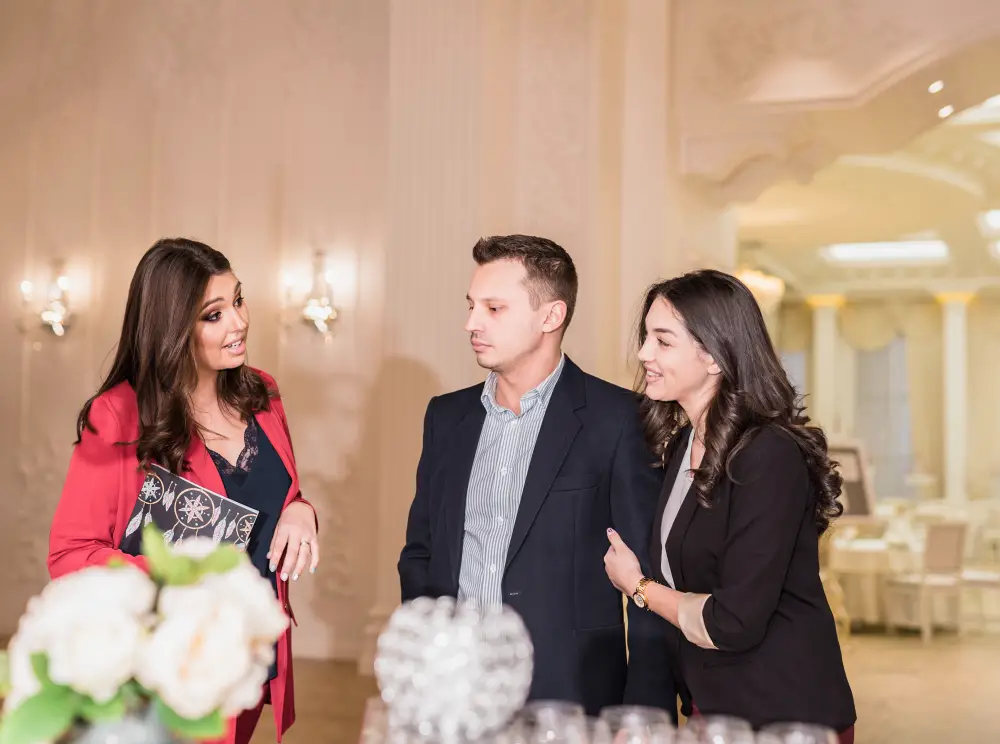
My name is Violet Morgan. I was twenty-eight years old when I walked into Rosewood Hall and discovered my wedding had been canceled two months before the date.
The woman behind the reception desk could not look at me directly. She kept her head down. She told me that my booking had been canceled in the flat apologetic tone people use when they are doing something they know is wrong but have decided to do anyway.
I did not say anything for a moment. My mind moved slowly. The sound of the fountain in the lobby was too loud. When I finally spoke, my voice was quiet. I just asked why.
She shifted her weight. She looked at the floral arrangement beside her computer. She whispered that the Wellington family had offered triple the rate for the same date. Their daughter’s engagement party would be hosted here instead.
I felt a band of metal tighten around my ribs.
I did not need to ask who the Wellingtons were. I knew the Wellingtons. They were my aunt Vivian’s family, my mother’s sister, the family who had always moved through the world as though it existed for their convenience. And the bride-to-be was Chloe Wellington, my cousin, the one who had called me dollar-store Barbie when I was sixteen because my clothes were not as expensive as hers. She had said it knowing it would hurt. It did. It always did.
The contract was signed. It was paid in full. I had saved for two years for the deposit. I forced my voice steady. “That’s illegal,” I said. The receptionist flinched. She said she would have to call the owner. Good, I told her. Do that.
I put the contract on the glass desk and sat down in the lobby chair and waited. The leather was soft. The lawn outside was perfectly green and manicured. That was why I had chosen this place. It was far from my old life. It felt like proof that I had built something real.
I need to explain my old life.
Three years before this day, my parents had quietly disowned me. They did not use that word. They did not need to. My father’s method was withdrawal; my mother’s was temperature, making everything cold.
I had fallen in love with Ethan Carter, a paramedic I met while volunteering at a community center art therapy class. He was giving a life-saving seminar. He was wearing his uniform, clean and pressed, looking tired but ready in the specific way of people who run toward emergencies for a living. We talked about art. He talked about his work in a way that suggested he thought of it as a calling rather than an income bracket. He was curious. He asked real questions. He listened to the answers.
He was not wealthy. He was not from a family my mother considered good. He lived in a small apartment, drove an old truck, worked double shifts without complaint. But when he looked at me, I felt seen in a way I never had in the house I grew up in, where the kitchen was all white marble and stainless steel and we never really cooked in it, and where my birthday gifts were always expensive and always wrong.
When I was twenty-one, I asked for a simple camera. I wanted to photograph the city. My father bought me a sports car instead. Red. Loud. “This,” he said, tapping the steering wheel, “is how a Morgan travels.” I drove it five times. I sold it when I moved out and used the money for art supplies.
When I told my mother about Ethan, she stopped wiping a speck of dust from a cabinet and stood up straight and asked about his retirement fund, his trust, his family name. I said, he has me. It sounded weaker than I meant it to.
The pressure went on for two weeks. Not shouting. Cold, calculated. My father said little. His silence was louder than her words: judgment without effort.
When Ethan proposed in a park with a picnic and a ring he had bought with three months of overtime, I said yes without hesitation. He had asked me to a place we had walked before, a bench by the water, and he got down on one knee without ceremony, and the ring was exactly right. I called my mother from outside the restaurant where we were celebrating with a few close friends. She did not come.
The next morning: You’re choosing poverty. Don’t expect our help.
My father did not text. He wired money. My college savings. A bank message followed: Consider this a goodbye gift.
I cried for a day. Then I stopped. I used the money for an apartment deposit and the beginnings of my art therapy practice. I built something: a life teaching children with special needs to express themselves through art, slow work with real results, the opposite of the decorative uselessness my parents had designed me for. I saved separately for the wedding. Two years of whatever was left over each month, going directly into one account earmarked for one thing: Rosewood Hall.
This venue was the symbol of my new beginning. Grand but not pretentious, beautiful in a way that felt accessible rather than exclusive. I wanted the photographs to say quietly and unmistakably to everyone who had doubted me: I am fine. I am more than fine. I am happy.
And now my cousin had stolen it.
I sat in the lobby and watched the receptionist make the call and waited for another layer of humiliation.
I was not ready for what actually happened.
The receptionist put the phone down. She told me, in a confused voice, that the owner wanted to speak with me. She handed me the receiver.
I took a breath. I said my name. I said that my contract was valid and had been paid in full. The voice on the other end did not apologize. It did not argue. It asked a single question.
“What’s your fiancé’s name?”
The question stopped me. It had nothing to do with contract law.
“His name is Ethan Carter,” I said.
A long silence followed. Then the voice changed slightly, losing some of its formal edge.
“Miss Morgan, please stay in the lobby. Don’t leave the building. I’ll be there in ten minutes.”
I put the phone down.
She arrived in exactly ten minutes. She was a woman in her fifties in a simple tailored suit, silver-haired, moving through the lobby with quiet authority. Not the loud demanding authority of the Wellingtons. Something earned. Everyone in the room seemed to straighten without being asked. She walked directly to me.
“I’m Margaret Delaney. I own Rosewood Hall. My staff made a mistake that ends today.”
Before I could form a response, the glass doors opened with violence.
My aunt Vivian swept in wearing an expensive bright pink coat. Chloe trailed behind her, carrying a massive handbag, dripping designer perfume, wearing the expression of someone who has already won. Vivian saw Margaret across the lobby and smiled the wide false smile that never touched her eyes.
“Margaret, darling. I told your assistant we’ll pay double for the Morgan girl’s slot. Three times if we must.” She paused and let her gaze settle on me. Her smile disappeared. I felt myself shrink slightly, the old automatic response.
Margaret did not move. She did not flinch. She folded her arms across her chest.
“I’m aware,” she said quietly. “Which is why I didn’t call you.”
Vivian’s smile wavered.
“I called my daughter.”
The glass doors opened again. A woman in her early thirties walked in, professional blazer, clipboard, confidence that came from somewhere real. She walked up to Margaret and said, quietly and easily: “Mom.”
Margaret put a hand on her daughter’s shoulder and turned to me.
“Violet, this is my daughter, Savannah.”
The name moved through me like a current.
Savannah Carter.
Ethan’s sister. The one he spoke about with reverence he rarely applied to anything: Savannah worked three jobs to help me pay for my EMT training. She’s the smartest person I know. She told me to keep my head up when I thought I was going to fail.
Savannah was looking at me with warm, sharp eyes.
“You must be Violet,” she said. “Ethan’s fiancée.”
I managed to nod.
“He never told me you owned this place,” I said. It was all I could think to say.
Savannah’s expression warmed a degree. “He doesn’t brag. It runs in the family.”
This was too much for my aunt. Vivian let out a high, fake laugh designed to break the quiet.
“Oh, this is adorable. Nepotism and charity rolled into one.” She turned to Margaret with commanding certainty. “Margaret, be reasonable. My daughter’s engagement will attract the governor, the Hadleys, the mayor’s wife. You’ll be booked solid for a year. That’s real business. This Morgan girl’s wedding will be a handful of paramedics and art teachers. It’s bad for your brand.”
Savannah took one step forward. She did not raise her voice. She did not look at my aunt. She spoke calmly, in the register of someone who has practiced telling the truth for many years.
“And the tabloids,” she said, “when they find out that the Wellingtons bullied a paying customer out of a signed contract.” She turned to face Vivian directly. “We’ve hosted enough of your kind, Mrs. Wellington. My mother built this hall for real celebrations, not PR arrangements. And we don’t cancel valid contracts for people who haven’t paid their outstanding bills.”
The room went completely still.
Vivian sputtered. “You cannot speak to me that way.”
Savannah smiled, cold and controlled. “I can, because this is my venue. You are a customer, Mrs. Wellington. Nothing more.” She picked up the black notebook from the desk without looking at it. “Your outstanding balance is $62,000. For the Save the Manatees gala that ended in three police calls and a missing centerpiece. You promised to pay when your daughter’s engagement party was booked.” She closed the notebook with a quiet click. “You jumped the line. You assumed we were as desperate as you are.”
She turned away from Vivian completely, her attention entirely on me.
“Violet, your wedding proceeds as planned. You have the contract. You have the venue. You have my apology for what happened in this lobby today.” She glanced at the contract on the desk. “And we’ll upgrade your entire package as compensation for the distress. Platinum suite, full staffing, anything you want.”
I tried to speak. Three years of rebuilding, the saved-for deposit, the quiet pride of proof: it all compressed into my chest at once. I managed one word: why.
Savannah’s answer came without hesitation.
“Because my brother loves you. And he is a good man, the best man I know. Anyone who hurts him deals with me.”
Vivian made a sound of defeat. Chloe stepped away from her mother. She looked young suddenly, not superior, not polished. She looked like a girl watching her family’s ugliness exposed in public.
“Mom, stop,” Chloe said. “Just stop. We can’t do this. Maybe we don’t deserve this one.”
Vivian turned to me one last time. Her voice had dropped to something bitter and private. “You think love pays bills, Violet? You think an ambulance driver can save you from real life? You’re naive. You always were.”
I smiled. Not with bitterness. With the quiet of someone who has finally found solid ground.
“Maybe love doesn’t pay bills,” I said. “But it keeps you from choking on your own bitterness. That’s a price you can’t pay.”
I called her Vivian, not Aunt Vivian. She had not earned the title.
She left. Chloe followed. The glass doors closed behind them.
Margaret put her arm around my shoulder, and I let myself cry. Quiet, steady tears. Not performance. Relief. I had spent three years being strong. Being held felt like putting something down.
We went into Margaret’s private office, a room that felt like a home rather than a boardroom: books, art on the walls, a worn leather couch. I sat down and gripped the coffee Margaret brought and tried to process what had just happened in the span of twenty minutes.
Ten minutes ago I had been facing total humiliation. Now I was being offered an upgrade by my fiancé’s sister and his mother, who owned the building in which all of it had occurred.
Savannah pulled her chair close and leaned forward. The business expression was gone. She looked like a person talking to someone she intended to know.
“Tell me about Ethan,” she said. “How did he tell you about me?”
“He said you worked three jobs to help him through his EMT training,” I told her. “He said you believed in him when he thought he was going to fail. He talks about you the way people talk about the most important people in their lives.”
Savannah was quiet for a moment. Then she said: “He doesn’t talk about us much because he doesn’t want to seem like he’s leaning on our success. He worked for everything he has independently, by choice, even when mom and I could have helped more.” She looked at me. “He’s stubborn about it. He wanted to earn you, specifically. He told me that before he ever introduced you.”
“He earned me on a bench by a park fountain,” I said.
She smiled. “That sounds right.”
Margaret told me what I had already guessed: she had started with catering gigs, saved, bought land, built the hall over years of eighteen-hour days. Savannah had worked alongside her while Ethan went through training. This was a family that understood what it meant to build something from nothing, which was exactly what I had spent three years trying to do.
“Your parents gave you a goodbye gift,” Savannah said. She did not make it a question. She had heard the shape of the story.
“They sent the college fund. A bank message that said consider this a goodbye gift. It was very efficient.”
Margaret shook her head. “Your mother was a shareholder, not a parent. She was investing in a certain kind of daughter. When you didn’t produce the expected return, she cashed out.”
It was the truest and simplest explanation I had ever received for something I had spent years trying to understand without finding language for.
Savannah reached across the table and put her hand over mine.
“Ethan is my family. You are marrying him. That makes you my family. And in this family, we protect each other. We pay our debts. We don’t let anyone bully us.”
I called my mother three days later when she called me, her voice sharp and high-pitched, saying Vivian was hysterical and Chloe was crying and the whole engagement was a disaster and it was my fault for causing a scene.
“I didn’t cause a scene,” I said. My voice was calm in a way that surprised me. “I went to discuss my wedding. Vivian showed up and tried to bully the owner into canceling my legal contract. It was a business matter. I was just there.”
“You should have taken the refund. You should have walked away quietly. That’s what a lady does.”
Walk away quietly. That phrase had been the instruction of my entire childhood. Don’t cause trouble. Don’t make things difficult. Don’t speak about the pain. Just disappear and let us have our perfect world.
“I had a valid contract,” I said. “When people try to bully me, I don’t walk away quietly anymore. I learned that the hard way.”
“You’re marrying a man who works twelve-hour days to pay for a tiny apartment,” she said. Her voice had moved from panic to contempt, which was familiar territory. “Your father and I gave you a future of security.”
“You gave me a future of cold control,” I said. “Ethan gives me warm safety. There is a difference. I prefer the safety.”
Then my father was on the line. His whisper, the one he used when I was a child and had done something wrong.
“Violet, this ends now. You will call your aunt and apologize. This reflects poorly on the Morgan name. And the Morgan name is all you have left.”
That sentence, once upon a time, would have cracked something open in me. I looked at the children’s art papers on my kitchen table. Messy, colorful, full of real life, none of it designed to impress anyone.
“The Morgan name reflects poorly on me,” I said. “I don’t want it anymore. You chose Vivian’s reputation over my happiness three years ago. You chose silence over defending me. I am choosing the Carters. They are honest, they protect their own, and they do not treat me like a bank statement.”
His voice dropped lower.
“When your paramedic leaves you, when you are broke, you will crawl back here. And the door will be closed.”
It was the deepest cut: the fear planted in me since childhood, the fear of being alone and undefended. The fear that had kept me quiet for so long.
I thought about Ethan on the bench by the fountain. About Savannah standing in the lobby of Rosewood Hall not raising her voice, not making threats, just stating facts until the Wellingtons ran out of room.
“You’re wrong,” I said. “Ethan will never leave me because he loves me for who I am, not who you want me to be. And I will never crawl back because I’m already free.”
I hung up.
The kitchen was quiet. I sat with the emptiness for a while. Severing something is disorienting even when the thing was rotten. I grieved the parents I had wanted rather than the ones I had, which is a specific kind of grief and takes its own time.
I texted Ethan: I love you. Call me when you get off shift.
His reply came back immediately: I love you more. Almost done. Save me some dinner.
I made dinner. I called Savannah and we talked about flower arrangements for twenty minutes. The ground slowly came back.
When Ethan came home I told him about the call. He sat down beside me and took my hand and looked at me the way he had looked at me the day he proposed.
“Your choices didn’t collapse their lives,” he said. “Their choices did. Your happiness is not their tragedy. It is our victory.”
I held onto that sentence for a long time.
The weeks that followed were full of wedding planning and the discovery of what a healthy family actually felt like. Savannah took me dress shopping at a small local dressmaker. I found a simple lace dress, nothing theatrical, nothing designed to announce anything except that I was happy. When I put it on and looked in the mirror, I did not see the girl my cousin had mocked. I saw Violet Morgan. A woman loved. A woman ready.
Savannah cried.
One package arrived from Aunt Vivian: a loud, shiny pink dress with a small card in her perfect handwriting: Wear this. It’s the only way you’ll stand out at your little party. The final attempt to define me.
I looked at it for five full minutes while the old shame tried to crest in me. Then I took it outside and dropped it in the dumpster behind my building. Not dramatically. Simply. It was trash. I treated it like trash. That was the whole of my response.
The Wellingtons fell on their own weight. David Wellington’s financial practices had been propped up for years by my father’s quiet backing. The Rosewood Hall incident cracked the arrangement: Savannah’s professional communication to the events board and two creditors about the unpaid debt was technically just business. It was enough. David’s main investment deal collapsed. The papers ran vague but meaningful stories. The banker Chloe had been engaged to calculated the reputational risk and called her.
My mother rang me in a panic. My father was ill, the yacht was being sold, she needed me to call Savannah and ask her to stop.
“Savannah is collecting a debt that was owed to her,” I said. “It’s business. It has nothing to do with me.”
“It has everything to do with you. If you had just been quiet—”
“David Wellington accumulated $62,000 of debt himself,” I said. “My choices didn’t do that. You are all responsible for your own lives. I’m responsible for mine. I can’t help you.”
I meant it with kindness. But I meant it absolutely.
The morning of the wedding arrived clear and bright. The white roses Savannah had arranged filled Rosewood Hall with the smell of something clean. The string quartet played quietly. I stood in the platinum suite with Margaret fixing my veil and Savannah handing me a small box.
Inside was a silver bracelet. Three words engraved on it: We protect our own.
“Welcome to the family, Violet,” Savannah said. It was not sentiment. It was a statement of fact, which was how she said most things. That was why I believed her completely.
I walked down the aisle toward Ethan, who was wearing his best dress uniform, clean and sharp. He was crying a little and not ashamed of it. I did not look for my parents. They were not there. I felt no sorrow about their absence, only peace about what was present: Ethan, Savannah, Margaret, the friends from my art therapy practice, the people who had appeared in my life because I had chosen honestly.
We exchanged vows we had written ourselves. They were simple: trust, loyalty, the daily act of choosing each other. When the room cheered, it was full of joy rather than status, and the difference between those two sounds was larger than I had known possible.
At the end of the night, Ethan and I stood by the tall windows of Rosewood Hall with the grounds lit up beyond the glass. He took my hand.
“Ready to go home, Mrs. Carter?”
I had spent three years building proof that I had chosen correctly. The proof was everywhere around me in that room, in the people who had shown up and the family who had fought for me. I did not need the proof anymore. I already knew.
“I’m ready,” I said.
We walked out together into the cool evening. I had left behind the family that measured love in money and the family that used silence as punishment and the girl who had believed for too long that their judgment was the truth about her. I had chosen something smaller and quieter and infinitely more solid.
Behind me, Rosewood Hall glowed against the dark.
I did not look back.
What I had not expected was how much the wedding planning itself would feel like healing.
Every decision I made was a small act of defiance against the version of me my parents had tried to create. I chose white roses because they were peaceful. Not rare flowers flown in from another continent, not anything designed to impress people who were not coming. Just white roses, clean and honest.
I made the guest list small. Ethan’s friends from the firehouse. Parents from my therapy practice who had become my actual friends. Savannah, Margaret, their family. A gathering of people who had seen me truly and loved me for it, not for what I represented or what I might provide.
Savannah took me dress shopping at a local dressmaker who worked out of a small studio above a bakery. We spent the afternoon trying on things that were exactly like me and exactly not, until I found a simple lace dress that felt as though it had been waiting. When I put it on and looked in the mirror, I did not see dollar-store Barbie. I saw Violet Carter, a woman who had built something real and was about to stand in front of the people who loved her and say so out loud.
Savannah cried. Then she pretended she had not.
One package arrived from Aunt Vivian in those weeks: a loud shiny pink dress with a note in her perfect cursive: Wear this. It’s the only way you’ll stand out at your little party. The final attempt to define me.
I looked at it for five minutes while the old shame tried to arrive. Then I took it outside and put it in the dumpster. Not dramatically. The dress was trash. I treated it like trash.
The Wellingtons fell eventually, on the weight of their own choices. David Wellington’s business practices had been propped up for years by my father’s backing. The Rosewood Hall incident cracked the arrangement: Savannah’s professional communication to two creditors about the outstanding debt was technically just business. David’s main investment deal collapsed. The banker Chloe had been engaged to calculated the risk and called the engagement off. The local papers ran their stories vaguely but clearly enough for anyone paying attention.
I did not celebrate it. I did not want them to fail. I had only wanted them to be decent. But watching their choices arrive at their natural conclusion felt, quietly, like justice.
My focus had moved past them entirely by then. I was planning a wedding with two women who had never met me six weeks ago and had already become my family.
The morning of the wedding was clear and bright. White roses everywhere. Margaret fixed my veil in the platinum suite and said, “Never apologize for your kindness, Violet. It is your strength.” Savannah handed me a small box. Inside: a silver bracelet, three words engraved: We protect our own.
I walked down the aisle toward Ethan in his best dress uniform, clean and pressed, crying a little without shame. I did not look for my parents. They were not there. I felt no sorrow about their absence, only the fullness of what was present.
We exchanged vows we had written ourselves. Simple promises about trust, loyalty, choosing each other every day. When the room cheered, it was pure joy, nothing else underneath it.
At the end of the night, Ethan took my hand by the tall windows.
“Ready to go home, Mrs. Carter?”
Three years of proof, all the saved money and the quiet pride and the need to show them I had won: none of it mattered anymore. I already knew.
“I’m ready,” I said.
We walked out. Rosewood Hall glowed behind us against the dark. I did not look back. I had left behind the family that measured love in money and the girl who had believed too long that their judgment was the truth about her.
The future was ahead, solid and warm and entirely mine.

Laura Bennett writes about complicated family dynamics, difficult conversations, and the quiet moments that change everything. Her stories focus on real-life tensions — inheritance disputes, strained marriages, loyalty tests — and the strength people find when they finally speak up. She believes the smallest decisions often carry the biggest consequences.