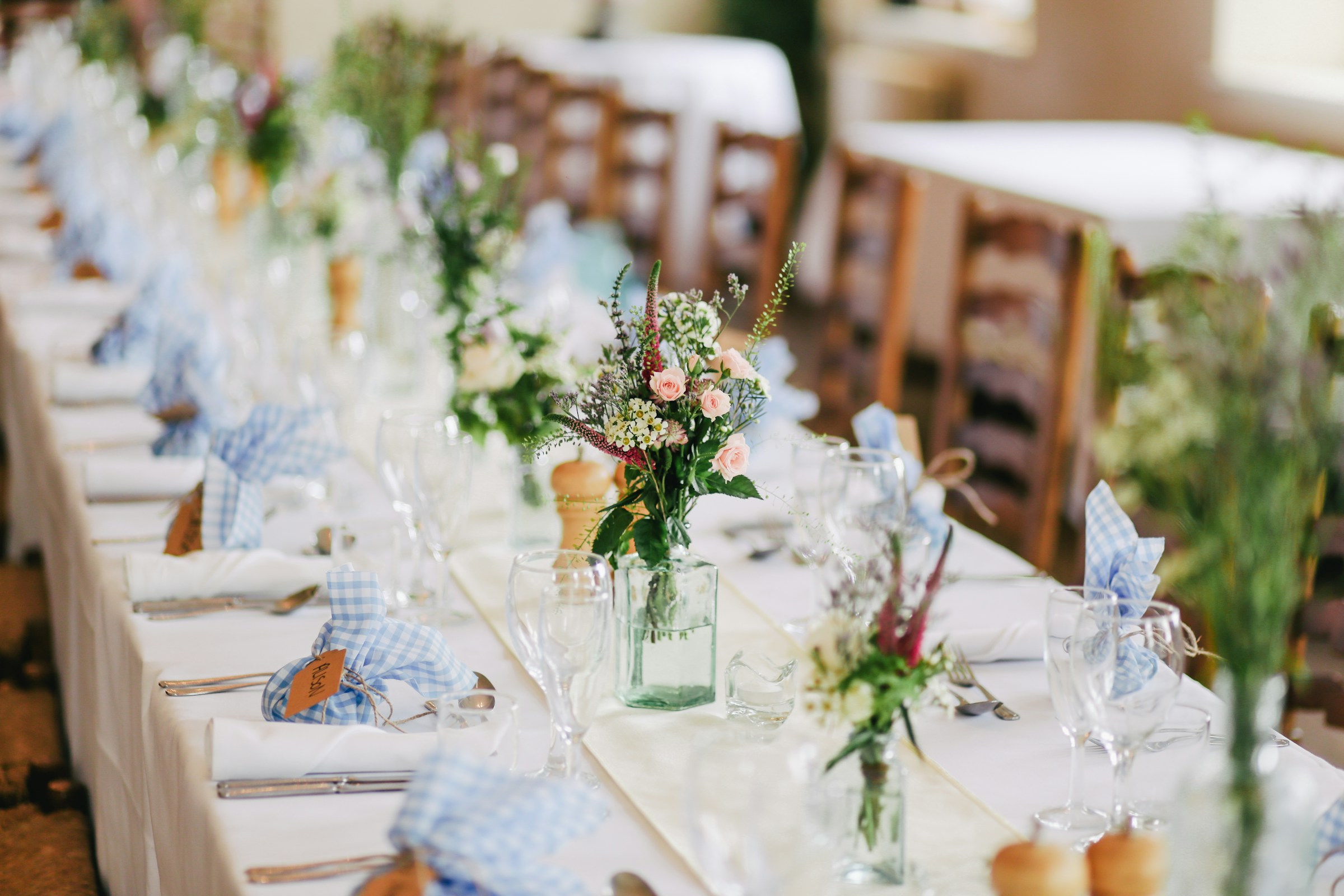
By the time my sister leaned toward me across the bare table, the ballroom felt less like a wedding reception and more like a play I had been dragged into without knowing my lines.
Crystal chandeliers scattered light across the polished marble floor, catching on sequins and champagne flutes, turning everything glittering and slightly unreal. The scent of roses and roasted salmon hung thick in the air. Waiters in black vests moved between tables in that fluid, choreographed way that costs a great deal of money to make look effortless, carrying plates overflowing with food, pouring wine no one had to ask for, straightening centerpieces that were already perfect.
And then there was my table.
Shoved against the far wall, half hidden behind a marble pillar wide enough to block a grown man’s shoulders, it looked like something dragged in as an afterthought by someone who had remembered, very late in the planning, that Brooke had a sister. No centerpiece. No folded linen napkins. No gleaming silverware. Not even a place card with my name written in the careful calligraphy that decorated every other seat in the room. Just a bare tablecloth and an empty plate, the kind of detail that could be passed off as an oversight to anyone who didn’t know better.
I knew better.
I sat with my hands folded in my lap, back pressed against the cool wall, and watched the golden performance play out a few yards away. My sister Brooke stood at the center of it, white dress shimmering as if it had swallowed all the available light and decided not to give any back. She moved between clusters of guests with that easy, practiced grace she had been perfecting since childhood, laughing at the right moments, tilting her head at compliments, holding her champagne flute the way women in magazine spreads hold champagne flutes.
She saw me eventually.
Of course she did. I was the one wrong note in the composition she had spent months arranging.
She detached herself from a group of bridesmaids and floated toward my corner, veil trailing behind her like a comet’s tail, her perfume arriving several seconds before she did. Sweet, expensive, suffocating. She leaned down over my empty place setting, voice calibrated at that precise volume where a handful of nearby guests could hear but she could later claim it was a private remark.
“You really thought I’d waste the good food on you?” she said, teeth still showing in a bridal smile. “That’s adorable.”
The words were light. The tone underneath them wasn’t. It slid beneath my skin the way cold water finds its way into your shoes on a rainy day, slow and thorough and impossible to ignore.
She paused for a beat, letting the words settle, then added with a small, magnanimous wave of her hand, “You can drop your gift off and head home. There’s really no need to stick around.”
Home. The house where my name never appeared in toasts or Instagram posts, but where my money kept the mortgage current. The place where my chair at the table was always there, but the person sitting in it was somehow never quite present enough to count.
I didn’t answer immediately. I turned my head, looking past her.
My parents stood just a few feet away. My mother, Linda, in lavender that matched the floral centerpieces exactly, had found sudden profound interest in the arrangement of her silverware. My father, Charles, adjusted his cufflinks and took a long sip of wine, the practiced move of a man choosing to be somewhere else without actually moving.
For one suspended second, I thought one of them might intervene. A gentle hand on Brooke’s arm, a murmured “sweetheart, that’s enough.” Some small acknowledgment that they had a second daughter and she was sitting right there, watching.
Instead, my father muttered toward his glass, barely loud enough to qualify as words, “Maybe she should just go.”
Something inside me went perfectly, precisely still.
I remember the sound of a fork meeting a plate with a sharp clink somewhere nearby. A bridesmaid’s breath pulling in quickly. The string quartet continuing, absurdly romantic and completely wrong for the moment.
I stood up slowly, and my chair scraped against the marble floor with a sound that carried further than it should have. My napkin slid from my lap and drifted down like a small white flag of surrender that I refused to claim.
“Okay,” I said, and was surprised to find my voice calm. “I’ll go.”
Brooke’s smile sharpened at the corners, satisfied. She thought she had won something.
I smoothed the navy fabric of my dress down over my ribs. I had chosen it that morning because it felt more like armor than clothing.
Then I looked at my sister directly, and I said, quietly and without any trembling at all, “You will regret this. All of you will.”
A ripple moved through the nearest tables. Heads turned. Conversations faltered.
It wasn’t a threat. It was the kind of statement that comes from a place too deep for anger, from a part of you that has been watching long enough to know how things end. I had been making statements like that my whole life. Nobody had ever wanted to hear them.
What none of them understood, in that hushed and glittering moment, was that the scene they were watching was not a beginning. It was an ending. The inevitable conclusion of a story my family had been writing for years, with Brooke luminous at the center and me fading quietly into the margins.
I grew up in a neighborhood outside Charleston that looked like it had been assembled from a real estate catalog. Brick houses, white shutters, lawns trimmed with geometric precision, neighbors who waved at exactly the right moments. From the sidewalk, nothing ever bled or cracked. Everything appeared exactly as it was supposed to.
Our hallway was the detail that stayed with me. A long wall lined with framed photographs, birthdays and vacations and school achievements and family portraits that looked custom-ordered. To any visitor, it presented as a timeline of a family who had done everything right.
In nearly every picture, Brooke stood in the center.
She had that kind of gravity even as a child. Blond hair that caught light in every season. A laugh loud enough to fill a room and easy enough that nobody resented it. The natural ability to make other children orbit her without any visible effort on her part. In every team photo, she was the one with the trophy. In school concert pictures, she was front row, center, smile already practiced for the camera.
And me? I was always a little off to one side. In the second row. At the edge of the composition. Not pushed out precisely, just placed there, like someone needed to hold the corner of the frame and I was a convenient shape.
My mother would never have admitted she had a favorite. She did not need to. You could hear it in the register of her voice every time Brooke walked into a room. “Brooke, honey, you’re home!” That particular lift, that warm brightness, reserved and automatic. For me, it was usually “Oh, Madison. Did you need something?” Or, on the harder days, nothing at all.
My father measured worth in titles and salaries and things that could be put on a resume. By the time we were teenagers, he had already written Brooke’s story and decided where it was going. At every neighborhood barbecue, at every holiday dinner, the words came out the same way: “Brooke’s captain this year. Already talking about law school.” When someone asked about me, he would wave a hand. “Madison’s figuring things out.”
Even when I wasn’t figuring things out. Even when I was quietly building something entirely my own, just outside the range of what they were willing to see.
The thing I could never ignore about myself was this: my mind noticed things. Patterns. Small wrong details. Behavior that didn’t fit the surrounding context. I felt wrongness the way some people feel a change in barometric pressure before a storm, as a physical awareness, a hum beneath the surface of everything. The older I got, the sharper it became. Not just in people but in systems, in decisions, in the gap between what was being said and what was actually true.
Nobody at home wanted to hear about that.
I was eleven when my father brought home a man named Victor, a “business friend” presented with the same puffed-up pride he reserved for new cars and market tips. Victor came for dinner one Friday, a bouquet of supermarket flowers in hand, smile ironed flat across his face. My mother fluttered. My father laughed too loudly. Brooke, already an expert at charming adults, asked him adorable questions about his company. I sat at the table lining up my peas along the rim of my plate and watched.
Victor’s smile never reached his eyes. His hands moved too quickly when he gestured. His gaze made quick, appraising sweeps of our kitchen cabinets, my mother’s jewelry, my father’s watch. He laughed a fraction of a second late after my dad’s stories, like a man watching for cues rather than actually listening. Something about the way he occupied that chair at our table made my stomach feel cold and wrong.
When my mother stepped into the pantry, I followed her.
“Mom,” I whispered, tugging her sleeve. “Something is wrong with him.”
She turned from the cabinet, plates balanced in her hands. Her expression wasn’t concern. It was exhaustion. “You don’t have to like everyone your father works with.”
“No,” I said, chest tightening. “I mean something is actually wrong. He’s not who he says he is.”
She sighed and stepped past me. “You read into things, Madison. You’re sensitive. It’s called being dramatic. Go set the table.”
Two months later, the house filled with shouting I had never heard before. Drawers yanked open. Papers scattered. My father’s voice rough with disbelief: “He emptied it. The entire account. Gone.” The word embezzlement arrived in fragments over the following days. I sat at the top of the stairs and listened and waited for someone to come to my door and say, simply, “You were right.” Nobody did. The truth sat in the middle of the house like a large, ugly piece of furniture everyone agreed, without speaking, not to look at directly.
I learned to keep my warnings to myself after that. At least for a while.
In eighth grade, a substitute gym coach appeared for a week. The other girls thought he was funny. I thought his compliments felt sticky rather than kind. The way his gaze moved over us was wrong, dipping too low, lingering in the wrong places, flicking away fast whenever another teacher crossed the gym. The locker room felt different when he was nearby, smaller, pressurized in a way I couldn’t name but couldn’t ignore either.
I found Ms. Harris, my English teacher, after class one afternoon and stood in her doorway for a long moment before speaking. When I did, I told her exactly what I had observed. No drama. No hysteria. Just the specific, clear details that my brain had catalogued without my permission.
She set her pen down and listened without once reaching for that smile adults use to let you know they are about to dismiss you.
“Thank you for telling me,” she said.
The next day, the coach was gone. A week later, whispers moved through the school about a hidden camera found in the girls’ locker room. An investigation.
Ms. Harris pulled me aside. “You were right,” she said. “And because you spoke up, they caught him before he could do more damage.”
“You believe me?” I said, and the question came out more raw than I intended.
“Of course,” she replied. “Some people are better at seeing cracks. That’s not a flaw, Madison. That’s a gift.”
Nobody had ever called it that before.
She introduced me, a few months later, to her aunt Evelyn at a school career event. Evelyn had silver hair cut short, dark eyes that weighed things, and a scarf thrown around her neck like punctuation. She called herself a consultant in strategic risk assessment, which she translated immediately for me: “People pay me to notice problems before they explode. Or after they’ve exploded, to trace how it happened and make sure it doesn’t happen again.”
My heart had done something odd and urgent in my chest. That was already what my brain did on its own, constantly, whether I wanted it to or not.
Under Evelyn’s guidance, over years of coffee meetings and case studies and books about systems failures and fraud and behavioral economics, I learned to transform raw instinct into something usable. She taught me how to map behavior, how to separate intuition from anxiety, how to trace patterns in markets and organizations and human decision-making the way you trace a crack in a wall all the way back to its source.
“Every disaster leaves footprints,” she would say. “If you train your eye, you can read them before the avalanche hits.”
By the time I finished college, I was doing small consulting jobs for businesses that had survived close calls, working under Evelyn’s quiet recommendation, proving myself without anyone’s name attached to mine. No office. No suit. Just my laptop, notebooks filled with scribbled patterns, and the relentless, unasked-for way my brain connected what everyone else considered unrelated dots. The work thrilled me in a way that nothing else ever had.
At home, it translated into exactly nothing.
Brooke had sailed through the traditional sequence without a stumble: varsity athletics, leadership roles, the right sorority, internships with important-sounding firms. She and my parents formed a kind of closed circuit of mutual confirmation, each one reflecting the other’s belief that she was exactly what success looked like. My graduation photo joined the hallway wall, smaller and to the left of hers, which I noticed without particular feeling. That was just accurate.
The financial reality of our household was quieter and more complex than the portrait on that wall suggested. My father had made some poor investment decisions in my early twenties that he never fully discussed. The mortgage had tightened more than once. When the AC needed replacing during a brutal summer, I transferred the money without comment. When my father’s car needed a repair he couldn’t absorb, I covered the difference the same way. My mother accepted these contributions the way people accept passed salt, with a brief nod and no particular sense that anything had changed hands.
“You should think about getting a proper office job,” my father said, loosening his tie in front of the evening news. “Something with structure. A salary.”
“I have three clients on retainer right now,” I would say. “Wire transfers every month.”
He would make a noncommittal sound, and my mother, from the kitchen, would sigh about stability and colleagues and why Brooke’s firm might be hiring assistants.
Assistants.
I stopped explaining after a while. The work kept growing regardless. Word spread through the quiet, trusted networks that Evelyn had spent decades building, and then through the clients I built myself. If my family chose not to register what I did, that was their limitation, not mine.
Then Brooke brought home Lucas.
My parents threw a dinner in his honor. My mother used her best china. Lucas arrived with an artfully practiced presence, the kind men develop when they learn early that charm is a currency and they have no other savings account. Handsome in a constructed way, collar open just the right amount, watch expensive but not ostentatiously so. He shook my father’s hand with fierce enthusiasm, complimented my mother’s dress until she blushed, and managed to make the act of sitting down seem like a performance.
Most people at that table saw confidence. I watched his eyes make their quick, cataloging sweep of the room, measuring the furniture, reading the wine label, assessing the family photos, running the math on what kind of family this was and what it might be worth to him.
His stories about his father’s company were vivid but strategically vague. “Expanding markets.” “Restructuring assets.” “Taking on more responsibility soon.” The phrases landed with just enough weight to imply substance without inviting specifics. My father leaned forward across the table, feeding on every word.
“Where specifically is the headquarters?” I asked, keeping my voice mild.
Lucas glanced at me as if remembering I existed. “Atlanta,” he said. “Holdings in a few other places.”
“And your role there currently?” I pressed. “Day to day.”
The smallest hesitation. Not long enough for anyone else to clock it. “Overseeing the transition,” he said smoothly. “Moving into a leadership position.”
Brooke beamed. “He’s being modest. He’s practically an heir.”
The word made my skin tighten in a way I could not immediately explain. Something hollow underneath the polish. Something stretched too thin.
Later, when we were alone in the kitchen, I pulled Brooke aside and said gently that maybe they were moving quickly, that it might be worth getting to know the specifics of his situation before committing to a shared future.
She turned the faucet off and looked at me with that particular expression she had been developing since childhood, the one that put me on the wrong side of the conversation before I had finished speaking.
“Not everything is a disaster waiting to happen,” she said flatly. “My friends love him. Mom and Dad love him. Just because your gut twitches doesn’t make everything suspicious.”
She made air quotes around the word gut.
I swallowed what I wanted to say and dried a plate and set it on the counter.
“Just be careful,” I said.
She snorted. “You could try, for once, to just be happy for me.”
The door closed. It stayed closed through the engagement announcement, through the wedding planning, through the group email that went out to the family with a cheerful subject line about logistics and, tucked midway through, a paragraph noting that to avoid any unnecessary freeloaders, unapproved plus-ones were not welcome. Every other name on the guest list had a partner attached to it. Mine didn’t.
I stared at that word for a long time. Freeloaders. Black on white. Then I closed my laptop and went back to work.
A few nights before the wedding, my mother asked across the dinner table, without quite meeting my eyes, if I was planning to make a scene.
“I’m not the one who wrote freeloaders in a family email,” I said.
Brooke told me I was being self-centered. My father reached for the gravy boat. The conversation ended. Nobody addressed the email again.
The wedding was in Savannah, at a coastal hotel with white stone balconies and glass railings above the ocean. The weather was clear and still in the way that sometimes precedes a storm rather than avoiding one. I arrived before my family on purpose, wanting a few minutes to breathe before stepping into the performance. The lobby hummed with guests in pastels and tailored suits. I caught fragments as I moved through: “She’s always been so accomplished.” “Lucas’s family is loaded, you know.” “Brooke’s the golden one, always has been.”
I slipped past them like a ghost.
During the reception, I found my table as I had known I would find it. Near the back wall, half hidden behind a thick pillar. No centerpiece, no water, no place card. I asked a passing server about the delay in setting it up. She flushed, checked her folder, and told me quietly that she had been instructed the table was “self-managed.”
In a fully catered ballroom.
“Thank you,” I said, and let her hurry away.
I sat and watched the rest of the room fill up. I watched champagne get poured and bread baskets delivered and waiters appear at elbows with practiced precision. I watched my parents move through the crowd in their good clothes, smiling for photographs. I watched Lucas stand at the head table looking like a man performing confidence rather than feeling it.
Eventually Brooke saw me.
Her expression shifted the way weather shifts, pleasure tightening briefly into something sharper before she smoothed it over and glided toward my corner.
She leaned down over my empty place setting, hands smoothing her hips.
“You know there’s no meal for you, right?” she said pleasantly.
“Your staff called it a self-managed table,” I replied. “Very innovative.”
“Honestly, Maddie, what did you expect?” she said, voice dropping to the intimate register people use when they want an audience to lean in. “You barely participate in this family. You don’t bring anyone. You sit in corners. Why spend money on dinner for someone who doesn’t really engage?”
There it was, spoken cleanly into the air. The translation of freeloaders into my face.
People at the nearest tables had gone quiet, the way people go quiet when they sense blood in the water. My throat tightened. My fingers dug into the edge of my chair.
“I think,” I said slowly, “that you’re confusing not performing with not being present.”
She tilted her head. “This is my wedding. Could you please not make things about you?”
“I’m not the one who assigned herself a banquet and her sister an empty table.”
She straightened, done with the exchange. “You can leave the gift and go. Truly. Nobody will mind.”
I looked past her to where my parents stood within easy earshot.
“Mom?” I called lightly. “Dad? Any thoughts?”
My mother’s fingers tightened around her clutch. “Don’t start, Madison. Not today.”
My father shrugged toward the middle distance. “If you’re going to cause trouble, you should probably go.”
There it was. The confirmation written plainly enough that even I couldn’t argue with it anymore. In the hierarchy of this family, I ranked somewhere below fresh flowers and plated salmon.
The hurt was real. I will not pretend it wasn’t. But beneath it, underneath the heat rising in my face and the tightness in my chest, something else surfaced. Not anger exactly. Clarity. The particular kind that arrives when you finally stop waiting for a verdict that was never coming and realize the case closed itself.
I stood. My chair scraped the marble. Someone’s fork clinked against a plate. Conversations faltered.
“Okay,” I said, smoothing my dress down over my ribs. “I’ll go.”
Brooke’s smile widened. She thought this was the victory.
“But I want you to understand something first,” I added. “You will regret this. Maybe not today. Maybe not for a while. But you will.”
The words were calm. They came from the same place all my predictions came from, that cold, clear certainty that patterns have consequences and consequences don’t wait for permission.
For a moment the room held its breath.
Then a chair scraped somewhere near the front of the hall.
A man in a slate-gray suit rose to his feet. Tall, dark-haired, jaw set, posture relaxed but deliberate. He looked like someone who was accustomed to being the calmest person in a difficult room.
“I care,” he said.
His voice cut through the ambient noise with the clean efficiency of a line drawn on paper.
Brooke blinked. “I’m sorry. Who are you?”
“Grant,” he said. “Lucas’s brother.”
The name landed like a stone into still water. Lucas stiffened at the head table. Grant’s gaze moved across the room before settling, briefly and with something like quiet apology, on me.
“I’ve kept quiet,” he said, still addressing the room more than any one person, “because I didn’t want to ruin the day.” A small pause. “But it looks like that ship has already sailed without my help.”
Nervous laughter rippled through the crowd and died.
“Since we’re all so invested in appearances,” Grant continued, “maybe it’s worth tearing a few down.”
Brooke’s smile turned brittle. “This is completely inappropriate. Security, can someone please” but her voice dissolved into the noise.
“Lucas.” Grant’s voice was even and unhurried. “Tell her.”
Lucas had gone pale beneath his expensive tan. “Grant. Not here. Not now.”
Grant looked at Brooke directly. “You think you’re marrying into a dynasty. That his family’s company is a fountain you can draw from indefinitely. That your future is taken care of.”
He let the pause breathe.
“My father’s company filed for bankruptcy six months ago. The assets are tied up in court proceedings. And this man has been unemployed since before he proposed to you.”
The silence that followed was not truly silent. It was full of tiny sounds: the clink of glass against glass, the rustle of fabric, sharp inhalations pulled in and held.
Brooke stared at Lucas. She appeared to be waiting for him to deny it with the confidence he deployed so easily in every other room.
“He’s exaggerating,” Lucas said quickly. “I’m between positions. It’s a transitional period.”
“You said you were taking over,” Brooke said, voice gone thin.
“I said I was involved in restructuring. You extrapolated.”
“He also,” Grant added, with no particular pleasure, “did not mention whose name is on the condo lease. Or whose number appears on the debt collection notices.”
Brooke’s breath caught audibly. “My condo. You told me your parents were handling the deposit because” and then she stopped, the sentence collapsing under its own weight.
“Didn’t have the credit anymore,” Grant supplied. “He left that part out.”
A low, electric murmur moved through the room. My mother’s hand trembled around her wineglass. My father’s face had flushed dark, his jaw working without sound, the carefully constructed story he had told himself about his daughter’s brilliant future cracking down the middle in real time.
And then a different voice arrived.
Older, deeper, carrying the particular authority of someone who does not often need to raise it.
“That’s enough.”
From a table near the front, a silver-haired man rose deliberately, adjusting his cuff as he stood. Straight posture, unreadable expression, a quality of stillness that made the surrounding noise feel like interference rather than reality.
Mr. Dalton.
I had spent dozens of hours with him over Zoom in the preceding year, reviewing documents, tracing the origins of a near-catastrophic leak in his company’s financial controls, building the recovery plan that had ultimately kept two hundred jobs from disappearing. I had never seen him in person before.
Brooke found her smile immediately, some automatic mechanism taking over. “Mr. Dalton, thank you so much for coming. I didn’t realize you knew” but he had already looked past her.
He did not look at her.
His gaze found me, directly and without hesitation.
“I came out of respect,” he said, and his voice carried easily in the stunned quiet. “Not for the event. For her.”
He extended one hand and pointed across the room.
At me.
“Your daughter,” he said, addressing my parents with the same calm precision he brought to every board meeting I had ever observed, “saved my company six months ago. She found what our entire internal team missed, traced the vulnerabilities that would have brought the whole structure down, and delivered a recovery plan that worked. Quietly. Without credit. Without anyone outside my organization knowing her name.”
He paused, letting the room absorb that.
“Several of you are here today enjoying stable jobs and comfortable investments. Some of you work for organizations that have, at some point in the last three years, benefited from consulting that eventually traces back to her. You might want to reconsider,” he said, his voice settling into something cooler, “what you’re calling a freeloader.”
I did not move. I could not. Every eye in the room had rotated toward me, and for once I was not at the edge of the frame. I was the center of it, unasked and unprepared and somehow, underneath the discomfort, completely steady.
My mother’s lips had parted. My father’s color had changed again, moving from flushed to something closer to gray.
“You never said,” my father started.
“I did,” I said. “You weren’t listening.”
Grant moved to stand nearer to me, not dramatically, just a quiet repositioning that said: she is not alone in this corner.
Mr. Dalton’s gaze swept the room one final time. “She doesn’t need your approval,” he said simply. “She never did. She only needed to be heard.” His eyes landed on the bare table behind me, and his jaw tightened briefly. “I’d suggest considering what else you’ve refused to hear from her.”
The whispers that moved through the room now were different from the ones I had navigated all my life. Not the idle kind, not the dismissive kind. The computing kind. People reassessing what they thought they had been watching.
“They made her sit with no food,” someone murmured, dismayed.
“She saved his company and they put her behind a pillar.”
“Is he saying she’s been paying their bills this whole time?”
Brooke had gone paper-white beneath her foundation. She swayed slightly, catching the back of a chair.
“This is my wedding day,” she said, and her voice had lost all its rehearsed quality, stripped down to something genuine and frightened. “You’re all ruining it.”
“You did that,” Grant said quietly, “when you decided humiliation was entertainment.”
Lucas looked between us all with the trapped, rapid calculation of a man who has run out of angles. He had nothing left in the room. No charmed father to impress, no borrowed status to claim, no future income to imply.
My mother moved toward Brooke, not toward me.
Of course.
“Sweetheart,” she said, reaching for her older daughter’s arm. “Let’s just take a moment.”
Brooke jerked away. “Everyone leave if you’re not here to support me!” Her voice broke on the last word in a way that was real, the kind of breaking that happens when you have been performing strength for so long that you forget you are not actually made of it.
A champagne glass tipped somewhere nearby. A pale stain spread across white linen.
The string quartet, receiving no instruction to the contrary, continued playing.
I drew a slow breath. For the first time all day, I felt like my lungs could actually fill.
Grant touched my elbow gently. “Let’s go,” he said. “This room has nothing left for you.”
No rescue complex in his voice. No drama. Just a statement of fact, offered without performance.
I nodded.
I picked up my clutch from the edge of the empty table. My gift, a card with a generous check inside that I would have written more carefully if I had known it would be my last act of optimism in that family story, I left where it was.
We walked toward the doors together.
Nobody followed. Not my mother. Not my father. Not my sister in her perfect disintegrating gown.
When the ballroom doors swung shut behind me, the ocean breeze reached my face immediately. Not cold. Just clean, the way air feels after something has finally cleared.
The fallout did not arrive in a single dramatic wave. It moved the way damage usually moves through real life, gradually, revealing itself in corners and quietly at first.
The wedding video circulated within days, filmed on someone’s phone from the corner of the room. Thousands of views, then more. My extended family, cousins and aunts and people I had not spoken to in years, flooded my messages with variations of shock and belated support and the particular mortified sympathy of people who had benefited from my family’s narrative without questioning it.
Brooke and Lucas locked their social media accounts. My parents deleted several “perfect family” posts. The internet moved on, as it always does, to fresher drama.
In the real, physical world, consequences were slower and more thorough.
Lucas left the city within weeks. Not with a dramatic exit, just a progressive silence: blocked numbers, unanswered messages, vague texts about “staying with a friend for a while” that stopped arriving altogether. He left Brooke with a condo lease in her name that was eating her monthly salary and a series of debts she had known nothing about until the paperwork arrived.
My parents tried to help. They cut back on restaurant dinners, sold some furniture my mother described as having “always been too formal anyway,” downgraded their grocery habits. Without my quiet contributions to cover gaps they had never acknowledged, certain bills that had always been quietly managed were suddenly unmanageable.
They called me. Not to apologize. To ask if I could help Brooke.
“She’s going through a hard time,” my mother said, her voice brittle with the effort of making the request sound reasonable.
“Is she going through a hard time,” I said carefully, “or is she experiencing the consequences of choices she made while ignoring every warning she received?”
“Madison,” my mother said. “She’s family.”
“So am I,” I replied.
A long silence followed.
“You’ve always been so dramatic,” she said finally, so quietly it was almost not there. “We just want everyone to move past this.”
She never used the word sorry. Neither did my father, in his occasional calls that functioned less like conversations and more like negotiations with a creditor he had not realized he’d been indebted to.
I ended those calls without slamming anything. I simply stepped back, and then further back, until the distance felt less like abandonment and more like accuracy.
My new apartment was small. One bedroom, exposed brick, floors that creaked in the same two spots every time. The windows looked out over a narrow street lined with old buildings and cafes that smelled like espresso and bread. It was not impressive by any standard my parents would apply. It was entirely mine, and in the first week I lived there, sleeping in a room where the emotional weather could not shift without warning, I woke at three in the morning expecting noise and found only the hum of the ceiling fan and the distant sound of a car on the street.
The silence was not frightening.
It was the first peace I had felt in longer than I could accurately remember.
Mr. Dalton’s speech at the wedding had consequences in my professional life that I had not anticipated. Within days, my inbox was filling with referrals and inquiries from people who had either been in that room or heard about it through the tight, trusting networks that connect old money and serious business. The work that had been building quietly for years suddenly had a name attached to it.
Evelyn met me for coffee and nearly cried looking at my calendar.
“This,” she said, tapping the screen with the satisfaction of someone watching a long-running experiment finally deliver its result, “is what happens when the right people see what you can do. Not because you changed. Because they caught up.”
We built a proper structure around the practice. Real contracts, fair rates, systems that didn’t depend on my willingness to undercharge because some buried part of me still believed I should be grateful for anyone’s trust at all. I hired a virtual assistant. I invested in better equipment. I stopped apologizing for my standards.
Every now and then a new version of the wedding video would resurface in my message threads, some reaction post or think-piece or comment thread using my family’s afternoon as a case study in family dynamics. I watched a few. I didn’t watch them all. It was my life, not a media property.
Brooke came to my door on a Friday afternoon in early spring, months after the wedding. Jeans and a hoodie, hair pulled back without care, eyes shadowed. No designer bag, no heels, nothing of the performance I had watched her maintain my entire life.
I checked the camera first. Then I pressed the buzzer.
She climbed to the third floor and stood in my doorway looking at the apartment with something like surprised relief, the way people look when they find out a place they feared is actually livable.
“This is nice,” she said awkwardly.
“Thanks,” I said. “Water or tea?”
We sat at my kitchen table with mismatched chairs, sunlight falling across the surface between us, and she told me about the bills. The condo eating her salary. The debts Lucas had left behind that had nothing to do with her until they had everything to do with her. My parents trying and failing to fill a gap they had never acknowledged having.
“I kept waiting for you to call,” she said, staring at the condensation ring her glass had left on the table. “To yell. To demand something. I thought you would make me grovel.”
“I was waiting,” I said, “for you to call and apologize without needing to be asked first. We were both disappointed.”
She winced. “I deserve that.”
I told her what she had not known. About the transfers I had made for years, the quiet accounting of gaps that kept their life running. About the AC unit and the car repair and the investment loss my father had never told anyone about and somehow absorbed without anyone noticing that I had absorbed it for him. About the mortgage payments that made sense on paper partly because someone had been quietly helping them make sense.
She stared at me like I had pulled a load-bearing wall out from behind a painting she had never thought to look behind.
“They never said,” she whispered.
“It didn’t fit the story,” I said. “The golden daughter with the golden fiancé. The quiet one in the corner doing computer stuff.”
She flinched hard at that one.
“I said awful things to you,” she said.
“Yes,” I agreed. “You did.”
We sat with that for a moment.
Then I told her the rules. No lies. No using my personality against me. No manufacturing helplessness to get what she needed without admitting she needed it. No pretending she had had no choices when she had in fact chosen, repeatedly, to look in a different direction.
“I thought,” she said, voice fracturing at the edges, “that if I kept everything perfect, nobody would notice how scared I was. That I might fail. That I might not actually be what everyone said I was. And Lucas made it so easy to believe I had arrived somewhere. That everything was handled.”
I believed her. Not as an excuse. As an explanation.
We spent the rest of the afternoon at my kitchen table spreading her bills and statements between us, turning the mess into categories, then into a plan. A possible sublease on the condo. A realistic budget. A list of what was actually owed versus what felt impossible. The kind of work I did professionally, now applied to the wreckage of something personal, and strangely it felt like both at once, like the same instinct that had always made me useful was finally being allowed to operate on things that actually mattered to me.
At one point she looked up from the spreadsheet and shook her head slowly.
“How did I never realize you did this?” she said.
“You never wanted to look,” I said.
She didn’t argue.
Grant kept in touch. It started with a text the day after the wedding checking that I had gotten home safely, and continued in the unhurried, curious way of someone who was interested in the world and had no particular agenda to press. He listened more than he talked. He asked questions that felt like genuine inquiry rather than interrogation. When he was in Charleston for business, we met for coffee and talked for two hours without either of us noticing the time move.
“What tipped you off about Lucas?” he asked at one point.
“Which time?” I said.
He grinned. “Start at the beginning.”
So I told him. About the delayed laughs and the roving gaze and the strategic vagueness around his job. About trying to warn Brooke and being shut down so thoroughly that I learned to stop trying. About the cold certainty I carried for months that something was going to break, and the long wait while everything slowly, predictably did.
“That’s not on you,” he said simply. “That’s on her, and on him.”
“I know,” I said. “Knowing it doesn’t always make the years before it easier.”
“No,” he agreed. “It doesn’t.”
We did not label what was between us, and I did not feel the old urgency to do so. For the first time in my life, I was not desperate to stamp something as real in order to believe it existed. His presence felt good and steady and genuinely optional, which somehow made it more valuable than anything I had ever felt compelled to hold onto.
One evening, months after the wedding, I stood at my apartment window with a mug of tea warming both hands and watched the city lights come on, one by one, as the sky went from gray to the deep, specific blue that means night has fully arrived. Cars passed below. A couple laughed on the sidewalk. A dog barked somewhere down the block.
My phone sat on the table behind me. A new client inquiry. A message from Evelyn. Something from Grant that I already knew would make me smile.
I did not rush toward any of it.
I stood there feeling the weight of my own life settle around me, not like a burden but like something that finally fit, the way a coat fits when it was made for your specific measurements rather than borrowed from someone else’s closet.
For years I had lived inside the story my family told about me, the sensitive one, the dramatic one, the one who was figuring things out while everyone else was actually going somewhere. The quiet one at the edge of every photograph, useful in the margins and inconvenient in the center.
They were not entirely wrong about one thing. I was quiet.
But quiet is not the same as invisible. Quiet is how you see things other people miss when they are too busy being loud.
Quiet is how you hear the wrong note in a chord everyone else is too charmed to question.
Quiet is how you survive long enough in someone else’s frame to finally understand that you were never meant to stay in it.
I set my mug down on the windowsill and turned back toward the room. My notebook lay on the table beside my phone. I picked it up, settled into my chair, and opened it to a clean page.
There were still patterns to trace. Still cracks that needed mapping. Still systems quietly failing while the people inside them looked the other way and called it stability.
Not because anyone needed me to. Not because it earned me a seat at someone else’s table. But because it was what my mind had always done, and I had finally, at thirty-two, stopped treating that as a problem to apologize for and started treating it as the most honest thing about me.
The girl at the forgotten table had stood up, walked out, and built something real on the other side of the door.
And for the first time, she was not waiting for anyone’s permission to believe it.

Sophia Rivers is an experienced News Content Editor with a sharp eye for detail and a passion for delivering accurate and engaging news stories. At TheArchivists, she specializes in curating, editing, and presenting news content that informs and resonates with a global audience.
Sophia holds a degree in Journalism from the University of Toronto, where she developed her skills in news reporting, media ethics, and digital journalism. Her expertise lies in identifying key stories, crafting compelling narratives, and ensuring journalistic integrity in every piece she edits.
Known for her precision and dedication to the truth, Sophia thrives in the fast-paced world of news editing. At TheArchivists, she focuses on producing high-quality news content that keeps readers informed while maintaining a balanced and insightful perspective.
With a commitment to delivering impactful journalism, Sophia is passionate about bringing clarity to complex issues and amplifying voices that matter. Her work reflects her belief in the power of news to shape conversations and inspire change.