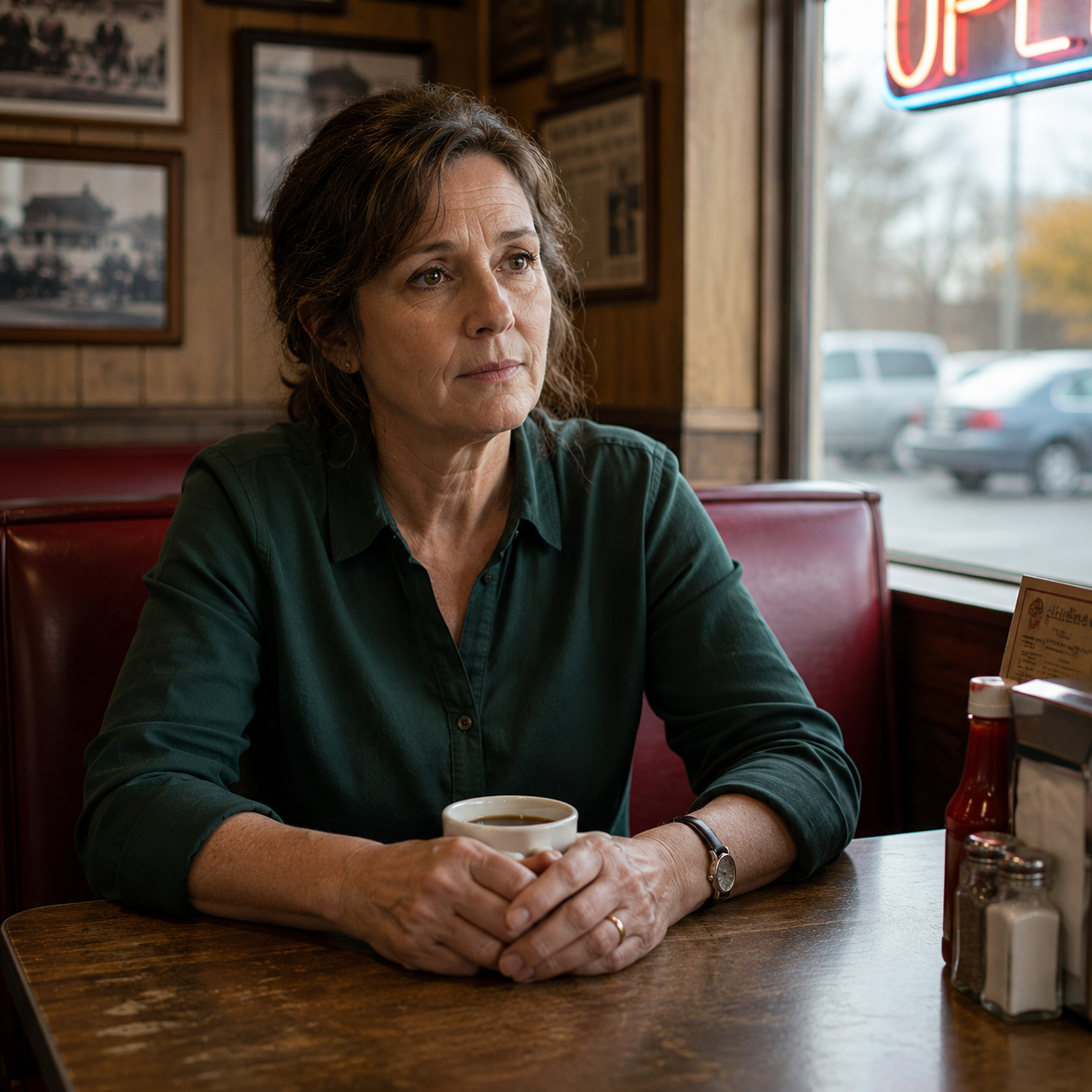
The restaurant had been my father’s idea in 1969, but it had been my work for thirty-four years.
I do not say this with bitterness. I say it as a matter of arithmetic. My father had opened Kovacic’s Family Restaurant on a small lot off Highway 19 outside of Steubenville, Ohio, in the spring of 1969, with money he had saved from twelve years of working at the steel mill and a small loan from his cousin in Cleveland who owned a hardware store. He had run it himself for the first eleven years, with my mother managing the kitchen and a rotating cast of teenagers from the high school waiting tables. In 1980, when his back went out and the doctor told him he would need to either retire or accept that he would not be able to walk by sixty, he had handed the restaurant to me.
I was twenty-two years old. I had just finished two years at the community college in Steubenville, where I had studied accounting because my father had told me that the only useful education was one that could keep a small business from going under. I had not asked to take over the restaurant. My father had not asked me whether I wanted to take it over. He had handed me the keys on a Tuesday afternoon in March of 1980, in the small office behind the kitchen, and he had said:
“Marcy, the place is yours now. Run it the way you think it ought to be run. I will not second-guess you.”
He had kept that promise.
He had retired to a small house in Florida with my mother in 1985, and he had visited the restaurant twice a year for the next eighteen years, and he had never once told me what I should be doing differently. He had eaten at the corner booth he had eaten at since 1969. He had asked the waitresses whose grandchildren they were. He had paid for his meal with cash. He had hugged me at the door and told me he was proud of me, and he had gone back to Florida.
My brothers had a different relationship with the restaurant.
I have two brothers. The older one is named Anthony. He is six years older than me. He lives in Cleveland and has worked, for the last thirty-eight years, in commercial real estate, which is a phrase that has covered a wide range of activities of variable success. The younger one is named Vincent. He is four years younger than me. He lives in Pittsburgh and has worked, for the last twenty-six years, in what he calls hospitality consulting, which has meant, at various points, owning a small bar that closed after eighteen months, owning a different small bar that closed after eleven months, and currently serving as a consultant to a restaurant group in southwestern Pennsylvania that I have never been able to find evidence of on the internet.
Anthony and Vincent had both, at different points, been offered the restaurant by my father. Anthony in 1976, when my father had first begun to think about his back. Vincent in 1979, when my father had begun to think more seriously about it. Both of them had declined. Anthony had said, in 1976, that he had bigger plans than a small-town diner outside Steubenville. Vincent had said, in 1979, that the food-service industry was beneath him. My father had accepted both of their answers, and he had passed me the keys the following year, and that had been the end of the conversation about who was going to run Kovacic’s.
That had been the end of it for thirty-four years.
In the thirty-four years between 1980 and 2014, I had taken a restaurant that had been doing $310,000 a year in revenue when my father retired and turned it into a restaurant that was doing $2.4 million a year. I had expanded the dining room twice. I had added the catering business in 1991. I had bought the adjacent lot in 1997 and built the banquet hall in 1999. I had paid off the original mortgage in 2003. I had bought out my father’s interest in 2006, with cash, in a transaction that had been overseen by his lawyer and that had been documented in three notarized agreements. I had raised two children of my own in the apartment above the restaurant, with my husband Daniel, who had been the head cook from 1986 until his death from pancreatic cancer in 2011.
I had done this work.
Nobody else had done it.
My brothers had visited the restaurant, in total, fewer than twenty times in thirty-four years. Anthony had come for my father’s seventieth in 1995. Vincent had come for my mother’s funeral in 2002. Both of them had come for Daniel’s funeral in 2011. They had come for two or three Thanksgivings in the 1990s. They had not come for my wedding in 1985. They had not come for the births of my children. They had not come for the opening of the banquet hall.
This was not a complaint. I am not the kind of person who complains. I had run the restaurant for thirty-four years and I had not needed my brothers to be there. I had needed Daniel, and the staff, and the customers who came in on Tuesday mornings for breakfast and had been coming in on Tuesday mornings for thirty-four years.
But my father died in October of 2014. He was eighty-three. He died in the small house in Florida, with my mother beside him, of complications from a fall the previous spring. We brought him home to Steubenville for the funeral. He was buried in the small Catholic cemetery off Route 7, in the plot beside the empty plot that my mother would eventually occupy.
The funeral was on a Thursday. The reading of the will was on the following Monday.
My brothers had flown in for the funeral. They had not flown out yet. They had decided, both of them, that they would stay through the will reading. They had said this casually, in the parking lot of the cemetery after the funeral, in the polished tone of two men who had been waiting a long time to attend a meeting they considered overdue.
I am fifty-six years old. My name is Marcy Kovacic. I had run Kovacic’s Family Restaurant for thirty-four years by the autumn of 2014, and I had assumed, without ever speaking it aloud to anyone including my husband, that my father’s will would leave the restaurant to me. He had given me the keys in 1980. He had stayed out of my way for thirty-four years. He had told me, every single year on his birthday phone call, that I had done with the restaurant what he had hoped someone would do with it.
I had assumed.
I had been wrong to assume.
The will reading was at the office of my father’s lawyer, a man named Richard Tessari, who had handled my father’s affairs for over forty years and who had also, in 2006, handled the buy-out paperwork between my father and me. His office was on the second floor of a small brick building on Market Street in downtown Steubenville, above the dry cleaner’s, with a small frosted-glass door and a small brass nameplate and the worn carpeting of a small-town professional who had stopped updating his office sometime in the late 1990s.
We sat in his small conference room at ten in the morning on a Monday in late October. My mother sat in the chair closest to the window. Anthony and Vincent sat on the other side of the table from me. Mr. Tessari sat at the head of the table with a thick folder in front of him.
He opened the folder.
He read the will.
The first half of the reading was procedural. The house in Florida went to my mother. My father’s small investment accounts went to my mother. The small life insurance policy went to my mother. The contents of the house went to my mother. The car in Florida went to my mother. None of this was surprising. None of this was contested.
Then Mr. Tessari turned the page.
“The matter of the business,” he read, “known as Kovacic’s Family Restaurant and the associated real property at 1147 Highway 19, Steubenville, Ohio. The decedent’s interest in the business and the real property, to the extent that any such interest survives the buy-out agreement of June 2006, is to be divided among the decedent’s three children, Marcellina Kovacic Bruno, Anthony Joseph Kovacic, and Vincent Marco Kovacic, in equal shares.”
The room went quiet.
I did not move. I did not, at first, understand what I was hearing. I had bought out my father’s interest in 2006. He did not have an interest to leave. The buy-out had been complete. I had paid him eight hundred and forty thousand dollars in 2006, in cash, in a transaction that Mr. Tessari himself had overseen.
But Anthony was leaning forward. Anthony was smiling slightly. Anthony was, I could see now, the reason that this clause was in the will.
“Mr. Tessari,” Anthony said. His voice was the practiced steady voice of a man who had been preparing for this moment. “Could you clarify the language on that?”
Mr. Tessari looked at him.
“The language is clear, Anthony.”
“But the buy-out in 2006 was contested.”
“By whom?”
“By the family.”
Mr. Tessari paused. He looked at me. He looked at Vincent, who had folded his hands on the table and who was looking down at them with the small careful posture of a man who had been told what to do in this meeting and was now doing it. He looked back at Anthony.
“Anthony,” he said. “The buy-out in 2006 was a transaction between your father and your sister. There was no contesting party. There was no family vote. There was no family involvement. The transaction was between two individuals, your father and your sister, and it was completed in this office on June 14th, 2006, with three notarized signatures.”
“That’s what I’m contesting now.”
“You cannot contest a transaction that was completed eighteen years ago. The statute of limitations on any conceivable cause of action has long since passed.”
“Then I am asking you to interpret my father’s will. The language says that the decedent’s interest in the business, to the extent that any such interest survives the buy-out agreement, is to be divided among his three children. I am asking what that means.”
Mr. Tessari put down the folder.
“Anthony.”
“Yes.”
“What you are asking me is whether your father, in writing his will, was trying to undo the buy-out he had completed in 2006 with your sister. The answer to that question is no. The answer is that he was being careful with his language because he had a small remaining contingent interest in some of the equipment in the kitchen that he had personally purchased between 2006 and 2011 and donated to the restaurant. That equipment, to the extent that it still exists, would be the only property covered by this clause of the will. It is worth, in my estimation, perhaps two thousand dollars. To be divided three ways.”
The room went very quiet.
I looked at Anthony.
Anthony’s face had not yet changed. He was still processing the sentence. He had been preparing, I now understood, for an entirely different conversation. He had flown in from Cleveland for what he had believed was going to be a redistribution of the restaurant. He had brought Vincent, who had flown in from Pittsburgh, on the assumption that the two of them together would be able to outvote me in some kind of family decision-making process that did not exist in any legal sense but that they had apparently believed would be acknowledged.
They had brought a plan. They had brought, I now realized, possibly a lawyer they had retained. They had certainly brought the expectation that the meeting was going to go a particular way.
Anthony said: “I would like to consult with my own attorney.”
“You may,” Mr. Tessari said. “But your attorney will tell you the same thing I have just told you. The restaurant is your sister’s. It has been your sister’s since 2006. Your father’s will does not change that, and it was not intended to change that, and the language was carefully constructed by your father and myself in 2009 to make absolutely sure that no one could claim it did.”
Mr. Tessari paused.
He took off his reading glasses. He set them on the table. He looked at all three of us.
“I am going to tell you something that I would not normally tell you in a will reading,” he said. “But I am going to tell you anyway, because I knew your father for over forty years, and I know what he would have wanted me to say in this moment.”
He looked at Anthony. Then at Vincent. Then at me.
“In 1998, your father added a sentence to his will. I had drafted the will the previous year. He came back into my office, in March of 1998, and he asked me to add one sentence. The sentence is in the file. It has been in every version of the will since 1998. It is in the version we have just read.”
He turned the page of the folder. He found the place. He read it aloud.
“The clause reads: In the event that any of my children attempt to contest the disposition of Kovacic’s Family Restaurant after my death, on the basis of a claim that they were entitled to a portion of the business that they did not earn through their own labor, the entirety of any interest they would have received from this estate shall be forfeited, and shall pass instead to my daughter Marcellina, who has earned the business by running it.”
He paused.
“Your father added this clause in 1998. He added it five years before the buy-out. He added it because, by 1998, he had begun to anticipate that this conversation might happen at his death.”
He looked at Anthony.
“Your father knew you, Anthony. He knew both of his sons. He loved you both. But he knew you. And he wrote this sentence into his will twenty-six years ago, because he wanted to make sure that on a Monday morning in his lawyer’s office, when his three children were sitting around a table after his funeral, his daughter would not be on her own.”
Anthony did not speak.
“You came into this office today,” Mr. Tessari continued, “with the apparent intention of contesting your sister’s ownership of the restaurant. I am required to inform you that under the terms of your father’s will, drafted twenty-six years ago, the moment you formalize such a contest, the small contingent interest that your father did leave to the three of you, the one worth perhaps two thousand dollars total, will pass to your sister.”
Anthony stared at him.
“And so will any other claim you might choose to make against this estate at any point in the future.”
Anthony did not speak.
Vincent had stopped looking at his hands. Vincent was now looking at his older brother with an expression I had not seen on Vincent’s face since he was a child being told he was about to be caught at something.
Mr. Tessari closed the folder.
“Your father loved you both,” he said. “Very much. He stayed in touch with you, he sent you money on more occasions than your sister knew about, he paid for parts of your educations and for several of your business ventures that did not work out. He did all of those things, in his life, with love.”
He paused.
“And he did this one thing, in 1998, with foresight. He knew his children. He protected the one of you who had earned the protecting.”
He pushed the folder back into the center of the table.
“This concludes the formal reading of the will. If anyone would like a copy of the documents, I will have my assistant prepare them. I would suggest, Anthony, that you not pursue this matter further. Your father has answered the question you came here to ask.”
The room was very quiet.
I sat at the table and looked at my brothers.
I had run the restaurant for thirty-four years. I had not, in any of those years, expected my father to do what he had done in March of 1998. He had not told me about the clause. He had not, in any of the eighteen years of his retirement, mentioned to me that he had written it. He had simply gone on visiting twice a year and eating in his corner booth and telling me he was proud of me, and he had let me run the restaurant the way he had said in 1980 that he would let me run it.
But he had also, in March of 1998, walked into Mr. Tessari’s office on Market Street, and he had asked his lawyer to add a sentence to his will, because he had known what kind of sons he had raised, and he had not wanted his daughter to be alone in this room twenty-six years later.
I looked at my mother. She was looking at me across the table. Her eyes were wet. She nodded once, slowly. She had known, I realized. She had known about the clause for twenty-six years. She had kept it the way she had kept many things in her marriage to my father, in the private chamber of herself where she kept the things she was not asked to share.
We left the office.
My mother and I walked down the stairs together. My brothers walked behind us. None of us spoke. We went out onto Market Street, and my mother and I turned toward the parking lot where I had left my car, and my brothers turned the other way, toward the rental car they had driven from the Pittsburgh airport that morning.
Anthony did not say goodbye. Vincent did. He hugged me, briefly, with the careful embrace of a man who had just realized that he had spent three days flying in for a meeting that had been decided against him twenty-six years before he had thought to attend it.
“Sis,” he said.
“Vincent.”
“Pop loved you.”
“I know.”
“He loved us, too. I think.”
“He did, Vincent.”
“I’m sorry.”
He let me go. He walked to the rental car. He drove away with Anthony, and I did not see either of them again for fourteen months, until my mother’s funeral in December of 2015, where they both attended and where neither of them said anything about the will or the restaurant or the meeting in Mr. Tessari’s office.
My mother and I drove back to the restaurant.
The lunch rush was just beginning. The dining room was about half full. Tracy, who had been my morning hostess since 1992, looked up when we came in, and she said, “How did it go, Marcy?”
I said: “It went all right, Tracy.”
She nodded. She did not ask anything else.
My mother and I sat in the corner booth. The booth my father had sat in for forty-six years. I had not eaten in it since his last visit in May of 2014. I had not been able to. But that afternoon, with my mother beside me, in the booth where my father had sat twice a year for eighteen years and told me he was proud of me, I sat down and I ordered the meatloaf, which had been on the menu since 1969 and which I had not changed in thirty-four years of running the place.
My mother ordered the meatloaf too.
We did not say very much. There was not very much to say. The restaurant kept running around us, the way it had been running around me for thirty-four years, the way it would keep running for the years I had left to run it.
I am fifty-six years old now. I will be fifty-seven this October. I have run Kovacic’s Family Restaurant for thirty-four years, and I expect to run it for at least another ten, and possibly fifteen if my knees hold. My son Tony, named for my father, works in the kitchen now. He is twenty-six. He has been training for the last four years to take over when I retire. He has told me, more than once, that he wants to keep the meatloaf on the menu.
I have not heard from Anthony in nine years. Vincent calls once or twice a year. He has not asked about the restaurant. I have not offered.
My father’s clause is still in the file at Mr. Tessari’s office, even though my father has been dead for nine years and the question it was protecting against has long since been settled. I have read it once. Mr. Tessari gave me a copy of the will after the reading. I sat in my apartment above the restaurant that evening, with a glass of wine, and I read the clause my father had added in March of 1998.
I have thought, in the years since, about what my father did.
He could have left the restaurant to me explicitly in 1997 when he first wrote the will. He could have written: the restaurant goes to Marcellina, the end. That would have been the obvious way to do it.
But he had not done it that way. He had instead added a single sentence, in 1998, that protected me only if my brothers attempted to take from me what I had earned. The sentence did not trigger unless they tried. It did not announce itself. It did not put words in my mouth or in their mouths. It waited, for twenty-six years, for the moment when it might be needed.
He had known what he was doing.
He had known that the only way to protect the daughter who had stayed was to make sure that the sons who had left could not undo, after his death, what he had decided in his life.
He had known that the way to do this was to make the protection conditional on his sons’ own behavior. If they did not contest, they would not lose. If they did contest, they would lose everything.
That is the kind of arithmetic that a father does when he has watched his children for forty-five years and has decided that he knows, in the end, who his children are.
The math comes out.
It comes out in restaurants, too.
It always does.

Adrian Hawthorne is a celebrated author and dedicated archivist who finds inspiration in the hidden stories of the past. Educated at Oxford, he now works at the National Archives, where preserving history fuels his evocative writing. Balancing archival precision with creative storytelling, Adrian founded the Hawthorne Institute of Literary Arts to mentor emerging writers and honor the timeless art of narrative.