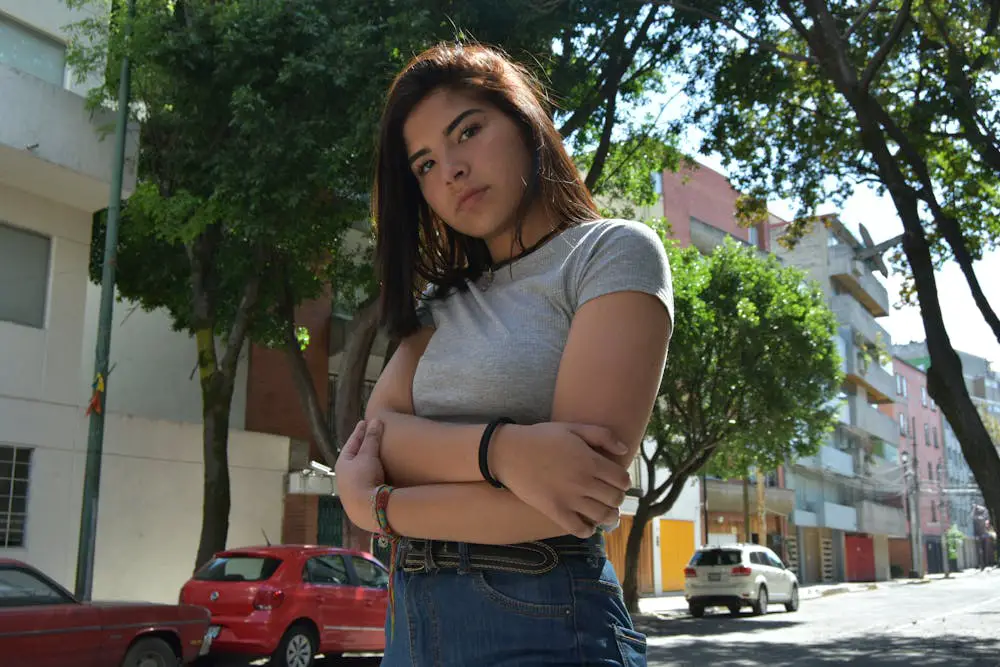
The Girl With Mismatched Shoes
The first time Lucy showed up at my door, I almost sent her home.
She was forty minutes late, her hair half-pulled into a lopsided bun that had given up somewhere between her apartment and mine, and she was wearing one white sneaker and one black flat. Not as a fashion statement. She genuinely had not noticed. She stood in my doorway holding a backpack with a broken zipper, slightly out of breath from the stairs, and she said, “I’m so sorry, Mrs. Calder, the bus was — ” and then she looked down at her feet and went quiet for a moment before finishing, “I’ll be on time next time.”
I thought: this girl is going to burn my house down.
I hired her anyway, because I was desperate, and because my neighbor had vouched for her, and because something in the way she looked at my daughters in those first five minutes told me she was going to be kind to them. You can usually tell. Children know it first. My youngest, Sophie, walked straight up to her and said, “Your shoes don’t match,” and Lucy said, “I know. I was running late and grabbed the wrong ones. Which do you like better?” and Sophie thought about it seriously and said, “The black one.” Lucy pulled off the white sneaker and handed it to Sophie. “Hold onto that for me,” she said. “I’ll need it later.”
Sophie carried that shoe around for the rest of the afternoon like a treasure.
That was five years ago.
Lucy was sixteen then, a junior at the high school three blocks away, already raising a toddler on her own with help from her mother and a schedule that would have collapsed most adults. She babysat for us three afternoons a week, then four, then five. She became part of the furniture of our lives, part of the rhythm, the person who knew where we kept the extra batteries and how Sophie liked her grilled cheese and which of my daughters needed to be held when they cried and which needed to be left alone. She was young enough to get on the floor and play, old enough to be trusted with the serious things.
When Ray and I started having trouble, Lucy saw it before the girls did. She never said anything about it. She just showed up a little earlier on the hard days, stayed a little later. That was her way.
I want to be honest about Ray, because he was not a villain. He was a man who loved his family in ways that sometimes looked like disappearing. When Sophie was sick, he drove to specialists in other cities while I slept at the hospital. He spent months researching her treatment options at night when he should have been sleeping, cross-referencing medical journals and calling doctors whose papers he had found online. He was, at his core, a man who believed he could fix things if he worked hard enough. That belief was both his best quality and the thing that eventually broke us open.
Sophie’s cancer treatment lasted eleven months. The disease was caught early enough that the prognosis was good, but good prognosis and easy are not the same thing, and no one who has not lived inside a children’s oncology ward understands what those months cost. Not just financially, though financially the damage was staggering. It was the smaller erosions that accumulated into something structural: the sleep deprivation, the waiting rooms with their terrible coffee and outdated magazines, the particular loneliness of being surrounded by other families in crisis and still feeling completely alone, the conversations with Ray that kept sliding sideways because neither of us knew how to talk about fear without feeding it. We became very efficient at managing logistics and very bad at everything else.
The bills were catastrophic. We had insurance, but insurance is a document that promises to help you until you actually need help, at which point it produces a detailed list of exceptions. Each denial letter required an appeal. Each appeal required documentation. Each piece of documentation took time I did not have, and the cycle repeated in the background of everything else, this steady administrative grind that felt deliberately designed to break the people navigating it. We borrowed from my parents and from Ray’s, and we put things on credit cards we had no clear plan for paying off, and we told ourselves we would sort it out later once Sophie was well.
We sold the house in Oak Park fourteen months after Sophie’s last treatment, when the debt had stacked itself into something that felt architectural, permanent, like a second structure we were living inside.
I did not want to sell the house. I want to say that plainly. We had lived there for nine years. My daughters had grown up in those rooms. Sophie had learned to walk in the hallway, using the baseboards for balance. Valerie had written her name in pencil on the wall inside her closet when she was seven, and we had laughed and left it there, and it had become a ritual, all three girls measuring themselves against the doorframes every birthday. The kitchen had a window that caught the afternoon light in a way that made even ordinary Tuesdays feel gentle. I loved that house the way you love something you built into, something you shaped yourself around over years.
We signed the papers on a Tuesday. That night, after the girls were in bed and Ray was somewhere making calls I didn’t ask about, I sat in the empty bathroom of our almost-former home and I talked to the house. I said, forgive me. As if it were a person. As if it could hear me.
I had thought no one was listening. I was wrong about that too.
Lucy moved in with us briefly during the transition, helping with the girls while we packed, and I had assumed she was asleep by then. She was not. She heard everything through the thin wall, a sixteen-year-old girl who had grown up in apartments where the walls were always thin, where you learned early that adults cried in bathrooms because they had nowhere else to go. She did not knock. She did not say anything. She went back to her room and started saving.
We moved into my cousin Dana’s apartment on the third floor of a building with no elevator and clotheslines strung between windows and the perpetual smell of someone else’s cooking. Dana was generous in the way only people who have been poor understand how to be, which is to say she gave us the space without making us feel the weight of it. The girls shared a room. I slept on a fold-out. Ray had been staying somewhere else, somewhere I had stopped asking about, because by then asking felt like one more thing I did not have the energy for.
Ray and I had not separated formally. We had simply drifted apart by attrition, the way marriages sometimes do when survival takes up all available space. There was no dramatic confrontation, no single breaking point. There was just the cumulative exhaustion of crisis after crisis, and Ray’s habit of going quiet when he should have spoken, and my habit of refusing to ask questions I was afraid to know the answers to.
I was scheduled to sign some papers the next afternoon. A finalization of the sale agreement, some lingering legal matter the attorney said needed my signature. I did not understand all of it, which in retrospect I should have recognized as a warning sign. But I was tired. I had been tired for two years.
The call came at seven in the evening.
I was in Dana’s kitchen trying to heat up soup and help Sophie with a worksheet at the same time when my phone rang. I did not recognize the number immediately, and when I heard Ray’s voice I felt the small apartment tighten around me, as though the walls had shifted inward by a few inches. Lucy was standing in the doorway, watching me with an expression I could not immediately read.
“Don’t sign anything tomorrow, Patricia.” His voice was low and careful in the way voices get when someone is trying to control what they’re feeling. “Not until you know the whole truth.”
I laughed. It was not a kind laugh. “The truth. Three months without answering my texts, Ray. Three months where your daughters only see you on video calls, when you remember to call.”
“I know. I know how it looks.”
“It doesn’t look like anything. It is what it is.”
Lucy lowered her eyes. And in that moment I understood something that tightened my chest harder than anything Ray had said. She already knew. Whatever he was about to tell me, Lucy already knew.
“Patty,” she said softly.
I held up my hand.
“Ray. If you have something to say, say it now.”
A pause. Then: “I’m downstairs.”
I crossed to the window. Three floors down, on the sidewalk below the clotheslines, Ray stood with his phone pressed to his ear, looking up. He was thinner than I remembered. He had not shaved in days. He was wearing a jacket I recognized from years ago, something he’d had since before we were married, and he stood the way people stand when they have run out of places to go and have finally stopped running.
“Come up,” I said. I hung up.
Sophie and the other girls were in the back room. Matthew, Lucy’s son, was asleep on the couch under a blanket printed with superheroes, his small mouth slightly open, one hand curled near his cheek. I looked at him for a moment before I looked at Lucy.
“How long have you known?” I asked.
She did not try to soften it. “Six months.”
Six months. I repeated it in my head twice before I trusted myself to speak. “And you didn’t say anything.”
“He asked me for time. He said he was trying to fix it.”
“It wasn’t yours to carry.”
“It wasn’t my secret to tell, Patty.”
I wanted to argue with that. Part of me still does. But Lucy had her own architecture of loyalty, built from years of being on the receiving end of other people’s silences, and I understood it even when it made me furious.
The knock came before I could say anything more.
Ray walked in without looking at me directly. He had a black legal folder tucked under his arm. His shirt was wrinkled and he smelled of the city, of rain and underground trains and the particular exhaustion of a person who has been sleeping badly for months. Lucy offered to make coffee. I told her to stay.
Ray set the folder on the table. The rain had picked up outside, drumming against the metal awning over the window. Somewhere below us a street vendor was calling out his prices, and the ordinariness of it felt offensive, the way the world always continues around the edges of your worst moments.
“Talk,” I said.
He did.
He told me that when we sold the house, he had known the buyer was a developer. A firm that was buying up properties in Oak Park to demolish and replace with condominiums. The attorney had told him after the papers were signed, once it was too late to reverse course. Ray had not told me because he had thought he could fix it. He thought he could buy the house back before I found out it was gone.
To do that, he had sold his shares in a technology company in Boston, a partnership stake he had been quietly building during the years before Sophie got sick. It would have been worth something substantial in time. He sold it for far less than its value because he needed the money quickly, and even then it was not enough. The medical debt was layered beneath other debt, interest accumulating on loans he had taken quietly, and every time he thought he was close, another bill surfaced.
And then he had gone to his brother.
Ethan. I had known Ethan for twelve years and had never fully trusted him, which is something I had always kept to myself out of respect for Ray. Ethan was charming in the way that makes you check your pockets. He sent a text during Sophie’s chemotherapy that said God works in mysterious ways, as if theology were an adequate substitute for showing up. He smiled at family gatherings with the particular warmth of a man who has calculated exactly how warm to be.
Ethan told Ray he could help recover the house. He had connections with the development company, he said. He knew people. He just needed Ray to sign some paperwork to expedite the process, a power of attorney arrangement to keep things moving quickly. He explained it in the casual shorthand of a man discussing something simple, a favor between brothers, nothing to worry about, just a formality. Ray was desperate and exhausted and he trusted his brother the way you trust people you grew up with, against all evidence, because love is often slower to update than intelligence. He signed.
What Ray signed was a conditional assignment. If Ethan failed to complete the purchase within a specific window, the right to buy the property transferred to him. The house had already been marital property. None of this had been disclosed to me. None of it had been done with my knowledge or consent. The entire arrangement had been constructed, deliberately, around my absence.
When Ray finally understood what Ethan had done, he did not come to me. He ran. Not literally, not all at once, but in the incremental way that some people flee, growing quieter and more absent, answering texts with a delay and then not at all, until the silence became its own statement. He told himself, I think, that he was protecting me from information that would cause pain before he had a solution to offer. This is the story people tell themselves when they disappear. They are sparing you. They will come back once they have something to show for the time they were gone.
I listened to all of it without moving. At some point Lucy had sat down at the far end of the table. The soup was still on the stove, gone cold.
I wanted to scream at him. I wanted to describe in precise detail what it had been like to sit beside Sophie’s hospital bed and watch her ask, with genuine curiosity, whether her smile was going to fall out along with her hair. I wanted to tell him about selling my car, my grandmother’s earrings, the good winter coat, each thing with its small private grief. I wanted to explain that I had never once had the option of disappearing, that motherhood does not come with an exit, that I had held everything together through sheer refusal to let go and I had done it alone while he was out there drowning in a silence of his own making.
The bedroom door opened before I said any of it.
Sophie came out barefoot, in her pajamas, her dark hair loose around her shoulders. She was eleven. The scar near her collarbone from the central line caught the lamplight. I used to press my lips to that scar when she was sleeping, a habit I had developed in the hospital and never stopped.
She looked at Ray and said, “Dad?”
He broke completely.
Not the contained, manageable grief of a man in distress, but the kind that takes the whole body, the kind you cannot reason with or manage. He sat down hard in the nearest chair and put his face in his hands and cried the way people cry when they have been holding it for too long.
Sophie walked to him slowly, carefully, with the particular deliberateness of a child who has spent time in hospitals, who has learned that gentleness is sometimes the most serious thing a person can offer. She put her hand on his arm.
“Why are you crying?”
“Because I missed you so much, sweetheart.”
She considered him for a moment. “Then don’t leave so much.”
Five words. He pressed his face further into his hands. I had to look at the window.
The attorney’s office the next morning was in a building designed to make you feel small. Cold marble floors, plants that had never been watered by anyone who cared about them, the kind of architecture that communicates wealth as a way of communicating power. Lucy sat beside me in the back of the cab. Her hair was up with the same purple elastic band she had worn the first day she came to my house. Her shoes matched, but one had a broken lace tied in a double knot.
“Some things never change,” I told her.
She looked down at her feet and smiled slightly. “I match seasonally.”
I laughed in spite of everything. She had that effect.
Ethan was already waiting in the conference room when we arrived. Blue blazer, expensive watch, the broad easy smile of a man who has rehearsed confidence until it became indistinguishable from the genuine article. He moved toward me with his arms slightly open, the social choreography of a greeting, and I stepped back and he stopped.
Lucy straightened beside me. “The teenage mother your family said was going to ruin everything,” she said pleasantly. “It’s a pleasure.”
Ray said nothing. I said nothing. The attorney gestured for everyone to sit.
Ethan laid out his position efficiently. Ray had defaulted on the conditional agreement. The right to purchase had legally transferred. He was offering us the opportunity to sign a waiver and avoid litigation, which he framed as generosity.
“Patricia,” he said, turning to me with practiced reasonableness, “you don’t have the resources to fight this. It would save everyone a great deal of difficulty if you simply accepted the situation.”
There is a particular kind of strength that lives somewhere below the ribs, in the place where you store everything you survived. I felt it come online like a furnace.
“You have no idea what resources I have,” I said.
Lucy reached into her backpack, the same battered one with the broken zipper she had carried since I met her. I had given her two new bags over the years and she continued to use this one out of a loyalty I had never fully understood. She pulled out a USB drive, a spiral notebook covered in stickers, and a green folder, and she set them on the table with the quiet precision of someone who had been waiting for exactly this moment.
“Before we proceed,” she said, addressing the attorney directly, “I’d like you to look at something.”
She opened the folder.
Lucy had spent two months working quietly, methodically, without telling me. She had gone to the City Register’s office with a classmate who was studying pre-law. She had pulled documents, cross-referenced transaction records, and traced the money. The down payment Ethan had submitted for the property had not come from a personal account. It had come from a development company, and that development company shared its principal with the original buyer of the house, the same firm that had purchased it from Ray and me.
It was not a coincidence. It was a loop, a closed circuit of fraud designed to transfer marital property through a series of transactions that kept my name off every document while depending entirely on rights that could not legally be exercised without me.
The power of attorney Ray had signed, Lucy explained, had been used to transfer a purchase agreement. That agreement concerned property that was legally and jointly mine. Under the law, no such transaction was valid without my knowledge and consent.
“What that means,” Lucy said, looking at the attorney rather than at Ethan, “is that none of this could have happened without her signature. Which she never gave.”
The attorney looked up from the folder. His expression had changed.
Ethan’s face had lost some of its carefully maintained color. He recovered quickly, the way practiced people do, and he raised his voice in the way that men sometimes do when they realize an argument is going badly for them. He used a word to describe Lucy that I will not repeat. The attorney told him to lower his voice. He told her she had no idea what she was doing.
Lucy took out her phone and set it on the table and pressed play.
The recording was not long. Ethan’s voice came through clearly, a conversation he had apparently had on the phone some weeks earlier, discussing the timeline for the sale of the house and the division of proceeds. The clarity with which he discussed ensuring I would not find out was remarkable, even to me, and I was sitting in the room having already braced myself.
Ray stood up. I said his name once, sharply, and he sat back down. The truth was not going to be served by a fistfight. The truth was already in the room, on the table, laid out in Lucy’s careful handwriting and her methodically assembled documents.
Ethan stared at the phone like it had bitten him.
“That recording may not be admissible,” he said.
“That’s a question for the courts,” Lucy replied. “But the property records are public. The account transfers are documented. The signature irregularities are a matter of law, not interpretation.” She paused. “You’re welcome to test it.”
The negotiation that followed was not dramatic. Drama had already happened. What remained was the grinding, practical work of leverage, and Lucy had brought enough of it that by the time we walked out two hours later, the fraudulent transaction had been formally contested, Ethan had agreed to surrender his purchase claim in lieu of litigation, and the development company had agreed, through its attorney, to facilitate a buyback at the outstanding balance.
We stood on the sidewalk outside.
The folder was in my hands and my hands were shaking slightly, not from fear but from the particular physical response to adrenaline draining out of a body that has been running on it for too long. Ray stood a few feet away. Lucy was zipping her backpack.
“I can’t cover the buyback amount,” I said. “Not all of it.”
Ray told me about his severance package from the job he had lost two months earlier, a fact he had not mentioned until that moment. He told me he had what remained from the share sale. Together it was a partial amount, less than half.
“I have the rest,” Lucy said.
I told her no. She had a son. She had her own life to build.
She opened her sticker notebook. On a page between a drawing of a unicorn and a list of motivational phrases she had copied down from somewhere, there was a column of numbers. Dates and amounts going back years. Tips from the diner where she had picked up weekend shifts. Overtime. Birthday money from her mother. Labeled envelopes she described so specifically I could picture each one, Matthew’s school fund, emergency fund, a third one simply labeled Patty’s house.
“Since when?” I asked.
“Since the night you moved. I heard you in the bathroom.” She looked down at the notebook. “You said forgive me to the house. Like it was a person.”
I had believed I was alone in that bathroom. I had believed no one heard.
“I couldn’t give back what you gave me,” she said. “But I could protect a little piece of it.”
I have been asked, since then, what I did in that moment. I hugged her. That is what I did. I stood on a sidewalk in the middle of a city that continued to move around us, taxis and pedestrians and the ambient noise of ordinary life, and I held that young woman who had arrived at my door in mismatched shoes and somewhere along the way become one of the people I trusted most in the world.
We went back to Oak Park three months later, on a Thursday morning in October when the light was thin and the leaves were mostly gone.
The house had not been maintained. The paint on the front was blistering in places, peeling back from the wood in strips. The yard had gone to bare dirt and a few stubborn weeds. But the tree on the sidewalk was still there, the small unremarkable tree I had always meant to have someone look at, the one that had no business surviving the summers it had survived, and it was taller now and its trunk had thickened and it stood in the cool morning with the particular dignity of something that has simply decided to remain.
Valerie went in first, which was typical. She had her mother’s impatience and her father’s need to be the first to understand a room. She walked through the empty front hall and found the wall where we used to mark their heights in pencil on birthdays, and she put her hand flat against it and said, quietly, to no one in particular, “I’m still here.”
Sophie stood with me in the doorway.
“Is it ours again?” she asked.
I looked at Ray. We had been talking in the months since the attorney’s office, carefully, without promises in either direction. He was in therapy. He was rebuilding. I did not know yet what we were to each other, but I knew he was trying, and I knew that trying, for now, was enough.
He did not answer for me. I had noticed that he was learning not to, and I appreciated it more than I had expected to.
“Yes,” I told Sophie. “But it’s not the same as before.”
She thought about that. “Is that bad?”
The morning light came through the doorway and caught the dust floating in the empty hall, and I thought about all the years layered into those walls, the height marks and the crayon scribbles and the spot in the kitchen floor that always creaked and the window that made ordinary afternoons look like something worth painting.
“No,” I said. “It just means we have to get to know each other again.”
Sophie seemed satisfied with that. She went inside.
I stayed in the doorway for a moment longer, thinking about the girl who had shown up late and disheveled with a broken backpack and a toddler on her hip and one white shoe and one black flat, who had sat on my kitchen floor and played with my daughters and held everything she learned about our family with the careful discretion of someone who understood what it meant to be trusted. Who had cried in my kitchen the day she found out she was pregnant again and thought her life was ending, and who had stayed up with me the night Sophie’s fever spiked past a hundred and four while we waited for the on-call nurse to call back, and who had, without ever being asked, without ever making it a transaction, decided that our home was worth saving.
She had not done it out of obligation. She had done it because she had been given shelter once, when she needed it, and she had understood at some deep level what that meant, what it cost the people who gave it, and what it was worth.
Some people come into your life wrapped in chaos. Mismatched shoes and broken zippers and late arrivals and wrong turns. You look at them and you calculate risk and you make your best guess and sometimes you are wrong in the most ordinary directions, and sometimes you are wrong in a way that changes everything.
I was wrong about Lucy.
She did not burn my house down. She was the one who saved it.

Lila Hart is a dedicated Digital Archivist and Research Specialist with a keen eye for preserving and curating meaningful content. At TheArchivists, she specializes in organizing and managing digital archives, ensuring that valuable stories and historical moments are accessible for generations to come.
Lila earned her degree in History and Archival Studies from the University of Edinburgh, where she cultivated her passion for documenting the past and preserving cultural heritage. Her expertise lies in combining traditional archival techniques with modern digital tools, allowing her to create comprehensive and engaging collections that resonate with audiences worldwide.
At TheArchivists, Lila is known for her meticulous attention to detail and her ability to uncover hidden gems within extensive archives. Her work is praised for its depth, authenticity, and contribution to the preservation of knowledge in the digital age.
Driven by a commitment to preserving stories that matter, Lila is passionate about exploring the intersection of history and technology. Her goal is to ensure that every piece of content she handles reflects the richness of human experiences and remains a source of inspiration for years to come.