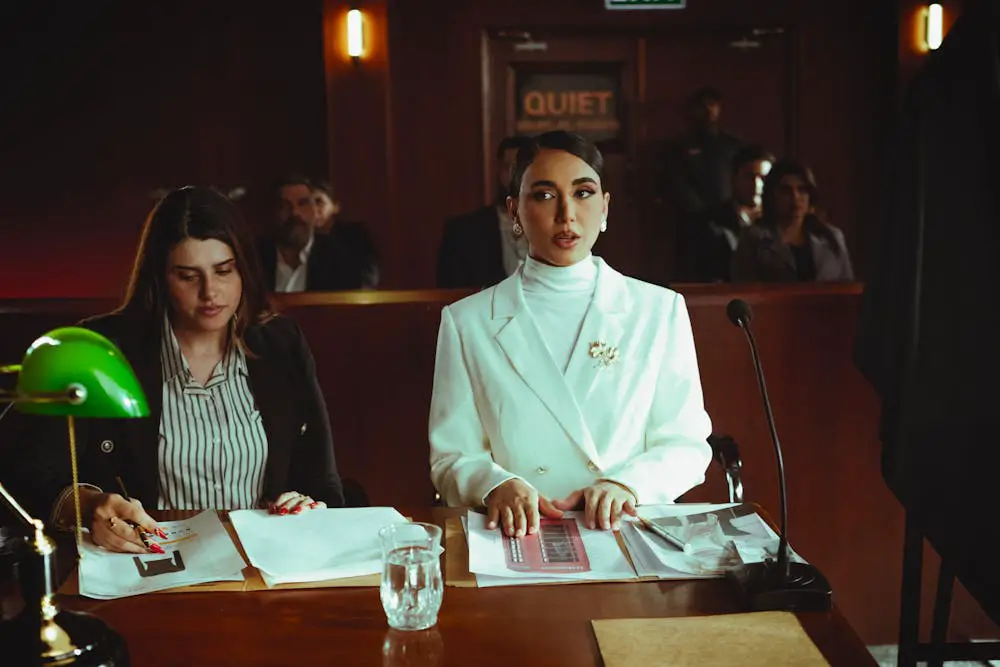
The Person Qualified to End His Career
My sister laughed in the courthouse hallway and said I was legally stupid.
Her attorney stood right beside her and he smiled too, the practiced smile of a man who has spent his career watching people fold under pressure and has learned to recognize the signs early. He had been building this case against me for eight months and had seen only what I had let him see: a woman who did not respond to threatening letters with anything more than a quiet formal reply, who did not appear in depositions with the electric fury of someone wronged, who did not call anyone crying, who seemed to absorb each new accusation with the patience of someone who did not understand what was being done to her.
He had catalogued my composure as confusion. He had mistaken my silence for ignorance.
Then Vanessa leaned close enough that I could smell her perfume, the expensive French variety she bought herself for every occasion she expected to win, and she whispered: I’m going to destroy you.
I looked past her toward the courtroom doors, toward the polished marble floors, toward the reporters waiting near the elevators. Vanessa had personally invited those reporters. Of course she had. My sister had always needed an audience for the moments she intended to win, understood instinctively that witnesses without full information were a resource she could shape, had spent decades refining the performance of the wronged party until she could do it so naturally that she no longer had to think about it.
Vanessa believed courtrooms worked the way family dinners had worked when we were children. The first person to cry won. The loudest voice received sympathy. Whoever performed helplessness most convincingly got protected. This method had served her well for most of her adult life and she had no particular reason to believe it would fail her now.
I had watched Vanessa develop this understanding from the time we were children. When we were eight and eleven she had learned that crying before our mother arrived to arbitrate a dispute meant being heard first. When we were teenagers she had learned that the person who framed the story to our father got to control the outcome. As an adult she had refined these instincts against larger audiences and she was genuinely good at it, genuinely skilled at resembling exactly the person that observers in a conflict without the full history are inclined to believe.
I had watched it work against me more than once. I had learned, over many years of watching it, that arguing with Vanessa’s version in real time was not useful, because she was better at arguing than at being right, and because the performance of conviction is very difficult to counter in the moment. The only thing that could counter it was documentation. Facts. A record that did not care about the quality of the performance around it.
I had been building that record.
She was wrong about the courtroom.
But I am getting ahead of things.
Our father, Raymond Arden, was diagnosed with stage three lung cancer eleven years ago and spent the following decade in a complicated truce with his own body, gaining ground and losing it in a slow and exhausting rhythm that I came to know intimately because I was the one in the house with him. I moved in during his first round of chemotherapy. I told Vanessa I was going to do this. I told her what I expected it to involve and asked if she wanted to share the responsibility. She said she was in the middle of something, she would come when things settled down. Three years passed. Things did not settle down. Vanessa did not come.
I paid the property taxes on the house in Caldwell where Dad had lived since before we were born, a house on a quiet street that had always smelled like his woodworking projects and the particular coffee he ordered by mail from a company in Vermont. I managed his medications, the complex rotating schedule of what needed to be taken when and with what food and at what interval from the next dose, the schedule that took me several weeks to fully understand and that changed every time his treatment changed. I drove him to appointments and sat with him through the ones that frightened him and learned how to read the faces of his oncology team well enough to understand the news before it was spoken. I slept in the room beside his with the door open so I could hear the oxygen machine that kept him safe through the night.
During those years, I received occasional calls from Vanessa. She wanted to know how he was doing. She said she was planning to visit. She said she would be there for the holidays. One Christmas she came for three days and photographed the decorated house and posted the photographs with captions about the people we love. Then she flew home.
Dad watched this and said very little. He was a man who formed his opinions decades before he expressed them. But in the last year of his life, when he could feel clearly where things were going, he asked me to sit with him in the evenings and he told me things.
He told me he was leaving the house to me. He was leaving Vanessa a substantial cash inheritance from his investment accounts, real money that would provide for her. But the house was different. The house was not provision. The house was acknowledgment. He said the word carefully, as if he had been deciding for some time which word was right.
He asked his attorney to record a video statement. He said he wanted his intentions preserved in a form that could not be interpreted away after he was gone. He was a careful man. He understood exactly what he was doing.
When Dad died in early spring, I stayed in the house and managed his estate. Vanessa came for the funeral dressed in black she had bought for the occasion. She cried beautifully. People who had barely known her told me what a devoted daughter she must have been, and I thanked them, because the funeral was not the moment.
Then the will was read.
Vanessa’s response was immediate and complete. She told everyone who would listen that I had stolen the house. She said I had isolated our father, controlled his communications, manipulated his perceptions, prevented her from being as present as she had wanted to be. She said the will was the product of confusion and coercion and that Dad had not been himself in his final years. She said these things with the conviction of someone who has repeated a story enough times that she has stopped being able to feel where the story ends and the memory begins.
The probate court reviewed the will, examined the evidence, interviewed his attorney and his physicians, and upheld it.
Vanessa filed a civil lawsuit.
When that case began developing in ways that did not favor her, she hired Blake Monroe.
During those years, I received occasional calls from Vanessa. She wanted to know how he was doing. She said she was planning to visit. She said she would definitely be there for the holidays. One Christmas she did come, for three days, during which she photographed the decorated house and posted the photographs on social media with captions about family. Then she left.
Dad watched this. He said almost nothing about it. He was not a man who spoke badly of people, even when the evidence warranted it. But in the last year of his life, when he could feel clearly where things were going, he asked me to sit with him and he told me things he wanted me to know.
He told me he was leaving the house to me. He told me he was leaving Vanessa a cash inheritance from his investment accounts, which was substantial. He told me he had made this decision not out of punishment but out of clarity. The house was where I had lived for eight years. The house was what I had maintained, what I had made the center of my life, what I had held together while he was unable to hold it himself. It belonged to me in a way that preceded the paperwork.
He asked his attorney to videotape his final statement. He said he wanted it preserved in a form that could not be misremembered.
When Dad died in early spring, I stayed in the house and managed his estate, which I had been managing for years anyway. Vanessa arrived for the funeral wearing black that had clearly been purchased for the occasion. She cried beautifully. People she had never met told me what a devoted daughter she must have been. I thanked them and did not correct them, because the funeral was not the moment and because correcting them would have served no one.
Then the will was read.
Vanessa’s response was immediate and loud. She told everyone who would listen that I had stolen the house. She said I had manipulated our father during his illness. She said the will was the product of coercion and that Dad had not been in his right mind. She said these things to extended family members, to his friends, to neighbors, to anyone who called to offer condolences, and she said them with the conviction of someone who had repeated a story enough times that she had begun to believe it herself.
The probate court reviewed the will, examined the evidence, spoke with his attorney and his physicians, and upheld it.
Vanessa filed a civil lawsuit.
When that case began to unravel, she hired Blake Monroe.
Blake Monroe had silver hair and the particular ease of a man who had spent decades in rooms where things went his way. His suits communicated money in the way that very specific suits do, not flashily but with a precision that told you exactly what they cost if you knew what you were looking at. He had a reputation for finding the soft place in an honest person’s story and pressing on it until settlement felt like relief rather than surrender.
He sent me letters. The letters accused me of elder coercion. They implied I had isolated my father from outside contact during his illness. They attached declarations from caregivers who Blake claimed had observed concerning behavior in the household. When I looked carefully at those declarations, I found problems. One caregiver had never worked in our home at all. I verified this through the home health agency, which had records. A second listed an address that did not exist as described. A third had a notarized signature bearing the stamp of a notary whose license had expired before my father signed anything. I could find this because I had managed my father’s legal files for fifteen years and understood how to read documents of this kind.
I noted each discrepancy carefully, with my attorney, and kept copies of everything in an organized file.
Blake’s investigator called my father’s neighbor, a woman named Mrs. Caldwell who had known our family for more than thirty years. She had spent considerable time in our house during Dad’s illness, bringing meals and sitting with him on the porch during the good weather. The investigator told her, according to what she reported to me afterward, that he was preparing materials for a civil lawsuit and that it would be helpful if she could provide a statement confirming she had observed me pressuring my father. He offered her five thousand dollars.
Mrs. Caldwell told him to leave. Then she called me.
I recorded her account of the conversation, thanked her, and added it to the file alongside the demand letters, the forged declarations, the expired notary record, and fifteen years of my father’s carefully maintained legal documents.
I had one more thing that I had not mentioned to anyone on Vanessa’s side, because no one had thought to ask.
For three years, I had served on the State Bar Association’s Disciplinary Review Board. I had been appointed through a professional network connected to my work in legal administration, a field I had entered quietly and built steadily over the years when I was not in the house managing my father’s illness. I attended monthly hearings. I reviewed evidence. I had spent three years learning to identify, from the documentation alone, the specific patterns that distinguish aggressive but legitimate litigation from fabrication with letterhead on top of it.
This was not a secret. It was public record, available to anyone who searched my professional background. It simply had not occurred to Blake Monroe to search, because he had already decided what kind of person I was. He had assessed my quiet responses and my absence of visible anger and my failure to respond to every accusation with a counter-accusation, and he had concluded that I was exactly the kind of frightened, isolated person his strategy was designed to break.
I had been building my record, and letting him build his trap in the one place where I was most qualified to see it for what it was.
The morning of the hearing, Vanessa was dressed as if victory had selected her outfit personally. She stood in the courthouse hallway and told me I should have settled months ago. She said Blake had assured her the judge would see how confused I was and that I would be lucky not to lose everything. Blake stood beside her and told me, in the smooth tone of someone who has delivered this particular message many times, that the legal system could feel overwhelming for people without training.
I smiled. That clearly bothered him more than he expected.
Inside the courtroom, reporters filled the back rows because Vanessa had arranged this. She had understood that public attention was a kind of pressure, that a record of the case in the news created its own momentum toward a particular kind of resolution. She had always been good at managing the context around a story.
The judge entered. We stood.
Before opening arguments, I approached the court clerk and handed over a sealed envelope. Then I turned toward the bench.
“Your Honor, before these proceedings continue, I need to formally disclose my professional credentials.”
Vanessa rolled her eyes in the way she had when she wanted to communicate to everyone watching that she was not impressed.
“I currently serve on the State Bar Association’s Disciplinary Review Board.”
Blake Monroe’s pen slipped from his hand and struck the table. The sound was sharp enough that several people near him reacted.
I watched him understand.
The judge opened the envelope. Inside were Blake’s demand letters, the forged caregiver declarations, the expired notary record, and Mrs. Caldwell’s account of the investigator’s visit and the five-thousand-dollar offer.
The judge read in silence. Blake’s expression had gone from careful professionalism to something more closely resembling the expression of a man watching his own choices assemble themselves into a consequence he can no longer prevent.
“Mr. Monroe,” the judge said, “did your office submit these witness declarations?”
Blake stood slowly. He was trying to find the pace and register that communicated calm authority. He did not entirely succeed. “Your Honor, I need time to review the materials.”
“You filed them,” the judge said. “You had time.”
Vanessa turned to him. “You said they were real.”
He did not look at her.
In that specific moment, I watched my sister understand something she had not fully understood before: that she had hired an instrument she believed she controlled, and that instruments of this kind do not distinguish between their intended targets and the people who engaged them.
I turned toward Blake. “Neither of you thought to ask why our father trusted me to manage his legal files for fifteen years. It did not occur to you to check who I was before assuming what I was.”
The judge’s expression had the quality of someone who has assessed a situation quickly and completely. “Mr. Monroe, I strongly suggest you stop speaking until you have counsel of your own.”
Vanessa’s mouth opened.
Blake asked to withdraw from the case. The judge refused until substitute counsel could be arranged, and ordered every original declaration preserved for examination.
Then my attorney stood and submitted my father’s final video statement.
His face appeared on the courtroom screen. He was thin, thinner than I had known him for most of my life, but his voice was the voice I had known since childhood. Unhurried. Precise. The voice of a man who believed words were worth being careful with.
He looked at the camera.
“Vanessa,” he said, “I love you. But love is not ownership. Claire stayed. Claire cared. Claire gets the house because she never treated it like a prize.”
Vanessa cried. Not the composed theatrical tears she had deployed for decades. The other kind, the kind that have nowhere to go and nothing to accomplish, the kind that arrive when the story you have been telling about yourself finally dissolves and what remains is just the fact of what you actually did.
The judge dismissed the emergency petition, froze the disputed filings for investigation, and ordered Vanessa to pay my immediate legal fees pending the sanctions review. Blake left through a side door with two court officers following him at a distance that was not quite escort but was close enough that everyone in the room understood what it meant.
In the hallway, Vanessa caught my arm.
“You set me up,” she hissed.
I pulled free. “No. You hired someone who fabricated evidence. You assumed I was too simple to notice. Those are different things.”
Her face did several things in quick succession. I had watched my sister’s face perform its way through difficult moments my entire life, and I recognized the specific sequence: fury first, then calculation, then the reaching for whatever version of events might still be salvageable.
She said: “I’m your sister.”
“You were my sister when Dad was dying too,” I said. “You were my sister during every year of chemotherapy and every medication schedule and every night I slept with the door open so I could hear the oxygen machine. You were my sister through all of it. You just weren’t there.”
She did not have an answer. She had spent years building a version of our family history in which her absence had been my fault, in which her inability to be present had been the result of my manipulation and control rather than her own choices. She had told this story so many times and with such conviction that she had stopped being able to feel the places where it didn’t hold together. The years she was not present, the taxes she did not pay, the calls that said she would come when things settled down and did not come when they did not settle down: these had been smoothed over in the retelling until she could no longer locate them as the decisions they had been.
I had watched her do this for years. I understood how it worked. A person can cause genuine harm from inside a story they believe completely. Understanding the mechanism does not require accommodating the harm, and accommodating the harm does not heal it.
“The case is over,” I said. “Blake’s situation is his own to manage now. I would suggest you find counsel who will give you an honest assessment of what comes next for you.”
She was still standing in the hallway when I walked out.
Blake Monroe resigned three months later, before his disciplinary hearing concluded. The forged declarations were referred for criminal investigation of his investigator, who had operated illegally in at least two other jurisdictions. Vanessa dropped the remaining case after her new attorney, a woman with considerably more caution than Blake had shown, explained that the documented evidence against the false filings would only compound over time and that continuing to litigate would expose Vanessa to sanctions of her own.
I kept the house.
Not because I had prevailed in some competition, not because the court had validated something that required external validation. Because my father had been watching for eight years and had understood what he saw and had made a deliberate decision that reflected that understanding. I had not needed the courtroom to confirm what I already knew. The courtroom had simply made what I already knew impossible for anyone to argue with.
On the first warm morning that spring, I was on my knees beside the front steps, working compost into the soil along the base of the foundation where the light was good for most of the day. My father used to sit on those steps with his morning coffee and watch the street come to life. He had done this for as long as I could remember, and he had particular opinions about the quality of light at different hours and the way the neighborhood changed through the seasons, which he expressed with the care of someone who has learned to pay close attention to small things because the small things are where most of life actually lives.
I was planting lavender. I thought it was something he would have liked. Something that would smell of itself in the warm afternoons and in the early evenings when the air cooled.
My phone buzzed. A message from Vanessa. We need to talk, it said.
I looked at the house, the garden, the quiet street.
I thought about what talking with Vanessa had cost me over the years, the specific exhausting work of being known incorrectly by someone who needed you to be something other than what you were, of managing her version of events and her version of my motivations and the space between what she said and what was actually true.
There are people who want a conversation because something in them has genuinely shifted and they have something different to offer. And there are people who want a conversation because consequences have found their address and they are hoping a conversation might redirect the consequences somewhere else.
I deleted the message.
The lavender was planted. The morning was quiet. The coffee was still warm.
My father’s house smelled like his woodworking projects and the coffee he used to order by mail and the particular quality of a house that has held a long life within its walls. It was mine now, in every sense. He had said so in a recorded statement in front of his attorney and a camera and eventually in a courtroom where his words outlasted every forged declaration and expired notary stamp and offer of five thousand dollars to a neighbor who had known him for thirty years.
He had been right. He had always been right about the things that mattered. That was one of the qualities I had learned from watching him: the patience to be right quietly and wait for the record to confirm it.
I went inside to make more coffee, and the morning was exactly as quiet as it was supposed to be.
Some things are only complicated because someone with an interest in the complexity has been working hard to make them seem so. Strip away the fabricated evidence and the tactics designed to make an honest person feel small and outnumbered, and what remained was simple. Simple and, in the end, impossible for anyone to argue with.
A daughter stayed.
A father noticed.
A house was left to the person who had been there, year after year, as it should be, as it always should have been.
That was all.
That was everything.

Adrian Hawthorne is a celebrated author and dedicated archivist who finds inspiration in the hidden stories of the past. Educated at Oxford, he now works at the National Archives, where preserving history fuels his evocative writing. Balancing archival precision with creative storytelling, Adrian founded the Hawthorne Institute of Literary Arts to mentor emerging writers and honor the timeless art of narrative.