A Wrong Turn
The fog still lay low over Willowbrook Farm when the mistake that would change Ezra Hawthorne’s life came rumbling down his gravel driveway.
It was one of those Kentucky mornings when the world seemed half-asleep, wrapped in pale gray mist and the soft breath of early autumn. The old barn stood quiet beyond the fence line, its faded red boards damp with dew, and the pasture stretched in rolling green patches where Ezra’s dairy cows moved like shadows through the fog. He had been awake since before sunrise, as always, carrying a dented feed bucket and talking softly to the cows as though they were old friends who expected conversation with breakfast.
At sixty-seven, Ezra Hawthorne moved slower than he once had, but he still moved with the steady rhythm of a man who had belonged to the land for most of his life. His back ached when the weather changed, his hands were knotted from decades of work, and grief had carved deep permanent lines around his mouth since Martha died two years earlier. The grief had not diminished, exactly. It had simply redistributed itself into the daily fabric of things, present in the way the house was too quiet after supper, in the particular emptiness of the passenger seat on the drive to the feed store. But each morning he still put on his worn denim jacket, stepped into his boots, and did what needed doing because the farm did not care if a man’s heart was broken, and neither did the cows.
He was pouring grain into the trough for Buttercup, his oldest Holstein, when the sound came through the fog. At first he thought it was a delivery truck passing on the main road, but the engine grew louder and heavier and much too close. Ezra wiped his hands on his jeans and walked toward the gate as a massive livestock trailer rolled out of the mist and turned straight into his driveway.
The driver climbed down with a clipboard and the irritated expression of a man who had been driving too long.
“You sure you got the right place?” Ezra called.
“Says here Willowbrook Farm, Bourbon County,” the driver answered. “Delivery for a bull named Thunder Strike. Transport paid from Colorado.”
“Son, I think you’ve got your wires crossed. I run a small dairy operation. I haven’t ordered any bull.”
The driver, whose name tag said Clint, looked as if he had already decided the problem belonged to someone else. “I just drive the load. Paperwork says Willowbrook Farm, GPS brought me here, and I’ve got another job waiting. I need to unload.”
Before Ezra could argue, Clint had moved to the back of the trailer and worked the latch. The metal door groaned open, and a deep, heavy sound rolled out from inside. Buttercup lifted her head. The younger cows stepped away from the fence.
Then Thunder Strike emerged.
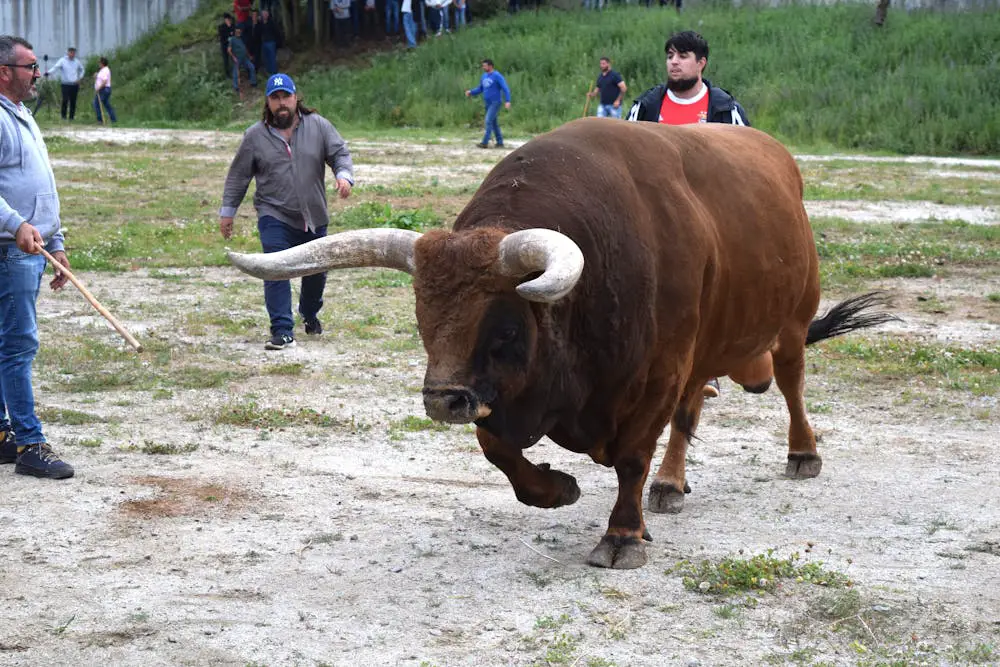
Ezra had seen bulls before. He had grown up around cattle, watched auctions, visited breeding operations. But the creature stepping down from that trailer looked less like livestock and more like a storm given flesh. He was enormous, nearly twenty-eight hundred pounds of muscle and bone, with the high shoulder hump of a Brahman and a gray coat that glimmered silver under the weak morning light. His head was broad and his horns curved with quiet menace. Yet it was not his size that made Ezra take one slow step backward.
It was his eyes.
They were dark, watchful, and painfully intelligent. Not wild. Not mean. They held something Ezra had seen before in animals Martha used to bring home from bad places: weariness, caution, and a sadness too deep for a creature with no words.
“That is one hell of a bull,” Ezra murmured.
Clint gave a humorless laugh while guiding Thunder Strike toward a temporary holding pen. “Yeah, well, he’s yours now. Papers are in this envelope.”
“Wait,” Ezra said. “He’s not mine.”
But Clint was already backing away. “Take it up with whoever paid for the transport. I’ve got a signed delivery record and an address match. I’m done.”
The truck was gone ten minutes later, leaving Ezra standing alone with a bull worth more than everything he owned and a manila envelope full of trouble.
He opened the papers at the kitchen table. The first pages were impressive: bloodlines, registration numbers, auction history. Thunder Strike had been sired by a legendary bull whose name Ezra recognized even as a small dairy man. Then he turned the page and felt his stomach sink.
Rejected by three breeding facilities. Aggressive tendencies. Failure to perform breeding duties. Destroyed equipment. Charged handlers. Not recommended for conventional program placement.
Ezra read it twice, then looked out the kitchen window toward the pen. Thunder Strike stood motionless near the fence, his giant head lowered, his ears angled toward the house as if he knew he was being judged again by people who had already decided what he was.
“Looks like we’re both dealing with some kind of mistake,” Ezra said softly.
His neighbor Delilah Riverong came rattling up the drive an hour later, bringing dust and the blunt honesty she had carried since childhood. Delilah was fifty-two, strong from running a horse rescue next door, with silver threaded through her dark hair and a way of climbing fences that made younger people feel ashamed of themselves.
She read the paperwork, her eyebrows rising page by page.
“Ezra,” she said at last, “do you understand what you have here?”
“A problem with horns?”
“A fortune with horns. This bloodline is worth serious money.”
“Then why does nobody want him?”
As if the question had reached him, Thunder Strike walked toward the fence. Up close, his size was overwhelming, but so were the marks on him. Rope burns around the neck. Old scars along the flank. A raw patch near one shoulder where equipment had rubbed too hard. He did not charge. He did not snort. He simply stopped a few feet away and looked at them.
Delilah’s expression changed.
“Oh,” she whispered. “You poor thing.”
“What?” Ezra asked.
“They tried to break him. And when he wouldn’t break the way they wanted, they called him dangerous.”
Thunder Strike lowered his head then, slow and careful, until his nose hovered inches from Delilah’s outstretched hand. For a long moment nobody moved. Then she touched his muzzle lightly, and the great bull closed his eyes.
Ezra felt something shift inside his chest, something he had tried to bury with Martha.
Martha had always said some animals did not need a firmer hand. They needed a safer world.
For three days, Ezra waited for Thunder Strike to prove the paperwork right. He expected trouble when the bull heard the tractor. He expected a charge when he walked too close to the pen. He expected the splintering of rails, the thunder of hooves, or some flash of the rage described in those Colorado reports.
None came.
Instead, Thunder Strike watched everything. He watched Ezra feed the dairy cows. He watched the old farmer carry tools to the fence line. He watched Delilah bring apples and talk to him like he was an injured horse instead of a bull with a terrifying reputation. There was an intensity in his attention that unsettled Ezra at first, less like being watched by livestock and more like being studied by someone trying to understand the rules of a new world.
On the third morning, Buttercup stepped wrong near a coil of old wire half-hidden in the grass. The aged Holstein jerked, lost her balance, and let out a distressed low as the wire tightened around one hind leg. Ezra cursed and dropped his tools. Before he could reach her, Thunder Strike crossed the pasture.
A bull that size moving toward a trapped cow should have meant disaster. Instead, Thunder Strike slowed as he approached, lowered his massive head, and nudged the wire. Not hard. Not wildly. Carefully. He worked it loose with small, deliberate movements. When Buttercup pulled away, the bull stepped back immediately, giving her space. He stood between her and the tangled wire until Ezra reached them, then turned his great head toward the old farmer as if to say: I handled what I could.
“Well, I’ll be damned,” Ezra whispered.
Word spread through Bourbon County the way farm stories always spread, and by Saturday morning Ezra had more visitors than he had seen in six months. Delilah arrived with Dr. Magnolia Clearwater, the county’s most trusted large-animal veterinarian: forty-five, calm, practical, and not easily impressed by emotional stories about livestock.
She reviewed the paperwork while observing the bull from outside the fence.
“Multiple aggression reports. Charging handlers. Refusal to lead. Stress reactions during breeding attempts.”
“Does that look like a stress reaction to you?” Delilah asked.
Thunder Strike was lying in the shade with three cows around him, his eyes half-closed, his breathing slow and steady.
Dr. Clearwater frowned. “No. It looks like an animal that finally feels safe.”
Ezra heard the words and felt them settle somewhere deep.
Safe.
It had been a long time since Willowbrook Farm felt like that to him. After Martha died, the house had become too quiet, the kitchen too large, the evenings too long. He had gone through the motions of living, but there was no warmth in it. The cows kept him moving, the farm kept him breathing, but nothing had truly reached him.
Until a wrong delivery had left a massive rejected bull in his pasture.
That evening, Ezra carried hay to the pen and stopped when Thunder Strike approached the fence. The bull lowered his head, not demanding, not pushing. Ezra held out a handful of hay. Thunder Strike took it gently from his palm, his lips barely brushing the farmer’s skin.
Ezra looked away quickly because his eyes had begun to burn.
“Martha would’ve liked you,” he said. “She always did have a weakness for anything the world gave up on.”
The next morning, the phone rang.
“This Ezra Hawthorne?” a hard voice demanded. “This is Brutus Ironclad from Ironclad Breeding Ranch in Colorado. That bull was supposed to go to Willowbrook Breeding Facility outside Lexington. Similar name, wrong farm. He’s scheduled for auction. I’m sending a truck this afternoon.”
After the call, Ezra stood for a long time in the kitchen, watching Thunder Strike graze beside Buttercup. The bull had been at Willowbrook only a few days, but the farm already felt different with him there, as if some sleeping thing had stirred awake.
He walked out to the pasture.
“I’m sorry, big fella,” he said. “Looks like your vacation is over.”
Thunder Strike came toward him. Slowly, gently, he rested his massive head against Ezra’s shoulder through the rail.
Ezra stopped breathing for a second. He had been alone for two years in ways no one saw. His children called less and worried more. Neighbors checked in but only from the edge of his grief. Yet this animal, this supposedly dangerous creature, stood there offering the one thing Ezra had not realized he missed most.
Trust.
He pulled out his phone before he could talk himself out of it.
“Mr. Ironclad,” he said when Brutus answered, “I’d like to make you an offer for that bull.”
The silence stretched long enough to become its own kind of warning. Then Brutus laughed. “You want to buy Thunder Strike?”
“I do.”
“Do you have any idea what kind of liability you’re asking for?”
“How much?”
Brutus named a price meant to discourage him. Ezra countered. They argued. Brutus warned him about lawsuits, injuries, and regret. Ezra listened, then looked at Thunder Strike, who stood calmly beside him.
“I’ll take responsibility,” Ezra said. “Send the papers.”
By sunset, Thunder Strike belonged to Willowbrook Farm.
Ezra’s daughter called the same afternoon. Luna Hawthorne Morrison lived in California, where everything in her life sounded clean and scheduled, and she loved her father from a distance that had grown wider after Martha’s funeral.
“Daddy,” she said, “tell me Delilah is exaggerating.”
“Depends what she told you.”
“She told me you bought some dangerous bull that got dumped at your farm by mistake.”
Ezra looked out the window. Thunder Strike stood under the oak, sunlight along his back, Buttercup grazing nearby. “He’s misunderstood,” Ezra said.
Luna went quiet, and when she spoke again her voice was softer but more frightening. “Phoenix and I have been talking. About you. About the farm. About whether this is still safe.” She paused. “You’re sixty-seven. You live alone. You won’t sell even though the place is too much for one person. And now you’ve spent money on an animal that could hurt you.”
“This farm was your mother’s home,” Ezra said.
“I know,” Luna said, and her voice broke. “But Mama is gone, Daddy. You’re still here. And we’re scared we’re going to get a call one day saying something happened and nobody found you until morning.”
When she hung up, Ezra sat on the porch until the shadows stretched across the grass, understanding for the first time that his children had been quietly making plans for him, plans that involved selling the land beneath his feet. He had thought they were simply busy. He had not understood they were waiting for the right moment to do what people do when they love someone and are frightened and have run out of other ideas.
Luna arrived the following week in a rental car coated with road dust, wearing boots that sank immediately into Kentucky mud. She looked like her mother around the eyes and like Ezra around the jaw, which meant she could soften a man’s heart and challenge him in the same breath. She had come ready to be reasonable. Ezra could tell by the way she greeted him, careful and gentle and braced, like someone preparing for a negotiation they were determined to handle kindly.
Dr. Sterling Blackwood from the university’s agricultural extension department had come with Delilah that same morning. He wore pressed clothes and carried a leather briefcase, and his expression said he had reviewed the genetic reports and was trying to contain his excitement about it.
Before anyone could explain anything to anyone else, a border collie came racing from Delilah’s property, chasing a tennis ball that had bounced through a gap in the fence. The dog shot across the grass and ran straight beneath Thunder Strike’s lifted front leg. Luna gasped. Ezra’s body went cold.
But Thunder Strike froze. Every muscle in that enormous body went still. He lifted his hoof higher, held it suspended over the small dog, and waited. The collie grabbed the ball, spun around, and darted away. Only then did Thunder Strike place his hoof down, carefully, as if setting glass on a shelf.
No one spoke.
“That’s impossible,” Luna said.
Dr. Blackwood opened his briefcase with unsteady hands. “That level of spatial awareness and restraint is extraordinary. Mr. Hawthorne, Thunder Strike’s genetic markers show an extremely rare combination associated with advanced cognition in bovines. This kind of profile may appear once in thousands of births.”
“In plain English,” Ezra said.
“In plain English,” Dr. Blackwood said, “your bull may be one of the most intelligent cattle ever documented. The aggression reports may have been misread. High intelligence in stressful environments can look like defiance. If he was forced, mishandled, confined in ways he understood as threatening, his behavior may have been self-protection.”
At some point in the conversation, Thunder Strike moved toward the fence. He lowered his great head and pressed his forehead gently against Ezra’s chest. It was such a quiet, affectionate gesture that even Luna’s defenses crumbled.
“Daddy,” she said, “I came here to make you leave.”
Ezra kept one hand on Thunder Strike’s neck. “I figured.”
“But I don’t think I understood what I was asking you to give up.”
The news spread fast. Within days, Willowbrook Farm had become the center of a story Ezra never wanted told. News vans lined the gravel road. Reporters stood at the gate shouting questions at anyone who appeared. A morning show wanted a live interview. A documentary producer left six messages before breakfast.
Thunder Strike hated it. He stayed at the far side of the pasture, away from the road, his body tense, his head low. Every time camera crews raised equipment over the fence, he withdrew further into himself, and that broke Ezra’s heart more than any violent reaction could have. He had seen the same thing happen to Martha’s rescues: an animal that had finally learned to trust, set back weeks by one frightening afternoon.
The biggest offer came from a Texas investor named Rodrik Goldstein: two million dollars, then three million when Ezra didn’t answer the first time. The number made Ezra sit down at his kitchen table and stare at the wall. It was more money than he had imagined holding in one place. It was enough to secure everything, fix everything, worry his children into silence.
After the second call, Ezra walked to the fence. Thunder Strike was still trembling from the media circus of the previous days.
“I’m sorry,” Ezra whispered, reaching through the rails. “I let them turn you into something to look at.”
Thunder Strike pressed his forehead against Ezra’s chest with a desperate heaviness that made Ezra close his eyes. This was not livestock handling. This was a promise being asked for without words.
Luna came up behind him. “Goldstein raised the offer. Three million.”
“Tell him Thunder Strike is not for sale,” Ezra said.
“Daddy, are you sure?”
“This animal trusted me when every other human failed him. I won’t become one more person who sells him to the highest bidder.”
Ezra changed the rules. No strangers in the pasture. No camera crews. No testing without Thunder Strike’s comfort. Any researcher who wanted access had to work through Dr. Clearwater, who understood that a living creature was not a machine designed to produce answers on command.
Some people mocked him. Others called him noble. Investors called him stubborn. Ranchers called him sentimental. Ezra stopped caring.
Six months later, Willowbrook Farm no longer looked like the forgotten place Ezra had once been quietly fading inside. The house still needed paint. The barn roof still complained in wind. But something living had returned to the land.
Dr. Clearwater helped establish a small research center. It was not polished: a converted feed barn, a shaded observation area, a few clean stalls, and a strict list of rules taped beside the gate.
No loud equipment. No forcing participation. No crowding. No touching without permission. Thunder Strike decides when he is done.
Researchers at first found the rules odd, then inconvenient, then revolutionary. Because under those rules, Thunder Strike flourished. He learned pattern games with colored blocks. He responded to hand signals from Ezra. He recognized people by posture and tone, avoiding those who approached with impatience and relaxing around those who moved gently. He showed problem-solving abilities that startled everyone who witnessed them.
Most remarkable was the way he watched Ezra. If the old farmer’s knee hurt, Thunder Strike slowed his pace near the fence. If Ezra was sad, the bull approached without being called and stood beside him in silence. If strangers made Ezra uncomfortable, Thunder Strike positioned himself between the farmer and the fence line, not aggressively, but with quiet awareness.
An animal psychologist from Stanford visited and left with tears in her eyes. “He isn’t just intelligent,” she told Luna. “He is emotionally sophisticated. He adjusts himself according to Ezra’s state. That is not training. That is relationship.”
Luna stayed longer than anyone expected. Two weeks became a month. She moved into Martha’s old craft room, sorting through fabric boxes and old photographs while helping Ezra manage the endless flood of contacts from people who wanted a piece of Thunder Strike’s story. One morning she stood beside Delilah near the fence, watching Ezra place colored blocks in a row.
“I never thought I’d come back here,” Luna said.
Delilah smiled. “Your mama knew you would. Eventually.”
Luna watched her father laugh as Thunder Strike nudged a blue block into place. “I think Mama sent him that bull. Not just for Daddy. For all of us.”
Delilah said nothing, but her eyes shone.
Ezra spoke at a university seminar once, wearing his best shirt and looking deeply uncomfortable behind a podium until someone asked what made Thunder Strike special. Then he forgot to be nervous.
“Everybody wants to talk about how smart he is,” he told the room. “But intelligence isn’t the miracle. Forgiveness is. That bull was mishandled, rejected, and labeled dangerous by people who never asked why he was afraid. He had every reason to hate us. But when he found one place that treated him with patience, he chose trust. That’s not just intelligence. That’s wisdom.”
The video of that speech spread farther than any news story had.
The final test came on a quiet Tuesday afternoon, when Goldstein called again. This time his voice held less arrogance and more calculation. He wanted to buy not the bull but the method: training centers across the country, Thunder Strike as the face of a movement, carefully managed appearances at agricultural conferences, luxury care, legacy.
The money attached was enormous.
After the call, Ezra walked to the oak tree where Thunder Strike loved to rest in the late afternoon. The bull lowered himself beside the old farmer, folding his great body into the grass.
“What do you think, big fella? You ready to become famous?”
Thunder Strike rested his head near Ezra’s lap.
Something in the movement was slower than usual.
Ezra noticed because love notices what ambition misses.
The next morning, Dr. Clearwater listened to Thunder Strike’s heart for a long time and then asked Ezra to step outside.
“He’s showing early signs of a heart condition. It happens in large bulls at his age and size. We can manage his comfort, monitor him, keep stress low.”
“How long?”
“Could be years. Could be months. We don’t know.”
Ezra called Goldstein that afternoon. “Mr. Goldstein, Thunder Strike’s traveling days are over.”
“You’re walking away from a fortune.”
“No, sir,” Ezra replied. “I’m keeping a promise.”
That evening, Luna found her father beneath the oak tree, sitting beside Thunder Strike while the dairy cows grazed in the golden light. She sat on the other side without speaking for a while.
“Mama would be proud of you,” she said.
Ezra smiled faintly. “She’d say I took long enough to learn.”
Luna leaned her head against his shoulder.
Thunder Strike spent his days in peace. He played his games when he wanted. He walked the pasture with Buttercup. He stood near Ezra when the old farmer seemed tired. Some afternoons he rested under the oak while visitors watched from a respectful distance, witnessing not a performance but a friendship.
Willowbrook Farm became known across the country, but to Ezra it remained what it had always been at its best: a place where broken things were allowed to rest, where patience did what force never could, and where love proved quieter and stronger than profit.
On the mornings when fog returned thick over the fields, Ezra stood at the fence and watched Thunder Strike step through the mist, silver-gray and magnificent, moving toward him with the calm certainty of an animal who knew he was home.
“Morning, big fella,” Ezra said.
Thunder Strike lowered his head, and Ezra touched his forehead gently, feeling the warmth of a living thing beneath his palm, steady and real.
The world had called it a delivery mistake.
Ezra knew better.
It had been a miracle arriving in a livestock trailer, wearing scars no one had cared to understand, carrying a heart bigger than any fortune, and finding the one farm in the world where it would finally be seen for what it was.

Adrian Hawthorne is a celebrated author and dedicated archivist who finds inspiration in the hidden stories of the past. Educated at Oxford, he now works at the National Archives, where preserving history fuels his evocative writing. Balancing archival precision with creative storytelling, Adrian founded the Hawthorne Institute of Literary Arts to mentor emerging writers and honor the timeless art of narrative.