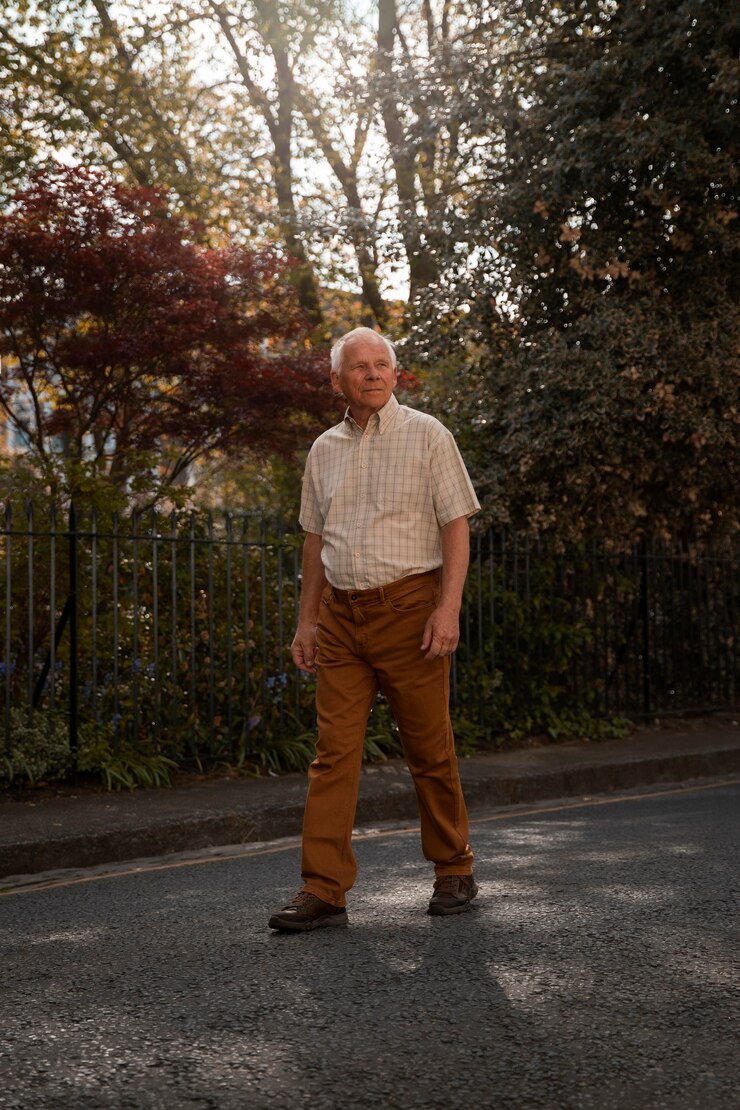
After nine days away, I came home to find my garage studio padlocked, my late wife’s rocking chair missing, and a white crib sitting where my cameras used to be.
My son did not apologize.
He said, “The baby needs this space. Stop being selfish.”
For a few seconds, I just stood in the driveway with two grocery bags cutting into my fingers and the October air sitting cold in my chest. The neighborhood sounded normal in that insulting way the world does when your own life has just shifted. A dog barked two houses down. Dry leaves scraped across the pavement. Somebody’s truck door slammed on the next block. And there I was, staring at a new padlock on my own garage.
That studio was not a spare room. It was not a hobby room. It was not dead space waiting for Daniel and Melissa to decide it had a better purpose. It was where I kept the pieces of my life that still made sense after Patricia died.
My cameras were there. My lenses were there. My workbench was there, scarred from decades of small repairs and bigger silences. A framed photo I had taken of Patricia was on the wall, the one where she was laughing in afternoon sunlight with her hand lifted like she was about to tell me to stop wasting film.
She had been gone long enough for people to assume I should be fine. Grief has a strange expiration date in other people’s minds. They stop saying her name, then expect you to stop needing the places where her name still lives. The garage was one of those places. After cancer took Patricia from me, I could not sleep in our room some nights. I could not sit at the kitchen table without hearing her chair pull back. But in that garage, with the smell of sawdust and camera leather and old coffee, I could breathe.
For three and a half years, my son Daniel and his wife Melissa had lived in my house. They said they needed time to get back on their feet. At first, I was proud to give it to them. Daniel was my son. He had grown up in that house. I had measured his height on the pantry doorframe until Patricia made me stop because she wanted the kitchen painted. I had taught him how to change a tire in the driveway and how to apologize without adding the word but.
When he came to me with Melissa and said rent was getting too high, I told him they could take the upstairs bedroom until things settled. I meant six months.
Then six months became a year. Then five hundred dollars of rent became three hundred. Then three hundred became, “Dad, can we catch up next month?” Then next month turned into a long stretch of silence where I paid the utilities, bought the groceries, fixed the leaking sink, and pretended not to notice the math.
A newer SUV appeared in the driveway before any back rent did. Packages kept landing on the porch. Melissa’s office took over the spare bedroom because she needed quiet for remote work. Daniel kept saying things were tight while carrying iced coffee through the kitchen every morning like tight was just something that happened to other people’s wallets.
I kept quiet. I told myself quiet was patience. I told myself patience was love. But silence, held too long, starts looking like permission.
That afternoon, I carried the groceries into the kitchen and found Daniel and Melissa in the living room. The television was on low. Melissa sat on the couch with one hand on her pregnant belly. Daniel had his phone in his hand, thumb moving across the screen, like my coming home was only background noise.
Melissa looked up and smiled. “How was the trip?” she asked.
I remember the grocery bag slipping on the counter. A can of soup rolled out and knocked against the baseboard. Neither of them moved to pick it up.
“Where are my things?” I asked.
Daniel sighed before he answered. That sigh hurt more than it should have. It was the sigh of a person who had already decided I was unreasonable.
“Dad, the baby needs a nursery,” he said.
I looked past him toward the garage door. “The garage is my studio.”
“The spare bedroom is Melissa’s office,” he said. “And we knew you’d make this hard if we asked first.”
That sentence told me everything. They knew it was wrong. They just thought I would absorb it.
Melissa leaned forward slightly, her voice careful and sweet. “Your equipment is safe in storage, Gerald. Nobody threw anything away.”
Safe in storage. That is the sort of phrase people use when they want theft to sound organized.
I asked where Patricia’s rocking chair was.
Daniel looked away.
There are moments when a parent sees the child and the grown man at the same time. I saw the boy who once cried because he broke Patricia’s blue mug. I saw the man who now could not look me in the eye after taking her chair.
I picked up the can from the floor and set it on the counter. “Where is the storage unit?” I asked.
Daniel said he would text me the information later. He did not.
That night, I stood in the hallway outside my bedroom and looked at the empty place where Patricia’s photo used to hang. It had not been moved to the living room. It had not been leaned safely against the wall. It was gone from its place. I found it two days later wrapped in an old towel inside a plastic bin near the laundry room. The glass had a thin crack across Patricia’s shoulder. Not enough to ruin the picture. Enough to change it.
I did not say anything that night either. That was my mistake.
Two weeks later, Melissa’s father came over. He had always been polite to me in a distant way, the kind of politeness that comes with never intending to help. He stood in my kitchen wearing his good jacket and told me any decent man would give up a hobby room for his grandchild. He said hobby room like he had practiced it.
The coffee maker sputtered behind him. The smell turned burnt and bitter while he talked. I let him finish.
Then I asked, “If everyone is so worried about the baby, why has nobody else offered them a place to live?”
His face changed. He called me selfish. He said Patricia would be disappointed in me.
That was the first time I told someone to leave my house in years.
Daniel came to me that night furious. He did not ask what happened. He did not ask why Melissa’s father thought he had the right to speak my dead wife’s name in my kitchen. He said I had humiliated his father-in-law.
“You embarrassed Melissa,” he snapped.
Melissa stood beside him with her arms folded, her face pale and tight.
I looked at my son and felt something inside me settle. Not break. Settle.
Love can make you patient. Guilt can make you foolish. When they start feeling the same, somebody is already using one against the other.
That morning, I had driven to the storage facility listed on a small label Daniel had accidentally left stuck to one of my old shelves. I did not go inside yelling. I did not demand anything. At 8:17 a.m., I spoke with the clerk at the front desk. At 9:03 a.m., I wrote down the unit number she repeated to me. At 10:40 a.m., I came home and checked my bedroom.
The lockbox was still under the winter blankets. It was a small black lockbox Patricia and I had used for important things. Birth certificates. Insurance papers. Her wedding ring after her fingers became too thin for it. The spare key to the garage. An envelope Patricia had written my name on during her last month, when she could still sit up long enough to sign Christmas cards for people she knew she would never see again. I had not opened that envelope in almost four years. Some grief becomes sacred because touching it feels like asking the dead to leave all over again.
When I lifted the lockbox, it felt wrong. Not visibly wrong. Wrong in the hand.
The small envelope with Patricia’s handwriting was still there. The insurance papers were still there. But one thing was missing.
Patricia’s wedding ring.
I sat on the edge of the bed and stared at the empty space in the little velvet pouch. At first, my mind refused to understand it.
A crib, I could argue about. A garage, I could reclaim. A chair, I could search for. But her ring had nothing to do with a baby. Nothing to do with space. Nothing to do with anybody getting back on their feet. It was small enough to fit in a pocket. It was big enough to show me what my kindness was worth to them.
So when Daniel stood in my hallway that night accusing me of humiliating Melissa’s father, I asked him one question.
“Did you go into the lockbox in my bedroom?”
The room changed instantly. Daniel’s jaw tightened. Melissa stopped rubbing her stomach. The television in the living room kept murmuring to nobody.
Daniel said, “What are you talking about?”
I did not answer right away. I looked at Melissa. Her face had changed before Daniel could finish pretending. That was when I knew she knew.
I walked into the kitchen and picked up the blue folder I had carried in from the truck. It was not dramatic. It was not fancy. It was the same folder I used for household bills. Inside were the electric statements, the unpaid water notice, the storage office note, and the record of what Daniel and Melissa had not paid for three and a half years.
When I slid it across the counter, Daniel looked angry. Melissa looked sick.
“This is ridiculous,” Daniel said.
“No,” I said. “Ridiculous is coming home to a crib in my garage.”
His eyes flashed. “My child needs a room.”
“And my wife’s ring needed to stay in my lockbox.”
Nobody spoke.
There are silences that comfort you. There are silences that accuse you. This one did both.
Daniel looked at Melissa. That was the part I did not expect. His anger shifted away from me and landed on her.
“What did you do?” he asked.
Melissa whispered, “I thought we could put it back.”
The words came out so softly I almost missed them. But Daniel heard. I heard. And whatever was left of the lie had no place to stand.
She said they had not sold it. She said it was at her cousin’s apartment for safekeeping because they were going to have it cleaned and reset. She said she wanted something meaningful for the baby. She said a lot of things people say when they have been caught and want intention to erase action.
I listened until she ran out of air. Then I said, “You took my wife’s ring out of my bedroom.”
Daniel said, “Dad, we can fix this.”
That sentence made me tired in a way anger never could. Because Daniel had said some version of it for years.
We can fix rent next month. We can fix the utilities. We can fix the garage. We can fix the chair. We can fix the ring.
But every fix required me to swallow the damage first.
I opened the folder again. I had written everything down. Dates. Amounts. Promises. Storage unit number. The missing ring. The cracked photo frame. The unpaid household bills.
I was not building a case because I wanted revenge. I was building a record because I finally understood that memory alone was too easy for them to argue with.
At 7:12 the next morning, I called a locksmith. At 8:30, I called the storage facility and told them I would be coming with identification and proof of ownership for the items that belonged to me. At 9:45, I called a woman from church named Ellen, who had known Patricia for twenty-six years and had a way of listening that made excuses sound embarrassed to be in the room.
I told her the whole story. She did not interrupt. When I finished, she asked one question.
“Gerald, do you want your home back, or do you want to keep pretending they still respect it?”
I stood at the kitchen window and looked out at the garage. The padlock was still there. The white crib was still visible through the window. The small American flag Patricia used to stick in the porch planter every summer moved in the cold wind.
For years, I had thought being a good father meant absorbing more than I should. More noise. More bills. More disrespect. More excuses. But fatherhood was never supposed to mean handing your children the right to erase you.
That afternoon, Daniel found me in the garage with the locksmith.
The old padlock came off in one hard snap. It hit the concrete with a sound that traveled through the whole room.
Daniel said, “You can’t just do this.”
I looked at him. “It is my garage.”
Melissa stood behind him on the driveway. Daniel stared at me like he did not know me.
Maybe he didn’t. Maybe I had spent so many years being the quiet one that the real me looked like a stranger once he finally showed up.
I told them they had thirty days to find another place. I told him the ring needed to be returned by nightfall. I told him Patricia’s chair needed to be back in the house. I told him every item from my studio would be documented, cleaned, and returned to its place.
He said, “You’d throw out your own grandchild?”
“No,” I said. “I’m making two adults responsible for the home they keep saying they’re building.”
That was the first time Daniel had no answer.
By evening, Patricia’s ring was back in my hand. Melissa would not look at me when she gave it over. The velvet pouch shook between her fingers. I checked the ring under the kitchen light. It had a small scratch I did not remember.
I put it back in the lockbox anyway. Some things come back changed. You still protect them.
The rocking chair came back the next morning from Melissa’s father’s garage. He did not come inside. Daniel carried it in without speaking. One runner was scuffed and the cushion smelled faintly like dust and motor oil. I set it near the window where Patricia used to sit. For a long time, I just stood there with my hand on the back of it.
I did not feel victorious. People think standing up for yourself feels powerful right away. Mostly it feels lonely at first. It feels like hearing your own voice in a room where everyone had gotten comfortable with your silence.
Over the next month, Daniel and Melissa packed. There were arguments. There were slammed doors. There were long stretches when Daniel would not look at me across the kitchen. I did not chase him. I did not soften the deadline. I helped carry one box to the porch because it was heavy and Melissa should not have lifted it.
Daniel looked surprised when I did. I told him, “I can still be your father without being your storage unit.”
He did not answer. Maybe one day he will understand that sentence. Maybe he will not.
When they left, the house sounded too big for a few days. The refrigerator hummed. The floorboards creaked. The spare bedroom stood empty except for Melissa’s forgotten curtain rod leaning in the corner.
In the garage, I put my cameras back on the shelf. I rehung Patricia’s photo. I replaced the cracked glass. Then I sat in her rocking chair for the first time since it came back and held her ring in my palm until the metal warmed against my skin.
I want to say something about the ring, because it mattered in a way I am still working out.
Patricia and I had been married for thirty-one years. We were not a perfect couple. We were the ordinary kind, the kind that argues about grocery lists and makes up before dinner and goes to bed still slightly irritated about something that will not matter by morning. But we were steady. We built our life the way people who do not have much build things, carefully, in small pieces, over a long time. That ring was part of that. It had cost less than people spend on phones now. It had never left her finger except at the end, when keeping it on would have meant losing it to swelling.
When I put it in the lockbox after she died, I was not ready to look at it every day. I was not ready to make a decision about what to do with it. I just knew it needed to be somewhere safe while I figured out how to be a person again without her in the house.
Melissa had looked at that ring and seen something meaningful for the baby.
What she had not understood, or had chosen not to understand, was that it was already meaningful. To me. To Daniel, who should have known better. To the thirty-one years it had been on his mother’s hand. The baby would have other things to be given. This one was not available.
I have thought about that moment a lot since they left. I have thought about what it takes to open another person’s lockbox and remove something that small and that specific. It takes a decision. Not a mistake. A decision. Mistakes are things you do without thinking. Taking a wedding ring from a widower’s lockbox requires you to think at least twice and keep going anyway.
That is what I was living with for three and a half years without knowing it clearly. Not just a son who could not quite manage his own life. A daughter-in-law who had measured my generosity, found it sufficient, and begun helping herself to the portions she had not been offered.
And my son, who loved her and loved me and could not figure out how to stop the one without losing the other, and so chose to stand in the hallway looking at the floor.
I understand that choice in the way you can understand something and still not accept it. I understand that watching two people you love head toward each other is its own kind of paralysis. I understand that Daniel grew up watching me stay quiet and learned that quiet was what fathers did. I taught him that. I had been teaching him that for thirty years.
The difference is that I finally unlearned it, and he is going to have to decide whether he will too.
Daniel called about six weeks after they moved out. Not to argue. Not to ask for anything. Just to call. I let it ring twice before I answered, which is not much but was enough for me to decide what kind of conversation I wanted it to be.
He said he was sorry. He said it plainly, without qualifications, without the word but following it. I do not know whether that was his own work or someone had helped him find the shape of it. Either way, it was there.
I told him I loved him. I told him we would figure out the rest over time. I told him his child was going to be fine and that I wanted to meet the baby when the time came.
I did not say everything was fine. It was not fine. It was beginning to be better, which is different and more honest.
We talked for about twenty minutes. Mostly about nothing, the way fathers and sons talk when they are learning how to talk again. His voice sounded younger than it had in years, the way people sound when they have put something down that was too heavy.
After we hung up, I sat in Patricia’s rocking chair for a while with my coffee. The house felt different than it had the week they left. Less empty. More mine.
There is a way people talk about setting limits as if it is primarily about protection. As if you draw a line to keep something out. But that is only half of it. When you draw the line honestly, you are also deciding what stays inside. What you protect. What you keep.
Inside my line: Patricia’s ring, her chair, her photo on the wall with the replaced glass. The smell of camera leather and sawdust in a garage that is mine again. The quiet of a house that fits me.
Outside it: three and a half years of unpaid rent and borrowed kindness and the slow assumption that my generosity had no bottom.
I had spent years thinking silence was generosity. I know better now. Silence had only taught them where to take from.
So I locked the garage door myself.
Not to keep my family out forever. To remind myself that love without limits is just an open door with your name missing from it.
Patricia would have said I took too long to figure that out.
She would have been right.
She usually was.
There is one more thing I want to say, because the story did not end with the phone call or the chair by the window or the ring back in its pouch.
It ended, in the way these things end, in an ordinary moment about three months later.
Daniel and Melissa had found a place about twenty minutes from here. It was small, the kind of small that forces people to make decisions about what actually matters, which is sometimes exactly the right conditions for a person to grow up inside. I had not seen it yet. I had not been invited, and I had not asked, because some doors have to open from the other side.
The call came on a Sunday morning. Daniel, not Melissa. His voice was careful but not stiff, the way it gets when he is trying to say something correctly.
“The baby came,” he said. “Last night. A girl.”
I set down my coffee cup.
“She’s healthy?” I asked.
“Perfect,” he said. And something in that word, the way he said it, told me he had already changed in the way people change when they hold their child for the first time and realize nothing else is going to feel as important as this.
“What did you name her?” I asked.
There was a pause. Not a long one. “Patricia,” he said.
I did not say anything for a moment.
Outside the kitchen window, the November yard was mostly bare, the last of the leaves gone, the grass pale and flat. The American flag stood in the porch planter where I had put it back after everything settled.
“Your mother would have loved that,” I said.
“I know,” he said. “I’m sorry it took me so long.”
We did not talk about the ring. We did not talk about the garage or the chair or the cracked glass or the three and a half years of unpaid rent. We did not need to. All of that was underneath the conversation, the way old repairs are underneath a surface you have sanded smooth. You know they are there. You know the work was done. You do not need to point at the seams.
“Can I come see her?” I asked.
“That’s why I called,” he said.
I visited that afternoon. I brought nothing fancy. A small soft blanket Patricia had started knitting years ago for a grandchild she knew she might not live to hold. I had found it in the cedar chest after she died and kept it without knowing entirely why. It seemed right to bring it now.
Melissa met me at the door. She looked exhausted and young and a little afraid of what I would say. I did not make her wait.
“Congratulations,” I said. “You did the hard part.”
She started to cry, which was probably about more than the baby. I let her, because some apologies come out that way when words are not quite enough.
Daniel put the baby in my arms.
She weighed almost nothing. She had a faint line between her brows, the concentrated expression of someone working hard at existing, and a small perfect mouth that opened and closed like she was practicing for a conversation she would have someday.
I thought about Patricia in that photograph on the garage wall, laughing in afternoon sunlight with her hand lifted.
I thought about the ring in the lockbox, back where it belonged.
I thought about all the ways a person can be erased slowly, piece by piece, until they wake up in their own house feeling like a guest.
And I thought about how strange and humbling it is to hold a new person at the end of all that, someone who has no idea any of it happened, who needs nothing from you yet except warmth and steadiness and the willingness to show up.
I could do that.
I had always been able to do that.
I had just spent too many years doing it for people who mistook my availability for weakness.
This one was different.
This one had her great-grandmother’s name.
“Hello, Patricia,” I said quietly.
The baby opened her eyes. They were dark and unfocused, looking at nothing and everything at once the way new eyes do.
I held her for a long time.
Daniel stood nearby, one hand in his pocket, watching me the way sons watch fathers when they are trying to learn something they cannot ask about directly.
Outside, the afternoon light had gone the pale gold of late November, and the street was quiet, and somewhere down the block a dog barked once and went still.
The ordinary world, doing what it does.
I had locked the garage door and gotten my house back and refused to let grief and guilt be converted into a claim on my remaining years.
I had done all of that.
And now I was holding a baby named Patricia in the middle of a Sunday afternoon, and it turned out that love and limits were not opposites after all.
They were just the two things together that finally made space for something real.

Sophia Rivers is an experienced News Content Editor with a sharp eye for detail and a passion for delivering accurate and engaging news stories. At TheArchivists, she specializes in curating, editing, and presenting news content that informs and resonates with a global audience.
Sophia holds a degree in Journalism from the University of Toronto, where she developed her skills in news reporting, media ethics, and digital journalism. Her expertise lies in identifying key stories, crafting compelling narratives, and ensuring journalistic integrity in every piece she edits.
Known for her precision and dedication to the truth, Sophia thrives in the fast-paced world of news editing. At TheArchivists, she focuses on producing high-quality news content that keeps readers informed while maintaining a balanced and insightful perspective.
With a commitment to delivering impactful journalism, Sophia is passionate about bringing clarity to complex issues and amplifying voices that matter. Her work reflects her belief in the power of news to shape conversations and inspire change.