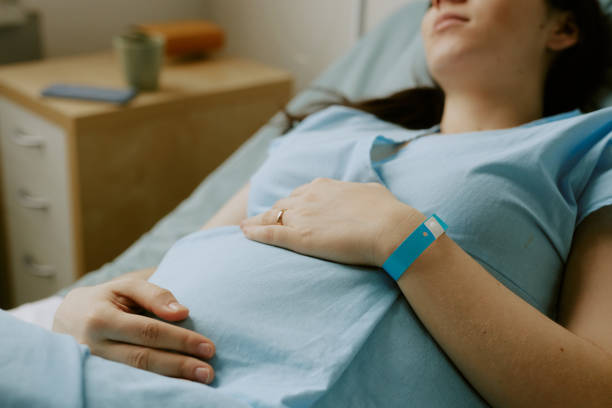
The first contraction hit me in my parents’ kitchen while the dishwasher hummed beneath the marble counter.
The house smelled like lemon cleaner, coffee, and the roast chicken my mother had bought instead of cooked. Outside the back windows, late sunlight stretched across the lawn and made the patio furniture glow gold for a few ordinary seconds. I remember thinking how pretty it looked. That’s the strange thing about the worst evenings of your life. They start out looking like all the others.
Then I bent in half.
One hand slapped the cold island. The other pressed under my belly, as if pressure alone could keep my daughter safe. I was eight months pregnant. Too early for this. Too frightened to pretend it was nothing.
“Mom,” I gasped. “Please call 911.”
My mother did not move.
Linda sat at the breakfast nook with her reading glasses low on her nose, scrolling through her phone beside a half-empty mug and a stack of mail. She looked up at me the way you look at a fly that has gotten into the house. Irritated. Not scared.
“Amelia, stop,” she said. “First babies take forever. You’re always so dramatic.”
Dramatic.
That word had followed me through childhood like a hand at the back of my neck. I was dramatic when I cried. I was dramatic when I asked why my sister Claire got forgiven faster, for bigger things, every single time. I was dramatic when I said I felt sick, or lonely, or embarrassed, or left out. By the time I was ten, I had learned the house rule that nobody ever wrote down but everybody enforced. In that family, pain became acceptable only after it stopped inconveniencing someone else.
I want to tell you about that, just for a minute, because the kitchen floor makes no sense without it.
When I was nine, I broke my wrist falling off my bike at the end of our street. I walked home holding my arm against my chest, and my mother told me to stop crying because the neighbors could hear. I sat through dinner. I sat through Claire’s piano practice. My father finally took me to urgent care at nine that night, after the swelling got bad enough that even he couldn’t pretend, and on the drive there he said, “You see? It’s fine. You always make everything a production.” The X-ray showed a fracture. Nobody ever mentioned the word production again, but nobody apologized either. The story just quietly became “the time Amelia hurt her wrist,” and the eight hours in between disappeared, the way inconvenient hours always disappeared in our house.
That was the training. Decades of it. So when I doubled over against their marble island at thirty-one years old, eight months pregnant, begging my mother to call an ambulance, some small, well-trained voice inside me was already whispering, maybe you are exaggerating. Maybe it’s nothing. Don’t be dramatic.
Across the room, my father, Robert, sat in his leather chair with the newspaper open. He still had his loafers on, because he and my mother had dinner reservations at 7:30. I knew about the reservations because my mother had mentioned them twice since I arrived, the way she mentioned anything she wanted protected in advance.
“Dad,” I whispered. “Please.”
He lowered the paper just enough to make eye contact over the top of it.
“Your doctor’s office is twenty minutes away,” he said. “You can wait.”
Another contraction took my breath away. It did not feel like the little tightenings my doctor had described at my appointments, the practice ones, the ones you time on an app. It felt like a belt closing around my spine and pulling until the whole room narrowed to a point.
Then warmth ran down my legs.
I looked at the tile. My water had broken on my mother’s imported floor.
For one second, nobody moved. The refrigerator clicked on. The dishwasher kept humming. The old clock in the hallway ticked with a steady, insulting calm. My mother’s thumb hovered over her phone screen. My father stared at the floor like it had betrayed him by making this real.
“I think my water broke,” I said.
My mother finally stood, but not quickly. She moved like a woman annoyed by an interruption, not terrified for her daughter. She actually glanced at the tile first. The floor. She looked at the floor before she looked at me.
“Oh, for heaven’s sake,” she said. “You are not the first woman to have a baby.”
My father folded the newspaper with slow precision, crease by crease, the way he did everything.
“We are not calling an ambulance because you panicked,” he said. “Do you have any idea what those cost?”
I stared at the two of them, and in the middle of the pain, with my heart slamming and my daughter coming too soon, I finally understood something I had spent my whole life trying not to know.
They were not waiting because they thought I was safe. They were waiting because my emergency had arrived at a bad time.
My legs gave out slowly. I slid down the cabinet front until I was sitting on the floor, my back against the cold wood, my knees up as far as my belly allowed. The marble island was above me now. The kitchen looked different from down there. The expensive cabinets looked tall and cold. My mother looked farther away than ten feet. My father looked like a stranger who happened to know my name.
At 6:48 p.m., I saw the time on the microwave clock above my mother’s shoulder. I didn’t know yet why that number would matter. Later, that exact time would end up written into a transport record beside the words premature labor and ruptured membranes. Later, a hospital intake nurse would ask whether anyone had called an ambulance, and the silence after her question would say everything. Later, my husband would stand so still when he heard the answer that I would learn something new about him. Fury does not always make noise. Sometimes it goes completely quiet and starts taking notes.
But in that moment, all I could do was breathe through another contraction and try not to scream.
My phone was on the counter. Too far. My hands were shaking against my belly.
“Please,” I said again, weaker this time.
My mother glanced toward the hallway mirror, and I swear to you, I watched her check whether her makeup had survived the inconvenience. My father looked toward the back door, toward the patio, toward the dinner that was slipping away from him.
Then the sound began.
At first I thought it was inside my head, part of the pain, some pressure in my ears. A low chopping rhythm, pushing through the distance, faint and strange. Then it grew. The windows trembled. The chandelier over the breakfast nook rattled hard enough that the crystals clicked together like teeth.
My father stood so fast his newspaper fell to the floor.
“What the hell—”
The rest of his sentence disappeared under the roar.
A helicopter descended into my parents’ backyard.
Rotor wind blasted across the patio, flattening the grass in silver waves and sending a wrought-iron chair skidding sideways into the flowerbed. The whole house seemed to shake around it. My mother dropped her phone. It bounced off the breakfast nook bench and landed face down, and she didn’t even look at it, and that alone told me the world had changed, because Linda always looked at her phone.
For the first time in my life, my mother looked unsure of the room she was standing in. Not annoyed. Not superior. Afraid.
The back door flew open before my father reached it.
Two flight medics came in first. Dark uniforms, equipment bags, fast eyes. They moved through that kitchen like it was a hallway, and the expensive marble and the custom cabinets and the curated everything suddenly looked small around them. One medic came straight to me on the floor. The other scanned the room and said, “Patient is Amelia?”
I tried to answer. A contraction stole the word right out of my mouth.
Then Ethan came through the doorway.
I need to stop here, because you don’t know my husband yet, and my parents thought they did, and both of those things matter.
Ethan was not wearing the soft gray sweater my mother always complimented in a tone that meant cheap. He was not wearing the polite, harmless expression he used at family dinners while my brother-in-law Daniel bragged about bonuses and my father pretended he wasn’t comparing the two men out loud. He wore a black aviation jacket with a small company crest on the chest. A headset hung around his neck. His face was pale, controlled, and hard in a way I had never seen inside my parents’ house.
And every single person in that kitchen responded to him before he said a word. The medics gave him space without looking up. My father stepped back. My mother put one hand on the table to steady herself.
“Amelia,” Ethan said, crossing the tile and dropping to one knee beside me. “Look at me.”
I did.
And the second I heard his voice, I started crying. Not because I was weak. Because I was finally safe, and the body knows the difference even when the mind is too busy to notice. You can hold yourself together for exactly as long as you have to. The moment someone arrives who will hold you instead, everything you were carrying comes down at once.
His hand went to my cheek, then to my wrist, then around my fingers. He looked at the medic beside me.
“How far apart?”
“Hard to say yet,” the medic answered. “Ruptured membranes. Active contractions. We need to move.”
The other medic checked my pulse and fired off questions. When did the pain start? Any bleeding? Any fever? Any call to the OB? I tried to answer between contractions, and Ethan filled in what he could. He knew I had felt wrong that morning. He knew I had planned to stop by my parents’ house after my appointment. He knew I had promised to keep my phone close, and he had not liked the pause in my voice when I said it.
That was Ethan. He did not panic. He prepared.
I married him three years earlier in a small ceremony with folding chairs, grocery-store flowers, and one aunt who cried through the entire vows. My parents came. They behaved. But they treated Ethan like a pleasant compromise, a decision I had made the way you settle for a reliable used car. Nice enough. Quiet. Stable, maybe, but unimpressive. My sister’s husband, Daniel, spent half our reception talking about his year-end bonus and the other half asking Ethan what he “really wanted to do long term.”
Ethan smiled and said, “I’m doing it.”
Nobody understood the answer. That was because Ethan never wanted them to.
Here is what my family did not know, because we never told them. After leaving the military, Ethan built a private emergency aviation company. He owned aircraft. He oversaw medical transport contracts across multiple states. He could talk to surgeons, pilots, dispatchers, insurers, and county emergency coordinators without raising his voice, and all of them listened. But at my family’s gatherings, he wore jeans, helped wash dishes, and drove an older SUV, because he had no interest in performing wealth for people who mistook volume for value.
Once, after my father made a joke about Ethan “still finding his footing,” I cried in the car on the way home. Ethan took my hand over the center console and said, “I don’t need your parents’ respect if it costs us our privacy.”
So I kept the truth quiet. I told myself I was protecting our peace. Looking back, I think I was also protecting my parents, protecting them from the embarrassment of realizing they had spent three years looking down on the only man in the room who would move heaven and machinery for me.
On the kitchen floor, my mother finally found her voice.
“We were just about to call,” she said.
Ethan did not look away from me.
“No, you weren’t.”
Two words. Flat. Certain. My father stiffened like he’d been slapped.
“Now wait a minute,” Robert started.
Ethan looked at him once. Just once. And the kitchen changed under that look.
“You watched my wife go into premature labor,” Ethan said, “and called her dramatic?”
Silence answered him. The dishwasher hummed. The rotors thudded outside. My parents, who had an explanation for everything, who had spent three decades editing every story until they came out right, had nothing.
That was when Claire arrived. My sister appeared breathless in the doorway with her designer purse still on her shoulder. She had probably come early to ride with our parents to dinner. She stopped so abruptly that Daniel bumped into her back. I watched her eyes travel the room. Me on the floor. The medics. The equipment bags. The helicopter lights flashing beyond the glass. And then Ethan’s jacket. The crest. The headset. The way the medics waited for his decisions.
Her usual smile flickered and failed. Daniel said nothing at all. For once, nobody asked Ethan what he did for a living.
The lead medic said, “We need to move now.”
My father stepped forward. “Move where?”
Ethan stood slowly, still holding my hand.
“To the aircraft,” he said. “Since no one in this house thought she was worth calling an ambulance for.”
My mother went white.
That was the sentence that broke something, and it didn’t break loudly. There was no shouting, no slammed door. But I saw it land. I saw my mother understand, in real time, that this story could not be edited in her favor. I saw my father realize there were witnesses now. Uniforms. Documents. Timestamps. A transport record. People trained to write down what actually happened instead of accepting the family version.
A house can train you to doubt your own pain. It trained me for thirty-one years. But paperwork does not care who was favored at Christmas.
The medics lifted me carefully onto the stretcher. Pain tore through me again, bright and sharp, and I gripped Ethan’s hand so hard my fingers ached. He leaned close.
“Stay with me,” he said. “You’re doing great.”
“I’m scared,” I whispered.
“I know,” he said. “I’ve got you.”
No grand speech. No dramatic promise. Just his hand around mine and his body between me and the people who had hesitated. That was how Ethan loved. He showed up. He had been showing up for three years in a hundred small ways my family never noticed, and now he was showing up in a way nobody on that street would ever forget.
The backyard hit me in pieces. Wind. Grass. Noise. The smell of fuel and cut lawn mixing into something I will associate with that night for the rest of my life. My hair whipped across my face until Ethan brushed it back with his free hand. Neighbors watched from behind fences and curtains. The small American flag mounted near the back porch snapped hard in the rotor wash.
My mother stood on the patio with one hand over her mouth. My father held the crumpled newspaper like he had forgotten what paper was for. Claire’s purse slid down her arm and hit the patio with a dull little thud. Daniel stared at the helicopter as if money had suddenly become a foreign language he only thought he spoke.
Just before they loaded me into the aircraft, Ethan leaned down and kissed my forehead.
“You are not going back into that house,” he said.
He said it quietly, meant only for me. But my father heard it too.
“What is that supposed to mean?” Robert demanded, raising his voice over the rotors.
Ethan didn’t answer him yet. The medic locked my stretcher into place. Another clipped a tablet to the rail, and the screen glowed in the fading light. My father’s eyes caught on it, and I watched him read.
There was a remote intake note at the top. The time said 6:31 p.m. Ethan’s name. My symptoms. Emergency transport approval. Premature labor risk. Ruptured membranes suspected.
His company’s medical desk had processed the request before my parents had even finished deciding whether their daughter deserved urgency. While I was begging on their kitchen floor, while my mother checked her makeup and my father protected his reservations, a dispatcher somewhere was already clearing airspace for me.
“You authorized this before you got here?” my father asked.
Ethan looked at him then.
“I authorized it the second my wife told me she felt wrong this morning,” he said.
My mother made a small sound. It was not an apology. It was not even close to one yet. It was the sound of a woman realizing that neglect looks very different when it has a timestamp.
The medic handed Ethan a headset. “We’re ready.”
Ethan climbed in beside me. And before the door closed, my mother moved toward us, one hand reaching.
“Amelia,” she said. Her voice cracked, just enough to sound almost human.
I looked at her. For thirty-one years, I had wanted that crack. I had imagined it, prayed for it, manufactured little emergencies in my childish heart hoping to hear it. I had wanted proof that Linda could be shaken by the idea of losing me.
Now the proof had finally arrived, and it had arrived too late to feel like comfort. It just felt like information.
Ethan placed one hand gently on my shoulder. The door closed. The helicopter lifted.
Through the window, I watched the backyard shrink. My parents became small figures on a patio they had cared about more than my pain. The house got smaller, then the street, then the whole neighborhood where I had learned to apologize for hurting. From up there it all looked so manageable. So little.
The flight was loud and strange and fast. One medic monitored my pulse and blood pressure. Another called ahead to the hospital intake desk, reading off numbers in a calm, clipped voice. Ethan stayed beside me, headset on, one hand still wrapped around mine. When another contraction hit, I cried out, and he lowered his forehead to our joined hands.
“Breathe with me,” he said.
I tried. In through the nose. Out through the mouth. Again. Again. The rotors kept time over our heads, and somewhere below us, my parents were presumably explaining things to their neighbors.
At the hospital, everything became light and motion. A corridor. A waiting nurse. A rolling bed. A blood pressure cuff biting my arm. Questions, forms, the sharp smell of antiseptic. And then, cutting through all of it, the baby’s heartbeat on a monitor. Fast and urgent and there.
There.
That sound made me sob harder than the pain ever had. And Ethan’s face changed when he heard it. For the first time all night, his control cracked open. He turned his head away, blinked fast, and pressed his mouth against my knuckles, and I felt his breath shake against my fingers.
Our daughter was alive.
The doctors worked quickly after that. Medication. Monitoring. Steroids for the baby’s lungs, because she was coming whether we were ready or not. A decision tree I barely understood while pain rolled through me in waves. Ethan translated what he could. He asked clear questions. He signed what needed signing. He never let go of me unless a nurse needed access to my arm, and even then his hand hovered, waiting to come back.
At 9:12 p.m., my mother called. Ethan looked at the screen and silenced it.
At 9:18, my father called. Ethan silenced that too.
At 9:26, Claire texted me. Mom is hysterical. Dad says Ethan embarrassed everyone. Please answer.
I stared at that message for a long time. Dad says Ethan embarrassed everyone. Not, how is the baby. Not, how are you. Even now, even tonight, the family emergency was their reputation, and the family assignment was mine, and my job, as always, was to come manage their feelings.
I turned the phone face down on the blanket.
For the first time in my life, I did not handle their emotions before my own emergency. The world did not end. The monitors kept beeping. My daughter’s heart kept up its quick, stubborn rhythm. It turns out the sky does not fall when you put yourself first. They just tell you it will.
Our daughter was born just after midnight. Small. Furious. Breathing with help. Alive.
We named her Grace, because when the nurse said, “She’s here,” the sound that came out of me needed a word big enough to hold it, and Grace was the only one I could find.
She was taken to the NICU. I was wheeled into recovery with an empty ache in my body and Ethan’s jacket folded over my feet because I could not stop shaking. He sat beside my bed until morning. He had calls to make. Pilots to update, contracts to shuffle, a company to run. He made none of them. He stayed in that chair with his elbows on his knees, watching me sleep in twenty-minute pieces, and every time I woke up gasping, he was already leaning forward, already saying, “I’m here. She’s okay. You’re okay.”
At 6:40 a.m., my parents arrived at the hospital. Claire came with them. Daniel trailed behind, quieter than I had ever seen him.
The nurse at the desk would not let them back without my permission.
I want you to sit with that sentence the way I did. A door finally existed that my parents could not open just because they wanted to. No charm worked on it. No indignation. No “we’re her parents.” Just a calm woman in scrubs saying the patient decides.
Ethan stepped into the hallway to speak with them. I watched through the narrow window in the door. I couldn’t hear every word, but I saw enough. My mother crying. My father talking with his hands, building the explanation, laying the bricks of the new official story. Claire staring at the floor. And Ethan, standing completely still.
Stillness was worse than shouting with him. It meant he had already decided what mattered.
When he came back in, I asked, “What did they say?”
He sat down beside me. “Your mother wants to see you. Your father wants to explain.”
“And you?”
“I want you to decide when you have the strength. Not before.”
I closed my eyes. All my life, need had been treated like drama in my parents’ house. But in that hospital room, my need was not drama. It was a monitor. A wristband. A chart. A tiny baby behind glass two floors up, fighting for every breath. Nobody in that building rolled their eyes at pain. They measured it, wrote it down, and treated it. I was thirty-one years old, and it was the first place I had ever been where hurting was simply believed.
“I don’t want to see them yet,” I said.
Ethan nodded once. “Then they wait.”
They waited.
For four days, Grace stayed in the NICU, and I learned the geography of that floor, the hand sanitizer stations, the soft beeping, the nurses who talked to my daughter like she was already a whole person, because she was. For four days, I learned the shape of a life where my mother’s disappointment did not automatically become my assignment.
My mother sent apologies that began with I’m sorry you felt, which is not an apology, it is a redecoration. They improved only after Ethan stopped answering entirely. My father sent one long message about stress and confusion and how no one could have known.
I read it sitting beside Grace’s incubator, my finger through the port, her impossibly small hand wrapped around it. Then I looked at the tiny hospital bracelet on my daughter’s ankle, and I deleted his message.
They had known enough. They had known I was on the floor. They had known I begged. They had known my water broke on their tile. They had known dinner mattered to them more. Confusion is when you don’t understand what’s happening. What happened in that kitchen was a choice, made twice, by two people, while a clock ticked.
A week later, my father came alone. He stood in the hospital hallway holding a paper coffee cup he never drank from, and he looked older than he had in the kitchen. Smaller, somehow, without his chair and his newspaper and his house around him.
“I failed you,” he said.
I had imagined that sentence for years. Decades, honestly. I always thought it would feel like victory, like a trophy finally handed over.
It didn’t. It felt like hearing a lock click after the room had already burned.
“Yes,” I said.
He flinched. He waited for the rest, for the softening, for the it’s okay, Dad that I had been providing free of charge my entire life.
I did not soften it. The word just sat there between us, true and complete, and for once I let it.
My mother came the next day with red eyes and no makeup, and I understood what that cost her. For once, she did not tell me I was dramatic. She stood by the door, gripping her purse strap, and said, “I don’t know how to fix this.”
I looked through the glass at Grace, at her little chest rising and falling with borrowed strength.
“You don’t start by fixing it,” I said. “You start by admitting what you did, without making me carry your shame for you.”
My mother cried then. And I let her. I did not cross the room. I did not pat her shoulder. I did not say it’s fine or I know you didn’t mean it or any of the other sentences I had been trained to produce on demand since I was old enough to talk.
I just let her cry, the way she had let me labor.
That was new too.
Grace came home three weeks later. Ethan drove us in the old SUV my in-laws used to laugh at, with the folded NICU discharge packet in the glove box and a tiny knit hat tucked beside the car seat. When we pulled into our own driveway, I sat for a moment with my hand on the baby carrier, just breathing.
The porch light was on. The mailbox leaned slightly, because Ethan had been meaning to fix it for a month. A small flag moved gently near the porch rail. Nothing looked grand. Everything looked safe. I had spent my whole childhood in a beautiful house, and I had to become a mother to learn that those are not the same thing and never were.
Ethan opened my door. “You ready?”
I looked at him, then at Grace, asleep with her fists up by her ears like a tiny boxer.
“Yes,” I said.
Months later, people in my family began retelling the story in softer ways. That’s what families like mine do. They don’t lie, exactly. They sand. There had been confusion, they said. Everyone was scared, they said. Ethan overreacted, they said, because he had resources most people don’t, and who lands a helicopter on a lawn, really.
I stopped correcting every version. I learned that you cannot chase down every edited copy of your own life, and you will exhaust yourself trying.
Instead, I kept the transport record. I kept the hospital intake notes. I kept the screenshot of the 6:31 p.m. authorization, and the memory of the microwave clock reading 6:48 while I sat on my parents’ kitchen floor in my own water, begging.
Not to punish them. I want to be clear about that, because punishment was never the point. I kept them to remind myself.
My pain was real before a helicopter made it undeniable. My fear was real before paperwork gave it a timestamp. My worth was real before Ethan forced an entire backyard to see it. The documents didn’t create the truth. They just made it impossible to edit.
My parents see Grace now, sometimes, on terms I set, in my house, with my husband nearby. The terms are not cruel. They are just terms, which is a thing I never had before. My mother follows them. My father follows them. Neither of them has called me dramatic since.
And someday, when Grace is old enough to ask why Grandma and Grandpa are not allowed to dismiss hurt in our house, why in our family we believe people the first time they say something is wrong, I know exactly what I will tell her.
Because love does not wait for dinner reservations to end. Because family does not call suffering dramatic. Because the people who love you do not make you beg for rescue while a clock ticks over their shoulder.
And because once upon a time, on an ordinary golden evening, her father heard a pause in my voice on the phone, and instead of telling me I was overreacting, he started the rotors.

Lila Hart is a dedicated Digital Archivist and Research Specialist with a keen eye for preserving and curating meaningful content. At TheArchivists, she specializes in organizing and managing digital archives, ensuring that valuable stories and historical moments are accessible for generations to come.
Lila earned her degree in History and Archival Studies from the University of Edinburgh, where she cultivated her passion for documenting the past and preserving cultural heritage. Her expertise lies in combining traditional archival techniques with modern digital tools, allowing her to create comprehensive and engaging collections that resonate with audiences worldwide.
At TheArchivists, Lila is known for her meticulous attention to detail and her ability to uncover hidden gems within extensive archives. Her work is praised for its depth, authenticity, and contribution to the preservation of knowledge in the digital age.
Driven by a commitment to preserving stories that matter, Lila is passionate about exploring the intersection of history and technology. Her goal is to ensure that every piece of content she handles reflects the richness of human experiences and remains a source of inspiration for years to come.