My Brother Begged Her Not to Paddle Out. She Had MS and He Had Spent Years Watching the Ocean Take Things From Her One at a Time. Then She Caught the Wave Anyway, and We All Stopped Breathing.
Her name was Hannah. She was thirty-one years old. She had been surfing since she was nine, and she had multiple sclerosis, and on the evening this happened she paddled out into a heavy swell that her brother had told her, twice, that she was not strong enough to handle.
I am the one who married her brother.
I was sitting at a weathered picnic table at a beach bar on the point that evening, across from the man I was going to marry, with two glasses of ice water sweating on the wood between us, watching the woman who was about to become my sister-in-law do the one thing her brother had asked her not to do.
I need to tell you the rest of it.
But first I need to tell you about Hannah.
Hannah was diagnosed with multiple sclerosis at twenty-four.
If you do not know much about MS, here is the part that matters for this story. It is a disease that attacks the nervous system in episodes. It comes, and it takes something, and then it goes quiet for a while, and then it comes back and takes something else. The taking is not predictable. You do not get to know, on any given morning, which version of your body you are going to wake up inside of.
Some days Hannah could run on the beach.
Some days her left leg would go numb from the knee down without warning, and she would have to sit on the sand and wait for it to come back, and sometimes it came back in an hour and sometimes it took until the next day.
She had been a competitive surfer before the diagnosis. Regional titles. A sponsor for a while. The kind of natural ability that her brother, Daniel, who could barely stand up on a longboard in flat water, used to describe by saying that Hannah did not ride waves so much as belong to them.
After the diagnosis, the doctors told her to stop.
Not in those exact words. Doctors do not say stop. They say things like we would advise caution and the risk of a relapse in open water is significant and have you considered lower-impact activities.
Hannah heard stop.
She did not stop.
She changed how she did it. She surfed smaller days. She surfed with a friend always in the water nearby. She learned to read her own body the way she read the ocean, to know the difference between tired and the other thing, the numbness that meant a leg was about to stop answering her.
But she did not get out of the water.
Daniel could not stand it.
I have to be fair to Daniel here, because it would be easy to make him the villain of this story, and he was not the villain.
Daniel was four years older than Hannah. Their parents had died within eighteen months of each other when Hannah was nineteen and Daniel was twenty-three. Their father of a heart attack. Their mother, everyone said, of a broken heart, though the death certificate said something with a longer name.
After that, it was just the two of them.
Daniel raised his sister through the last of her growing up the way an older brother does when there is no one else left. He went to her college graduation and sat in the seat where their parents should have been. He walked the floor with her the night she got the diagnosis. He drove her to the infusions. He learned the names of all her medications. He read every study.
And he watched the disease take things from her, one at a time, for seven years.
He watched it take her job as a physical therapist, because she could no longer trust her own hands on a patient.
He watched it take her ability to drive at night.
He watched it take a relationship with a man who decided, eighteen months in, that he had not signed up for this.
He watched it take small things. The ability to feel hot and cold correctly in her right hand. The ability to read for more than an hour without her vision blurring. The ability to be sure, when she stood up from a chair, that her legs would be there to catch her.
Daniel watched all of it.
And the one thing he could not watch was the ocean taking her too.
So when Hannah said she was going to paddle out that evening, on a day when the swell was bigger than she had any business surfing, Daniel told her no.
He told her no twice.
The second time, he was not gentle about it.
Here is what the evening looked like, before any of it happened.
It was the kind of evening you remember for the rest of your life even when nothing goes wrong. Golden hour on the point. The light coming in low and warm off the water and turning everyone the color of honey. A breeze just strong enough to lift the loose hair off the back of your neck. The smell of salt and fried food and sunscreen.
Daniel and I had driven down for the weekend to tell Hannah, in person, that we were engaged.
We had not told her yet. We were going to tell her at dinner.
The three of us had walked down to the beach bar on the point in the late afternoon, and Hannah had taken one look at the swell coming in, the long clean lines of it wrapping around the headland, and I had watched something change in her face.
I did not know her well enough yet to read it.
Daniel did.
He said, before she had said anything at all: “No.”
Hannah said: “I didn’t say anything.”
Daniel said: “You didn’t have to. Look at me. No. Not today. That’s a six-foot face out there and the water’s cold and you did your infusion Thursday and you are not paddling out into that.”
Hannah looked at him.
There was a long pause.
Then she said, quietly: “Danny. I love you. But you don’t get to decide which days are the last ones.”
She went to get her board.
Daniel and I sat down at the picnic table.
He ordered two waters because neither of us wanted a drink. He sat with his back half-turned so he could watch the water. I sat across from him and watched his face, because his face was easier to read than the ocean and I already knew his face was the thing I was going to be reading for the rest of my life.
I tried to talk to him about the wedding. About the date. About anything.
He answered me without hearing me. His eyes were on the line-up the whole time, where his sister was paddling out through the white water, duck-diving under the broken waves the way she had been doing since she was nine years old, getting smaller and smaller as she made it out past the break.
“She’s been surfing her whole life,” I said. “She knows what she’s doing.”
“She knows what she’s doing on a good day,” Daniel said. “The ocean doesn’t know it’s not a good day.”
I did not have an answer for that.
We watched her reach the line-up. We watched her sit up on her board, out past the break, a small dark shape against the gold and silver of the water, waiting.
And then a set came.
I am going to slow down here, because this is the part that I have played back in my mind more times than I can count, and I want to get it right.
The first wave of the set came through and Hannah let it go. She let it roll under her. She turned and watched it peel down the point without her.
The second wave came and she let that one go too.
The third wave was the biggest.
I know now, because Daniel explained it to me later, that this is what good surfers do. They let the first waves of a set pass to read the rhythm of it. They wait for the one they want. Hannah was not hesitating. Hannah was choosing.
She turned her board toward the beach.
She started to paddle.
And Daniel stood up from the picnic table so fast that he knocked both glasses of water over, and they rolled off the table and shattered on the deck, and he did not even look down.
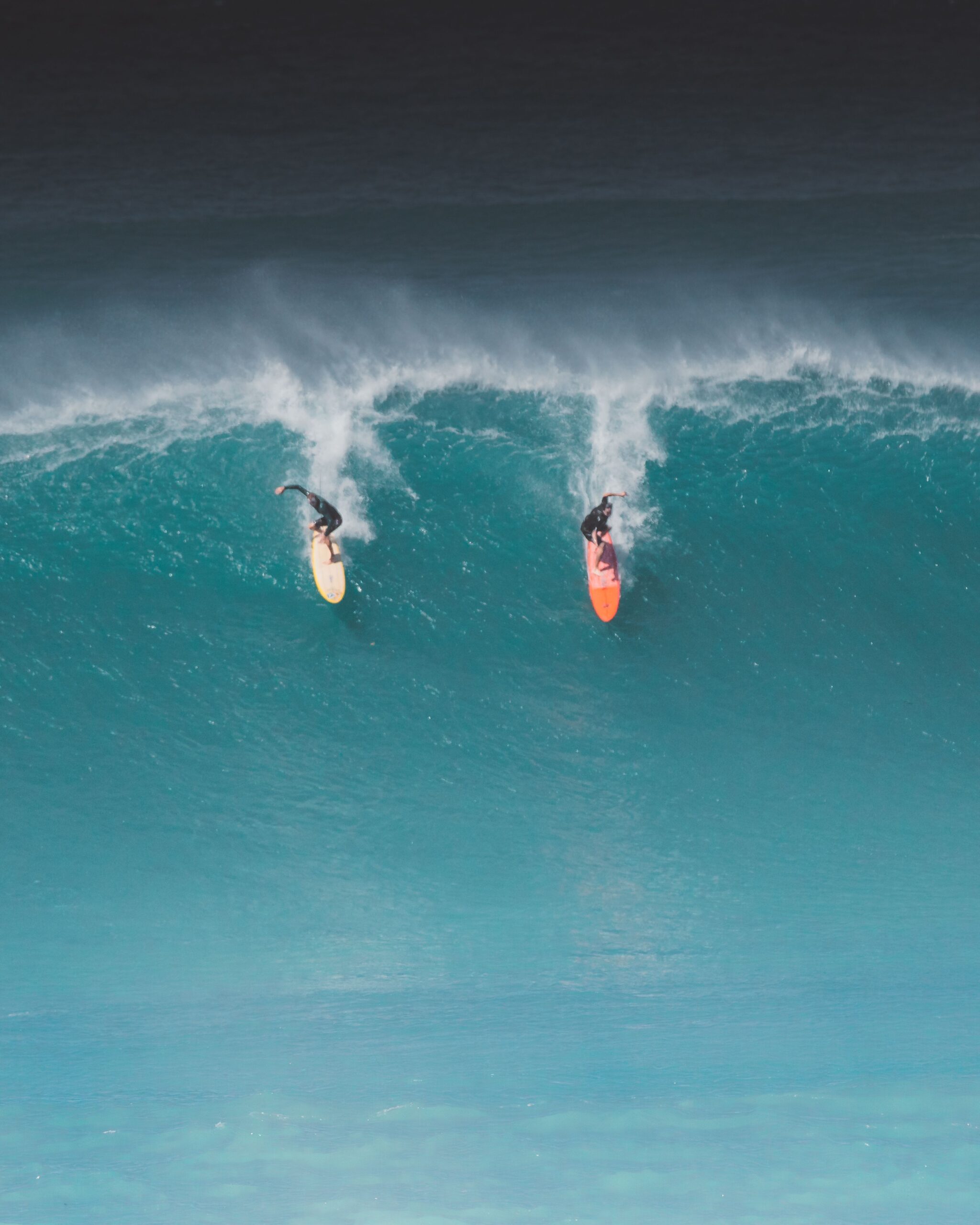
The wave lifted her.
For one second, maybe two, she was at the top of it, on her feet, dropping in, and it was the most beautiful thing I have ever seen a human body do. She came down the face of that wave and turned at the bottom of it and the whole wall of water opened up in front of her, and she was flying, she was exactly where she belonged, she was the thing Daniel had described to me, she did not ride the wave, she belonged to it.
And then her left leg gave out.
I did not understand what I was seeing at first.
One moment she was carving down the line, fully in control, and the next moment her body just folded in a way that bodies do not fold on purpose, and she went down, hard, off the front of the board, and the wave closed over the place where she had been.
The board flipped into the air.
She did not come up.
The whole beach bar went silent. Everyone had been watching her, the way everyone always watched her, because even strangers can tell when they are looking at someone who belongs in the water. And now the water had closed over her and she was not coming up and the silence on that deck was the loudest thing I have ever heard.
Daniel was already moving.
He went off the deck and across the sand at a dead run, kicking off his shoes as he went, and I was up and running behind him, and I remember thinking, with a terrible clarity, that I was about to watch the man I loved swim out into a six-foot swell to find his sister, and that I might be about to lose both of them.
The water was still closed.
Three seconds. Four.
Daniel hit the wet sand at the edge of the water.
Five seconds. Six.
And then, out past the break, in the churn of white water where the wave had broken over her, a head came up.
She came up.
She came up and she got an arm over her board, which was still leashed to her ankle, and she pulled herself onto it, and she lay across it on her stomach with her cheek against the wax, and even from the beach we could see her chest heaving as she coughed the ocean out of her lungs.
Her left leg was trailing in the water behind her, not kicking, not working.
But her arms were working.
And Hannah, thirty-one years old, with a leg that had stopped answering her in the middle of a six-foot wave, put her working arms into the water and began to paddle herself back toward the beach.
She did not wait to be rescued.
She did not raise a hand for help.
She put her head down and she paddled, one arm at a time, dragging a leg that would not move, across the inside section, through the white water, all the way to where the waves run up onto the sand.
Daniel waded out to his waist and caught the nose of her board and pulled her the last few feet in.
He did not yell at her.
I had been braced for him to yell at her. I thought the fear was going to come out of him as anger, the way it does with a lot of people, the way it came out of him on the deck when he told her no.
He did not yell.
He pulled her board up onto the sand, and he knelt down next to her in the shallow water with the small waves running up over both of them, and he put his hand on the back of her head, and he pressed his forehead against her temple, and the two of them stayed like that for a long time while the water ran up over their legs.
I heard what he said to her.
It was very quiet. I almost did not catch it.
He said: “Okay.”
Just that.
“Okay.”
And Hannah, with her cheek still against the wax of her board and her leg still trailing useless in the foam, reached up with one wet hand and held the back of her brother’s neck, and she said:
“I had to. You understand? I had to.”
And Daniel said: “I know. I know you did. Okay.”
Her leg came back the next morning.
That is how MS works, sometimes. It takes a thing, and then after a while, if you are lucky, it gives some of it back for a time. By the next morning she had feeling from the knee down again, and by the afternoon she could walk on it, with a limp that lasted about a week and then faded.
We told her about the engagement at breakfast the next morning, in the kitchen of her little rented house near the beach, while she sat with her bad leg propped up on a chair and a cup of coffee going cold in her hands.
She cried. She hugged me so hard it hurt. She told her brother that he had better not mess it up. She asked if she could be in the wedding.
She was in the wedding.
She walked down the aisle on her own two legs, slowly, on a good day that we had all quietly prayed for, and she stood up next to me as one of my bridesmaids, and when the minister got to the part about sickness and health, I watched Daniel look at his sister instead of at me for just a moment, and I did not mind at all, because I understood by then that loving someone with everything you have sometimes means standing on a beach and letting them paddle out.
There is a part of this story that I did not understand on the evening it happened, and that I only understood much later.
I thought, that evening, that the story was about a rescue. I thought it was about the terrible seconds when the wave closed over her and Daniel ran for the water and we all thought we were watching the worst day of our lives.
It was not about the rescue.
There was no rescue.
That is the whole point. Nobody pulled Hannah out of that water. Hannah pulled Hannah out of that water, with a dead leg and two good arms and thirty-one years of belonging to the ocean, and the only thing her brother did at the end was wade out to his waist and pull her board the last few feet onto the sand that she had already gotten herself to.
Daniel spent seven years trying to protect his sister from the things that were taking pieces of her.
And on a beach at golden hour, with his forehead pressed against her temple and the water running up over both of them, he finally understood the thing it had taken him seven years to learn.
You cannot protect someone from their own life.
You can only stand on the shore, and watch them paddle out, and be there to wade into the water when they come back in.
Hannah is forty-one now. She still surfs. Smaller days. A friend always nearby. She reads her own body the way she reads the ocean.
She has never once asked anyone’s permission.
And her brother, who used to stand on the beach with his whole body clenched against everything that might happen, learned to bring a chair down to the sand and sit in it, and drink his coffee, and watch his sister do the one thing the disease could never take from her.
The watching.
That was his to give.
The paddling out was always hers.

Adrian Hawthorne is a celebrated author and dedicated archivist who finds inspiration in the hidden stories of the past. Educated at Oxford, he now works at the National Archives, where preserving history fuels his evocative writing. Balancing archival precision with creative storytelling, Adrian founded the Hawthorne Institute of Literary Arts to mentor emerging writers and honor the timeless art of narrative.