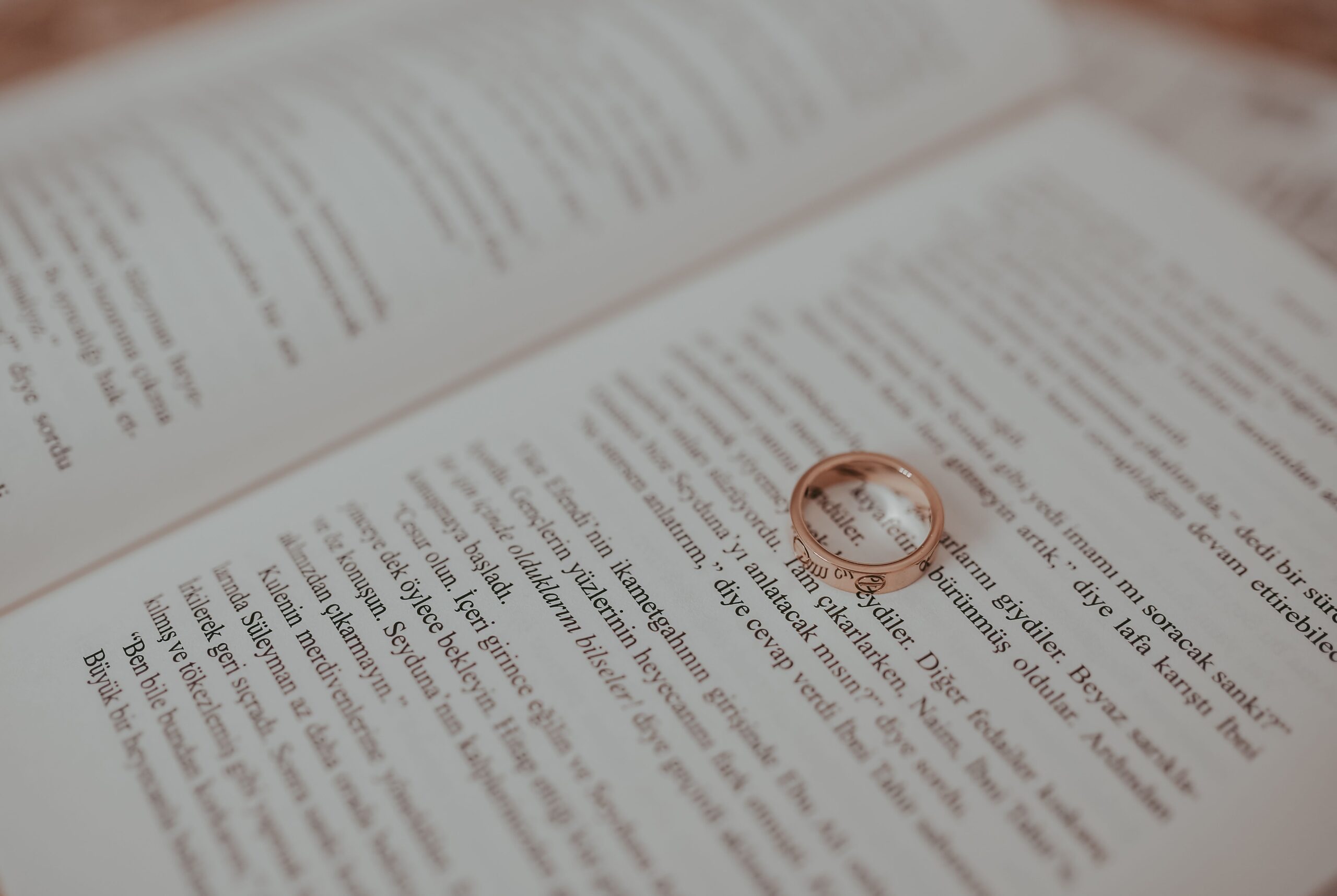
A boy walked into my jewelry shop on a Tuesday morning and set a ring on the counter and said his mother needed medicine, and when I picked it up and read the words engraved inside the band, my hands started shaking, because I was the one who had engraved them twelve years ago, and I had spent every day since believing the woman I gave it to was gone forever.
My name is Daniel Reyes. I’m forty-three. I’ve owned a small jewelry and repair shop on Calloway Street for nineteen years, the kind of place with a brass bell over the door and a glass case I polish every morning whether anyone comes in or not. I fix watches, resize rings, replace clasps. I am not a wealthy man. But I am a careful one, and I have a good memory for the things that pass through my hands, because in my trade the things people bring you are never just things. They are anniversaries and engagements and the last gift from someone who is gone.
That Tuesday started like any other. Gray light through the front window. The radio low. Coffee going cold beside the register.
Then the bell over the door rang, and a boy walked in.
He was maybe eleven. Thin, in a jacket a size too big, his dark hair combed down flat with water the way a child does when he is trying very hard to look presentable. He had a serious face. Too serious for a boy that age. He walked straight to my counter the way someone walks when they have rehearsed the trip in their head.
“Good morning,” I said. “Can I help you?”
He reached into his jacket pocket and took out a folded paper towel, and he unwrapped it carefully on the glass, and inside was a ring.
A woman’s ring. White gold, simple, a small stone. Worn smooth on the band the way a ring gets when it has been worn every day for years.
“My mom said to sell this,” the boy said. His voice was steady but I could hear the effort it took to keep it that way. “She’s sick. She needs medicine and we don’t have enough. She said this is worth something.”
I have heard versions of this before. People come in to sell what they love when the money runs out. It is the saddest part of my work and I have learned to be gentle with it.
“Let me take a look,” I said.
I picked up the ring.
And the world tilted.
I knew the ring. I knew it the way you know your own handwriting, because the ring was mine. Not mine to own. Mine to have made. I had sized that band. I had set that stone. And I had done something I almost never did for a piece that simple, because the man who ordered it had begged me, that man being me, twelve years ago, young and broke and in love.
I turned the band toward the light and looked inside.
The inscription was still there, worn but legible, in the small script I had cut by hand on a winter night when I could not afford an engraver and did it myself.
For Marisol. Wherever you go, I’m already there. D.
My breath stopped.
Marisol.
The boy was watching me. “Is it real gold?” he asked. “She said it was real.”
I could not answer him. I was looking at the inscription and the years were collapsing inward, twelve of them, all at once.
Let me tell you about Marisol, because you cannot understand what happened in my shop that Tuesday without understanding what happened to me twelve years before it.
When I was thirty-one I fell in love with a woman named Marisol Vega. She worked at a flower stand two blocks from my shop and she had a laugh that made strangers turn around on the sidewalk. We were together for almost two years. I have never, before or since, been as happy as I was in those two years.
I bought the gold when I could afford it, a little at a time. I made the ring myself, late at night in the back of the shop, and I cut the inscription by hand because I wanted the words to come from me and not from a machine. I was going to ask her to marry me on her birthday in October.
I never got to.
That August, my mother had a stroke back in Arizona, and I left to care for her, and I was gone four months, and in those four months everything fell apart in the way that things fall apart when two young people are poor and frightened and eight hundred miles from each other. There was a misunderstanding. Then a fight on the phone. Then silence. Then a letter from Marisol that I have read so many times the creases have worn through, a letter that said she could not keep waiting and that she was leaving the city and that I should not look for her.
I gave her the ring before I left for Arizona. I had it finished early and I could not wait for October, so I gave it to her one night on the steps of her building, not as a proposal, just as a promise, and I told her to hold onto it until I got back.
When she left, she took the ring with her.
I looked for her anyway, despite the letter. I called everyone we knew. I drove to the towns she had mentioned. Her flower stand was gone, her apartment was rented to strangers, her phone was disconnected. Marisol Vega had stepped out of my life as completely as if she had walked into the ocean.
For twelve years I assumed the worst kind of things. That she had married someone else. That she had forgotten me. That the ring was in a drawer somewhere or sold to a stranger or lost. I built a quiet life. I never married. I told myself I had made my peace.
And now a thin, serious boy in a too-big jacket was standing at my counter, asking if the ring was real gold, while his sick mother waited at home for the medicine my answer would buy.
“What’s your name?” I asked the boy. My voice did not sound like my own.
“Mateo,” he said.
“And your mother. What’s her name?”
He hesitated, the way a careful child hesitates before giving a stranger information.
“Marisol,” he said.
I had to put my hand flat on the glass counter to stay standing.
I looked at the boy. Really looked at him. The dark hair. The serious eyes. The shape of his face. He was eleven, maybe. He could be eleven.
I left in August twelve years ago. The math did itself in my head, cruel and simple, and I had to grip the counter harder.
“Mateo,” I said carefully. “How old are you?”
“Eleven. Almost twelve.”
Eleven. Almost twelve.
I am not a man who cries easily. I did not cry then, in front of the boy, because he did not need a stranger falling apart at him. But something broke open in my chest, quietly, the way ice breaks on a pond in spring, and underneath it was twelve years of cold water.
She had been pregnant when she left. She had known. The fight, the letter telling me not to look for her, the disappearing so completely, none of it was what I had spent twelve years believing. She had not forgotten me. She had been carrying my son, and for reasons I did not yet understand, she had decided to carry him alone.
And now she was sick, sick enough that she was selling the one thing she had kept through all of it, the ring with my promise cut into the gold, and she had sent our son to sell it to a stranger.
Except I was not a stranger. Of all the jewelry shops in all the city, the boy had walked into mine.
I looked at the inscription again. Wherever you go, I’m already there.
“Mateo,” I said. “Did your mother tell you which shop to bring this to?”
He nodded. “She gave me the address. She wrote it down.” He pulled a slip of paper from his pocket and put it on the counter. My shop’s address, in handwriting I knew, in handwriting I had not seen in twelve years, the same hand that had written the letter I had worn through with reading.
She knew. She had known exactly where she was sending him.
This was not chance. Marisol had not lost track of me in twelve years any more than I had truly stopped looking for her. She had known where my shop was. And now, sick and out of options, she had sent our son to me, with the ring, with the inscription, knowing I would read it, knowing I would understand.
She had not asked me for help in twelve years. She was too proud, or too hurt, or too afraid, and I did not yet know which. But she was not too proud to save her son’s mother. And so she had done the only thing she could do that would tell me everything without making her say a single word out loud.
She had sent me the ring. And she had sent me the boy.
“Is it worth a lot?” Mateo asked again, anxious now, reading something in my face he could not name. “Can you buy it? She really needs the medicine.”
I set the ring down on the velvet pad, gently, like it might break.
“Mateo,” I said. “I’m not going to buy this ring.”
His face fell, and I saw the fear flood in, the fear of a boy who had been sent to do an impossible adult thing and had failed, and I could not let that stand for even one more second.
“I’m not going to buy it,” I said, “because I’m the one who made it. Twelve years ago. I made this ring for your mother. The words inside it, I cut them myself.”
He stared at me. He did not understand. How could he.
“What’s your name?” he asked. The same question I had asked him.
“Daniel,” I said. “My name is Daniel Reyes.”
And I watched the boy’s face change, because somewhere in his eleven years his mother had said that name to him, maybe once, maybe many times, and he knew it. He knew the name. His mouth opened.
“She said,” he started, and stopped, and started again, the way a child does when something too big is arriving. “She said if the man at the shop asked about her, I should tell him something. She made me memorize it.”
The shop was completely silent. The radio had gone to static. The cold coffee sat by the register. Twelve years had brought me to this exact square foot of floor behind my own glass counter.
“Tell me,” I said.
Mateo took a breath, the careful breath of a boy reciting something he had practiced, and he looked me right in the eye, calm and certain in the way only children can be when they are carrying a message they do not fully understand, and he said the sentence his mother had given him to say.
“She said: ‘I never sold it because I was always going to send it back to you. I just hoped it wouldn’t have to be like this.'”
I did not move. I could not.
“And she said one more thing,” Mateo added. “She said to tell you his name.” He paused. “My middle name. It’s Daniel.”
Mateo Daniel.
She had given our son my name and never told me he existed and kept the ring for twelve years and only now, only sick, only desperate, had let the truth find its way back to me through the hands of the boy we made.
I came around the counter. I do not remember deciding to. I knelt down so I was level with him, this serious child in his too-big jacket, and I wanted to gather him up and I did not, because he did not know me yet, because to him I was still the man at the shop, and you cannot rush twelve years into one moment on a Tuesday morning.
“Mateo,” I said, and my voice was wrecked and I let it be. “Where is your mother right now? Where is she sick?”
“At home,” he said. “She can’t really get up anymore. That’s why she sent me.” His careful composure was starting to crack now, because some part of him understood that the ground had shifted, that the man at the shop was not the stranger he had been five minutes ago. “Is she going to be okay?”
I was going to answer him. I was going to tell him that I would do everything, everything, that the medicine was the least of it, that I would carry his mother to every doctor in the state on my own back if that is what it took.
But right then, the bell over the door rang.
Someone had stopped outside, and pushed the door open, and was standing in the gray morning light of the doorway.
I looked up from where I knelt beside my son.
And there she was.
Marisol stood in the doorway, one hand braced against the frame because she did not have the strength to stand without it. She was thinner than I remembered, so much thinner, and there was gray in her dark hair that had not been there twelve years ago, and her face was drawn with whatever illness had been eating at her. But it was her. It was the woman from the flower stand whose laugh used to turn strangers around on the sidewalk. It was Marisol.
She was looking at me kneeling beside our son, and she was crying, and she had not said a word.
“Mom?” Mateo turned. “Mom, you’re not supposed to be up. The doctor said.”
“I know, mijo,” she said, and her voice was thin but it was hers. “I couldn’t let you do it alone. I tried to stay home. I couldn’t.”
Mateo looked between us, his careful eleven-year-old face working hard to assemble something out of pieces that did not fit. “You know him,” he said. It was not a question. “The man at the shop. You know him.”
Marisol came in slowly, and I stood and went to her without thinking, and I caught her arm because she was swaying, and the first time I had touched Marisol Vega in twelve years was to keep her from falling down in the doorway of my shop.
“Sit,” I said. “Please. Sit down before you fall.”
I brought the chair from behind the counter, the one I sit in when I work on watches, and I eased her into it, and Mateo hovered beside her with his hand on her shoulder, and for a moment none of us said anything at all.
Then Marisol looked up at me.
“You still have the shop,” she said. “I wasn’t sure. I thought, what if he moved, what if it’s gone, what if I send Mateo and it’s a stranger after all.” She laughed, a small broken sound. “But you’re still here. You never left.”
“I never left,” I said. “I looked for you. For a long time, Marisol, I looked everywhere.”
“I know.” She closed her eyes. “I made sure you couldn’t find me. That was me, Daniel. Not you. I have to tell you that first, before anything else. You did not fail to find me. I hid.”
I knelt again, beside the chair this time, so I could see her face.
“Why?” I asked. It was the only word I had. Twelve years in one word.
And she told me. She told me the thing she had never told anyone, and it was not what I had spent those years imagining.
When I left for Arizona to care for my mother, Marisol found out she was pregnant about three weeks later. She was going to tell me. And then my mother’s stroke turned into a long, hard decline, and I was gone month after month, and Marisol was alone and pregnant and scared in a city that was expensive and unkind to a young woman with no family of her own.
Her family. That was the part I had never known. Marisol had a father, a hard and frightening man she had run from as a teenager, and when she got pregnant and could not reach me reliably, in a moment of desperation she called the only blood she had. Her father came, and he saw a young pregnant woman alone with a boyfriend eight hundred miles away and no ring on her finger, and he did what cruel men do. He told her I was never coming back. He told her men always say they will return and never do. He offered to take her in, on the condition that she cut me off completely, that she never contact me, that she let him raise the child his way.
She was frightened and broke and her father was certain and loud the way certain loud men are, and she believed him for exactly long enough to do the damage. She wrote me the letter at her father’s kitchen table while he stood over her.
“I regretted it before the ink was dry,” she said. “But by then you had stopped calling, because of the letter, and my father had me convinced you were glad to be free of us. It took me two years to get away from him again. By then Mateo was walking. And I thought, what kind of woman shows up after two years and says, surprise, you have a son. I thought you would hate me. I thought I had ruined it past fixing.”
“You hadn’t,” I said. “Marisol. You hadn’t.”
“I kept the ring,” she said. “Through all of it. My father tried to make me sell it once, and I told him I already had. I hid it in the lining of a coat for two years so he couldn’t take it. Because it was the one thing I had that was the truth. Wherever you go, I’m already there.” She was crying again. “I read it to Mateo when he was small. I didn’t tell him it was about his father. I just told him it was the truest thing anyone ever wrote down.”
I looked at my son, who was standing very still, taking in the size of what he was hearing.
“And now I’m sick,” Marisol said. “And I won’t pretend it isn’t bad, because Mateo already knows it’s bad. I needed money for the medicine, that’s true. But Daniel.” She reached out and took my hand, and her grip was weak but it was certain. “That’s not really why I sent him here. I could have sold the ring anywhere. I sent him to you, with the inscription, with his name, because I am running out of time to be a coward. Because if something happens to me, he needs his father. And his father needed to know he exists. I should have done it twelve years ago. I’m doing it now because now is what I have left.”
The shop was silent except for Marisol’s breathing and the small hum of the lights.
I held her hand and I put my other hand on Mateo’s shoulder and I said the only true thing, which was: “You’re not running out of time. Not if I have anything to say about it. We’re going to fight this. All three of us. Starting today.”
I closed the shop that morning and I drove them both to the hospital myself, and I did not leave. The medicine she had sent her son to sell a ring for turned out to be the smallest part of what she needed. She was sicker than even she had let Mateo see. But she was not beyond help, and the thing about being beyond help is that it is usually a thing people decide because they cannot afford the alternative, and money was the one problem I could actually solve. Nineteen years of a careful life. I had savings. I had the shop. I had never had anyone to spend any of it on.
I have someone now. I have two someones.
The treatment is long and hard, and I will not dress it up, because Marisol made me promise not to. But she is still here. She is fighting. And every day she fights, Mateo and I are both right there beside her, because that is what wherever you go, I’m already there was always supposed to mean.
Mateo and I are slow with each other. You cannot pour twelve years into a boy all at once. But last week he called me Dad without thinking about it, just once, asking me to pass him something at dinner, and then he froze like he had broken a rule, and I told him there was no rule, that he could call me that or Daniel or anything he wanted, and I would answer to all of it for the rest of my life. He has called me Dad three times since. I am counting.
I kept the ring. I cleaned it and sized it for Marisol’s thinner finger and put it back where it has belonged for twelve years, and this time I asked the question I never got to ask that October. She said yes. We are not waiting for anything to be certain first. We have wasted enough time being afraid of each other.
People ask me if I am angry. At Marisol, for the twelve years. At her father, for the lie. I am not. I think about it this way. Of all the jewelry shops in all the city, my son walked into mine. Marisol will tell you she planned it, and that is true, she knew the address. But she could have sold the ring anywhere and kept the secret forever. She chose, finally, to send it home. And the part no one could plan is that it landed on a Tuesday morning when I was standing right there, behind my own counter, ready.
Some people would call that luck. Some would call it fate.
I call it the truest thing anyone ever wrote down. Wherever you go, I’m already there. I always was. It just took twelve years and a brave, serious boy in a too-big jacket to bring me the proof.
If this story touched you, the rest of what happened, where we are now and the one thing Marisol still made me promise to tell, is in the first c0mments. Leave a YES and a Like and I’ll share it.

Adrian Hawthorne is a celebrated author and dedicated archivist who finds inspiration in the hidden stories of the past. Educated at Oxford, he now works at the National Archives, where preserving history fuels his evocative writing. Balancing archival precision with creative storytelling, Adrian founded the Hawthorne Institute of Literary Arts to mentor emerging writers and honor the timeless art of narrative.