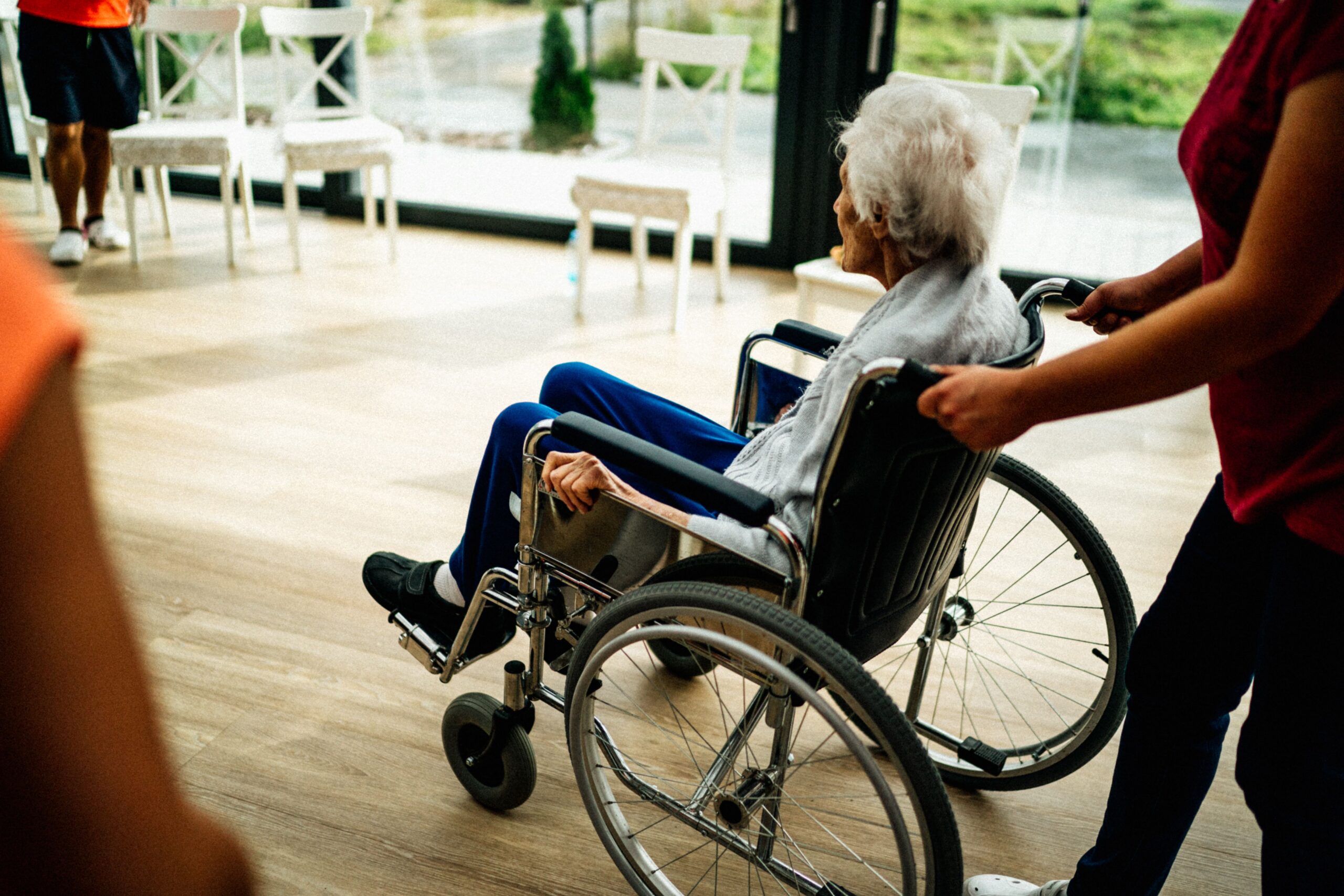
I wore my good coat the day my son took me to the nursing home.
It was the camel wool one Walter bought me the last winter before he passed — the one I’d only ever worn to church and to funerals, kept in a garment bag in the hall closet so the moths wouldn’t find it. That morning I took it out and laid it on the bed and looked at it for a long time before I put it on. Then I pinned on the little starburst brooch, the one Walter gave me on our first anniversary, back when a brooch like that cost a month of groceries and he’d gone without lunch for six weeks to buy it. I checked myself in the hall mirror twice. I smoothed my hair. I don’t entirely know why I bothered. I suppose I wanted my son to see his mother looking like somebody — one last time — before he put her away in a place where nobody would ever look at me twice again.
David picked me up at nine.
He didn’t come to the door. I’d been watching from the front window, and I saw his car pull into the drive, and I waited for him to come up the path the way he used to run up it as a boy, and instead my phone buzzed in my coat pocket. A text. One word. Ready?
I went out to him. I locked the door behind me — out of habit, though I knew, somewhere underneath, that I would never unlock it again — and I walked down the path Walter had poured himself, past the rose bush that was Walter’s mother’s before it was ours, and I got into my son’s car with my one small suitcase on my lap.
The drive
He didn’t look at me.
He had a call going on the speaker the whole way over, something about a closing, a buyer, a number with too many zeros for me to follow. I sat very still and I held my case and I watched the town I’d lived in my whole life go by the window. The church where I married Walter. The school where David learned to read. The diner where Walter used to take me on Friday nights, the two of us splitting a single slice of pie because we couldn’t afford two.
At a red light I tried, once, to say something. To reach across the years and the front seat and touch my son somehow.
“Do you remember,” I started, “when your father taught you to ride your bike in this parking lot—”
“Mom, I’m on a call,” he said, and turned it up.
So I stopped. I folded my hands on my suitcase and I didn’t try again.
He’d told me to pack light. “The room’s compact,” he’d said, the way you’d describe a closet. “Pack what fits.” So I had one case, and in it was forty-three years of a life pared down to what an old woman could lift by herself: three changes of clothes, my Bible, my pills, the photograph of Walter from our wedding day, and a smaller photograph I kept face-down at the bottom, underneath everything, that David did not know I still owned.
The house his father built
I want you to understand about the house, because the house is the whole of it, really. The house is where this story lives.
Walter built it. Not bought — built. He was a young man with good hands and almost no money, and he bought a weedy half-acre on the edge of town for next to nothing, and he put up our home board by board over three summers, working his regular job all week and the house every Saturday and Sunday until his hands cracked and bled. I brought him lemonade and held the other end of things. I was carrying David that last summer, big as a barn, and Walter laid the back garden out brick by brick so that I’d have somewhere pretty to sit with the baby when he came.
We raised two children in that house. We buried Walter’s parents from its front room. I nursed Walter himself in that same front room at the end, when the cancer came and took him in four months flat, and I held his hand right up until he wasn’t there to hold it back.
Forty-three years. Every doorframe in that house had a pencil mark where we’d measured the children’s heights. Every floorboard knew my step. The kitchen window over the sink looked out on Walter’s roses.
And my son had told me to pack what fit in a single case, and was, at that very moment, on the telephone arranging to sell it out from under me.
How a son becomes a stranger
People always want to know how it happens. How a boy you rocked to sleep — a boy who once sobbed for a solid hour because he’d stepped on a beetle by accident and couldn’t bear that he’d hurt something so small — becomes a man who can leave his own mother at a curb like a parcel on a porch.
I’ve had a long time to think about it now, and here is the truest thing I can tell you: it doesn’t happen all at once. That’s the cruel part. If it happened all at once, you’d see it coming; you’d have a chance to stop it. Instead it happens the way water gets into a foundation — one slow drop at a time, in places you can’t see, until one day the whole wall has gone soft and you never noticed it going.
David was a sweet boy. But somewhere along the way he decided that the measure of a man was the size of what he owned, and he married a woman named Diane who agreed with him entirely, and the two of them built a life that ran on appearances and arithmetic. There was always a bigger house to want, a better car, a neighbor to keep pace with. I used to think it was a phase. I used to think the grandchildren would soften him. I told myself a great many comforting things, the way mothers do, for a great many years.
After Walter died, David started “helping.”
That’s what he called it. He’d come by on a Saturday with a folder of papers and lay them on the kitchen table where Walter and I used to do the crossword. Power of attorney — “just in case, Mom, so I can step in if anything happens.” A change to how the accounts were held — “to make things simpler for you.” He talked fast, and he’d already filled everything in beforehand, and he’d tap the line where he wanted my signature and tell me not to trouble myself with the details, that he had it all handled.
And I signed. Most of it. Because he was my son, and because a widow’s house is a terribly quiet place, and because every visit — even a visit that was really only about paperwork — was a reason to put the kettle on and not be alone for one more afternoon.
But I didn’t sign quite everything. And I noticed a great deal more than he ever thought I did.
The things a mother notices
I noticed the realtor’s business card that slipped out of his jacket pocket when he hung the coat over my chair, and how he snatched it back up too quickly when he saw me looking.
I noticed him out in the back garden one afternoon, pacing it off heel to toe, holding his phone up and sweeping it slowly across Walter’s brickwork the way you do when you’re measuring something for a listing.
I noticed that at Sunday dinners, David and Diane had quietly stopped saying “if anything happens to Mom” and started saying “when.” Just that one little word. When. As though I were already a thing of the past tense, sitting right there at the head of the table passing them the potatoes.
And then, one warm evening early last spring, I noticed the worst thing of all.
I was at the kitchen sink and the window above it was cracked open, and David was out on the back porch on his phone, not knowing his voice carried straight through to me. He was telling whoever was on the other end that the property would “move fast once the old girl’s settled somewhere,” that the market was strong right now, that he just needed to “get her squared away” first and then it’d be smooth sailing.
The old girl.
That was me. That was what I had become to my own son — a logistics problem standing between him and a sale.
I set the dish I was washing down very gently, so it wouldn’t clatter and give me away, and I stood at that sink for a long, long while, with the water running cold over my hands.
And somewhere in there, standing at Walter’s sink looking out at Walter’s roses, I stopped being sad. And I started being careful.
Because I had finally understood the one thing I’d spent two years refusing to understand: my son was not waiting for me to need him. He was waiting for me to be gone. And in the meantime, he was counting what I’d leave behind.
The granddaughter they tried to erase
There is a part of this that David never once considered, because he’d spent three years pretending it didn’t exist.
His daughter. My granddaughter. Hannah.
David cut Hannah off when she was twenty-two. She’d left the business program he’d chosen for her — paid for, planned out, the whole future mapped to the year — and gone instead to work at an animal shelter for almost no money, because she said it was the only place she had ever felt like herself. Then she married a quiet, kind young man named Tom who fixed boilers and furnaces for his living, and who looked David dead in the eye at their one and only meeting and was plainly, completely unimpressed by him. I don’t think my son ever forgave the boy for that.
He called the whole thing a humiliation. He told Hannah to her face that she’d “thrown away everything he’d built for her.” He told the rest of the family she was not to be spoken of. Diane took her photographs down off their walls. At Christmas, her name simply stopped being said — the way you stop saying the name of the dead.
But here is what my son never knew, because he had long ago stopped paying any real attention to anyone who couldn’t be of use to him:
Hannah never stopped coming to see me.
Every Wednesday, for six years, that girl drove the forty minutes to my house after her shift at the shelter — still in her work clothes, still smelling faintly of dog and disinfectant — and she sat with me at my kitchen table, and she stayed.
She brought me library books, three at a time, and the cheap waxy chocolate I’ve loved since I was a girl during the war. She brought me stories about the animals nobody else would take in — the three-legged ones, the old blind ones, the mean ones that turned sweet if only you were patient enough with them. When my hip went bad, it was Hannah and Tom who came on a Saturday and put in the grab rail beside the tub, Tom doing the work and Hannah handing him his tools and the two of them laughing about something the whole time. When I couldn’t manage the stairs anymore, it was the pair of them who moved my whole bed down into the front room without me even having to ask, so I wouldn’t have to climb.
And on the anniversary of Walter’s death, every single year, Hannah came and sat with me and didn’t try to fix it or hurry me past it or tell me it was time to move on. She just held my hand and let me cry as long as I needed to, and then she got up and made the tea, and we’d sit together and look at the wedding photograph and she’d ask me to tell her again how her grandfather proposed.
In six years, that child never once asked me for a single thing. Not money. Not the house. Not so much as a passing mention in a will. I need you to understand that part completely, because it is the very heart of all of it: she was the only person left in my family who came to see me when I was still here — when there was nothing at all yet to inherit, only a lonely old woman to keep company on a Wednesday.
So when I finally understood what David was planning, I knew exactly what I was going to do. And I knew precisely whose quiet, clever husband I would ask to drive me to do it.
What I did
I telephoned Tom, and I told him I needed to see a lawyer — one who had never met my son and never would. He didn’t ask me a single question. He just said, “I’ll take Wednesday off, Eleanor,” and he did.
He drove me forty minutes in the other direction, to a small office in a town where David knew no one and had no reason ever to go, and he sat in the waiting room with his cap turning in his hands while I went in and spent the better part of three hours with a kind, careful woman who took me entirely seriously and did not once, not for a moment, treat me like a confused old lady who didn’t know her own mind.
I did not put it in a will. I’d thought very hard about that. A will can be contested, dragged through the courts, picked apart line by line by a patient man with a grievance and a good lawyer — and David had patience and grievance in abundance. So instead, five full months before my son ever so much as breathed the word “home” to me, I deeded the house over outright. While I was of entirely sound mind, with a fresh letter from my own doctor in hand to prove exactly that, and signed before two witnesses who were no kin to anyone in my family and could never be accused of having a stake in it.
The house Walter built belongs to Hannah now. It has belonged to her for the better part of a year. Every Wednesday she’d been driving out to sit with me, never once knowing that she was already sitting at her own kitchen table, in her own front room, under her own roof.
And then I waited.
I let my son go on believing I was a confused old woman who’d sign whatever was put in front of her. I let him make his arrangements and his phone calls. I let him book the room with the “compact” closet. I let him think he had already won — because, and I am not proud of this part, but it is the truth and I promised you the truth — I needed to know. After everything, I needed to see it with my own two eyes: just how far my own child would actually go.
He went all the way to the curb.
“The house is already gone, David”
He turned to leave me there at that door, my son. He didn’t even shut off the engine. He had somewhere to be.
So I said his name — “David” — in exactly the way I used to say it when he was small and had done something he knew in his heart was wrong, and was standing there hoping against hope that I hadn’t seen.
He sighed. A short, impatient little sigh, like I was the last item on a long list he was eager to be done with. He half-turned back toward me with his keys already in his hand.
And I told him.
“The house is already gone, David.”
I have been that man’s mother for fifty years. I have seen every single face he owns — the scraped-knee face, the first-day-of-school face, the wedding-day face, the face he made the night he stood in a hospital hallway holding his own newborn daughter. And I had never, not once in all those years, seen the color drain out of it the way it drained out of it then.
I watched him do the arithmetic right there on the pavement. I could see it moving behind his eyes, frantic and fast. She sold it. Where’s the money. Which account. Who has access. How fast can I undo this. Because even then — even in that moment, with his mother standing in front of him in her funeral coat — the very first thing my son reached for was not me, and not what he’d done, but the money.
“What did you do,” he said. It wasn’t really a question. It came out as a whisper.
I told him I’d given it away. All of it. The house, free and clear, to someone else entirely.
He demanded — his voice climbing and cracking now, right there in the parking lot — to know who.
And so I told him the one true thing I knew would break him in a way that no court, no lawyer, no last will and testament on this earth ever could.
“I gave it,” I said, “to the only person who ever came to see me.”
He didn’t understand at first. I watched him not understand. And then I watched it land, slow and terrible, like a building coming down one floor at a time.
I watched my son realize that someone in this family — someone he knew — had been driving forty minutes every Wednesday for six years to sit with his mother and ask for absolutely nothing in return. And then I watched him understand who that someone had to be. The daughter he had erased. The daughter whose name he had forbidden at his own table. The girl he had decided was as good as dead to him, because she’d chosen a shelter and a furnace man over the gleaming future he had mapped out for her.
He hadn’t just lost a house, there on that curb, in front of that building. He had lost it to the very child he’d thrown away in order to get it.
He didn’t say another word. He didn’t carry my suitcase in. He got into his car, and he drove off, and I stood at that door in my good coat with Walter’s brooch pinned to my chest — an old woman with one small case and, it would seem to anyone passing, nowhere left in the world to go.
And for the first time in a very long while, I was not afraid.
Where I am now
I never spent a single night in that nursing home.
Hannah was already coming. She’d known the broad outline of the plan for weeks — she just hadn’t known the exact day it would happen, because I hadn’t known it myself, not until my phone buzzed that morning with the single word Ready? I’d called her the moment David’s car pulled into my drive, and she had walked straight off the floor of the shelter mid-shift and driven like the very devil, and she pulled up to that building not twenty minutes after his taillights had vanished around the corner.
She got out of her car already crying. She crossed that pavement and she took the suitcase right out of my hand, and she looked at me and she said, “Grandma. Come home.”
And she took me home. To the house that Walter built. Where I belong, and where I have every intention of staying until they carry me out the front door feet first.
I live there now, with Hannah and Tom. My bed is back upstairs where it ought to be — Tom put in a chair lift himself one weekend, whistling the entire time and refusing to let me thank him for it. There are dogs underfoot, three of them, the ones nobody else in the county would take, and they sleep at the foot of my bed and follow me from room to room like I’m worth following. There is noise in that house again, and light through Walter’s kitchen window, and the smell of something always cooking on the stove.
And there is a high chair pulled up to the kitchen table now. Because last spring, Hannah had a little girl.
They named her Eleanor. After me.
David has telephoned twice. The first time, a few weeks after, to threaten a lawsuit that his own lawyer apparently had to tell him he would certainly lose — since a woman of sound mind may give her own house to whomever she pleases, and I had the doctor’s letter and the witnesses to prove I was exactly that. The second time was months later, very late at night, and he didn’t threaten anything at all. He just said, quietly, that he was sorry. His voice sounded old to me. Older than mine.
I don’t know if he meant it. I told him that I forgave him, and the truth is that I do — a mother always does, in the end; that’s the cruel trap built into the whole arrangement of it. But forgiving a thing is not the same as forgetting it ever happened, and it is not at all the same as undoing it.
I want to be very clear about one thing, because I can already tell that some of you reading this have decided I am a hard, cold old woman who outsmarted her own son out of spite, and that is not it. That was never it.
I would have given that man everything. The house. The money. Every last thing I own, gladly, with both hands and a glad heart. If he had ever once, in all those long years, come to see me simply because he wanted me — and not because of what I happened to be sitting on.
That is the whole of it, really. That is the one thing I’d ask you to carry out of here with you, especially those of you fortunate enough to still have a mother or a father waiting at the other end of a telephone line tonight.
It was never about the house.
It was about who showed up on the Wednesdays.

Specialty: Legal & Financial Drama
Michael Carter covers stories where money, power, and personal history collide. His writing often explores courtroom battles, business conflicts, and the subtle strategies people use when pushed into a corner. He focuses on grounded, realistic storytelling with attention to detail and believable motivations.