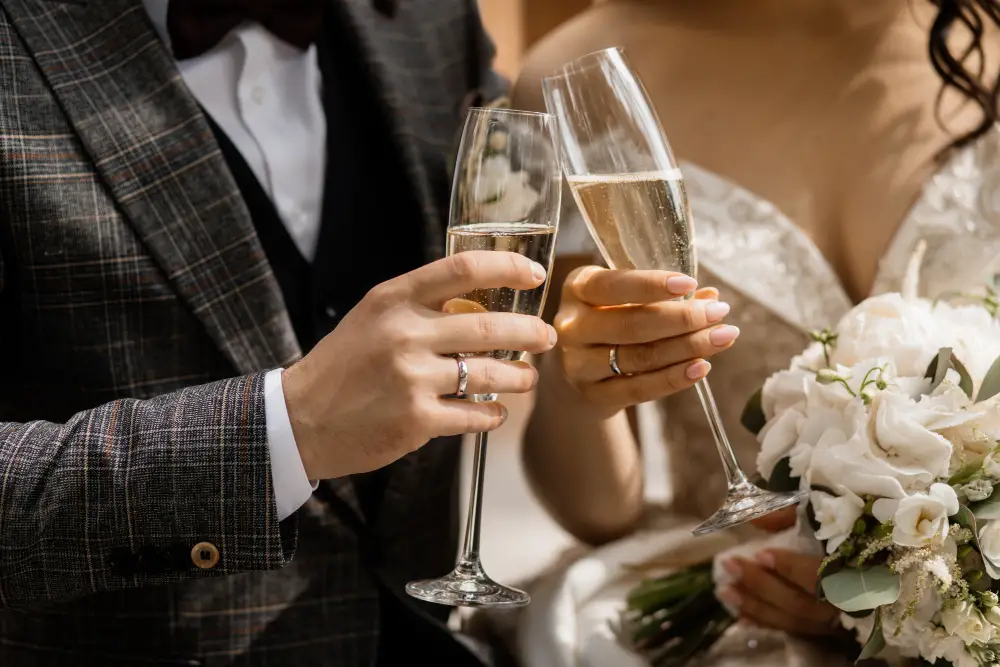
I never imagined I would live to see my ex-husband marry my daughter. And I certainly never expected the truth to come crashing down on their wedding day, delivered by my son in a packed reception hall, in a way so public it made my knees shake.
But the ending doesn’t make sense without the beginning, so let me start there.
I married Mark when I was twenty years old. It was not a whirlwind romance or an impulsive decision. It was simply what was expected of us. We came from old-money, country-club families in a town where reputation mattered more than feelings, and our lives had been intertwined long before either of us had any say in the matter. Our parents vacationed together, sat on the same charitable boards, attended the same galas, and exchanged professionally staged holiday cards every December. They had even begun hosting engagement parties before we were officially engaged, which should have told us something about who the marriage was really for.
We were not reckless. We were not madly in love. We were expected.
I walked down the aisle in a gown my mother selected. Everyone declared us a perfect match, two polished young adults raised with privilege, stepping seamlessly into the future our families had carefully planned. For a time, we believed that narrative ourselves. We played the roles with real commitment, sent glossy cards, hosted charity dinners, kept the lawn manicured and the living room magazine-worthy. I had our daughter Rowan the year we married and our son Caleb two years after that, and for a while the children gave the performance a kind of warmth that almost felt genuine.
But behind all of it, we were quietly suffocating. Being raised with privilege had not taught us how to survive a marriage without love. The worst part was that we did not even fight. Silence settled in, heavy and permanent, the kind you cannot repair because you cannot acknowledge it exists. We did not know how to argue without fearing scandal. We did not know how to voice resentment without feeling like we were betraying the families who had arranged us. And we certainly did not know how to grow as individuals when everyone expected us to exist only as a pair.
After seventeen years of shared history, unspoken frustrations, and raising children who deserved better than parents performing happiness, we collapsed under the weight of everything we had never learned to say. The divorce was quiet, less drama than a PTA meeting. It was not explosive or bitter, just hollow. Our parents were appalled. When the paperwork was finalized, Mark and I both felt, for the first time in years, something close to relief.
Five years later, I met Arthur, and he felt like oxygen.
He was nothing like the men I had known before. Quietly charming rather than performative, a high school teacher who loved poetry and kept classic cars in a garage that smelled permanently of motor oil and WD-40. He was forty when we met, divorced himself, raising three children of his own. He was warm, grounded, and genuinely funny in a way that had no audience. After years of living like a glossy advertisement for a life I had not chosen, his authenticity was irresistible.
We talked for hours about things that actually mattered. Regrets. Lessons learned badly. The particular exhaustion of parenting and the stranger exhaustion of dating in your late thirties. We shared the same values and a similar, well-worn sense of humor. With him, I did not have to pretend. For the first time in my adult life, I felt truly seen, which should have made me careful. Instead, it made me reckless.
We married quickly. Probably too quickly.
The marriage lasted six months. There were no fights, no dramatic revelations, just a slow and quiet unraveling. Date nights stopped without announcement. Conversations about the future simply faded, like a radio signal losing its station. I told myself it was the strain of blending two families, or unresolved grief from his first marriage, or the ordinary difficulty of two people trying to build something new from the rubble of their respective pasts. When we separated, it was peaceful, and I told everyone it was mutual. For a while, I even believed that myself.
We wished each other well. I assumed Arthur would become another closed chapter, a reminder to move more slowly next time. I could not have been more wrong.
Two years later, my daughter told me she was dating him.
Rowan had always been unapologetically decisive. By twenty-four she had her MBA and was moving fast inside a competitive marketing firm. She knew exactly what she wanted and had never once waited for someone else’s approval before going after it. When she sat me down in my living room, her cheeks flushed and her eyes bright with the particular glow of someone about to say something they have rehearsed, I felt a knot form in my stomach before she opened her mouth.
“Mom, I’m in love,” she said.
I smiled automatically.
Then she said his name.
“It’s Arthur.”
I froze. “Arthur who?”
“You know who,” she replied softly.
My throat tightened. “My Arthur?”
She nodded, still smiling, that wide and unwavering smile. “It just happened. He reached out. We talked. He’s always understood me, and since you’re not together anymore…”
After that, her words blurred. I could hear her speaking but nothing was registering. A forty-year-old man. Sixteen years older than my daughter. A man I had been married to, however briefly, however badly. It felt wrong on every level I could name and several I couldn’t. I tried to speak, to slow things down, to ask a single coherent question, but she moved past my silence with the kind of ultimatum only a child can deliver to a parent, sharp and unemotional and fueled by the unshakeable certainty of someone who believes she is defending love rather than walking into a trap.
“Either you accept this,” she said, “or I’m cutting you out of my life.”
I was stunned. I should have argued. I should have said every frightened, protective, furious thing rising in my throat. But losing her was not an option, not after everything we had already survived together. So I swallowed every instinct, every warning, every memory of Arthur’s half-smiles and evasions and the way his eyes never quite lined up with his words.
I told her I supported them.
It was the worst lie I ever told, and I told it out of love.
That year between Rowan’s announcement and the wedding was one of the longest of my life.
I watched them at family dinners, Arthur’s hand on my daughter’s chair back, his easy laugh, the way he looked at her with the same warm, attentive expression he had once turned on me. I looked for cracks in the performance and found none, which frightened me more than cracks would have. I smiled when I was supposed to smile and asked about wedding venues and bridesmaid dresses and catering options as if I were an ordinary mother of the bride, and every month that passed without incident made me wonder whether I was wrong about him, whether I had simply been a bad match and Rowan was something different, whether my instincts were colored by humiliation rather than actual perception.
Caleb was quieter about it than I was. He came to the dinners, shook Arthur’s hand, made conversation. He never said anything to me directly, but I would sometimes catch him watching Arthur with a particular focused attention that had nothing social in it. I asked him once whether he liked Arthur, and he said, choosing his words with care, that he was still deciding. At the time I took this for the polite noncommittal answer of a young man who did not want to upset his mother. Looking back, he had already started making calls.
I did not try to stop the wedding. I told myself it was because Rowan had made her position clear and losing her was not something I could survive. That was true. But there was another truth underneath it, smaller and harder to admit: I did not have proof. I had a bad feeling, old memories, the knowledge that Arthur had left me quickly and without adequate explanation. None of that was evidence of anything except a marriage that had not worked. People had short marriages that ended peacefully all the time. People moved on and found someone new. The age difference was significant and uncomfortable, but Rowan was an adult who had never in her life made a decision she had not thought through completely. I had no standing to overrule her, and she had made certain I understood that.
So I smiled. I helped with the flowers. I drove with her to fittings and tasted cake samples and offered opinions on centerpieces, and I performed the role of a supportive mother so convincingly that by the end I had almost convinced myself.
Almost.
A year later, I stood in a venue draped in eucalyptus garlands and filled with soft jazz and watched my daughter walk down the aisle toward the man I had once stood beside myself. I smiled for photographs. I raised my champagne glass. I played my role with the old, practiced ease of a woman who had spent seventeen years performing a marriage, because sometimes the only thing you can do is endure the performance and keep the people you love within reach.
My stomach was knotted the entire night.
Then, during the reception, Caleb found me.
He had always been the quieter of my two children. Not timid, just steady, the kind of steady that comes from paying close attention when everyone else is looking away. At twenty-two, he had already launched a small tech startup and somehow managed to stay completely grounded in the process. He was the son who called his grandparents every Sunday without being reminded, who read the fine print on contracts as a matter of habit, who thought three moves ahead without seeming anxious about the destination. So when he took my arm at the reception and said we needed to talk, I did not hesitate.
He glanced toward the newlyweds’ table. “Come with me,” he said quietly. “I need to show you something.”
I followed him out to the parking lot. Far enough from the entrance that the music softened to a murmur, close enough that I could still see the glow through the venue windows. The night air was cool, and my heels clicked softly against the pavement.
“What is it?” I asked.
He did not answer right away. He pulled out his phone and moved through several folders with the focused deliberateness of someone who had rehearsed this moment. “I waited until tonight because I needed everything in hand,” he said. “I hired a private investigator. I only got the full report a few minutes ago.”
I stared at him. “You did what?”
“I didn’t trust Arthur.” He kept his voice level, not angry, just factual. “Something about him never felt right to me. The way he dodged questions. The way Rowan started pulling away from the people who knew her best. It reminded me too much of how things ended between you and him.”
My confusion shifted into something colder. “What are you saying?”
“He isn’t who he claims to be,” Caleb said. “He never was.”
He handed me the phone. What I read was not rumor or speculation. These were court filings, financial records, an investigative summary arranged in clear and careful sequence. Arthur had filed for bankruptcy two years before he met me and had never mentioned it. There were defaulted business loans, credit card accounts sent to collections, years of unpaid back taxes. His ex-wife had filed a lawsuit detailing concealed income and years of missed alimony payments. There was a pattern to it, a consistent shape, the same moves executed against different women in slightly different settings.
“He targets women with money,” Caleb said, his voice tight now in the way it got when he was working hard to stay composed. “He sees Rowan’s name, your family connections, her career trajectory, and he sees a path to financial security he couldn’t build on his own. He’s been using her.”
I stood there in the parking lot and replayed my own brief marriage against this new information. Everything I had told myself was simply a rushed relationship, a bad match, two people who had moved too fast, looked different now. The way Arthur had hesitated when I mentioned a prenuptial agreement. The way his face had shifted, just slightly, when I pressed him on it.
I had looked him in the eye and said that if this was really love, a piece of paper would not frighten him. He had signed. But his smile had not quite reached his eyes, and not long after, everything had begun to thin out and dissolve.
He had not left because we were incompatible. He had left because he could not get what he came for.
Caleb took my hand. “He’s still tied up in litigation. Rowan doesn’t know any of this. He made sure of it.” He paused. “We have to tell her.”
“She won’t believe it if it comes from us,” I said, my voice cracking at the edges. “Not privately, not tonight, not while he’s sitting beside her at her own wedding. He’ll explain it away before she has time to process it.”
Caleb held my gaze. “Then we don’t do it privately.”
The two of us stood there in the cool night air while the music from inside drifted over us, and the plan took shape in the space between what I was afraid to do and what I understood we had no choice but to do.
We went back inside.
The reception was in full celebration. Candlelight moved warmly across the room. Laughter rose above the music as guests clinked glasses and gathered in front of the flower wall for photographs. Rowan sat at the head table in her ivory gown, radiant and unsuspecting, leaning slightly toward the man beside her. Arthur played the proud groom with practiced ease. The contrast between that performance and what was on Caleb’s phone was almost too much to hold.
Caleb touched my arm. “Are you sure?”
I looked at my daughter. “Yes,” I said. “If he survives in the dark, then we bring him into the light.”
Caleb made his way to the small stage at the front of the room and took the microphone. The emcee introduced him as the groom’s stepson, which was technically accurate given the circumstances and which no one had time to find unusual before he began to speak.
He stood straight and composed. I could see the tension across his shoulders from where I stood, but his voice was calm.
“I’d like to say a few words,” he began. “Not just as Rowan’s brother, but as someone who has known Arthur in more than one role.”
A small wave of uncertain laughter moved through the room.
Rowan smiled up at him from the head table. Arthur shifted in his chair.
“I want to congratulate my sister on her wedding day,” Caleb continued. “Marriage is built on love, trust, and honesty. Tonight I’d like to raise a toast to honesty. And to do that properly, I have a question for the groom.”
The room went still.
“Arthur,” Caleb said clearly, “how is your ex-wife doing? Is she still waiting on those alimony payments?”
A collective breath was drawn in across the room. A few nervous laughs followed, the uncomfortable kind that happen when people are not yet sure whether something is a badly timed joke or something else entirely.
Arthur’s face drained of color.
Caleb did not pause. “Or are you still tied up in court? I imagine it’s difficult to keep track, between the lawsuits and the unpaid debts. And the bankruptcy, of course. Should we toast to that as well?”
Rowan’s smile disappeared.
The silence in the room became absolute.
Caleb raised his phone and turned the screen toward the nearest tables. “These are not rumors,” he said, his voice entirely even. “These are legal documents. Public court records. Filed years before you ever met Rowan or our mother. You simply chose not to mention them.”
Arthur opened his mouth. Nothing came out.
“When were you planning to tell her?” Caleb asked. His voice had not risen. It did not need to. “After the wedding? After the honeymoon? Or had you decided she didn’t need to know at all?”
He turned toward his sister.
“You didn’t know,” he said gently. “I understand that. He is skilled at hiding what he needs to hide. He tried the same approach with Mom, but when he realized he couldn’t access her finances, he moved on. To you.”
Rowan rose slowly from her chair. Her hands were shaking. Her eyes moved between Arthur and the phone still lit up in Caleb’s hand, and I watched her face cycle through disbelief and confusion and then something rawer and quieter.
She looked at Arthur and asked, simply, “Is it true?”
He found his voice at last. “I… it’s complicated, my love.”
She absorbed that for exactly one second.
“No,” she said. “It isn’t.”
Then she turned and found me in the crowd, and her face was the face of a child again, wide-eyed and undone. “Mom… oh God.”
She crossed the floor and collapsed into my arms, and I held her the way I had held her when she was small and the world had suddenly shown her one of its hard edges. Together, without looking back, we walked out of her own wedding.
Behind us, the room broke into urgent whispers and the scraping of chairs. Caleb announced that the evening was over. As we reached the exit, I heard Arthur pushing through the crowd, his voice carrying the particular desperate note of a man watching his carefully constructed story unravel faster than he can revise it.
Within an hour, it was finished.
By morning, Rowan had filed for an annulment, citing fraud and false disclosures and Arthur’s intent to marry for financial gain. The paperwork had barely settled before she was legally free again. She packed what she needed from the apartment they had briefly shared and moved back in with me, and slowly, over the days and weeks that followed, we began to talk. Really talk, the way we should have been talking for the past year.
We talked about my divorce from her father, about all the years of performing a life we had not chosen. We talked about Arthur, what we had each seen in him and what we had each ignored. We talked about the way, when you are so determined not to repeat your parents’ mistakes, you sometimes find yourself making the same ones through a different door.
A few days after she moved in, she looked up from a cup of tea and asked me something I was not expecting.
“Did you love him?”
I thought about it honestly before answering. “I loved the version of him I believed in,” I said. “The man who asked about my dreams and made me tea when I was sick and laughed at the same things I laughed at. I think now, looking back, I loved the quiet he brought into my life. I loved the feeling of being seen after so many years of being staged. But him, the actual person underneath all of that. I don’t think I ever really knew who that was.”
She nodded slowly. “Me too.”
We sat with that for a moment, and then she laughed, a small and unsteady sound, the kind that lives right next to grief. I laughed too. It was real, which was more than I could have said for most of what had come before.
In the weeks that followed, I watched her begin to heal. Not only from Arthur but from the pressure and the expectations and the particular version of perfection she had been taught to chase ever since she was old enough to understand what our family valued. She started therapy. She took a solo trip to Colorado, hiking trails she had never had time for. She rearranged her apartment with furniture she actually liked. She came back to herself, carefully and steadily, the way recovery works when it is done honestly.
One afternoon over coffee at my kitchen table, she said, “I don’t know what comes next. But at least I know who I am again.”
I smiled at her. “You always did,” I told her. “You just lost sight of it for a while.”
She reached across the table and squeezed my hand, and for the first time in more than a year, the tight knot in my chest loosened.
Only then did I fully understand why my own marriage to Arthur had ended the way it had. I had spent two years telling myself it was simply a bad match, a rushed decision, two damaged people who had moved before they were ready. But the answer had been in front of me from the beginning, visible in the way he had hesitated over that prenuptial agreement, in the way everything had cooled so quickly once he understood he could not get to my finances, in the way he had simply stopped trying rather than trying differently.
He had not left because we were incompatible. He had left because I was not useful to him in the way he needed, and then he had found someone who was, someone with my last name and my connections and the particular vulnerability of a young woman determined to be nothing like her careful, cautious, twice-married mother.
The thought made me sick. It also gave me something I had not had before.
Clarity.
He had not broken me. And he had not broken her.
Caleb was the one who had made sure of it. He had waited because he understood that suspicion alone would not be enough, that Rowan would need proof she could not argue away, and so he had spent months quietly working, verifying records, confirming facts, building an airtight case out of public documents and court filings that Arthur had counted on no one bothering to look up. He had stood in front of a roomful of people and said the hard thing cleanly, without cruelty, without grandstanding, and he had done it because he loved his sister more than he feared the discomfort.
I called him the morning after the wedding, when Rowan was still asleep in the guest room and the house was very quiet. I did not know what to say, so I said simply that I was proud of him. He was quiet for a moment on the other end of the line.
“I should have moved faster,” he said.
“You had to be sure.”
“I know.” A pause. “I just kept thinking, what if I was wrong? What if it was nothing and I’d ruined her wedding over a hunch?”
“You weren’t wrong.”
“No,” he said. “But I was scared I was.”
That was the most he ever said about it. Afterward, he came to dinner more often, and sometimes I caught him and Rowan sitting at the kitchen table long after the meal was over, talking quietly while I washed dishes in the next room, and I thought that whatever damage this year had done, it had also made them closer in a way that would outlast it.
We never saw Arthur again. He never called. Never attempted an explanation. Whatever he might have said, he seemed to understand there was nothing left to say to us. He moved on the way he always had, quietly, to somewhere new, to someone who did not yet know his name.
Rowan moved into her own place eventually. She planted a small herb garden on the windowsill of the new apartment, which she mentioned to me with a kind of pleased surprise, as if she had not known until now that she liked growing things. She called more often. She showed up for Sunday dinners without the carefully managed brightness she used to carry in the door with her.
One evening she called me just to tell me about a book she was reading. Nothing urgent. Nothing she needed. Just a conversation between two people who had found their way back to each other after a long and difficult detour.
I sat at my kitchen table long after we hung up, listening to the quiet of the house, and I thought about what it had cost us both to get here, and whether any of it could have been avoided, and whether the answer to that question even mattered anymore.
I decided it did not.
We were here. We were honest with each other. We were okay.
That was enough to start with, and probably more than enough to build on.

Laura Bennett writes about complicated family dynamics, difficult conversations, and the quiet moments that change everything. Her stories focus on real-life tensions — inheritance disputes, strained marriages, loyalty tests — and the strength people find when they finally speak up. She believes the smallest decisions often carry the biggest consequences.