The storage unit smelled like rust and old cardboard and the particular dryness of a place that has been sealed against the weather for a long time. I stood in the entrance for a moment after rolling up the door, letting my eyes adjust to the dimness, my hand still on the metal handle.
I had been to this unit only once before, fifteen years ago, when Robert rented it to store his mother’s furniture after the estate sale. He had kept the key on a small hook behind the kitchen cabinet where we kept the light bulbs, the kind of place you only know about if you have lived in a house long enough to learn its hiding spots. I had found it three days after the funeral while reorganizing the kitchen out of the particular restless grief that makes women clean things. The key was attached to a paper tag in Robert’s handwriting.
It said only: Ellie. When you’re ready.
I had not been ready for six weeks.
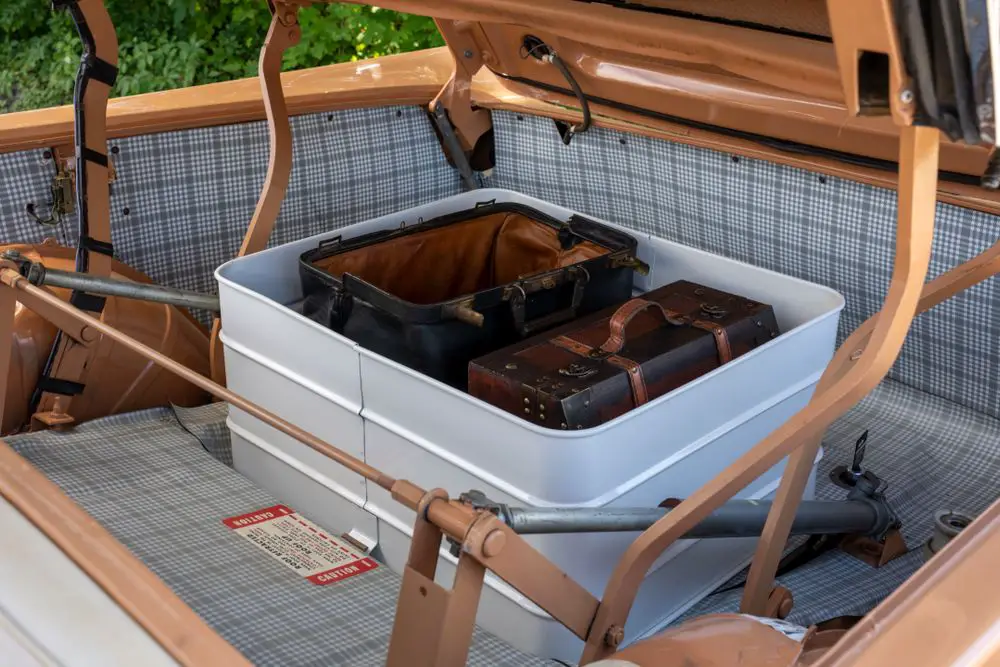
The trunk sat at the back of the unit on a metal shelf, navy blue with brass fittings, the kind of trunk that belonged in a Twenties photograph. Robert had owned it since before we married. I had always assumed it held old papers, tax records, the kinds of documents men of his generation felt obligated to keep but never actually reviewed. I had never opened it. He had never invited me to.
I carried it to the folding table near the entrance and sat down. My hands were steadier than I expected. My heart was not.
The trunk was packed with precision, the way Robert did everything. Neatly labeled folders arranged in order, sealed envelopes, a slim metal lockbox at the bottom. No clutter. No randomness. Just the quiet efficiency of a man who had been planning this moment for longer than I knew.
The first folder was labeled in his block capitals: DEBT, PUBLIC.
Inside were copies of loan documents, lawsuits, and financial statements I recognized from the last two years of his life. The same numbers our sons had thrown in my face at the hospital, at the kitchen table, at the funeral home when we were supposed to be choosing a casket. Six point two million dollars in liabilities. Insolvency. Risk of collapse. The language of failure that Mark and Lucas had wielded like a verdict, as if the size of a man’s debt said anything true about the size of his life.
I set the folder aside.
The next one stopped me cold.
ASSETS, PRIVATE.
I opened it slowly. Inside were documents I had never seen, had never been shown, had never been invited to understand. Offshore accounts. Silent partnerships. Shell LLCs registered in Delaware and Nevada, the names of which meant nothing to me until I traced them through the subsidiary pages and found Robert’s signature at the bottom of each one. Minority stakes in logistics software companies that had, according to the attached valuations, grown considerably in value over the past several years. Real estate holdings under corporate names I did not recognize, each one documented with quiet thoroughness, each one ultimately traceable to my husband.
I kept flipping. The numbers kept climbing.
By the time I reached the bottom of the folder, my hands were shaking.
Robert was not six point two million dollars in debt. He was worth, by the most conservative estimate in the documents before me, just over eighteen million dollars net.
I sat with that for a long time.
The debt was real. It existed on paper and in the court filings and in the disappointed mouths of my sons. But it was strategic. Deliberately structured to reduce tax exposure, to obscure asset accumulation from people who might use the information badly, and to keep certain people, our sons specifically, from knowing what he had actually built. He had hidden a fortune behind the appearance of failure, and he had done it so convincingly that I had half believed it myself. On the hard nights when Mark called to tell me the numbers looked bad and Lucas forwarded legal notices with clipped, impatient messages, I had lain awake wondering whether we had made some irreversible mistake.
We had made no mistake.
Only I had not been trusted with that knowledge, and I was not sure yet how to feel about that.
I opened the lockbox next. Inside was a flash drive in a small paper envelope and, beneath it, a letter folded into thirds. His handwriting on the outside.
Ellie.
I unfolded it.
He had written: If the boys are reading this, then you didn’t follow instructions. I structured everything so that anyone who judged me by appearances would assume failure. The companies, the properties, the accounts, everything is set to transfer only if you remain my sole executor. If the boys contest or pressure you, they get nothing. If they walk away, they still get nothing. This wasn’t punishment. It was a filter. I wanted to know who would stay when there was nothing to gain.
I sat in the storage unit for over an hour.
I thought about the last three years of his life, the years that had looked, from the outside and sometimes from the inside, like a slow financial unraveling. The late nights he called working. The careful, unflappable way he responded to accusations. The way he would look at our sons when they pushed him about money, a look I had never been able to fully read, something between grief and patience. I understood it now. He had been watching them reveal themselves, and he had not liked what he saw, and he had gone on loving them anyway while quietly arranging the consequences.
I had married a strategist and not fully known it.
But there was something else sitting with me in that cold unit, something I needed to be honest about before I could move forward. The man who had planned all of this, who had seen so clearly what would happen when he was gone and had built the architecture to meet it, had not told me. For thirty-one years of marriage he had managed a private empire and let me believe we were managing together. He had watched me worry about the numbers our sons threw around. He had allowed me to carry an anxiety that was, by his own careful design, unnecessary. He had chosen not to trust me with the truth, and he had done it, the letter said, to protect me, but it had also left me standing in a storage unit at sixty-three years old, learning who my husband was from a folder.
I sat with that for a long time before I decided how I felt about it.
What I came to, in that cold room with the smell of old cardboard around me, was this: Robert had trusted me with the thing that mattered most. Not the documents. Not the numbers. The choice. He had trusted me with the decision of what came next, for our sons, for the foundation, for everything he had built. He had left me the map precisely because he believed I was the only person who should have it. That was a different kind of trust than the kind I had wanted, but it was not nothing. It was not small.
I thought about our sons.
Mark had always been the impatient one, quick to identify an opportunity and quicker still to overestimate his ability to capitalize on it. He had his father’s intelligence and none of his father’s patience, which was a dangerous combination in business and had proven exactly as dangerous as it sounded. The tech startup he had spent three years building was consuming money faster than it generated any, not because the idea was bad but because Mark had chosen the competitive kill over the slow build at every fork in the road, apparently including, I now understood from Robert’s documents, attempting to bankrupt a logistics software firm that was quietly one of his father’s most valuable holdings.
Robert had watched that happen. He had not intervened. He had documented it.
Lucas was a different case. Lucas was charming in the way that sometimes substituted for substance, the kind of man who could walk into a room and make everyone in it feel warmly regarded without ever quite following through on the warmth. He had tried to get Robert to sign over the house deed at Christmas dinner, Robert had said in the video, and I thought about that Christmas, about Lucas’s easy laugh and his way of steering conversation, and I wondered how many moments I had missed because Lucas had always been so pleasant to be around.
Neither of them were beyond help. I believed that. I believed it while I sat in the storage unit and I believed it six weeks later when they showed up at my door and I believed it even through what came afterward. But belief is not the same as permission, and Robert had understood that better than I had.
I plugged the flash drive into the small laptop I had brought with me on instinct, not knowing what I was looking for.
There were twelve video files. I watched them in order, sitting in the folding chair with my coat still on because the storage unit was cold in November and I had not thought to bring anything warm.
Robert on camera, calm as always. Explaining the structure of each holding. Explaining his intent. Explaining, in the last three files, his disappointment. Not anger. He was never an angry man. Just disappointment, steady and clear, the kind that comes from loving someone for a long time and watching them become less than you hoped.
“I loved my sons,” he said in the eleventh video, looking directly into the lens the way he looked at you when he was saying something he needed you to hear. “But I didn’t like who they became when money entered the conversation.”
I watched that one three times.
The final file in the trunk was labeled Next Steps.
It contained a set of instructions, orderly as everything else he did, for activating the trusts, liquidating certain holdings in a particular sequence, and managing the transition of the charitable foundation he had established. At the bottom of the last page, in handwriting rather than type, a single note.
Ellie decides who deserves access. Or if anyone does at all.
I drove home and made dinner and did not call either of my sons.
They came to me a week later. Not together at first. Mark appeared on a Thursday evening, leaning against the doorframe with the careful casualness of a man who has rehearsed his entrance. He had heard things, he said. Rumors. Creditors going quiet. Lawsuits disappearing without explanation.
“People are saying Dad wasn’t actually broke,” he said.
I looked at him for a moment. “Well,” I said, “that depends on who you ask.”
He did not like that answer. I could see him deciding how to proceed.
Lucas came the next day with a different approach, softer, the concerned-son register he had always been better at than his brother. They should talk, he said. As a family. He used that word carefully, the way you use a word you know has lost some of its meaning.
“We already did,” I told him. “At the funeral you skipped.”
They came back. Different tactics each time. First confusion, then concern, then a gradual slide into entitlement, as if by visiting enough times they were accumulating some kind of credit. Mark sat on my couch one afternoon and told me that legally they were heirs, that if their father had hidden assets they had a right to know. Lucas stood behind him and added that their father had believed in transparency, which would have been a more persuasive point if Lucas had not, the previous Christmas, tried to get Robert to sign over the house deed over dinner, a moment Robert had described in detail on the fourth video file.
“He believed in consequences,” I said.
They kept coming. I let them talk. I did not show them the documents, did not mention the videos. I had learned something from Robert, watching his patience with them over those final years: some people will reveal everything about themselves if you simply give them enough space to fill.
Eventually desperation replaced strategy.
“We’re in trouble,” Mark said one afternoon, and his voice had lost its managed quality. “Some of Dad’s creditors are coming after us. They’re claiming we benefited from assets the estate should have covered.”
“Are they,” I said.
“Mom.” He leaned forward. “If there’s money.”
“There is,” I said.
He and Lucas both straightened.
“But it’s not yours.”
The silence in the room was long.
I told them enough. Not everything, not the full shape of what Robert had built, but enough so they understood that their father had anticipated this moment with precision. That the trusts were conditional. That their decision to dismiss his final months as financial embarrassment and their absence from his funeral had not been overlooked, had in fact been written into the architecture of everything he left behind.
“This is manipulation,” Lucas said.
“No,” I said. “This is observation.”
Mark’s voice broke, just slightly. “So he just cuts us off forever?”
“That depends,” I said, “on what you do next.”
They left angry. That was fine. I had expected it.
What came next I had not anticipated, though perhaps I should have.
A month after the estate lawsuits were quietly settled through one of Robert’s holding entities, I received a legal notice in the mail. My own sons were suing me for undue influence. Their argument, prepared by lawyers they could not afford, was that Robert had been mentally diminished when he structured the conditional trusts, and that I had taken advantage of his decline to direct his assets away from his rightful heirs.
They were not simply contesting the will. They were attacking his mind.
I sat at the kitchen table with the notice in my hand and thought about Robert for a long time. I thought about what it had cost him to watch our sons become who they had become, and to go on building anyway, quietly and without drama, because he believed that the right architecture could outlast the wrong behavior.
I called his attorney.
The court date was a rainy Tuesday in October. Mark and Lucas sat across the aisle in their best suits, their lawyers arranged around them in the practiced formation of men who are expensive and know it. They looked at me with a mixture of expressions I had spent the past year learning to read clearly: guilt still present, but diminishing. Greed, more patient now, wearing the costume of principle.
Their lead attorney stood and began to describe a confused old man, a narrative of decline and manipulation, a fortune hidden in a rusted trunk by a wife who had taken advantage of vulnerability.
I stood up.
“Your Honor,” I said, “I’d like to submit additional evidence.”
I handed a second flash drive to the clerk.
What appeared on the courtroom screen was a video Robert had recorded in the storage unit itself, the shelving visible behind him, the light casting familiar shadows. He looked tired. His eyes were not.
“It’s October, isn’t it,” he said, without quite making it a question. In the gallery, Mark and Lucas went still.
Robert looked into the camera with the steadiness of a man who has made his peace with a thing and is now simply completing it.
“If you’re watching this in a courtroom, it means my sons have traded their father’s dignity for a chance at his checkbook. They’re likely claiming I was diminished. So let’s talk about what I remember. Mark, on June 12th, you asked me for a million-dollar loan while I was supposedly confused. I denied it because the business model was predatory and you knew it. Lucas, you tried to get me to sign over the house deed at Christmas dinner. I remember the tablecloth. I remember what you were wearing. I have documentation of both conversations. I also have evaluations from three independent neurologists, conducted the day before I signed the trust documents, confirming that my cognition is intact and that I understand in full what I am doing and why.”
He paused. Not for effect. Just the way Robert paused when he was choosing his next words with care.
“I am not diminished. I am disappointed. There is a difference.”
The courtroom was quiet in the particular way of rooms where something irrevocable has just occurred.
The lawsuit was dismissed with prejudice. The legal fees consumed what remained of their personal savings. They came out of it with the stipends Robert had set aside, which were enough to live on, not enough to leverage, and which were now tied to conditions: mandatory financial counseling, regular community service hours, and a quarterly review with Robert’s attorney.
I executed the rest of Robert’s instructions in the weeks that followed.
Ten million dollars went to the Hale Foundation for Trade Excellence, funding the construction of three vocational centers, the first of which broke ground that spring in a neighborhood Robert had grown up in and never pretended not to be from. He had cared about skilled work, about the dignity of people who built things with their hands, with a consistency and depth that I understood better now that I could see what he had been quietly building with his. The foundation’s board included his old attorney, a retired machinist he had mentored in his thirties, and a woman who ran a workforce development nonprofit whose grant applications Robert had anonymously funded for eleven years. She had never known who her benefactor was until I called to tell her. She cried on the phone for a long time, and then she said, “He came to one of our graduations once. Sat in the back and left before anyone could speak to him.” I told her that sounded exactly right.
Five million went into a locked educational trust for future grandchildren. Not the grandchildren my sons currently were or were not capable of raising, but the grandchildren who might someday exist, who would inherit not Robert’s wealth directly but the opportunity to do something with it. Mark and Lucas could not access it. That was by design.
The remainder stayed with me.
I used some of it to travel. Robert and I had spent thirty years talking about the places we would go when things settled down, when the building phase was over, when there was finally time. He had been buying that time for us all along, quietly, while I worried about the balance sheets. I went to the places we had talked about, and I went alone, and it was both harder and more necessary than I had expected. I walked through a market in Lisbon and ate soup at a counter in Tokyo and sat in a square in Oaxaca watching pigeons, and in each of these places I felt Robert’s presence not as a haunting but as a companionship, the particular companionship of someone who wanted you to see things and arranged for you to see them.
I came home changed in ways I was still understanding.
Two years after the funeral, I drove the old blue Ford out of storage. I had had it fully restored over the previous months, the engine rebuilt, the paint returned to its original color, a deep navy that in certain light looked almost sapphire. Robert had bought the car three years into our marriage, secondhand, and driven it for twenty years before it became the storage unit’s quiet occupant. I had not understood until I found the trunk why he had kept it rather than selling it. Now I thought I did. Some things you keep not because they are useful but because they hold the shape of something you do not want to lose.
I drove to the cemetery on a Tuesday morning in late October, the kind of morning that cannot decide between summer and winter and settles for a thin, provisional light that makes everything look considered. The grass was still green. The trees along the path had gone to copper and orange. I parked and walked to his headstone carrying nothing, which was unusual for me.
I sat on the grass beside him and talked for a while.
I told him about the trade schools. I described the ribbon cutting at the first one, the way the students had stood in their work clothes looking simultaneously nervous and proud, the way the retired machinist on the board had shaken every hand. I told him that Lucas had held a steady job for fourteen months, the longest stretch of his adult life, and that Mark had built his consulting practice to the point where it was almost self-sustaining, which was not a large achievement by most measures but was, for Mark, significant. They were learning things the hard way, the only curriculum Robert had ever believed in for certain lessons.
I told him I had been to Portugal and Japan and Mexico. I told him the soup in Tokyo was the best thing I had eaten in three years. I told him I had thought about him in the market in Lisbon and felt, for the first time since he died, something that was not grief, or not only grief, but also gratitude. The uncomplicated kind. The kind that does not need to be explained or protected.
I sat there for a long time after I stopped talking. The cemetery was quiet except for a pair of geese moving along the path in their unhurried way. I had always liked geese, their complete indifference to human drama.
I was walking back to the car when I noticed something in the grass near the rear tire, a small glint that turned out to be a brass key. I picked it up and recognized it: identical to the one from the storage unit, the same weight, the same small loop at the top. I held it for a moment and then, on instinct, crouched beside the car and felt along the underside of the driver’s seat frame.
There was a panel. It gave way with the key.
Inside a small compartment, a final lockbox. Inside the lockbox, a note on a scrap of paper in his handwriting.
Ellie, the money was a shield for you. This is for us.
Beneath the note were two first-class tickets to the Amalfi Coast, dated two months from the day I was standing there. And beneath those, folded once, a document: the deed to a small villa on the Italian coast, purchased in my name alone, registered to no trust, no holding company, no corporate entity. Just my name on a piece of property he had bought decades ago and kept entirely separate from everything else, because some things are not strategy.
Some things are just love, set aside and waiting.
I stood beside the restored Ford in the thin October light for a long time.
Robert had built a fortress, methodical and impenetrable, designed to survive the worst that circumstance and human nature could produce. He had watched his sons become men he did not fully recognize and continued to provide for them anyway, not because they had earned it, but because he was still their father and some obligations are not conditional. He had worked late nights and said very little and trusted me with the map, even if he had waited longer than I wished to hand it over.
And then, separately, privately, he had bought a house by the sea and put my name on it.
Not a strategy. Not a structure. Not a test.
A home.
I put the deed in my coat pocket. I put the tickets in my bag.
I got in the car and drove to the airport.
I did not look back at the city. I had been Robert’s partner and Robert’s widow and Robert’s executor, and I had done each of those things as well as I knew how. I had filtered and structured and signed and witnessed and endured. I had sat in storage units and courtrooms and lawyers’ offices and kitchen chairs with my hands folded while my sons said things I had to allow myself to feel later, in private, when there was space for it.
All of that was finished now.
The engine hummed under me. The tickets were in my bag. The villa was in my name.
I was, for the first time in a very long time, simply Eleanor.
I was going home to a house I had never seen but somehow already knew.

Laura Bennett writes about complicated family dynamics, difficult conversations, and the quiet moments that change everything. Her stories focus on real-life tensions — inheritance disputes, strained marriages, loyalty tests — and the strength people find when they finally speak up. She believes the smallest decisions often carry the biggest consequences.