I waited tables at the Bluebird Diner on Route 9 for three years, and in that whole time the only thing that ever made me believe in anything was a man named Earl and the wife he brought with him every morning who had been dead for two years.
I should start with me, because none of this makes sense unless you understand the shape my life was in when Earl walked into it.
I was twenty-four. I had a four year old boy named Theo and an apartment with a heater that worked when it felt like it and a stack of envelopes on my kitchen counter that I had stopped opening, the same way you stop looking at a bruise because looking doesn’t change it. Theo’s father had been gone since before Theo could say the word father. I worked the breakfast and lunch shift at the Bluebird and then three nights a week I cleaned offices downtown, and in between I tried to be a mother, which mostly meant I was tired in a way that sleep didn’t fix.
The Bluebird is one of those old chrome and vinyl places that has been on the same corner since the 1950s and has the same menu it had then, more or less. Pie under glass domes. Coffee that comes in thick white cups with a blue ring around the rim. Booths with cracked seats that somebody patched with tape the same color, almost. It is not fancy. But the regulars are loyal, and the light comes through the big front windows in the morning in a way that makes even a hard day feel survivable for a minute or two.
Earl started coming in on a Monday in the fall. I remember because I almost didn’t seat him in my section, and I have thought a hundred times since then about how close I came to never knowing him at all.
He was somewhere in his eighties. Tall once, you could tell, though age had folded him down a little. He had a full head of white hair that he combed back neat, and wire framed glasses, and he was wearing a pressed dress shirt buttoned to the top with a tie. A real tie, knotted properly. At six fifteen in the morning. I had truck drivers coming in with their shirts inside out and this man looked like he was on his way to church.
He asked for the small booth by the window. Table six. The two seater. And he asked for it the way you ask for something that belongs to you, not rudely, just certain. So I sat him there.
“Coffee?” I asked.
“Two, please,” he said.
I looked past him, out at the empty parking lot, because I figured somebody was coming. “Sure. You expecting someone?”
And he smiled at me, this gentle, patient smile, and he said, “She’s already here.”
I will be honest with you. My first thought was that the poor man was confused. I had a great aunt who got like that near the end, talking to people who weren’t in the room. I felt sorry for him, and I brought the two coffees, and I went on with my morning.
But Earl wasn’t confused. Not even a little. I figured that out fast.
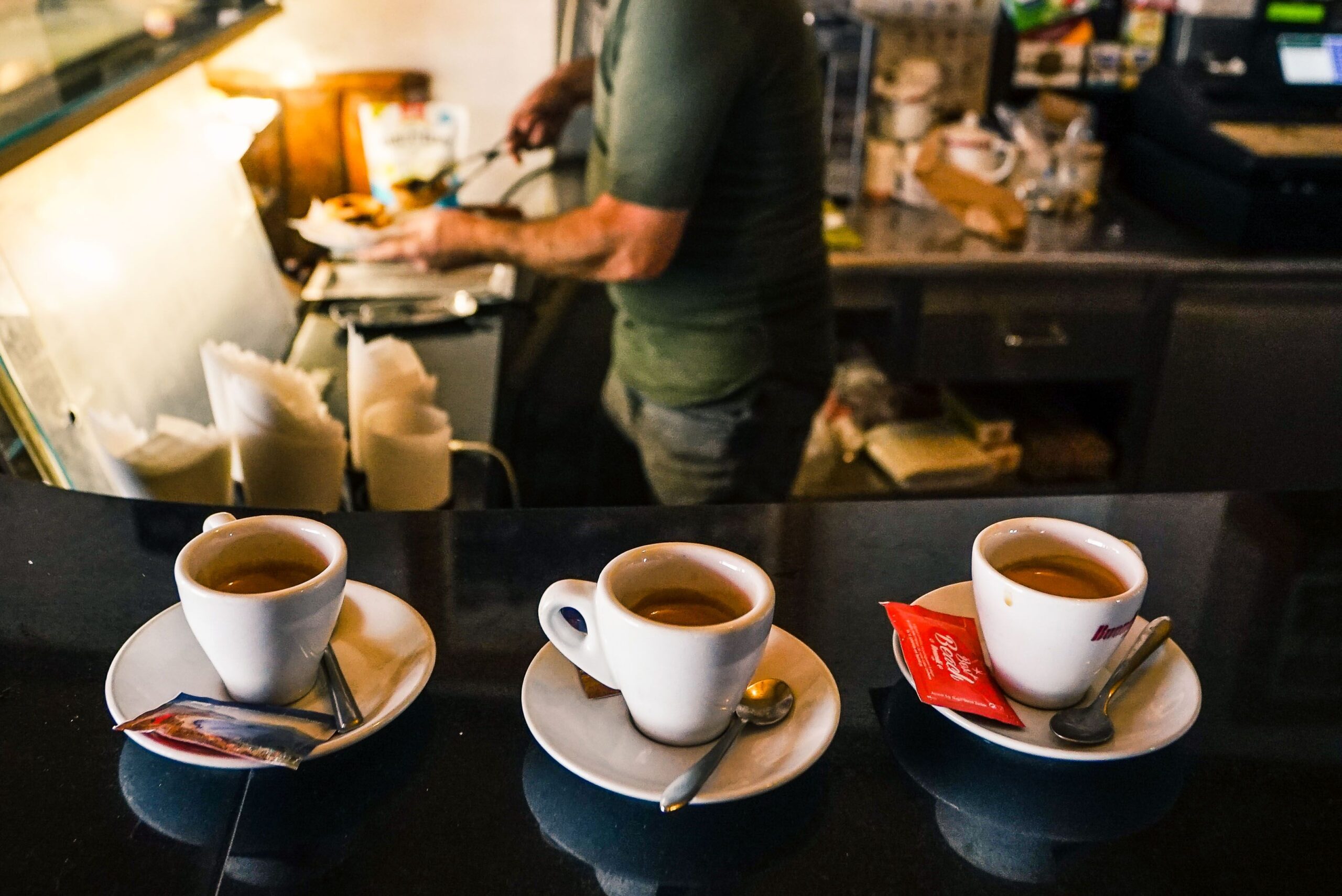
Here is what he did, that first morning and every morning after for almost two years. He took the second cup and he fixed it. A little cream from the steel pitcher. Two sugars, stirred slow. He set the spoon down on the saucer. And then he slid that cup across the table to the empty seat across from him, turned the handle to face that side, and he settled the cup just so, like he was setting it down in front of a person.
And then he talked to her.
I caught pieces of it over the weeks, the way you do when you are refilling cups and clearing plates. He talked about ordinary things. He told her it looked like rain. He told her his hip had been giving him trouble on the stairs. He told her that the Hendersons two doors down had finally painted their shutters and it looked terrible. Once I heard him laugh quietly at something, at nothing, at an answer only he could hear, and he said, “I know. I told you it would.”
He never drank the second coffee. Not once. He would sit for forty five minutes, maybe an hour, talking and going quiet and talking again, and his own cup would empty and I would refill it, but the second cup just sat there cooling, full, untouched. And when he got up to leave he would look at it for a long moment, and then he would stand, and he would put on his coat, and he would go.
It was the old man at the counter, a retired mechanic named Sal who had been eating at the Bluebird since before I was born, who finally told me the rest.
“You know who that is,” Sal said one morning, nodding at table six.
“Earl,” I said. “That’s about all I know.”
“Earl and Helen Whitcomb.” Sal stirred his coffee and didn’t look at me, which is how men of a certain age tell you something that matters to them. “They came in here every morning for over fifty years. Same booth. That one. He always took the side facing the door. She liked the window.” He paused. “Helen passed. Couple years back now. Her heart.”
I looked over at Earl, at the empty seat by the window, at the coffee with the cream and the two sugars going cold in front of it.
“He just kept coming,” Sal said. “Every morning. Orders her coffee the way she took it. Sits with her the same as always.” He finally looked at me, and his eyes were wet, and he was a little angry about it the way old men get angry about their own softness. “Some folks think it’s sad. I think it’s the least sad thing I ever saw.”
I had to go to the walk in cooler after that. I stood in the cold with my hand over my mouth and I cried in a way I had not cried in a long time, not since I was a girl, the kind of crying that isn’t really about one thing. It was about Earl, and it was about Theo’s father walking out, and it was about my own mother, and it was about being twenty four and so tired and so sure that the kind of love that brings a man to a diner at dawn to sit with a ghost was something that happened to other people in other lives.
When I came back out, I went to table six and I refilled Earl’s cup, and without thinking about it I straightened Helen’s, turned the handle a little so it faced her seat square. Earl watched me do it. He didn’t say anything. But his eyes went soft behind those glasses and he gave me a small nod, and from that morning on, the two of us had an understanding that we never once put into words.
That cup was sacred. I made sure of it. When new girls started I told them, before anything else, you do not touch the second cup at table six until the gentleman leaves, I don’t care if it’s been there two hours, you leave it. When we got slammed on a Sunday and I couldn’t get to him right away, I’d fix Helen’s coffee myself on my way past, cream and two sugars, so it was waiting for her when Earl sat down. He never asked me to. I just did, because it had become the most important thing I did all day, and most days it was.
Over that first winter, Earl started talking to me, too.
It came slow. A comment about the weather, the way he’d talk to Helen. Then a question about Theo, whose drawings I’d taped up behind the register. Then, one quiet Tuesday when the place was empty and the rain was coming down hard outside, Earl asked me to sit for a minute, and he told me how he met her.
It was 1961. He was nineteen and just back from two years in the service with no idea what to do with himself, and he took a job at the lumberyard down the road. And every morning before his shift he started coming into the Bluebird, which was brand new then, all shining chrome, for a cup of coffee he couldn’t really afford.
He came for the coffee for about a week. After that he came for the waitress.
Her name was Helen. She was eighteen, working mornings at the Bluebird to save money for secretarial school, and Earl told me she had a laugh that you could hear from the kitchen and a way of remembering everybody’s order that made every trucker and farmhand in the place feel like the most important man alive. Earl was too shy to say more than three words to her. He told me he would practice things to say in the truck on the way over and then sit down and lose every one of them the second she filled his cup.
So he did the only thing he could think of. He left her a tip.
Not a normal tip. A nineteen year old lumberyard hand in 1961 did not have money for big tips, but Earl left her everything he could scrape together, every morning, tucked under his coffee cup where she would find it when she cleared the table. It was the only way he could think of to tell her she mattered without having to get the words out of his throat.
He did that for two months. Every morning. A tip he couldn’t afford under a cup, and a woman he couldn’t talk to clearing it away.
And then one morning, Sal told me later that the whole diner knew it was coming before Earl did, Earl left a napkin under the cup instead of money. And on the napkin, in pencil, he had written the bravest sentence of his entire life.
It said, “Have coffee with me, Helen? Sit on the other side this time.”
She came and sat down across from him. The window side. And Earl told me they talked until her manager made her get back to work, and he came back that afternoon when her shift ended, and he never really left her side again for fifty six years.
They got married in the spring of 1962. They couldn’t afford a honeymoon so they spent it driving up the coast and stopping at every diner they could find, comparing them all to the Bluebird, where nothing measured up. They raised no children, which Earl told me plainly and without flinching, just said it had not been in the cards for them and they had made their peace with it and made their family out of each other instead. He worked his way up at the lumberyard until he owned it. She got her secretarial certificate and then mostly ran the office for him. And every single morning of all those years, rain or snow or sickness, they ate breakfast together at table six at the Bluebird Diner, him on the door side, her by the window.
“Fifty six years,” Earl said to me that rainy Tuesday. “And I never once got tired of looking at her across that table.” He turned his cup in its saucer. “When she got sick at the end, she couldn’t come anymore. So I’d bring it home to her. Two coffees, in a cardboard tray, and we’d sit at the kitchen table and I’d tell her who was in here that morning.” He smiled. “She always wanted to know who was in here.”
Helen died on a Wednesday in the early morning, in their bed, with Earl holding her hand. The next morning, the Thursday, Earl got up before dawn out of fifty six years of habit, and he pressed his shirt, and he put on his tie, and he didn’t know what else to do with himself so he drove to the Bluebird and he sat down at table six, and when the waitress came he said, out of a grief so total it had nowhere else to go, “Two, please.”
“I couldn’t stand the thought of her sitting alone over here,” he told me. “Even now. Especially now.” He looked at the window seat. “It’s the one hour of the day I still get to have her. I’m not ready to give up the one hour. I don’t expect I ever will be.”
That was when I understood the two dollars.
Because there was one thing about Earl I could never figure out, the thing I told you about. Every morning when he got up to leave, he tucked two dollars under Helen’s cup. The full one. The untouched one. Not under his cup, where a tip would go. Hers.
I asked Sal about it, because by then I couldn’t ask Earl without crying, and Sal told me, and I had to grab the counter.
It was the tip. The same tip Earl had left a beautiful young waitress under a coffee cup every morning in 1961 when he was too shy to speak to her. He had never stopped. All those fifty six years of marriage, on the mornings Helen wasn’t working, he still left it, a private joke between them, a man courting his own wife under a coffee cup for half a century. And now that she was gone, he left it for her still. Two dollars every morning under a cup she would never drink from again, because in his mind he was still that nineteen year old boy trying to tell her she mattered, and he had decided that being widowed was not going to stop him from courting his girl.
I don’t have the words for what that did to me. I am not sure there are words for it.
Earl started leaving the two dollars under my real tips, too, when he caught on to my situation. He never made it a thing. He’d just say, “Buy that boy of yours something,” and there would be more under his cup than the coffee could ever cost. He asked about Theo by name. He remembered I was behind on things without me ever telling him I was. One December morning he pressed a folded twenty into my hand and said, “Helen would want Theo to have a good Christmas. I’m just the delivery man.” I tried to give it back and he closed my fingers over it with both of his old hands and he wouldn’t hear another word about it.
I told myself we had years. That is the thing about a ritual. It makes you believe in tomorrow because tomorrow has always come before.
Last Tuesday it didn’t.
I came in at five thirty and set up my section and at six fifteen I looked up at the door the way I had looked up at it every morning for almost two years.
Earl didn’t come.
I told myself he had a doctor’s appointment. I told myself his car wouldn’t start. I fixed Helen’s coffee anyway, cream and two sugars, and I set it at the window seat of table six and I left the booth empty and waiting, and every time the door opened my heart jumped and it was never him.
By nine o’clock I knew. I think I had known at six sixteen, honestly. You feel a thing like that.
Around ten, a young man I’d never seen came in and asked for the manager, and they talked low by the register, and I watched the manager put her hand over her mouth, and the young man, who turned out to be Earl’s great nephew and the only family he had left, walked over to me, because Earl had apparently described me to him well enough that he knew me on sight.
He told me Earl had passed in his sleep on Monday night. Peacefully. The way Helen had. He told me Earl was eighty seven. And he told me that Earl had left instructions, very specific ones, written out by hand, and that one of them was about table six, and about me.
Then he handed me an envelope and he said Earl had wanted me to have it, and that he was supposed to make sure I opened it at the booth.
So I went to table six. Helen’s coffee was still sitting there where I’d left it that morning, going cold, cream and two sugars, untouched. And I lifted that second cup to set the envelope down, and there, underneath the cup, just like every morning for two years, were two folded dollar bills.
He had been in on Monday. His last morning. And he had left her tip under her cup one final time, not knowing it was the last, or maybe knowing, I will never be sure.
That is what put me on my knees on the diner floor. Two dollars under a cold cup of coffee. A man courting his wife one last time on his way out the door of his own life.
I opened the envelope at the booth, the way he wanted.
There was a letter, in the same careful pencil I imagined had written that napkin in 1961. And folded inside the letter, soft and yellowed and worn thin as tissue from being carried for sixty years, was a napkin. The napkin. “Have coffee with me, Helen? Sit on the other side this time.” He had kept it his whole life.
The letter is mine and I’m going to keep most of it to myself. But I’ll tell you the part I think Earl would want you to hear.
He wrote that he and Helen had never had a daughter, and that for two years I had felt like the closest thing to one that he was ever going to get, and that fixing Helen’s coffee the way I did, and guarding that cup the way I did, had given an old man a reason to keep getting up in the morning longer than he probably had any business doing. He wrote that he had watched me run myself into the ground for that little boy, and that he had a little money saved that was no use to a dead man, and that he and Helen had decided, he wrote it like that, decided, present tense, like she was still at the table, that it should go to me and to Theo.
There was a cashier’s check folded behind the napkin. I’m not going to tell you the number. I’ll tell you that it was enough to open every one of those envelopes on my counter and pay them and breathe for the first time in years. I’ll tell you that there is money set aside now for Theo to go to school. I’ll tell you that I sat in that booth and cried until the manager sent everybody else home.
The last line of the letter said this. “Don’t wait as long as I almost did, Nora. Find someone to have coffee with. And when you do, sit on the same side once in a while. The other side gets empty faster than you think.”
I still work at the Bluebird. I probably always will now. And table six stays the way it was. Every morning I fix a coffee, cream and two sugars, and I set it at the window seat, and I leave it there through the breakfast rush, and I don’t let anybody touch it.
People ask me who it’s for. New customers, mostly. I tell them it’s reserved.
It is. It’s reserved for a woman named Helen, and for the man who loved her so much that fifty six years of marriage and two years of widowhood and the whole entire fact of death itself were not enough to make him miss a single morning with her. It’s reserved to remind me, on the hard days, and there are still plenty, that the kind of love I was so sure I’d never find walked into my section in a pressed shirt and a good tie and left two dollars under a cup for me to find.
So if you’ve got someone, anyone, that you love like that, go have coffee with them this morning. Sit on the same side. Let them fix it the way you like it.
And if you’re still waiting on a love like Earl and Helen’s, the way I was, the way maybe you are, then take it from a tired waitress on Route 9 who has now seen it up close with her own two eyes.
It’s real. It exists. And it is worth every single morning of your life.

Lila Hart is a dedicated Digital Archivist and Research Specialist with a keen eye for preserving and curating meaningful content. At TheArchivists, she specializes in organizing and managing digital archives, ensuring that valuable stories and historical moments are accessible for generations to come.
Lila earned her degree in History and Archival Studies from the University of Edinburgh, where she cultivated her passion for documenting the past and preserving cultural heritage. Her expertise lies in combining traditional archival techniques with modern digital tools, allowing her to create comprehensive and engaging collections that resonate with audiences worldwide.
At TheArchivists, Lila is known for her meticulous attention to detail and her ability to uncover hidden gems within extensive archives. Her work is praised for its depth, authenticity, and contribution to the preservation of knowledge in the digital age.
Driven by a commitment to preserving stories that matter, Lila is passionate about exploring the intersection of history and technology. Her goal is to ensure that every piece of content she handles reflects the richness of human experiences and remains a source of inspiration for years to come.