On Mother’s Day morning, Helen Whitaker stood in her kitchen in Arlington, Virginia, watching the sunlight move across the marble counters she had paid for herself, inside the house she had nearly lost twice while raising three children on her own.
The coffee was still brewing. The birds were loud outside the window above the sink, the kind of cheerful that feels almost offensive when you are waiting for something you cannot name. She had been awake since five, which was not unusual. What was unusual was that she had not been awake worrying. She had been awake thinking, and the distinction felt important.
Her phone buzzed against the counter.
A group text from her oldest son, Brian.
Mom, we picked the restaurant. Sterling and Vine at 1:00. You’re covering all twelve of us, like always.
She read it twice. Then her daughter Madison added: Don’t be late. They charge if the whole party isn’t seated. And finally her youngest, Kevin, completed the trifecta with a laughing emoji and two words: Happy Mother’s Day.
Helen poured her coffee and held the mug with both hands and looked at the three messages for a long moment.
Twelve people. Her three adult children, their spouses, and six grandchildren, the oldest of whom was fourteen and the youngest of whom had recently learned to walk. Sterling and Vine was not a brunch spot. It was the kind of restaurant where a glass of orange juice cost fourteen dollars and the waitstaff described the butter with the reverence of a museum guide explaining a painting. Helen had eaten there once, years ago, when a colleague retired and the office had agreed to split the bill properly. She had thought it was lovely and also slightly absurd.
She thought about the fifteen years of holiday dinners she had paid for. The birthday meals. The family brunches that started as casual suggestions and somehow always evolved into three-hour affairs with multiple appetizers and dessert menus that nobody truly needed but everyone ordered from. She had paid for Madison’s divorce attorney when that marriage had finally come apart. She had covered Kevin’s car repair twice, then a third time without mentioning the other two. She had given Brian a loan for a business idea that had dissolved within a year, and the money had dissolved with it, and neither of them had said anything about it since.
She thought about every Mother’s Day that had followed the same architecture for fifteen years running. They chose the restaurant. They ordered what they wanted. They texted her the address as though she were the caterer. She sat at the head of the table and watched six grandchildren make a mess of the tablecloths and three grown adults treat the menu like a form of entertainment, and she paid the bill with a smile that had grown so practiced over the years she sometimes forgot to remove it on the drive home.
Once, two years ago, she had suggested they all chip in. The idea had landed with the same mild awkwardness as suggesting a beloved family tradition was actually optional. Brian had said of course, Mom, and then allowed the end of the meal to arrive without mentioning it again, and Helen had paid and said nothing because saying something would have meant having a conversation she was not yet ready for.
She was ready now.
Helen’s suitcase was already standing near the front door.
She had packed it the night before while listening to a playlist she had made specifically for the trip, all the music she loved that nobody else in her family had ever asked about. Navy blue suitcase, small enough for the overhead bin. Inside: linen dresses, walking shoes, the kind of comfortable underwear that requires no performance, a new journal with cream-colored pages, and a ticket confirmation for a flight from Dulles International to Rome, departing at 2:40 in the afternoon.
She set down her coffee and typed her reply.
Then enjoy it, because I’m spending today on a flight to Italy.
She sent it before she could think about it too carefully, which was, she had learned in sixty-two years, often the best way to do the right thing.
For thirty seconds, nobody responded. She could imagine them reading it, laughing at it, exchanging looks across the restaurant table they had not yet reached.
Then Brian: Very funny.
Then Madison: Mom, don’t start drama today.
Then Kevin: You’re not going to Italy. You don’t even like long flights.
Helen smiled at her phone with the faint, private pleasure of someone who has already made up her mind. She had not liked long flights in the way she had not liked many things that turned out to be about exhaustion rather than preference. She thought she might like this one considerably better. She slipped her passport into her purse, checked that the stove was off, and ordered a car to the airport.
At 12:54 in the afternoon, while her children settled into chairs beneath the vaulted skylight at Sterling and Vine, ordering mimosas and debating the merits of the seafood tower, Helen was moving through security at Dulles with her boarding pass on her phone and her carry-on rolling smoothly behind her.
Brian called at 1:37. She watched her phone ring and did not answer.
Madison called twice at 1:52. Helen declined both, not with hostility, simply with purpose.
At 2:11, Kevin sent a photograph. The restaurant table was a portrait of excess: lobster Benedict glistening under warm light, a steak occupying its own dedicated plate, champagne sweating in narrow flutes, a stack of pancakes with maple syrup pooling at the base, and three untouched side salads that nobody had actually wanted but someone had ordered to feel virtuous. Okay, joke’s over. Where are you?
Helen looked at the photograph for a long moment. Then she typed: Gate C18. Boarding now.
She did not add anything else.
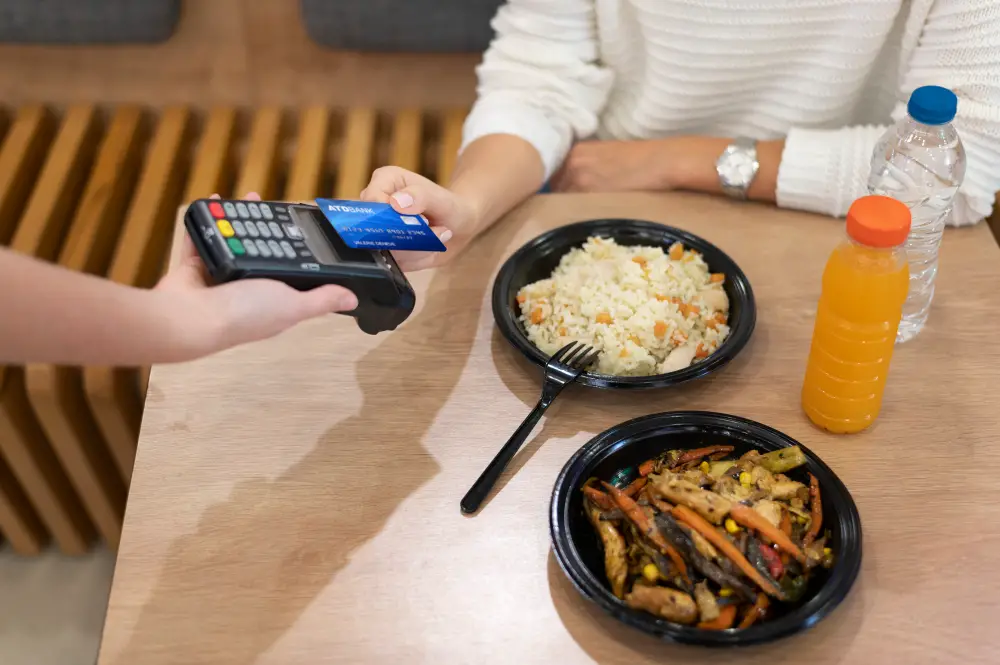
At 2:26, while Helen found her seat beside the window in row four and arranged her things with the careful deliberateness of someone settling in for something long-awaited, the waiter at Sterling and Vine set a black leather folder on the table beside Brian’s elbow with a quiet, professional smile.
Brian Whitaker opened it first because he had a lifelong habit of reaching for things he assumed someone else would ultimately handle. He looked down with the casual ease of a man checking a receipt he did not intend to pay, and then every muscle in his face went still.
His wife Lauren leaned over. “How much?”
Brian closed the folder too quickly.
“It’s wrong,” he said.
Madison reached across the table and pulled the folder from his hands. Her bracelets knocked against her champagne glass. She opened it, saw the total, and her mouth came open but produced no sound for several seconds.
Kevin was still working through a piece of maple-glazed bacon. “Come on, it can’t be that bad.”
Madison turned the folder toward him.
Kevin stopped chewing.
The restaurant continued around them in its polished, indifferent way. Forks rang softly against china. A violin arrangement of something unidentifiable drifted from hidden speakers near the ceiling. The grandchildren were restless and sticky-fingered and beginning to ask about dessert. The waiter, whose name was Tomas and whose patience was professional and absolute, stood nearby.
“Will there be one card,” he asked gently, “or would you prefer to split it?”
Brian cleared his throat. “Our mother is joining us.”
Tomas glanced at the empty chair that had been set for thirteen. “Of course. Would you like more time?”
“She’s on her way,” Madison said, in the sharp, bright tone of someone buying themselves thirty seconds to think.
Kevin looked at his phone. Nothing from Helen since the gate message. He tried calling. Voicemail. Madison tried. Voicemail. Kevin sent three question marks into the void and received no reply.
Lauren folded her arms slowly. “Brian. Did your mother actually go to Italy?”
Brian said she wouldn’t, but there was nothing behind it.
Madison’s husband Eric said quietly that perhaps someone should have confirmed the plan before ordering two seafood towers, and Madison told him not to start. Kevin’s wife Amber pushed her mimosa glass to the edge of the table and said this was embarrassing, and she was right, though not for the reason she meant.
Brian’s oldest daughter Chloe, fourteen years old and therefore in possession of information adults always underestimated, looked up from her phone. “Grandma posted on Instagram.”
Every adult head turned.
Chloe held up the screen. There was Helen, standing beside an airport window in a cream scarf and sunglasses, smiling in a way none of her children could quite place. Behind her, a plane waited on the tarmac beneath a sky so blue it looked deliberate. The caption read: First Mother’s Day gift to myself. Rome tonight.
The table was quiet.
Tomas returned. “Are we ready?”
They split the bill four ways. Not evenly, not gracefully, and not without a debate about who had ordered the tomahawk steak and whether the brunch special notation had been clear enough. Brian paid the largest portion and immediately sent a message to Helen informing her that what she had done was cruel. Madison wrote that she had humiliated the family in public. Kevin wrote that he hoped Italy was worth it, which was the only message that contained even a trace of genuine feeling beneath the complaint.
By then, Helen’s phone was on airplane mode.
Somewhere high above the Atlantic, she opened a small bottle of sparkling water and looked out at the darkening shapes of clouds below her. She had expected to feel guilty. She had made room for it, the way you make room for bad weather you believe is coming. But the guilt did not arrive. What arrived instead was something she recognized only slowly, because she had not felt it in so long it had lost its familiar shape.
Relief.
Plain and enormous and hers.
She pressed her forehead lightly against the cool window and watched the last lights of the eastern seaboard fade below the clouds. She had spent thirty years arranging her life around the needs of other people, first Daniel’s career, which she had supported without question, then the children’s childhoods, which had required everything, then the children’s adulthoods, which had somehow required nearly as much. She did not regret any of it in the clean, simple way that regret usually works. It was more complicated than that. She had wanted to give. She had given gladly, for a long time. The problem was not the giving. The problem was the way it had eventually stopped feeling like a choice.
She had been fifty-three when she realized her children had stopped asking how she was doing and started skipping directly to what they needed. She had been fifty-seven when Kevin borrowed money for the second time and she had given it without saying what she felt, which was a complicated sadness she had not found words for. She had been sixty when Madison had called from the parking lot of a grocery store to tell Helen that her ex-husband was being unreasonable about the holidays again, and Helen had said all the right things, and afterward had sat in her own kitchen in the dark for twenty minutes before she remembered to turn on a light.
She had told herself this was what mothers did. She had believed it for a long time because believing it made the cost feel purposeful.
Helen landed in Rome just after sunrise and stood near baggage claim with the warm handle of her suitcase in her hand and felt, briefly, the specific fear of being sixty-two and alone in a place where she did not know the streets. Daniel had promised her Italy when the children were grown. He had died at forty-eight from a heart attack while replacing a broken fence panel in their backyard, on an ordinary Tuesday in October, and after that, when the children are grown had become a phrase she flinched at, because the children had grown and the needs had only expanded, and the trip had remained on the list of things that were for later.
She gave the driver the name of her hotel near Piazza Navona and watched Rome materialize beyond the taxi window. Ancient stone walls catching the early light. Scooters threading through traffic with casual expertise. Narrow streets where the buildings leaned close enough to whisper to each other. Cafes unlocking their doors, chairs being dragged out to face the morning. She had forty-three unread messages. She put the phone in her bag and watched Rome instead.
Her room was not ready when she arrived, so she left her suitcase at the desk and went walking.
She bought a cappuccino and a pastry whose name she could not pronounce, from a counter where the man behind it handed it to her with the brisk efficiency of someone who had made this exact pastry ten thousand times and was proud of every one. She sat at a small outdoor table and ate without cutting anyone else’s food, without glancing sideways to see if anyone needed more water, without already calculating how much longer until she should signal for the check.
No one needed anything from her.
The feeling was so unfamiliar that it took her the length of the pastry and half the coffee to simply accept it.
At noon she opened the family group thread. Brian had written six messages, each one escalating in temperature. You made us look like idiots. Do you know how expensive that place was. You could have warned us. Madison’s messages were longer and more literary in their grievance: I cannot believe you chose Mother’s Day to prove whatever point you’re trying to prove. The kids were confused. Everyone was uncomfortable. You ruined the day. Kevin’s were shorter and aimed differently: Seriously, Mom. This isn’t you.
Helen sat on a stone bench near a fountain whose sound was old and steady and completely indifferent to family dynamics, and read every message twice.
Then she typed: You’re right. This isn’t the old me.
She turned off notifications and sat in the sun.
Back in Virginia, Lauren was standing in the doorway of Brian’s office with a laundry basket balanced on one hip when Helen’s reply came through. Brian read it and stiffened, and Lauren watched him do it, and said, “Maybe leave her alone.”
Brian said she had pulled a stunt. Lauren said no, she had stopped letting him pull one. The silence that followed lasted longer than Brian was comfortable with, which was how Lauren knew it had landed.
She had not spoken at the restaurant. She had sat through the bill argument and watched her husband call his mother inconsiderate while the evidence of their orders was still on the table in front of them: two seafood towers, a tomahawk steak, champagne for seven adults, pancakes for six children. She had watched her children absorb every bit of the performance. Brian looked back at his phone. Lauren picked up her laundry and went back down the hall.
Across town, Madison was retelling the brunch scene to her friend Nora on speakerphone, pacing through her kitchen in bare feet, and Nora listened until Madison reached the end and then was quiet for a beat too long.
What? Madison asked.
Nora said, gently: Maddie, you picked an expensive restaurant and told your mother she was paying.
It was Mother’s Day, Madison said.
Exactly, Nora said.
Madison stopped pacing. Her friend continued, carefully, that Madison had complained for years about her mother inserting herself through money, and maybe Helen had finally stopped. Madison said that wasn’t fair. Nora said maybe not, and also asked whether it was wrong. Madison hung up angry enough to cry and too proud to understand why.
Kevin went quiet. That was his way. He sat in his garage that evening with a beer on the workbench beside him and looked at the motorcycle he had been slowly reassembling for three years, half the parts paid for by his mother, none of the debt repaid. Amber stood in the doorway and told him he should apologize, and he gave a short laugh and asked whether she meant for brunch, and she said no. She meant for the last ten years. He looked at her for a long moment, and she looked back steadily, and he did not argue.
On her second morning in Rome, Helen walked to the Pantheon.
She stood beneath the dome and let her eyes travel up to the oculus, where a perfect column of sunlight pressed through the opening like something deliberate and ancient. She thought about the twenty-two-year-old version of herself who had wanted to study art history, who had loved buildings and handwritten letters and long walks through cities she had never been to. She thought about the thirty-five-year-old who packed lunches before dawn and drove carpool and signed permission slips and never mentioned the art history anymore. The forty-eight-year-old widow signing insurance papers with fingers that had gone temporarily numb. The fifty-five-year-old grandmother crossing town in a snowstorm with groceries because Brian had forgotten to shop.
All of those women had been real. All of them had been her. But none of them had to be the whole story.
That afternoon she joined a walking tour. The guide was a silver-haired Roman woman named Lucia who spoke English with warmth and authority. There were seven people in the group: two retired teachers from Oregon, a couple from Toronto, a nurse from Chicago, and a widower from Boston named Arthur Bell, who was sixty-six and carried a folded paper map even though his phone had navigation. During the tour he noticed Helen standing in front of a carved doorway longer than the others, her head tipped back to follow the stonework up toward the roofline.
First time in Rome? he asked.
First time anywhere just for myself, she said.
He smiled and said that was a very good reason to look slowly. They had coffee with the group afterward and separated with ordinary goodbyes. No sweeping revelation, no unlikely romance beginning. Just a pleasant exchange with a stranger who asked what she was interested in and then listened to the whole answer without redirecting the conversation toward himself. That, she thought, walking back toward her hotel in the late afternoon, was rarer than it ought to be.
By the third day, the messages had changed.
Brian wrote first, and she could tell he had started and deleted it several times before landing on the version he sent. Lauren had said some things he needed to hear. He was sorry for assuming she would pay. He was sorry for treating her generosity like infrastructure.
Madison’s message came that evening, longer and more complicated, which was true to form. She admitted that she had spent years being angry at Helen in ways she had never named directly: angry that her mother still had resources after the divorce while Madison had needed help, angry that needing help had made her feel small, angry that feeling small had somehow become her mother’s fault. She knew that was not fair, she wrote. She wanted to do better.
Kevin’s came last and was the shortest. He owed her more than an apology, he wrote. Literally and otherwise. He was making a list of what he had borrowed. He could not pay it all back at once, but he was going to start.
Helen sat on the edge of her hotel bed and read all three messages in the warm yellow light of the bedside lamp. The old instinct moved in her chest like a reflex: forgive immediately, smooth the surface, tell them it was fine and she understood and they should not worry. The instinct was strong. It had decades of practice behind it.
She did not follow it.
She wrote to all three together. She thanked them for apologizing and told them she loved them, both of those things true and without reservation. Then she said clearly that things were changing. She would not be paying for family meals unless she offered. She would not be giving loans. She would not be treating other adults’ poor planning as her emergency. She was their mother, and she was not their bank, and she needed them to understand the difference.
She paused, then added that when she came home they could have dinner at her house. Potluck. Everyone brings something.
Brian replied: Okay. A single word, but she could feel the work behind it.
Madison sent a thumbs-up and then, a minute later: I’ll bring salad.
Kevin wrote: I’ll bring dessert. And a check.
Helen laughed out loud at that, sharply enough that she startled the woman in the adjacent room into knocking softly on the wall. She pressed her hand over her mouth, still smiling.
She visited the Vatican Museums and stood inside the Sistine Chapel and cried quietly, not from sadness, but from the particular way that beauty sometimes finds the bruises people have forgotten they carry. She had not expected to cry. She had expected to crane her neck and think about the logistics of painting a ceiling and take a photograph that would not do justice to any of it. Instead she stood in the center of the room with strangers pressing gently around her and felt something release in her chest that she had not even known was held.
She took a day train to Florence and bought a leather journal from a shop whose owner stamped her initials inside the cover with a small brass tool, looking pleased with his work in the unselfconscious way of someone who takes genuine pride in small, precise things. She walked through the Uffizi until her feet ached, eating a sandwich on a bench in a courtyard between galleries, and nobody needed to know where she was or when she would be back.
She ate pasta with clams beside a window during a late-evening thunderstorm, watching rain flatten the puddles in the narrow street outside and the occasional scooter navigate through with cheerful recklessness. She ordered dessert because she wanted it and not because anyone else was ordering. She got lost twice on her way back to the hotel and found streets better than the ones she had been looking for.
On her last night she ate alone at a small restaurant near the river. The waiter asked if she was waiting for someone, and she said no, just me, and he gave her the table by the window without making her feel that this required justification.
She watched the river and drank her wine and thought, with no drama and considerable peace, about the life she intended to live from here.
When she returned to Virginia she took a cab from the airport. She had not asked anyone to come. She unlocked the front door and stood in her own quiet hallway for a moment, listening to the particular silence of a house that has been empty and is being returned to.
Three envelopes waited on the kitchen counter.
Brian’s held a printed repayment plan for the old business loan, signed at the bottom, organized into monthly amounts that were modest but consistent. Not everything she had given him, and not fast, but written down and signed, which meant he had taken it seriously enough to sit down with a calendar and a calculator.
Madison’s held three handwritten pages. The handwriting was messier than usual, which meant she had not rewritten it. She had been angry at Helen for having stability after the divorce, she wrote, angry that needing help had become a habit she could not seem to break, angry that none of it was truly Helen’s fault and she had aimed it at her anyway. None of that excused what she had done. She wanted to be better. She was asking, without drama, for the chance to try.
Kevin’s envelope held a check for five hundred dollars and a sticky note in his handwriting: First payment. Also fixed the loose porch railing. No charge.
Helen walked outside. She took hold of the railing at the top of the porch steps and it held steady under her hand. She stood there for a moment in the evening air, holding on to something that had been repaired.
The following Sunday, all of them came.
Brian brought roasted chicken in a covered dish. Lauren brought potatoes. Madison arrived with salad and two bottles of lemonade and a slightly too-bright expression that meant she was nervous and trying not to show it. Eric carried folding chairs out of the garage without being asked. Kevin brought a chocolate cake and a second check in a plain envelope, which he set beside his mother’s wine glass without ceremony.
The grandchildren ran through the backyard while the adults arranged the table and moved around each other in the cautious way of people who are renegotiating the terms of something familiar.
There was awkwardness. There was always going to be awkwardness. A family does not change shape without the joints creaking.
Brian apologized in person, standing in the kitchen while Helen was opening lemonade. He was stiff about it, which meant it was real. Madison cried before dessert and held her mother so tightly that Helen said, gently, that she still needed air to breathe. Kevin said less than either of them but washed every dish after the meal without being asked, which said more than he probably intended.
When the evening was ending and the grandchildren were being collected from the yard and the folding chairs were going back in the garage, Brian stacked the paper plates and said: Same time next month? We could rotate houses.
Helen looked at her three children in her kitchen with the remnants of a meal that had not been paid for by her, and understood the difference between the need that had moved through her family for years and the love that was trying, imperfectly and with real effort, to replace it. Need grabbed. Love made room.
We can, she said. And everyone pays their own way through life.
Kevin lifted both hands in agreement. Madison smiled, sheepish and genuine. Brian nodded slowly, like a man accepting the terms of something he had taken too long to read.
Helen walked them to their cars one by one. She hugged the grandchildren. She watched the taillights disappear down the street. She went back inside and poured herself a glass of wine and carried it to the table where the leather journal from Florence was waiting.
She opened it to the first page.
She wrote: Mother’s Day was the day I finally gave my children something useful: the bill.
Then she sat by the window in the quiet house and began making notes for the next trip.

Specialty: Emotional Turning Points
Rachel Monroe writes character-driven stories about betrayal, second chances, and unexpected resilience. Her work highlights the emotional side of family conflict — the silences, the misunderstandings, and the moments when someone quietly decides they’ve had enough.