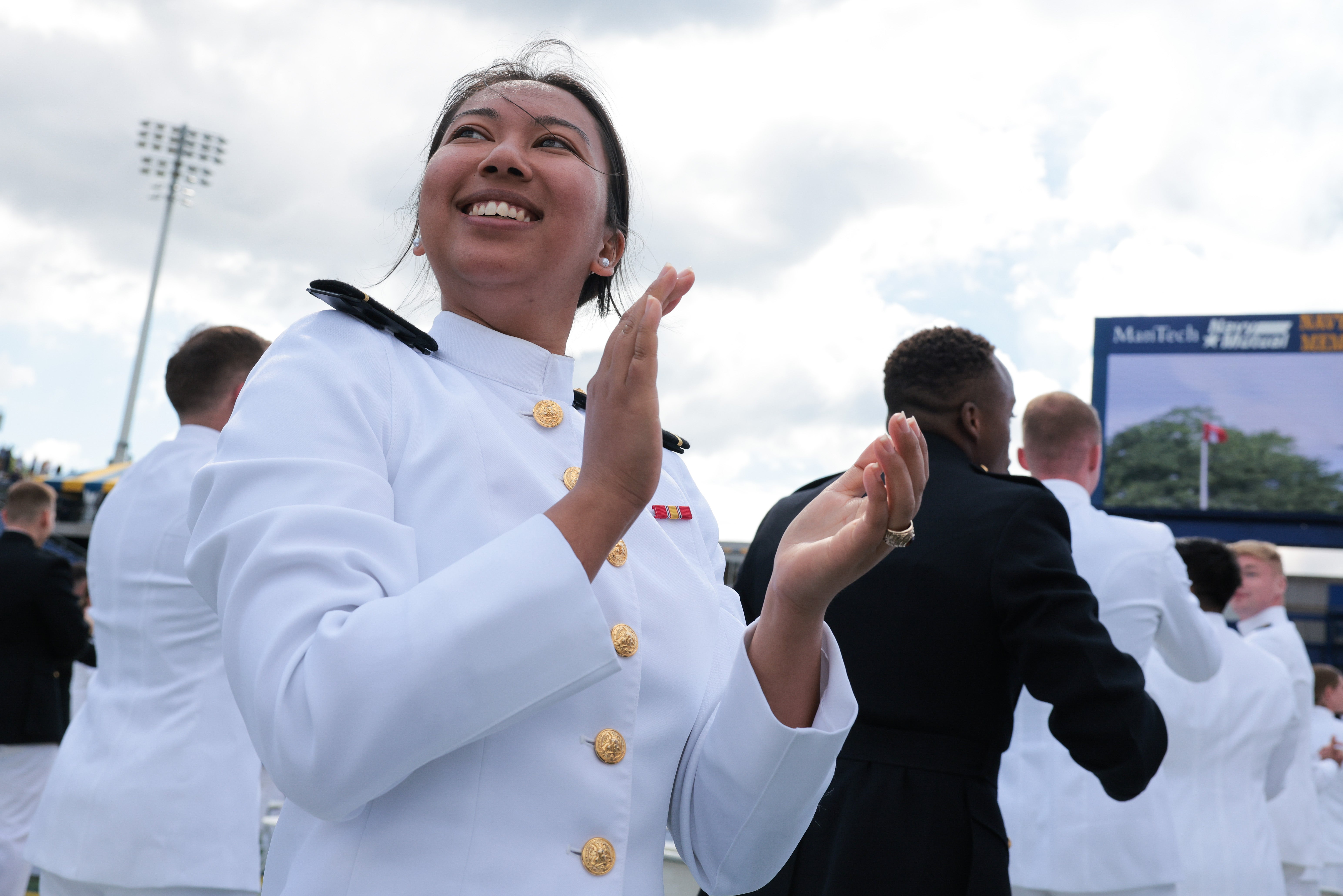
My parents cut my wedding dress in half the night before my ceremony, so I walked into a small-town American church in full Navy whites, two gold stripes on my shoulder boards, and watched my father’s face drain of color in front of everyone who had ever called me the quiet daughter who left for the military.
Until that week, I had still been foolish enough to believe weddings could sand down old family edges. Not heal them exactly, but soften them for a day.
I pictured church bells, warm July air, folding chairs set on grass behind the fellowship hall, sheet cake disappearing too quickly, older relatives retelling the same stories with cleaner endings than real life ever gives. I thought maybe my wedding would be the first time my parents looked at me and saw the woman I had become instead of the girl they had spent years trying to keep manageable.
I grew up in a town small enough that people remembered what you were at sixteen and often refused to update the file. My brother, Mark, was loud, charming, and celebrated for things that happened under stadium lights. I was quieter. I did my homework, kept my room neat, spoke when I had something worth saying, and learned early that in my father’s house, a quiet daughter was convenient only when she stayed invisible.
The moment she developed a will of her own, quiet became cold, proud, difficult, too good for us.
When I joined the Navy, my father told people I was going through a phase. When I made officer, he called it paperwork. When I deployed, he told neighbors I was basically doing office work somewhere near the coast. My mother followed his lead the way she always did, not because she didn’t know better, but because peace in our house had always been purchased with silence.
I stopped trying to explain my life to them after a while. I still called. I still sent invitations, photos, updates, Christmas cards from whatever duty station owned me that year. They rarely asked questions, and when they did, it was usually just enough to remind me I had left and would be punished for it forever.
Then I met David.
David never once asked me to shrink. We met at a charity event on base through mutual friends, and by the end of the night he had made me laugh hard enough to forget I was still wearing shoes that hurt. He was steady in the ways that matter. He listened all the way through an answer. He didn’t flinch from complicated things.
His parents were the kind of people who looked directly at you when you spoke. His mother hugged without making it conditional. His father, a retired Air Force officer, carried himself with the calm of someone who had seen enough to know ego was not the same thing as strength.
When David proposed, we agreed on a small church wedding in my hometown because his grandmother could no longer travel and because some part of me wanted to try one last time with my family. I told myself I was not hoping for a miracle. I was hoping for basic decency. Sometimes those feel dangerously close until the moment they split apart.
I flew home from Virginia two days before the ceremony. I kept my rank quiet. I wore civilian clothes. I wanted one day when no one called me Ma’am, when I wasn’t introduced by title or expected to carry the room.
In my childhood bedroom, four dresses hung in a row. They were not all contenders in the dramatic way people might imagine. One had been my grandmother’s backup suggestion. One belonged to a boutique that gave me an extra night because the owner knew my mother. One was a simple backup David liked. One was the dress I had chosen, the one I planned to wear down the aisle.
I remember standing there before bed, touching the lace at the cuff, thinking how strange it was that after everything my life had been, what scared me most in that moment was ordinary bride anxiety.
I woke sometime after two in the morning because I heard whispers. At first I thought it was the television downstairs. Then I smelled something dry and chalky, the scent of cut fabric and old closet dust.
My bedroom door was not quite latched. Moonlight crossed the floor in a pale stripe. One garment bag hung crooked. Another had been unzipped halfway.
Fear moved through me before thought did.
I went to the first dress and pulled the zipper down. The bodice had been sliced straight across. I opened the second. The skirt was ruined. The third had been hacked through the sleeves and side seams. The fourth looked as if someone had taken their time with it, cutting every place that held its shape, every place that could not be hidden with a pin or stitch.
I dropped to my knees on the carpet surrounded by ruined white fabric and felt a grief so sharp it was almost childish in its purity. Not because they were expensive. Not because the wedding had to be changed. Because someone had wanted me to wake up and feel helpless.
My father appeared in the doorway while I was still kneeling there. He did not look caught. He looked satisfied.
My mother stood behind him, hands trembling at the hem of her robe. Mark leaned in the hallway with his arms crossed, wearing the ugly little half-smile he always wore when cruelty had been dressed up as family discipline.
“You deserve it,” my father said. His voice was low enough that a stranger might have mistaken it for calm. “You think wearing a uniform makes you better than this family?”
He looked at the dresses, then at me. “The wedding is off.”
That sentence hurt more than I wanted to admit, not because he had the power to stop my wedding, but because some buried part of me was still young enough to care that he believed he did.
I had made it through deployments, casualties, long nights, and ceremonies under folded flags. I had held myself together for grieving families when every instinct begged me to look away. Yet there I was, thirty-something years old, back in my childhood room, discovering that the deepest cut I had taken in years came from a man who should have been unable to imagine doing that to me.
Around three in the morning, I stopped crying. I started packing.
Duty had taught me that when emotion becomes too large to carry, motion helps. I packed shoes, toiletries, a change of clothes, my small framed photo of David and me on our first Christmas together, and the card he had slipped into my carry-on before I flew home. It said, Whatever tomorrow looks like, I’ll be waiting.
Then I opened the back of the closet and took out the one garment bag no one in that house had touched.
My dress whites.
Every button was polished. Every ribbon had been placed exactly where it belonged. The jacket felt familiar in my hands in a way no wedding dress ever had. I traced the edges of the shoulder boards and stared at the two gold stripes there.
Those stripes had cost me years. They had cost me sleep, comfort, certainty, and whatever naive version of family I had left after my twenties. They had been earned, not gifted. No one in that house had granted them, and no one in that house could take them away.
I loaded the ruined dresses into my trunk and drove back to base before dawn. The town was still asleep. Porch lights glowed softly over quiet streets. American flags drooped from a few front porches in the humid dark.
At the gate, the young sailor on watch recognized me and straightened immediately. He asked if I was alright. I said I just needed some air, and he had the decency not to press.
Near the chapel, I found my old mentor, a Master Chief who had been carved by weather, years, and responsibility into someone who never wasted words. I told him what happened in a flat voice that did not sound like mine.
When I finished, he looked at the garment bag in my hand, then at me. “They can cut fabric,” he said. “They can’t touch who you are.”
It was exactly what I needed. Not comfort. Not outrage. Truth.
By sunrise I was standing in front of a mirror in guest quarters on base. Morning light caught the ribbons on my chest and the gold at my shoulders. For the first time since I woke up, I could breathe.
I did not look like a woman whose wedding had been ruined. I looked like a woman who was done negotiating with disrespect.
When I drove into the church parking lot later that morning, conversations stopped mid-sentence.
David’s mother crossed the pavement toward me before I had even turned off the engine. One look at my face, one look at the uniform, and she wrapped me in her arms. “Oh, sweetheart,” she whispered. “What did they do to you?”
I didn’t answer right away because I was afraid my voice would break.
David reached us seconds later. He looked at me from my shoes to my collar and then up to my face. There was no confusion in him. No embarrassment. No attempt to manage me into something more digestible.
“You look like yourself,” he said quietly. “I’m proud of you.”
Inside the chapel, my parents turned and saw me properly for what felt like the first time in their lives. Mark’s mouth actually fell open before he recovered. Two older veterans near the middle pews sat up straighter. My aunt leaned toward my cousin and whispered, far too audibly, that I was an officer.
David’s father did not say a word. He just watched, and I had the strange feeling he understood exactly how much had happened before I ever stepped through that door.
I walked down the aisle alone. No bouquet. No veil. No lace. Just white gloves in one hand and the sound of my own shoes against old wood.
When I reached the front, I turned toward my parents and touched one ribbon on my chest. “This,” I said, “is what you tried to cut.”
Silence hit the room so hard it almost felt physical. My mother covered her mouth. My father went pale.
The officiant, trying to keep hold of the ceremony, asked in a careful voice whether we should continue.
That was when my father shoved his chair back and stood. “I have something to say,” he said.
Before he could continue, David’s father rose from the front pew, took out his phone, and stepped into the aisle. His voice was calm, but it carried through the whole chapel. “Before you say one more word,” he said, “there is something this church needs to hear.”
My father froze.
David’s father looked at the phone, then at the room. “This voicemail came in at 12:43 this morning.” He glanced at my father once. “You left it for me.”
My father tried to recover. He straightened his tie and said this was not the time for theatrics. He said I had turned a wedding into a spectacle. He said I had always cared more about applause than family. Every word sounded rehearsed, the kind of speech a man builds when he knows truth is coming and wants to outrun it.
David’s father didn’t argue. He hit play.
There was a crackle of static. Then my father’s voice filled the church, low and furious and unmistakable.
You need to stop this wedding. Do you hear me? She thinks those stripes make her better than us. I cut the damn dresses and I’d do it again before I sit there and let her walk into church dressed like she’s above her own family. If you have any sense, you’ll call this off. She’s doing this to humiliate us.
No one moved. For a second, the only sound in the chapel was the tiny hiss of the phone speaker finishing the recording.
Then everything broke at once.
My aunt gasped. Someone in the back row said, My God. One of the veterans near the middle pews closed his eyes and shook his head slowly, like a man who had just watched a flag hit the ground. Mark stood up so fast his knee struck the pew.
My father opened his mouth, but nothing useful came out.
And then my mother did the one thing I had never once seen her do in public. She stopped protecting him.
“I told you not to cut them,” she said, her voice cracking. She was staring at my father, not at me. “I told you this would destroy her.”
The entire church turned toward her. She looked smaller than I had ever seen her.
“He said she needed to be taught a lesson before she embarrassed us in front of everyone. Mark held the bags open. I stood there and let it happen.”
Mark started protesting immediately, saying he hadn’t thought Dad would really do it, saying it was supposed to scare me, not ruin everything, as if there were a version of that night that deserved a gentler description.
My father barked at him to shut up. It was the first honest moment of the morning. They looked exactly like what they were: not protectors of family dignity, but people caught in the light.
I stepped away from the altar and faced them fully. All my life I had imagined that if there were ever a moment like this, I would either explode or collapse. Instead, I felt cold and clear.
“You didn’t ruin my wedding,” I said. “You ruined any right to stand here and act like family.”
My father tried one last time. He said I was ungrateful. He said I had always wanted strangers to admire me. He said the uniform proved his point, that I had made the whole day about rank.
I shook my head. “No. You made today about power. You cut four dresses because cloth was the only thing in that room you still thought you could control.”
No one came to his defense. Not one person.
David moved to stand beside me. Then his mother did. Then his father. The veterans in the pews remained seated, but there was something in their faces more solid than movement. Respect, yes. But also judgment.
I looked at the side door of the chapel and then back at my parents. “Leave,” I said.
My mother’s eyes filled instantly. My father stared at me as if he still expected the girl from that house to flinch. When I didn’t, something in his face seemed to cave inward. He put a hand on the pew to steady himself.
Mark muttered a curse under his breath and headed for the aisle. My mother followed, crying quietly. My father was last.
At the door, he turned like he wanted to say something final, something that would restore him. But all that came out was my name, small and useless. Then he left.
The chapel stayed silent for another few seconds after the door closed.
The officiant looked at me carefully. “Would you like a moment?”
I looked at David. He did not rush me. He did not beg me to continue. He simply held out his hand.
I took it. “No,” I said. “I’d like to get married.”
So we did.
I stood in dress whites before the altar of the church I had attended as a child, and I married the man who had never once asked me to become smaller so he could feel tall.
My voice shook during the vows, but it held. David’s broke first, which made half the room smile through their tears. His mother cried openly. His father kept his composure until the rings, then had to clear his throat and look away.
When the officiant finally pronounced us husband and wife, the sound that rose in that chapel was not polite applause. It was relief. Joy. Something earned.
Outside, the summer air felt different against my skin, like I had stepped into a life that belonged to me without negotiation. People who had barely spoken to me in years came up with stunned expressions and awkward congratulations. The two veterans from the middle pew asked if they could shake my hand. One of them did it with tears in his eyes.
My aunt hugged me and whispered that she was sorry for not knowing. I nearly told her that not knowing had been the whole design of my family, but the day was too raw for speeches.
At the reception, David danced with me in the fellowship hall while my ribbons caught the light and little girls from his side of the family stared at my uniform like I had stepped out of another world. Maybe I had. Maybe that was the point.
My mother found me outside just before sunset. She had mascara tracks on her cheeks and a small white box in her hands. Inside was a scrap of lace from the least damaged dress, folded carefully as if neatness could undo violence.
“I should have stopped him,” she said.
There are apologies that arrive like bandages, and there are apologies that arrive like labels finally placed on the wound. Hers was the second kind. It did not fix anything. But it named what had happened.
“You should have,” I said.
She nodded and cried harder. She asked whether she could call me later. I told her not that day. Maybe not for a while. She accepted that in the way people accept consequences only after all other exits have closed.
I never fully repaired things with my father. He sent one letter months later that spent three pages blaming humiliation, stress, the town, my choices, David’s family, and finally his own temper, as if the truth were a hallway he could circle forever without entering the right room. I didn’t answer.
Mark texted once to say things had gotten out of hand. I didn’t answer him either.
My mother and I eventually spoke again, slowly, awkwardly, in careful increments that felt more like learning a foreign language than returning home. She told me my father had spent years dismissing my career because every promotion of mine exposed the smallness of his own ideas. She said he could tolerate my service only when he could rename it, reduce it, or hide it. Seeing me walk into that church in uniform had shattered his last illusion that he controlled the story.
Maybe that’s why the memory that stays with me most is not the ruined dresses or even the voicemail. It is the look on his face when he realized the whole room could finally see me clearly, and that none of them were looking at him for permission.
People still ask whether it hurt to get married in uniform instead of a gown. The truth is that by the time I reached the altar, the uniform felt more honest than silk ever could have. The dresses had represented a hope that my family might meet me in tenderness. The uniform represented the life I built when they didn’t.
Sometimes I think about that scrap of lace my mother handed me outside the reception. I kept it, not because I needed a relic of what was ruined, but because it reminds me that betrayal is often most devastating not when someone strikes, but when someone else stands there and lets it happen.
And love, real love, is not proved by who claims you when you’re easy to define. It is proved by who stands beside you when the truth arrives wearing all of itself.
I got married that day. I lost people too. The strange part is that those two facts do not cancel each other out.
Some families break when they are asked to tell the truth. Some people would rather destroy a dress than admit a daughter became someone they never imagined.
I still don’t know whether that is the saddest part of the story or the clearest warning it ever gave me.

Specialty: Emotional Turning Points
Rachel Monroe writes character-driven stories about betrayal, second chances, and unexpected resilience. Her work highlights the emotional side of family conflict — the silences, the misunderstandings, and the moments when someone quietly decides they’ve had enough.