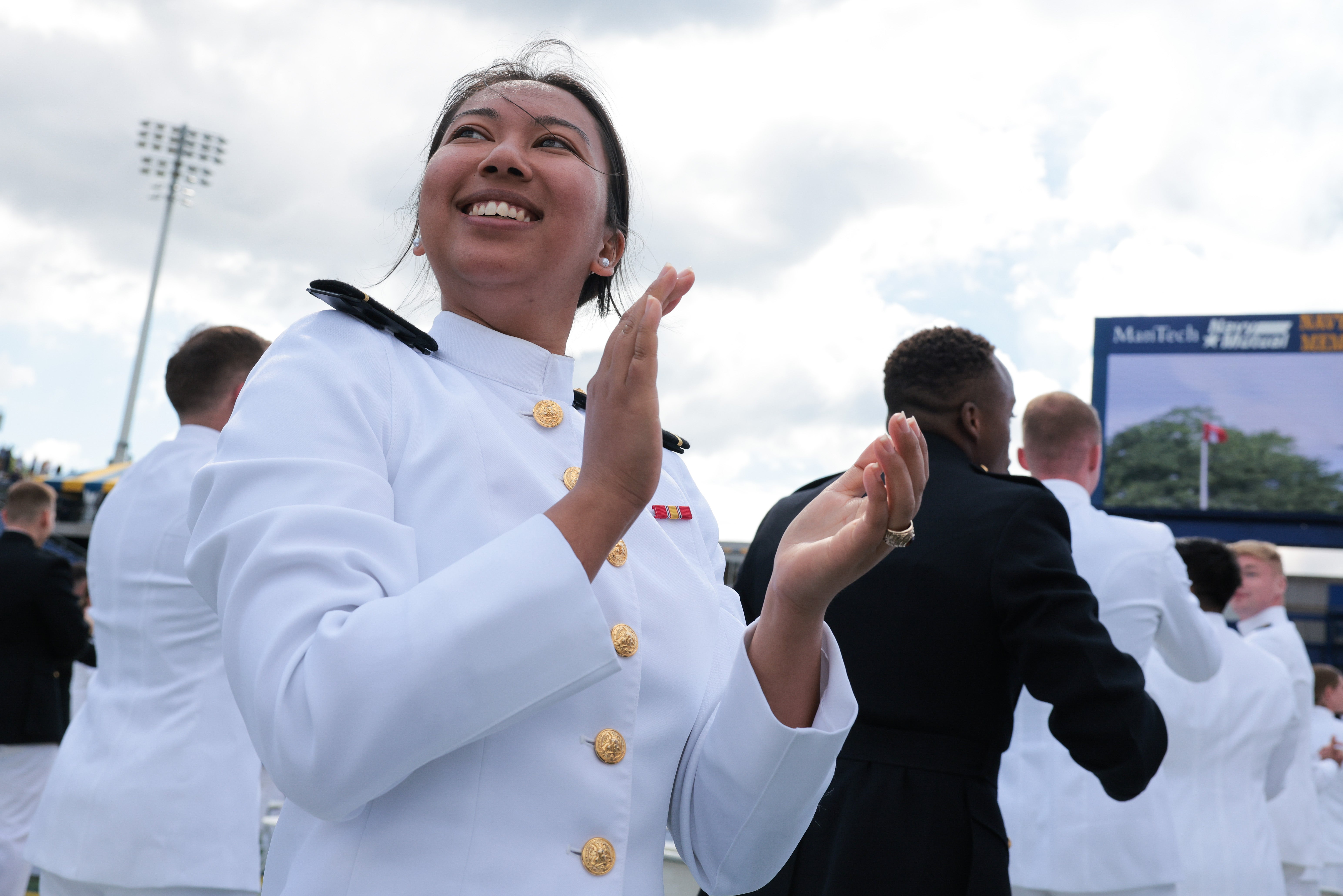
The envelope had been riding against Petra Callahan’s ribs all morning. Not in her purse. Not in a folder. Not tucked somewhere safe where she could forget it for an hour. It sat in the inside pocket of her dress jacket, stiff enough that every breath reminded her it was there.
Grandpa Harold had given it to her the last time she saw him alive. He had been lying in a hospital bed with a thin blanket over his legs, his hands spotted and narrow, his eyes still sharp enough to make nurses straighten when he spoke.
“Not until the right room,” he told her.
Petra had asked him what that meant.
He had only closed his hand around hers and said, “You’ll know it when your father starts smiling.”
That sentence had stayed with her through three months of grief, paperwork, uniforms, flight schedules, ceremony planning, and the kind of family calls that sounded polite until you hung up and realized your shoulders hurt.
Now she stood inside Naval Air Station Pensacola while the right room filled around her. It smelled like floor wax, coffee, starched fabric, and the faint metallic bite of old folding chairs. A microphone popped once near the stage. Programs rustled. Medals flashed under clean overhead lights. Outside, the Florida morning was bright enough to make the windows glow white at the edges.
Inside, Petra’s family arrived like they were attending something arranged for them.
Her mother, Linda Callahan, came through the doors with her purse tucked against her ribs and her chin lifted just slightly, the way she always did when she wanted a room to understand she belonged near the front. Her father, Ray, walked beside her with the small smile Petra knew too well. It was not happiness. It was certainty. Ray smiled that way when he believed the world was about to confirm what he already thought.
Kyle came between them, broad-shouldered in a navy blazer, tugging the sleeves straight every few steps. He was older now, but Petra could still see the boy who got the bigger bedroom, the better stories, the louder praise. Kyle had not stolen all of that. He had simply learned never to question why it arrived in his hands.
The relatives had come from Raleigh for what Linda kept calling a family reunion. Aunts, cousins, in-laws, and a few people Petra only half remembered from holiday tables filed into the ceremony hall looking pleased and confused. Most of them had no idea why a family reunion had been scheduled around a military ceremony.
Petra knew. Grandpa Harold had known too.
At 9:17 a.m., seven minutes before the ceremony began, Petra came down the side hallway and heard her mother laughing. It was a careful laugh. Light. Clean. The kind of laugh Linda used when she wanted cruelty to sound like social grace.
One of Petra’s aunts asked where Petra fit into all this.
Linda did not lower her voice. “She’s just a cook on a ship.”
The hallway changed. Not loudly. That would have been easier. It changed in the quiet public way a space changes when everyone hears something they are not supposed to admit they heard. A man in dress blues glanced toward Petra and immediately looked away. A cousin stopped whispering. Someone near the coffee urn pretended to read a program he was holding upside down.
Ray gave a little snort. “Ray always said the Navy would find somewhere to put her,” he said, speaking about himself in the way he did when he wanted the room to join him.
Kyle smiled. That smile was smaller than their father’s, but it hurt more because it came without effort.
Petra stopped with one hand over the envelope inside her jacket.
For a second, she was eighteen again. She was back at the dinner table on Birchwood Drive in Raleigh, the casserole dish sweating in front of her, the ceiling fan clicking overhead. She had just told them she had enlisted. Her mother had looked at her as if Petra had announced a bad haircut. Her father had leaned back in his chair and said, “The Navy doesn’t need little girls. Maybe you can cook on the ship.”
Kyle had laughed with a mouth full of bread.
Petra had stared down at the casserole until the cheese blurred. She knew if she looked up, they would see her face break. She did not let it break then. She did not let it break in Pensacola.
For thirty-one years, her family had known exactly how to make her small. Not with one clean blow. That would have been easier to name. They did it with corrections, jokes, omissions, and little smiles at the edges of rooms.
Honor roll became “Petra has always been bookish.” Basic training became “she is trying to prove a point.” Her first deployment became “she travels a lot.” Sixteen years in uniform became “she found a steady job.”
Every promotion arrived at the family table already wrapped in somebody else’s doubt. Kyle got the framed photos. Kyle got the graduation dinner. Kyle got Ray’s hand on his shoulder at barbecues and Linda’s voice rising with pride whenever she said his name. Petra got, “Well, she keeps busy.”
The strange thing about being underestimated by family is that it can start to feel like weather. You stop expecting shelter from it. You learn where to stand so the rain hits your back instead of your face.
Grandpa Harold had been the exception. He had been Ray’s father, which should have made him the first person to agree with him. He never did.
When Petra graduated from basic training, Grandpa Harold mailed her a card with twenty dollars tucked inside and one sentence written in blue ink. Stand straight even when fools are seated.
When she made lieutenant commander, he called her at 6:12 in the morning because he said he wanted to hear the news before Ray had time to ruin it.
When she came home once with salt still in her hair from travel and exhaustion sitting deep under her eyes, Grandpa Harold opened the front door before anyone else and saluted her in the driveway. Ray had told him not to be dramatic. Grandpa had said, “Respect only feels dramatic to people who don’t practice it.”
Petra never forgot that.
By the time she reached the ceremony hall, the front row had reserved tags placed neatly on several chairs. Linda spotted them and smiled. Ray accepted his seat without once wondering who had arranged it. Kyle sat beside him and smoothed his blazer again.
Petra watched from near the side aisle. The admiral stood close to the stage, speaking quietly with two officers. He had a calm that made the room organize itself around him.
Linda noticed him immediately. She touched her hair, then smoothed her skirt.
Ray leaned toward Kyle. “Big show for a kitchen job,” he said.
Petra heard it. So did the woman two seats away. The woman’s eyes shifted toward Ray, then away. An aunt lowered her gaze to the printed program. A cousin froze with his mouth slightly open. The whole front section held still for a heartbeat. Forks and plates were not involved, but it felt exactly like a family dinner after a glass breaks. Everybody knows who dropped it. Everybody looks at the table anyway.
Nobody moved.
Then the speaker crackled.
At 9:24 a.m., Petra’s name filled the hall. “Petra Callahan.”
Not Petey. Not Ray’s daughter. Not Kyle’s little sister. Not the girl who had to be explained before she could be respected. Petra Callahan.
The room rose. Her parents rose late. That detail landed in Petra’s chest with a small, hard click.
She walked toward the stage. Every step sounded too clear. Her dress shoes touched the polished floor. The envelope pressed into her ribs. The old laughs walked behind her. She kept her face still.
People thought the Navy taught that kind of control. Petra knew better. The Navy had taught her procedure, command, consequence, and how to make decisions with incomplete information. Home had taught her how to stand still while someone tried to shame her in public.
The pins waited in a small open case. Two stars.
Linda saw them first. Her chin lifted, not with pride, but with confusion. Ray’s smile stayed in place for half a second too long. Then it began to thin. Kyle leaned forward.
The admiral stepped down from the stage before anyone expected him to move. The room seemed to lean with him. He passed Ray without stopping. He did not shake Kyle’s hand. He did not acknowledge the family line that had spent the morning arranging itself around importance.
He walked straight to Petra, squared his shoulders, and saluted.
Every conversation in the hall died at once.
Petra returned the salute. Her hand was steady. Her breathing was not.
Behind her, someone whispered, “Two stars?”
Linda sat down without meaning to. Her purse slid from her lap and hit the floor with a soft thud that somehow carried farther than the microphone pop had.
Ray’s face changed in pieces. First his eyes. Then his mouth. Then the color beneath his cheeks.
Kyle looked from the admiral to Petra and back again, as if searching for the trick. There was no trick. There was only a truth he had never been asked to carry.
The admiral lowered his hand. “Rear Admiral Callahan,” he said, clear enough for the front row to hear, “before we continue, you told me there was one family matter your grandfather asked to have witnessed.”
That was when the room found Petra’s pocket. Every person in the first three rows watched her hand move.
Petra reached inside her jacket and took out Grandpa Harold’s envelope. The paper had softened at the edges from years in his nightstand and three months in hers. Across the front, in his slanted old handwriting, were four words. For the right room.
Ray stared at it. Not confused. Recognizing. That was worse.
Petra broke the seal with her thumb. The sound was small. To her, it felt louder than the speaker. She handed the envelope to the admiral.
He opened the first page, looked once at Petra, then turned toward Ray, Linda, Kyle, and the relatives who had laughed seven minutes earlier. Then he read the first line aloud.
“To my granddaughter Petra, the only Callahan who ever understood what service meant.”
Nobody breathed normally after that.
Ray’s hand tightened around his program until it bent down the middle. Linda whispered, “Ray,” but he did not answer her. Kyle’s face went blank in a way Petra had never seen before. It had no charm on it. No lazy confidence. No brotherly amusement. Only calculation.
The admiral continued. “If this is being read in the room I requested, then Petra has reached the rank I always knew she would reach, and Ray has had to sit close enough to hear the truth without interrupting it.”
A breath moved through the family rows. Someone made a tiny sound and covered it with a cough.
Petra looked at her father. Ray did not look back.
The admiral turned the page. That was when Linda bent to pick up her purse, missed the strap once, then twice, and stayed crouched beside the chair like the floor had become safer than the room.
There were three sheets inside the envelope. The first was Grandpa’s letter. The second was a notarized witness statement dated three months before he died. The third was a copy of a county clerk filing with Ray Callahan’s signature marked in blue ink.
Petra had seen it only once before. Grandpa Harold had shown it to her in that hospital room after making her promise not to act until the right room. She had documented the date. She had photographed the envelope. She had logged the file with the ceremony office under a sealed family witness request.
Not revenge. Procedure. That was the part her father never understood. Anger runs hot and wastes itself. Procedure waits, records, and arrives wearing polished shoes.
The admiral held the second page. “This statement was signed by Harold Callahan in the presence of two witnesses,” he said.
Ray’s mouth opened.
The admiral did not pause. “It concerns the handling of his personal effects, correspondence, and one educational fund established in Petra Callahan’s name when she was seventeen.”
The word fund moved through the room like a draft. Petra felt Kyle look at her.
Ray finally lifted his head. “Now, hold on,” he said. His voice had lost the easy warmth he used for rooms.
The admiral looked at him with the patience of a man who had heard louder objections from better men. “Mr. Callahan,” he said, “you will have a chance to respond after the letter is read.”
Ray sat back. Not because he wanted to. Because everyone was watching. That had always been his weakness. He could hurt Petra in a kitchen, in a hallway, in the backseat of a car after church, at a holiday table when everyone agreed to laugh. But he had never known what to do with witnesses who did not belong to him.
The admiral read on. “Ray told Petra there was no money for college because she had chosen a path that embarrassed him.”
Linda made a small sound. Petra’s aunt turned sharply toward Ray. Kyle stared at the floor.
“He told the family she enlisted because she lacked discipline for anything else.” The admiral’s voice remained even. “He told me the account had been closed at Petra’s request. That was not true.”
Petra watched her father’s fingers crush the program harder. The edges bit into his palm.
Grandpa’s letter continued, each line plain enough to stand without drama. Harold had opened an educational fund for Petra after watching Ray ignore her scholarship letters. He had placed money there quietly because he knew Ray would resent any help that did not pass through his hands. When Petra enlisted, Ray had told Harold she had rejected the money. He had produced a signed request. Grandpa believed it for years.
Then, near the end of his life, he found the old paperwork in a box Ray had returned after clearing out storage. The signature was not Petra’s. The county clerk copy proved the transfer had been redirected. The redirected account had benefited Kyle.
That was when Kyle finally spoke. “I didn’t know,” he said. It came out too fast.
Maybe it was true. Maybe it was half true. Petra did not know. She only knew that for once, her brother’s ignorance did not get to be the center of the room.
The admiral lowered the page.
Ray stood. “Petra,” he said, and the softness in his voice made something old and tired move in her chest. There had been years when she would have given almost anything to hear him say her name like that. Now it sounded like a tool he had pulled from a drawer.
“No,” she said.
The room heard it. One word. Thirty-one years late.
Ray blinked.
Petra turned toward him fully. “You do not get to make this private now.”
Linda sat back in her chair, one hand at her throat. Kyle whispered, “Dad, what did you do?”
That question should have hurt Ray. Instead, it seemed to offend him. “What did I do?” he snapped, and for one second the old Ray flashed through, the father who could turn any accusation into disrespect. “I kept this family together while she ran off playing soldier.”
The room went colder, though the light had not changed. The admiral’s expression hardened. Petra did not move.
There are sentences that reveal more than confessions do. A confession admits one act. A sentence like that opens the whole house and lets everyone see where the rot began.
Linda whispered, “Ray, stop.”
But he did not stop. “She made her choice,” Ray said. “Kyle had plans. Kyle needed help. She had the Navy feeding her, housing her, dressing her. What did she need it for?”
The silence after that was complete. Even Ray seemed to hear himself once the words were outside his mouth.
Petra looked at Kyle. He was staring at his father now, not at her. For the first time, the chosen son looked less chosen than trapped.
Grandpa’s letter was not finished. The admiral read the final paragraph.
“I cannot undo what my son took. I cannot give Petra back the years she spent believing her family had nothing for her but jokes. But I can make sure the truth is witnessed by the same people who were taught to laugh at her.”
Petra looked down. Her eyes burned. She hated that. Not because tears were weakness. Because her family had trained her to fear giving them any visible proof that they had reached her.
The admiral folded the page carefully. “Rear Admiral Callahan,” he said, “your grandfather also asked that this be returned to you after the reading.”
He took a small object from the envelope. Grandpa Harold’s service ring.
Petra had not known it was inside. That was the only moment that broke her posture. Her hand came up before she could stop it.
The ring sat in the admiral’s palm, worn dull at the edges, the metal thinned where Grandpa’s finger had carried it through decades of work, family, regret, and stubborn love.
Petra took it with both hands.
Ray sank back into his chair. Linda began crying quietly. Kyle kept looking at the floor. No one comforted them. That was new.
For years, Petra had watched rooms rush to soften the consequences of Ray’s cruelty. Someone would change the subject. Someone would say he did not mean it. Someone would ask Petra not to make things awkward. This time, the awkwardness belonged to the people who earned it.
The ceremony continued because procedure always does. Petra received her stars. She stood under bright hall lights while the same relatives who had laughed in the hallway watched her rank pinned into place.
The applause came slowly at first. Then stronger. Not from her family. From the sailors, officers, staff, and strangers who understood what they were seeing.
Petra did not look at Ray during the applause. She looked at the small case, the flag by the stage, the admiral’s steady face, and Grandpa’s ring resting in her palm.
Afterward, in the reception area, Linda approached first. Her makeup had smudged under one eye. “Petra,” she said.
Petra waited.
Linda looked smaller without the room agreeing with her. “I didn’t know about the money,” she whispered.
Petra believed her. That did not absolve her. “You knew about the laughing,” Petra said.
Linda flinched. That was the truth that had no paperwork. No clerk stamp. No notarized statement. Just years of silence, polished into manners.
Ray did not come over right away. He stood near a wall with Kyle, speaking low and fast. Kyle shook his head once. Then again. Petra could not hear the words, but she knew the shape of them. Damage control. For once, it was not her job to manage it.
When Ray finally approached, he had rearranged his face into something like sorrow. “Petey,” he began.
“Rear Admiral Callahan,” she said.
The correction landed between them with more force than anger would have. Ray’s jaw tightened. The old reflex rose in him. She could see it. He wanted to call her dramatic. He wanted to tell her family did not embarrass family in public. He wanted to make the room small enough to control again.
But the room was not his. Not anymore.
Kyle stepped beside him, pale and shaken. “I really didn’t know,” he said.
Petra looked at her brother for a long time. Maybe he had not known about the fund. Maybe he had not known about the forged request. Maybe he had simply accepted every advantage handed to him and never asked whose absence paid for it. That was its own kind of choice.
“I know,” Petra said.
Relief moved across his face too soon.
Then she finished. “And now you do.”
He looked down.
Grandpa’s ring felt warm in her palm by then. It had taken the heat of her skin.
The admiral approached quietly and asked if she needed a moment before greeting the rest of the guests.
Petra closed her fingers around the ring. “No, sir,” she said. “I’m ready.”
Across the room, her relatives stood in clusters, no longer laughing. Her aunt would not meet Ray’s eyes. One cousin looked at Petra with something like apology but did not come close enough to offer it. The woman who had heard Ray’s kitchen-job comment gave Petra a small nod. Petra nodded back.
It was not victory in the way people imagine victory. There was no music swell. No perfect speech. No childhood restored. The fund was gone. The years were gone. The eighteen-year-old girl staring at the casserole dish would never get that night back.
But the story had changed owners. That mattered.
For thirty-one years, Ray Callahan had narrated Petra’s life in rooms where she was expected to stay polite. That morning, under bright lights at Naval Air Station Pensacola, with Grandpa Harold’s letter in an admiral’s hand and the whole family forced to listen, Petra finally took the story back.
Later, someone would ask her whether she felt proud when the admiral saluted her. She would say yes. But that would not be the whole answer.
The truer answer was this: she felt steady. She felt the weight of two stars on her uniform. She felt Grandpa’s ring in her palm. She felt every old dinner-table laugh lose its teeth.
And when Ray tried once more to catch her eye from across the room, Petra did not look away because she was afraid. She looked away because she was finished.
Family had taught her how to stand still while someone tried to shame her in public. The Navy had taught her what to do after the room went quiet.
So Petra Callahan stood straight, smiled for the official photograph, and let the truth remain exactly where Grandpa Harold wanted it. In the right room.

Specialty: Quiet Comebacks & Personal Justice
David Reynolds focuses on stories where underestimated individuals regain control of their lives. His writing centers on measured decisions rather than dramatic outbursts — emphasizing preparation, patience, and the long game. His characters don’t shout; they act.