The engagement party was already loud when I pulled into the circular driveway of my vacation home in Lake Geneva, Wisconsin.
Strings of warm patio lights glowed against the water, and a rented white tent covered the lawn the way a wedding rehearsal covers a lawn, with a self-importance that assumes everyone approves. My sister’s laugh carried across the deck before I was even out of the car, high and performative, the kind she used when she wanted to make sure an audience was tracking her.
I parked, smoothed my black sweater, and reminded myself I was doing the mature thing. I had let Madison use the house because my mother begged me to keep the peace, her specific phrase for the arrangement in which I absorb the inconvenience so everyone else can be comfortable. I had even paid for the caterer, because agreeing was easier than explaining, once again, that this was my home and not a community resource.
I had bought the house three years earlier with a consulting bonus and a small inheritance from my father. The deed was in my name only. The utilities, the insurance, the mortgage: all mine. My mother had been there twice. Madison had been there perhaps five or six times, always at my invitation, always on my terms, which apparently she had decided were negotiable without informing me.
The moment I stepped onto my own stone walkway, conversation thinned. Faces turned in that particular way they do when someone arrives whose presence surprises people who knew she was coming and arranged for her not to. Madison’s fiancé Logan looked at me the way you look at a waitress whose name you never caught. Then my mother, Janet, strode toward me with the tight, overcalibrated smile she used when she had already decided how a scene was going to go and was simply waiting for the other party to begin their assigned role.
Madison followed close behind, clutching her ring hand to her chest like a prop she needed to keep visible.
“You’re early,” Mom said. Her voice was too bright, too loud, pitched for an audience rather than a conversation.
“I’m not early,” I said. “It’s my house. I came to say hi.”
Madison’s smile sharpened into something it was not safe to call a smile anymore. “Who are you?”
I blinked. “Madison, knock it off.”
She turned to Logan and the two friends flanking her. “I told you,” she said. “This is what she does. She shows up and tries to ruin everything.”
Mom stepped closer, placing herself squarely between me and the deck. “Ma’am,” she said, in the projected voice she used when she wanted to make sure everyone around her was paying attention, “you need to leave. You weren’t invited.”
The word ma’am landed like a slap. I looked around, certain someone would laugh, certain the joke would end. Nobody moved. Nobody laughed. The servers had paused their trays. The string quartet had dropped to a hum.
“I’m Avery Bennett,” I said, keeping my voice level. “This is my property. My ID can confirm that. My name is on the deed, the insurance policy, and the utilities. I can pull up any of those right now if that would help.”
Madison’s voice cracked across the space. “Don’t touch anything. Don’t go into the house.”
Mom was already on her phone. “Yes,” she said into the receiver, her eyes steady on mine. “We have a stranger trespassing. She won’t leave. She’s causing a disturbance.”
My stomach dropped in a way that felt physical. “Are you serious?”
Madison leaned close enough that I could smell her perfume, something sweet and expensive. “You always wanted to be the victim,” she whispered. “Here. Have it.”
The party watched. The servers had gone entirely still. Logan’s jaw was tight, but he did not move. And I understood, with a clarity that felt cold and very precise, that this was not a prank. This was a performance they had planned, and I was the villain they had cast, rehearsed, and saved a seat for.
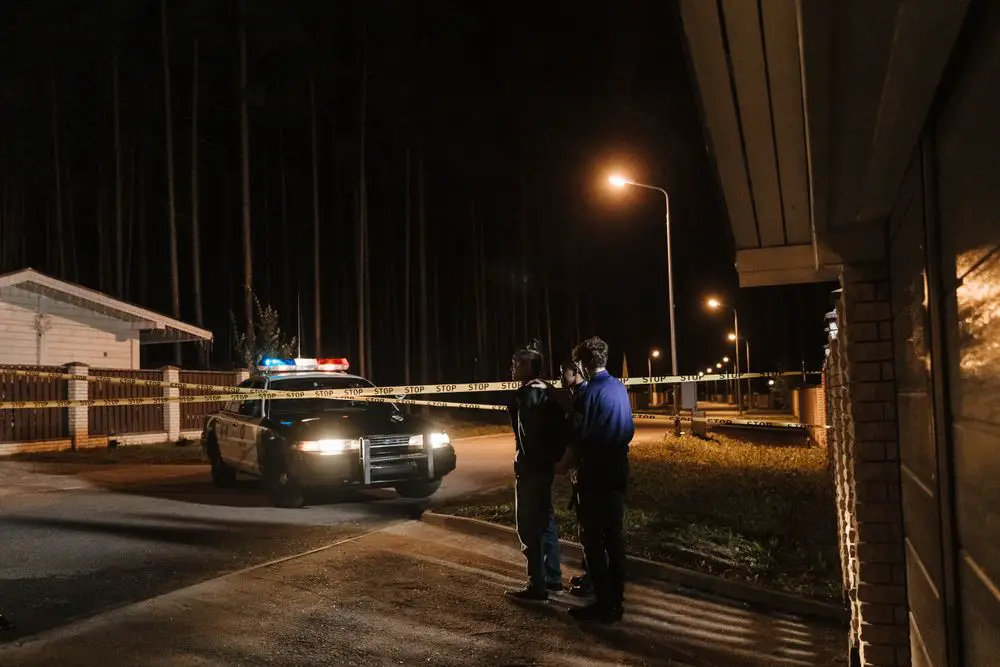
Two squad cars arrived within minutes. Red and blue light swept across the water and the white tent, and an officer approached with his hand near his belt and his posture carefully cautious.
“What’s going on?” he asked.
Mom pointed at me, her eyes bright and glassy. “That woman came onto our property. She’s harassing my daughter.”
“Our property?” I repeated.
Madison moved to Mom’s arm and addressed the officer with a trembling voice she had dialed in with precision. “Please,” she said. “I don’t know her. She’s been stalking me online.”
The officer looked at me. “Ma’am, can I see your ID?”
I handed it over. He studied it, then me, then my mother and sister, as though he was trying to reconcile their confidence with what he was holding. My name. My address. The property address.
Mom did not even blink. “Fake,” she said. “She’s done this before.”
Something inside me went quiet. Not rage, something colder and more deliberate. The understanding that screaming would only give them what they wanted: footage of me as unstable, as desperate, as the woman they had described before I arrived. I took a slow breath and gave the officer a small, cooperative smile.
“I understand,” I said. “If they feel uncomfortable, I’ll step back.”
Madison’s eyes widened a fraction. Mom’s mouth tightened in a way that told me she had expected resistance and was disappointed to be denied it. I handed the officer my ID back without argument. “No problem,” I added, in the pleasantest voice I owned. “I won’t ruin their celebration.”
I walked back to my car while a hundred eyes followed me, and I heard Madison exhale a laugh behind me that sounded like someone claiming a prize.
I drove away without a scene.
Half a mile down the main road I pulled over, opened my notes app, and typed one sentence. If they want to pretend I’m a stranger, I’ll make sure the law agrees.
By Monday morning, the humiliation had hardened into something more useful.
I did not start with revenge. I started with paperwork, which is where revenge usually lives when it has any discipline behind it.
The vacation home was not a family house in any legal sense. It was mine, purchased with a bonus from my consulting firm and a small inheritance from my father Thomas, documented and deeded and insured exclusively in my name. My mother had a key because I had given her one two years ago, after a summer weekend when she visited and I did not want to arrange anything complicated. Madison had been given the code to the front gate once, for a weekend she spent there with friends while I was traveling. One time. Under specific circumstances. With my explicit permission.
Neither of those things constituted shared ownership. Neither of those things constituted access rights. Neither of those things meant anything that my mother’s voice had implied when she stood on my walkway and announced that families share.
The security system was registered to my account, with cloud backups storing sixty days of footage. When I logged in Monday afternoon, the footage was exactly as crisp and unambiguous as I had hoped.
I called Caleb Foster first. He was my attorney, had been for two years, calm and dry in the specific way of people who make a living converting other people’s disorder into procedure. He listened without interrupting while I laid out the full sequence: arriving at my own property, my mother calling 911, Madison telling an officer she did not know me, the officer’s confusion, my decision to leave without making a scene.
“Do you have documentation?” he asked.
“I have the security footage, the deed, the insurance policy, the mortgage statements, and three years of utility bills in my name,” I said. “And I’m requesting the bodycam footage.”
Caleb exhaled softly. “Then we handle this the clean way.”
That afternoon I logged into the security portal and reviewed the footage with the particular attention you bring to something you know is going to become a legal document. Me arriving, my mother moving to block the walkway, Madison whispering to me, my mother on the phone with dispatch. You could hear her say, stranger trespassing. You could hear Madison say, I don’t know her. You could hear the whole performance laid out in chronological order with time stamps and no ambiguity whatsoever.
It was so blatant it almost looked staged. Because it was.
I requested the police bodycam footage through a public records request. Caleb drafted a letter to the department explaining the situation and requesting that the incident report be amended. He also advised me to file a report of my own: false reporting to law enforcement and attempted unlawful removal of a property owner from her own property.
Then I did the things that made my hands shake, not from fear but from the particular weight of deciding to stop being convenient. I changed the gate code, the alarm code, and the smart lock codes. I called the event rental company and told them that future bookings at the property were unauthorized unless they came through me directly. I called the cleaning service with the same instruction.
I sat for a long time afterward, looking at the screen. You cannot un-file a report. You cannot un-send a certified letter. You cross a line with your family and you carry the crossing in both directions, toward the past that made it necessary and toward the future that will require you to live with it.
I crossed it anyway. Some lines are worth crossing cleanly.
On Wednesday, my mother called.
“Avery,” she said, in the voice she used when she wanted to sound wounded and restrained simultaneously, “your sister is devastated. Why didn’t you come back? You embarrassed her.”
“You told the police I was a stranger,” I said.
“You were acting strange,” she replied, pivoting without pause. “You’ve been bitter for years. Madison deserves a fresh start without you hovering over everything.”
“She was having her fresh start in my house,” I said. “Using a caterer I paid for.”
“It’s just a house,” Mom said, the kind of thing people say when something belongs to someone else and they want it to sound like selfishness. “Family shares.”
“Then why did you tell an officer you didn’t know me?”
A silence, one beat too long.
“Don’t be dramatic,” she said when she recovered. “It got out of hand.”
“I agree completely,” I said. “It got out of hand the second you called 911.”
Her breath changed. “What are you doing, Avery?”
“Fixing it,” I said. “Legally.”
“You wouldn’t.” A statement dressed as a question.
“You already did,” I said. “I’m catching up.”
That night Madison messaged me from a number I did not recognize. You’re insane. Mom said you’re trying to press charges. You always have to make everything about you. I read it twice, then forwarded it to Caleb without reply.
By Friday the police department called me back. The officer’s tone was careful in the way tones become careful when an institution realizes it has been used as a weapon by the wrong party.
“Ms. Bennett,” he said, “we’ve reviewed your documentation. The property is clearly yours. The report from last weekend contains statements that appear inconsistent with the evidence.”
“Inconsistent,” I repeated.
“We’ll be speaking with the reporting parties. Would you like to file a formal complaint?”
“Yes,” I said. “I would.”
I filed it. Caleb prepared a civil cease-and-desist as well. He also suggested something that felt, in equal measure, both petty and perfectly proportionate.
“Since they publicly asserted you’re a stranger, on record, to law enforcement,” he said, “you can formally revoke any implied permission for them to access the property. Written notice. Certified mail.”
So I did.
I sent my mother and my sister certified letters stating they were no longer authorized to enter the property for any reason, and that any attempt to do so would be treated as trespassing under state law. I signed them with my full name and included a copy of the deed.
I mailed them on a Thursday. I did not feel good about it. I did not feel bad about it either. I felt clear, which was something I had not felt in a long time when it came to my family.
I waited. Not with hope, and not with anger. With the particular patience of someone who understands that people who create scenes to win do not stop after winning once. They escalate. The escalation is the point.
The following Saturday morning, my phone buzzed at 7:14 a.m.
Logan.
I almost did not answer. Then I did, because I was curious, and curiosity sometimes cuts through caution.
“Avery,” he said, his voice tight in the way of someone managing panic they have not yet decided how to categorize. “I didn’t know who else to call. Your mom is at the property. Madison too. There are squad cars.”
I sat up. “They went back?”
“Madison said it was for planning. Bridesmaids. A photographer. They were setting up the tent again.” He swallowed. “The police pulled up and told everyone to step away from the doors.”
I said, very gently, “Logan, they’re trespassing. They were served notice. They went back anyway.”
A long pause. “Janet said the house was a family asset. That your father intended for it to be shared.”
“My father died,” I said. “He left me money. I used it to buy a house. The deed is in my name. None of that is ambiguous.”
His voice dropped. “Madison told me you were unstable. That you have episodes.”
I laughed once, quietly. “Did she also tell you she looked me in the face, on my own front walkway, and told a police officer she didn’t know me?”
Logan did not answer. In the silence, I could hear him rearranging something.
I got dressed and drove out. Not to confront anyone. To witness what happens when a fiction collides with documentation and the documentation is better organized.
When I arrived, the driveway was a small chaos: folding chairs, a catering van idling near the gate, bridesmaids in matching outfits standing in a cluster looking uncertain about whether they were supposed to be there. Two officers stood near the front entrance. My mother was in full performance, hands moving, voice carrying across the water. Madison was crying in the careful, directional way she cried when she wanted someone specific to observe it.
Caleb stood slightly apart from all of it, holding a folder, looking like the calmest person at a very loud party. He nodded when he saw me. “Perfect timing.”
Mom spotted me from across the lawn and moved toward me like a woman who has decided that forward motion is a substitute for a valid argument.
“There she is!” she announced to the officers. “She’s harassing us. Arrest her!”
One officer turned to me with the measured expression of someone who has already reviewed the documentation and knows how this ends. “Ms. Bennett?”
“Yes,” I said. I looked at the officer, not at my mother. “I’m the property owner. I revoked permission in writing. They were served by certified mail. I have the receipts, the delivery confirmation, and the deed.”
Caleb handed the officer the folder. Inside were all of it: the certified letters, the delivery confirmations, the original deed, the incident report from the previous weekend, the security footage summary, the bodycam request.
Madison’s crying paused for half a second, involuntarily, the way it does when something real interrupts a performance.
Mom’s voice sharpened. “This is ridiculous. You cannot do this to your own family.”
The officer’s tone remained neutral, which somehow made it harsher than anger would have. “Ma’am, you’ve been formally notified you’re not authorized to be on this property. Being here now constitutes trespassing. We also need to discuss the report you filed last weekend.”
Mom’s eyes widened. “False?”
“The property owner has documentation indicating the statements in that report were inaccurate.”
Madison said, “She was acting weird, she came out of nowhere and,” and the second officer interrupted, not harshly, just with the finality of someone who does not need to raise his voice to end a sentence. “Ma’am. We have security footage. We have bodycam.”
Madison’s mouth opened and then closed.
And then the scene collapsed in the way scenes collapse when the story holding them together stops being believable to the people inside it. The bridesmaids shifted and looked at the ground. The photographer lowered his camera and began carefully not making eye contact with anyone. The catering driver found something important to attend to near his van.
Logan stood by his car, watching Madison, and his expression was the expression of a man who is seeing something clearly for the first time and finding that clarity deeply inconvenient.
Mom tried once more. “Avery, please. You’re doing this to punish us.”
I looked at her and kept my voice steady and unremarkable. “No. You did something. I stopped absorbing it. Those are different things.”
The officers asked Mom and Madison for identification. Mom protested loudly enough that the sound carried out over the lake. Madison cried harder, and the harder she performed the worse it worked, because performance is calibrated for sympathetic audiences and neither officer was offering one.
I did not request their arrest. Not from softness, and not from any remaining hope that the gesture would be recognized as generous. I simply did not need cruelty to achieve what I needed, which was for the record to be clear and for the property to be mine again in every practical sense. The officers issued formal trespass warnings, documented everything, and took additional statements about the previous false report.
As Mom and Madison packed their things in furious, frantic silence, folding up a celebration that had been built on someone else’s property and someone else’s money and someone else’s patience, Logan crossed the lawn toward me.
“I’m sorry,” he said. He looked tired in the way of someone who has spent a week being told one story and has spent the last hour discovering it was constructed. “I didn’t know.”
“You were told a story that benefited them,” I said. “That’s different from lying.”
He nodded, turning the thought over. “She told me you were unstable. That you had a history of making things up to get attention.”
“Did she tell you she told a police officer she didn’t recognize me? On my own walkway? Within ten feet of my front door?”
He looked past me at Madison, who was yanking tent stakes out of the ground with the focused energy of someone who needs the anger to have somewhere to go. His shoulders settled. “No,” he said. “She didn’t tell me that.”
I let that land without adding to it. There was nothing I needed to say next. The situation had already said it.
I stood on my own lawn and looked out at my own lake while the cars pulled away one by one and the afternoon got quieter, and I waited until the driveway was empty before I went inside.
The house was unchanged inside, the same counters and furniture and light through the same windows, and I walked through it slowly, the way you walk through a space after something has happened in it that has not fully registered yet. I made coffee. I stood at the window over the kitchen sink and drank it while the light moved on the water outside.
I called Caleb. “How does it look?”
“Very clean,” he said. “The trespass warnings are documented. The false report investigation is ongoing. The certified mail creates a clear record of notice.” He paused. “They’d have a very difficult time spinning this in any direction that helps them.”
“And if they try?”
“Then we use the footage,” he said. “All of it.”
After I hung up I sat at the kitchen table for a long time, not thinking about anything in particular, which was unusual. I was usually thinking about the next thing, the next problem, the next item on the list of things I was managing alone. The quiet felt unfamiliar. I let it settle.
My mother called that evening. I did not answer. She left a voicemail that began with wounded dignity and ended in something closer to threat, the promise that I would regret this, that I had made enemies of the only people who would ever really be in my corner, that Logan’s family was important and I had humiliated everyone. I listened to it once and deleted it.
Madison did not call. She sent a screenshot of a group chat instead, a group chat whose name appeared to be Avery Update, in which she had apparently been narrating the summer to a collection of friends I did not know. I read enough of it to understand the version of me that had been constructed for their consumption: controlling, bitter, jealous of Madison’s happiness, desperate for attention, never satisfied. It was written with the internal consistency of someone who had been telling the story long enough to believe it.
I forwarded the screenshot to Caleb.
Two weeks later, the police department closed their review of the original incident. The report was amended. My mother received a formal notice that filing a false police report was a criminal offense and that the documentation in their possession indicated the statements made in the original report were not accurate. It was, in the dry bureaucratic language of such things, a warning.
I received a phone call from Logan two weeks after the police department closed their review.
He was brief and direct in the way of someone who has thought carefully about what he wants to say before dialing. He said he had asked Madison directly about the night of the party, about what she had told the officer, and she had said it was complicated and that I had a history of making scenes. He had then asked to see the bodycam footage. She had told him it was private and that accessing it would be a violation of her privacy. He had pursued the public records request on his own.
“I watched it,” he said. “All of it. Multiple times, because I wanted to make sure I was understanding it correctly.”
I waited.
“She said she didn’t know you,” he said. “To a uniformed officer. On the walkway of your own property. While you were standing right there.”
“Yes,” I said. “That is what happened.”
A long pause, the kind that contains more than silence. “I grew up in a family that covered for each other,” he said finally. “I thought that was what families did. I’m starting to understand that there’s a version of that which is loyalty, and a version that’s just participating in something that isn’t true.”
I did not tell him what to do. It was not my decision and not my relationship, and I had learned enough about the cost of involving myself in other people’s arrangements to know better than to reach in and rearrange one without being asked. But I said: “Whatever you decide, I hope you decide it based on what actually happened.”
He said he understood. We hung up.
I did not know what happened between them after that, and I told myself it was not my concern to find out. The engagement continued or it did not. Those were things that would resolve without me, the way most things involving my mother and sister had resolved without me for most of my life, except that those resolutions had generally required my property or my money or my silence or some combination of all three.
That fall I drove out to Lake Geneva on a Friday evening after work, alone, with a bottle of wine and nothing planned for the weekend. No family to coordinate around. No permissions to quietly negotiate. No cost I would not be able to name later.
I unlocked the front door with my own code, turned on the lights, opened the window in the kitchen to let the evening air through. The lake was the dark flat silver of early October, and the trees around it were starting to turn, and the whole scene had the particular quality of a place that has been waiting for you and is now simply being itself now that you have finally arrived.
I poured a glass of wine and took it out to the deck and sat in the chair I had bought myself two summers ago when I furnished the house, a chair I had chosen alone from a store in a town on the way out here, a chair nobody had any opinion about because nobody else had been there. I listened to the water. I watched the last of the light leave the sky in the unhurried way it leaves lakes in October, slowly and then completely.
I thought about my father. He had worked long and carefully so that some portion of what he built could become something solid and real for me, not as a gift from someone who wanted something back but as a simple, honest transfer from one hand to another. I thought about the year I had spent looking at houses, driving out on weekends to see places that were too expensive or too far or simply not right, and the afternoon I had walked through this one and known before I finished the first room.
My name was on the deed. My money was in the walls. My light was on the water outside.
A great deal had been attempted against those facts. None of it had changed them.
I sat on the deck until the night came all the way in and the lake went dark and the patio lights I had strung along the railing my first summer reflected off the water below in wavering lines, doubling themselves, going further than they could actually reach. Then I went inside, made dinner from the groceries I had bought on the drive out, washed the dishes in the kitchen sink, and went to bed in the room with the window that faces the water.
In the morning I woke before the alarm and lay in the quiet for a while, not reaching for my phone, not running through anything that needed to be managed.
I listened to the lake, which made the small patient sounds that water makes when it has been somewhere long enough to belong there.
Not revenge.
Not triumph.
Something simpler and considerably more durable.
My own life, finally arranged on my own terms, in a house that had always been mine and now, in every practical and documented and unambiguous sense, fully was.

Adrian Hawthorne is a celebrated author and dedicated archivist who finds inspiration in the hidden stories of the past. Educated at Oxford, he now works at the National Archives, where preserving history fuels his evocative writing. Balancing archival precision with creative storytelling, Adrian founded the Hawthorne Institute of Literary Arts to mentor emerging writers and honor the timeless art of narrative.