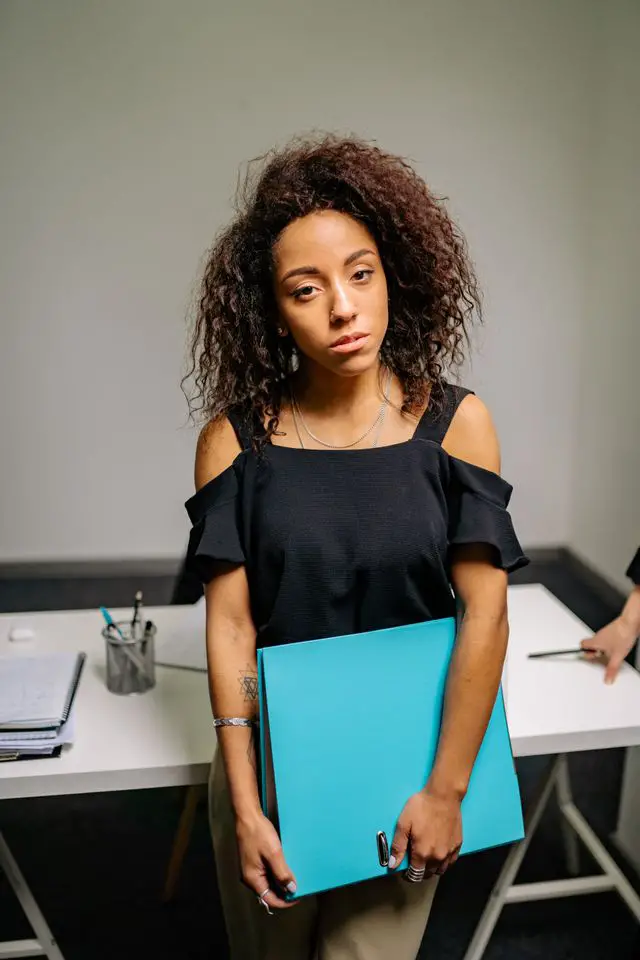
She whispered my name, and the entire office seemed to run out of air.
The receptionist hung up slowly, the way someone hangs up when they have received an order they are afraid to repeat. She looked at me the way people look when they are doing a rapid, unconscious accounting of a stranger. The sale-rack blouse. The bleeding knee. The stained sneakers. The puffy eyes that come from a night with no sleep and a morning with too much of the wrong kind of shock.
“Mr. Collins will see you,” she said. “Right this way, miss.”
Miss. At the Vanderbilt Group tower they had thrown me out like garbage. They had watched a guard’s hand close around my arm, watched Leonard drop bills on the marble floor at my feet, watched me bleed on their lobby tiles, and said nothing. Here, in a building I had walked into not knowing what I was walking toward, someone was calling me miss.
I followed the receptionist down a hallway lined with paintings that cost more than my mother and I had spent on rent in a decade combined. The air was cool and smelled of wood and freshly ground coffee. At the far end, a black door carried gold lettering.
Robert Collins.
Before I could raise my hand to knock, the door opened from inside. A man in his sixties stood in the frame. Dark suit, white hair, eyes that looked tired in the specific way of someone who has been carrying knowledge they were not allowed to share. He did not seem surprised by my appearance. He looked at me the way people look at something they have been expecting for a very long time.
“Sophia,” he said, and my name in his mouth sounded less like a greeting and more like something he had rehearsed without ever knowing exactly when he would need it. “Your mom was right. You were going to come when you were ready.”
I had held it together all morning. I had held it together through the guard’s grip and Leonard’s money and the cold sidewalk and the fifteen blocks I walked because I could not afford a cab and was too shaken to stand on a subway platform with strangers. I had held it together until this moment, and then I could not anymore.
“My mom is dead,” I said.
The lawyer closed his eyes for a second. It was not a polite gesture. It was pain, the real kind, the kind that lives in the jaw and the chest rather than the face. “I know. Thomas let me know.”
My adoptive father’s name in this stranger’s mouth made my hands curl into fists at my sides. “Did you know everything too?”
“I knew enough.”
“Well, I didn’t. So start.”
He let me in. He did not offer me water. He did not ask me to calm down. He did not try to seat me the way adults try to seat children when they want to manage what comes next. He simply pointed to an armchair and pulled a metal box from a desk drawer.
On the lid, in handwriting I would have recognized in my sleep, someone had taped a label.
For when Sophia asks.
My legs went weak. I sat before I meant to.
“She left this four years ago,” Robert said. He sat across from me without ceremony. “She asked me not to look for you. She said you would come on your own when the truth could no longer be hidden.”
“What truth?”
He opened the box. Inside were folders. A USB drive. Certificates. Contracts. Photographs. Bank statements that ran to dozens of pages. And a letter, folded in thirds, the crease lines soft from being folded and refolded until the paper had learned its own shape.
I recognized her handwriting before my hands had even touched the envelope. One word on the front. Soph.
My hands shook so badly I nearly tore it.
“Read it later,” Robert said. “First you need to understand”
“No,” I said. “I’m reading it now.”
I opened the letter.
Sweetheart. If you are reading this, forgive me for not telling you sooner who your blood father was. It wasn’t out of shame. I was never ashamed to have you. I was afraid they would take you away from me. Matthew Vanderbilt didn’t abandon me because he didn’t love you. He abandoned me because he was a coward. But Rebecca Sterling didn’t destroy me just out of jealousy. She destroyed me because she knew something Matthew wouldn’t find out until many years later. You weren’t a mistake. You were the only legitimate daughter who could take everything away from her son.
I stopped. I read that last line again. Then I looked up.
“What does legitimate mean?” I asked, and my voice came out strange, smaller than I intended.
Robert folded his hands in his lap. “It means that Matthew Vanderbilt and Rebecca Sterling signed a prenuptial agreement keeping their assets entirely separate. It means they were never able to have biological children together.” He paused. “Leonard is not Matthew’s son.”
The room tilted slightly. “What?”
“Leonard was registered as his. But he isn’t. Matthew discovered the truth when the boy was ten years old. Rebecca had forged medical records, dates, documents. By then, a public scandal would have destroyed the company, the family, and the image they had spent twenty years building.” He looked at me steadily. “So Matthew stayed quiet. And Rebecca knew he would.”
I tightened my grip on the armchair. “And me?”
Robert opened another folder and pushed a document across the desk toward me. It was a DNA test. The kind produced by a laboratory, formal and dispassionate, with numbers where a life ought to be. Matthew Vanderbilt. Probability of paternity: 99.9998 percent. My name. Sophia Miller. My date of birth.
“Your mom had it done when you were two years old,” Robert said. “Matthew paid for it in secret.”
“So he knew.” The words came out flat because there was no inflection that fit them.
“Yes.”
“And he still left us living under a leaky roof.”
Robert did not answer right away. That silence infuriated me more than any excuse he could have offered. I felt it move through me, hot and familiar, the specific rage of someone who has been told their suffering had a cause and a choice and a person behind it.
“Three hundred thousand dollars a month doesn’t buy a childhood,” I said, and my voice rose before I could stop it. “My mom died rationing her pills because she could not afford the full prescription. I worked double shifts at a tea shop while that man smiled in magazines with his arm around someone else’s son. Three hundred thousand a month and she died counting pills.”
Robert looked at the surface of his desk. “Your mom didn’t touch that money,” he said quietly. “She didn’t want Matthew to buy her forgiveness.”
I stopped. “Then where did it go? Eighteen years of deposits. Fifty million dollars. Where is it?”
The lawyer stood and crossed the office to a safe set into the wall. He entered a code. He removed a red folder and placed it in front of me without comment.
I opened it. At first, I did not understand what I was looking at. Investment contracts. Debt assignments. Equity purchases. Trusts structured through third-party names. Companies whose names I recognized from clippings my mother had kept in a shoebox under her bed, clippings I had always assumed were the harmless fixation of a woman who could not stop watching the people who had hurt her.
Then I found my name. Not the full name. Initials. S.M. Ultimate beneficiary.
“Your mom didn’t save the money,” Robert said. “She turned it into a key.”
“A key for what?”
He looked at me without looking away. “To enter Vanderbilt Group through the door they slammed in her face.”
I could not speak. He continued.
“For eighteen years, your mom used a portion of Matthew’s monthly deposits to purchase debt from the group’s subsidiaries during periods of financial crisis. She did it through third parties, in small portions, without drawing attention. She was patient in a way most people are not capable of being. No one imagined that a seamstress from the Bronx was quietly accumulating paper that could one day give a single person the leverage to bring a multi-billion dollar development firm to its knees.”
I thought about her patched jackets. Her worn-out shoes. The way she turned off lights in rooms she was about to reenter. The way she bought the bruised fruit at the back of the grocery display. I had watched her do those things my entire childhood and understood them as poverty, as the ordinary economics of a woman who did not have enough. Now I understood them differently. She had lived like a woman with nothing so that I could one day walk into a room as a woman with everything.
It made me want to cry, but not from sadness. From the particular, savage grief of rage.
“Why didn’t she tell me?” I asked.
“Because she was afraid you would go looking for them before it was time. She knew they would humiliate you, and she knew that if you were humiliated early, before you understood what you were holding, you might walk away from it entirely.” He set the USB drive on the desk between us. “And because she needed one more thing first.”
“What thing?”
“Matthew’s confession.”
He pushed the drive toward me. It was small and black and looked completely ordinary, the kind of object you would throw in a junk drawer without thinking. I picked it up. It weighed almost nothing. But it felt like it had been compressed under tremendous pressure, like something that should have been heavier than it was.
“Confession?”
“Six months ago, Matthew came to this office.” Robert’s voice shifted, just slightly, into something more careful. “He is sick, Sophia. Seriously sick. I don’t know how much time he has left. He wanted to legally acknowledge you. He had instructed me to begin the process of changing his will.”
I stopped breathing.
“And did he?” I asked.
Robert clenched his jaw. “He did not get the chance.”
“Why?”
“Because Rebecca found out.”
The name fell between us like something dropped from a height. I watched it land.
“What did she do?”
“What she always does. She contained the problem. For the past five months, no one who doesn’t pass through Rebecca’s approval can see Matthew. They have changed his doctors, his drivers, his nurses, his phone numbers. They have blocked my calls. They have told his existing staff that he has requested privacy for his recovery.” Robert looked at the window. “He is, for all practical purposes, unreachable.”
“Do they have him kidnapped?” I asked.
Robert was quiet for a moment. “Legally, I cannot make that statement without documentation.”
“But you are saying it with your face.”
He did not look away. “Yes.”
I stood up. My knee was burning. I had forgotten about my knee. “Then we get him out.”
“It is not that simple.”
“Nothing in my life has been simple. That has not stopped anything from needing to happen.”
Robert walked to the window. From there, across the city, the Vanderbilt Group tower was visible, glass and steel catching the afternoon sun with the particular arrogance of buildings that have never been told no.
“You should not have gone there today,” he said.
“I didn’t know.”
“They do now.” He turned. “When you gave your name at the front desk, you triggered a flag Rebecca had placed years ago. She had been waiting for you to surface. She has been waiting for a long time.”
A cold feeling moved down my spine. “Waiting?”
Robert reached into the box and removed a photograph. He placed it in front of me without comment.
It was me. But not a photograph I had ever taken or posed for or consented to. Me leaving work in my uniform, the tea shop apron still tied around my waist. Me getting on the bus, looking at my phone. Me entering the hospital on one of the last nights my mother was admitted. Me buying groceries, choosing the bruised fruit from the back of the display without knowing a lens was pointed at me.
I felt nauseous in a way that had nothing to do with the bleeding knee or the empty stomach or the sleepless night.
“They were following me?”
“For the last two years.”
“Did my mom know?”
“Yes.”
The rage came up so fast it almost had no shape. “Everyone knew except me,” I said, and my voice broke on the last word and I did not care. “My mom spent her whole life building something for me and she didn’t tell me. Thomas knew and didn’t tell me. You knew. Rebecca knew. Even the people who wanted to destroy me knew more about my life than I did.”
“Your mom was trying to protect you,” Robert said.
“My mom let me walk into that building with a business card from a dead woman’s box. I walked in there with nothing and they threw me out on the floor in front of everyone.”
“No.” His voice rose for the first time, sharpening in a way that stopped me. “Your mom let you come after she died because, alive, she would not have been able to bear watching you hate her for it.”
That landed somewhere very specific and very deep, and I could not answer it. I sat down again. I cried in the way you cry when you are not performing grief but living it, when you have reached the particular combination of exhaustion and understanding where your body simply decides it is time. I did not cry prettily. I cried the way my mother must have cried alone in our small apartment, in the bathroom with the fan on, the way women cry when they are trying to process love and pain at the same time and cannot find a way to separate them.
Robert handed me a tissue and waited without speaking.
When I could breathe normally again, I looked at him. “What am I supposed to do with all of this?”
“Your mom wasn’t ignorant,” he said. “She wasn’t weak. She wasn’t waiting for justice to arrive on its own. She was building it carefully, the way you build something meant to last. She built it for you.” He looked at me with the calmness of someone who has had years to make peace with a difficult truth. “You are the heir.”
I laughed. It came out wet and unhappy. “I’m not the heir to anything. I can’t wear heels without tripping over myself. I don’t know how to talk the way they talk or sit the way they sit or look at people the way they look at people. Today a guard grabbed my arm in a lobby and a man threw money at my feet and neither of them hesitated for even a second because looking at me, they could not imagine anything to be afraid of.”
Robert looked at me in silence for a long moment. “Yes,” he said. “That is exactly why you are going to learn fast.”
The office phone rang before I could answer him. The receptionist’s voice came through the intercom, and even through the static of the speaker I could hear that her composure had cracked slightly.
“Mr. Collins. Mrs. Rebecca Sterling is here.”
My entire body went still.
Robert did not react the way I expected. He did not reach for the phone. He did not stand. He looked at me with steady eyes. “Is she alone?”
“No. She’s with Mr. Leonard Vanderbilt. And security.”
I looked at the metal box. The USB drive. The folders. The documents with my initials printed on them. My name attached to things that could end a dynasty. Robert moved quickly but without panic, placing everything back into the box, returning the red folder to the safe, closing and locking with practiced efficiency.
Then he turned to me.
“Whatever happens next,” he said, “do not sign anything. Do not accept anything. Do not deny anything. Do not argue and do not explain. Just watch. Sometimes watching without fear is the first way to win.”
The door opened without anyone knocking.
Rebecca Sterling walked in as if the office had always belonged to her and Robert Collins had been using it in her absence. She was shorter than I had imagined. In my mind, assembled from photographs and fear and the magnitude of what she had done to my mother’s life, she had become something enormous. In person, she was a compact woman in a white suit, pearl necklace, red lipstick, and eyes that were the particular shade of pale that can look either kind or predatory depending on what they are focused on. At this moment they were focused on me, and there was nothing kind in them.
Behind her came Leonard. He was impeccable in the way of men who have never had to think about whether they could afford to be. When he recognized me, the disgust on his face shifted into something worse. Amusement.
“Look at this,” he said. “The girl from the lobby found someone to play along with her story.”
I did not answer him. Rebecca had not looked at him when he spoke. She was looking at me, and I understood, standing under that gaze, why my mother had kept quiet for so many years. Rebecca Sterling did not look angry. She looked accustomed. This was not a woman experiencing a crisis. This was a woman managing one. She had managed dozens of them before this and expected to manage dozens more.
“Sophia Miller,” she said, and my name in her mouth had the sound of something being picked up and examined for value before being set back down. “Your mother always had terrible taste in choosing her timing.”
I stood up. “Don’t talk about my mom.”
Leonard let out a short laugh. “Or what?”
I looked at him with as much steadiness as I could find. “Or you’re going to bend down and pick up the bills you threw at me.”
The amusement left his face. Robert moved to stand between us, calm and deliberate, the way a person inserts themselves into a space to redirect its energy. “Mrs. Sterling,” he said, “this is my office. I would suggest you watch your tone.”
Rebecca set a folder on the desk. She did not slam it. She placed it with precision. “I am here to prevent a disaster. Inside that folder is a non-disclosure agreement and a financial offer that is, by any reasonable measure, generous. The girl signs it, disappears, and everyone continues with their lives.”
“I’m not a little girl,” I said.
Rebecca’s eyes moved to my bleeding knee with the brief, efficient interest of a person confirming a detail. “No,” she said. “You’re worse. You are a poor adult with information she doesn’t understand.”
I felt the blow land. And I did not back down. “Then explain it to me.”
Something shifted in her expression, barely visible, the flicker of a woman who had walked into a room prepared for a specific kind of opponent and found something slightly different.
“Your mother was a fling,” Rebecca said. “An old embarrassment. A mistake that Matthew paid more than adequately for.”
“Three hundred thousand a month to keep her quiet?”
“To keep you both away.”
Robert raised his hand. “Careful, Rebecca.”
She continued as if he had not spoken. “Your mother could have lived well. She could have purchased a home, a car, decent clothing, a life with some dignity. She chose instead to perform martyrdom. That is not my fault.”
I took a step toward her, and I was aware of my bleeding knee and my sale-rack blouse and my stained sneakers, and I did not care about any of it. “Your fault was having her dragged through a factory floor while she was pregnant.”
Leonard turned to look at his mother. “What?”
Rebecca’s expression did not change. But her jaw tightened, and the tightening was visible, and in that tightening I saw the thing my mother’s letter had told me to look for. The seam. Every armor has one.
“Your mom hid things from you too,” I told Leonard. “Seems to be a family tradition.”
“Shut up,” he said.
“Did she tell you Matthew wanted to legally acknowledge me? That six months ago he came to this office and started the process of changing his will?”
Leonard went very still. Rebecca moved faster than he did. “Lies.”
Robert opened a drawer. He removed a single document, a copy, and placed it on the desk between us without ceremony. “Draft of acknowledgment. Dated six months ago. Matthew’s preliminary signature.”
Leonard picked up the paper. He read it. He was not a man accustomed to his face betraying him, but I watched the mockery drain out of him and something else replace it, something closer to the specific fear of a person who has just realized the ground they were standing on is not what they believed.
“Mom,” he said.
“That document carries no legal validity,” Rebecca said.
“Not yet,” Robert replied. “But it is sufficient to ask questions. And there are judges who become very curious when a seriously ill man changes his entire medical team immediately after attempting to acknowledge a biological daughter he never publicly recognized.”
Rebecca looked at me then, fully and without pretense, for the first time. Not as a nuisance to be managed. Not as a poor girl from the Bronx with a business card and a grievance. As a threat.
“You don’t know who you are dealing with,” she said.
“Yes I do,” I said. “I’m dealing with a woman who spent eighteen years being terrified of a seamstress.”
The slap came before I saw it coming. Her hand connected with my cheek and the sound of it was very loud in that quiet office and my ear rang and my face burned and my pride burned worse. Leonard stepped back. Robert said her name sharply. The security guards shifted their weight. But I did not fall.
I brought my hand to my cheek. I looked at her. And then I smiled, because in the upper corner of the office there was a camera, a small and unobtrusive lens mounted near the ceiling, and I had noticed it when I sat down and I had not forgotten it, and now Rebecca was looking at it too.
Too late.
“Thank you,” Robert said, and his voice was very calm. “That makes several things considerably easier.”
Rebecca’s composure fractured for just a second, a fracture so small and so quickly repaired that you would have missed it if you had not been watching for exactly that kind of crack. She picked up her folder from the desk. She walked toward the door. The security guards fell into step behind her.
At the doorway she paused. “You have forty-eight hours to accept the offer,” she said, addressing me without turning around. “After that, you are going to learn that blood is useless when you don’t have the last name.”
She turned only slightly, just enough to direct her final words at a specific target.
“Tell Thomas I still remember him.”
The door closed.
The office went quiet the way rooms go quiet after something loud has happened in them. I stood with my hand still pressed to my cheek and the ringing still in my ear and a new coldness spreading across the back of my neck that had nothing to do with the temperature.
“Thomas?” I said.
Robert was looking at the surface of his desk.
“Why did she say that?” I asked.
He did not answer.
“Robert.”
He exhaled slowly, the breath of a man who has been sitting with an additional truth and has now run out of space to continue holding it.
“Because Thomas didn’t marry your mother simply to protect her,” he said.
I felt my exhaustion disappear completely, replaced by the specific alertness of someone who understands they are about to receive a blow they did not know was coming.
“What are you saying?”
Robert reached into the metal box one more time and removed a photograph. He placed it on the desk in front of me and did not say anything.
It was an old photograph, the kind printed on paper with a slight gloss, the colors faded in the way of photographs that have been stored rather than displayed. My mother, young, maybe twenty-two or twenty-three. Thomas, the same age, his face without any of the lines I had always known on it. Matthew Vanderbilt behind them, younger but recognizable. And in the center of the frame, one hand resting on Thomas’s shoulder in a way that was too close and too familiar for formality, Rebecca Sterling.
I turned it over. On the back, a date. One year before I was born.
“Before working for Matthew Vanderbilt,” Robert said, “Thomas worked for Rebecca.”
My cell phone buzzed on the armchair where I had set it when I sat down. I picked it up.
A text from Thomas.
Sophia, don’t come back home. There are things your mom didn’t let me tell you.
Below the text, a photograph. Our front door was standing open. The living room was visible through the doorway. My mother’s furniture was still in it, the furniture I had grown up around, the furniture she had kept covered with throws to hide the wear, the furniture that still smelled faintly of her.
Sitting in my mother’s armchair, composed and unhurried, as if she had been there before and expected to be there again, was Rebecca Sterling.
I looked at the photograph for a long time. Then I looked up at Robert.
Outside the window, the Vanderbilt Group tower was still visible, glass catching the late afternoon sun, indifferent to everything happening at ground level. I thought about my mother buying bruised fruit and turning off lights. I thought about the shoebox under the bed. I thought about the label in her handwriting on a metal box she had left in a lawyer’s office four years before she died, the handwriting I would have recognized in my sleep, the single word she had written on the letter she had folded and refolded until the paper learned its own shape.
Soph.
She had known. She had known Thomas’s history and chosen him anyway. She had known Rebecca’s surveillance and walked her ordinary life in front of it anyway. She had known the moment would come when I would walk into a building I did not know the meaning of and have money thrown at my feet, and she had known it would have to happen that way, that I would have to feel it all the way down before I would be ready to understand what I was holding.
She had given me the key. She had given me the documents and the drive and the letter and the lawyer and the fifty million dollars quietly turned into leverage. She had given me everything except the one thing she knew I would have to find on my own: the decision to use it.
“What do I do now?” I asked.
Robert looked at me with the quiet attention of someone who has been waiting a very long time for this particular question.
“You have forty-eight hours,” he said. “Rebecca thinks that means you have forty-eight hours to decide whether to accept her offer.” He placed his hands flat on the desk. “It actually means you have forty-eight hours to decide what kind of person you are going to be.”
I looked at the metal box. The USB drive was still inside it. My mother’s letter was still inside it. The debt contracts and the trust documents and the equity purchases and the eighteen years of careful, invisible work were still inside it.
“She built it for me,” I said.
“Yes.”
“And she never spent a dollar of it on herself.”
Robert was quiet.
I thought about what that meant. I thought about the pills she rationed and the lightbulbs she saved and the way she had moved through a small, worn-out life with a patience I had always misread as resignation. She had not been resigned. She had been building. She had been building toward a specific moment that she would not live to see, and she had built it so carefully that even her death was part of the structure, because she had understood that I would not come looking until I had no one left to protect me from the truth.
She had trusted me with the thing she could not finish herself.
That was the weight of it. That was what made my hands stop shaking.
I picked up the USB drive.
“I need to understand everything that’s on this,” I said.
“Yes,” Robert said.
“And I need to know everything you know about Thomas.”
“Yes.”
“And I need to understand exactly how much of Vanderbilt Group’s debt my mother was holding when she died, and what that means for the next forty-eight hours.”
Robert reached for the red folder. He placed it open on the desk between us, the pages of investment contracts and equity assignments facing upward, my initials printed in the bottom corner of each one, S.M., the initials of a woman who had been built in secret for a purpose no one who had underestimated her could have imagined.
“Then let’s start,” he said.
Outside, the city moved in its ordinary way, indifferent to what was being decided in a small office above it. Somewhere across the skyline, the Vanderbilt Group tower caught the last of the afternoon light. Somewhere closer, in the house I had grown up in, Rebecca Sterling sat in my mother’s chair.
I thought about what my mother had written. You weren’t a mistake. You were the only legitimate daughter who could take everything away from her son.
My mother had been a seamstress from the Bronx who turned off lightbulbs to save electricity and rationed her pills and kept clippings in a shoebox and left a metal box in a lawyer’s office. She had done all of that quietly, without anyone watching, without anyone knowing, across eighteen years of ordinary days that were not ordinary at all.
She had not been waiting.
She had been winning.
And she had left the ending for me.
I opened the USB drive.
I began.

Lila Hart is a dedicated Digital Archivist and Research Specialist with a keen eye for preserving and curating meaningful content. At TheArchivists, she specializes in organizing and managing digital archives, ensuring that valuable stories and historical moments are accessible for generations to come.
Lila earned her degree in History and Archival Studies from the University of Edinburgh, where she cultivated her passion for documenting the past and preserving cultural heritage. Her expertise lies in combining traditional archival techniques with modern digital tools, allowing her to create comprehensive and engaging collections that resonate with audiences worldwide.
At TheArchivists, Lila is known for her meticulous attention to detail and her ability to uncover hidden gems within extensive archives. Her work is praised for its depth, authenticity, and contribution to the preservation of knowledge in the digital age.
Driven by a commitment to preserving stories that matter, Lila is passionate about exploring the intersection of history and technology. Her goal is to ensure that every piece of content she handles reflects the richness of human experiences and remains a source of inspiration for years to come.
I would have wanted to read rest of the story with her taking over the business and stay with her Dad until he died. The ending was not what I had hoped for. Out of all the stories I read, this is the first one kind of disappointing for me. Sorry
I will keep reading because one out of all I read is not bad at all. Thank you again for sharing the stories.