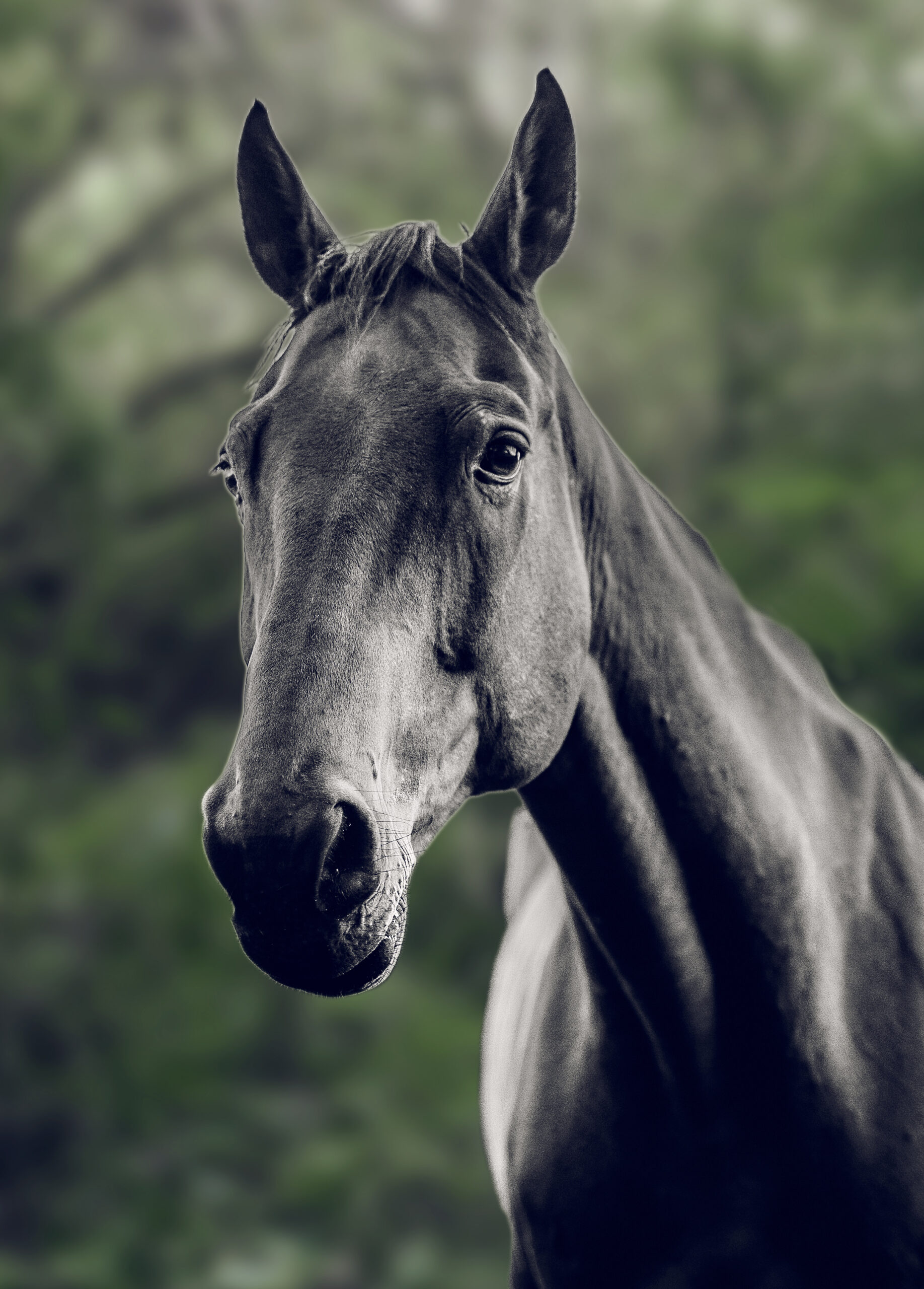
For weeks, everyone in the palace had been talking about the horse.
The sheikh had purchased him from a wealthy breeder in the south, a stallion considered so rare and magnificent that the man had parted with nearly ten million dollars without hesitation. He had been certain he was acquiring the most extraordinary animal in the entire region, something that would be spoken of for generations, a living testament to his wealth and taste.
Nothing had gone the way he expected.
From the first day, the stallion refused to acknowledge its new owner in any way that resembled acceptance. Each time the sheikh approached the stall, the horse flattened his ears against his skull, blew hard through his nostrils, and drove his hooves into the packed earth with a force that shook the stable floor. Twice he had lunged toward the sheikh’s hands. Once he had knocked an expensive bridle clean across the corridor with a single sideways strike of his head. The men who worked the stables had begun taking the long way around the building to avoid passing his stall.
The more the sheikh pressed for submission, the more violent the stallion became.
Several weeks passed. The horse barely touched his feed. He moved constantly in the stall, circling and circling, his dark coat damp with nervous sweat even in the cool mornings. He would lunge at the iron bars when anyone came close. Twice he tore his lead rope free from the post it had been tied to, sending two stable hands scrambling over the fence into the courtyard.
One morning, a worker tried to set a bucket of fresh water inside the stall door. The stallion struck without warning. The sound of the impact carried across the yard. The man was taken from the palace grounds on a stretcher, his forearm broken in two places, and did not return to work for six weeks.
After that, something close to genuine panic settled over the household.
The senior stable master suggested selling the animal before someone was killed. One of the sheikh’s advisors, choosing his words with the careful delicacy of a man who values his position, raised the possibility of having the horse destroyed. The sheikh himself, who had not been spoken to this way about anything he owned in many years, had begun to consider it. Ten million dollars was a significant loss. A dead worker was a worse one.
It was in the middle of one of these tense courtyard discussions that the sheikh noticed the girl.
Her name was Leila. She was perhaps twenty-two or twenty-three years old and worked in the palace as a general assistant, handling whatever tasks came her way, including occasional work at the stables. She was standing near the paddock fence, not with the nervous sideways posture of everyone else who passed that part of the grounds lately, but looking directly at the stallion with an expression that the sheikh, watching her from across the yard, could only describe as wonder.
He frowned. He walked toward her.
“How dare you look at what belongs to me with that expression,” he said.
Leila turned her head and regarded him with the same calm she had been directing at the horse.
“The horse may belong to you,” she said. “But he does not obey you.”
The courtyard went very still. Several stable hands exchanged glances. No one spoke to the sheikh this way, not staff, not advisors, not men who had known him for decades.
“You have a long tongue,” he said.
“I said what was true.”
He took one step closer. “Very well. Can that tongue of yours do anything useful, or are you only brave in conversation?”
She said nothing.
“Are you afraid?”
She remained quiet.
The sheikh was accustomed to silence of the apologetic kind, the silence of people scrambling to recover from having overstepped. This was not that kind of silence. He studied her for a moment.
“If you can tame that horse,” he said, half in contempt, half in something he could not quite name, “I will give you ten thousand dollars.”
“Money does not interest me,” she said.
He almost smiled. “Then what do you want?”
She looked directly at him.
“To become your wife.”
The courtyard was quiet for perhaps three full seconds. Then the sheikh laughed. It was a genuine laugh, open and unguarded, the kind that comes from being genuinely surprised. The guards along the wall laughed. Two of the stable hands laughed. Even the senior stable master allowed himself a smile.
“You are that certain of yourself?”
“Yes.”
“And I am certain,” he said, still smiling, “that the next person carried out of that stall on a stretcher will be you. But if you want to dream, I have no objection. You have my word.”
Leila nodded once. The conversation was apparently over as far as she was concerned.
The sheikh watched her walk away and felt, for the first time in weeks, genuinely curious about something.
By the following morning, the entire household had heard. Servants who had no business near the stables found reasons to be there. Advisors who ordinarily spent their mornings in the east wing drifted toward the paddock fence. Even members of the palace guard who were technically off rotation appeared at the fence line, arms crossed, waiting.
They had come to see the foolish girl receive her lesson.
When Leila arrived at the paddock gate, she was carrying nothing. No rope. No crop. No halter. No gloves. The sheikh stood at the fence with several of his men, his expression already wearing the comfortable arrangement of a man who knows how something is going to end.
The stallion registered the crowd and immediately became what the crowd had expected. He drove his hooves into the earth in a rapid, heavy rhythm and moved in a tight, agitated circle, his neck arched, his eyes white at the edges. The sound of him was considerable, a large animal in full distress, and several people at the fence took an unconscious step backward.
Leila opened the gate and walked inside.
The stallion came at her immediately. Not a full charge, but close enough. The crowd pulled in a collective breath. Two women near the back of the group turned away.
Leila stopped walking.
She did not run. She did not raise her hands in defense. She simply became still, in the way that a stone is still, in the way that a tree is still, in the way that things are still which have decided to remain exactly where they are regardless of what comes toward them.
The stallion stopped.
He stood perhaps six feet from her, his breath coming in hard, rapid bursts, his ears still back, his muscles tight under the dark coat. He was still agitated. He was still dangerous. But he had stopped.
Leila raised one hand, slowly, the way you raise a hand when you want to make clear that it holds nothing, threatens nothing, wants nothing except to be seen.
And she began to speak to the horse.
No one at the fence could hear the words. They were too low, or perhaps not quite words in any language the onlookers would have recognized. But the sound of her voice carried across the paddock, steady and unhurried, like water moving over a level surface.
One minute passed.
The stallion’s breathing slowed. The tight line of muscle along his jaw softened. His ears came forward by a few degrees, uncertain but no longer flattened. He was still watching her with the total attention of an animal that has learned caution, but the quality of that attention had changed. He was watching her the way a frightened animal watches something it is trying to understand, which is different from the way a frightened animal watches something it is trying to escape.
The sheikh had stopped smiling.
After several more minutes, Leila took one slow step forward. Then another. The stallion held his ground. She reached him and raised her hand the remaining distance to his neck, and when her palm made contact with his coat, the horse did something that no one present had seen him do since his arrival at the palace.
He lowered his head.
His eyes closed halfway.
A murmur moved through the crowd at the fence, the sound of people who expected one thing and are watching another.
Leila stroked the length of his neck twice, then spoke to him again in that low, unhurried voice. She walked toward the gate and signaled for it to be opened. Then she turned back to the horse, and with no saddle and no assistance and no particular ceremony, she stepped up onto the lower fence rail and swung herself onto the stallion’s back.
The crowd braced.
The stallion stood quietly for a moment, feeling the weight settle. Then he walked forward. Not the explosive, uncontrolled movement everyone had been expecting, not the bucking and the screaming and the cloud of dust. Just a horse walking, with a girl on his back, around the perimeter of the paddock, as if this were a thing they had done together many times.
The sheikh watched this without speaking for a long time after Leila had dismounted and walked the stallion calmly back to the gate.
When she came out, he crossed the yard to her.
“How did you do that?” he asked.
“I did nothing special,” she said.
“He wouldn’t let anyone near him for weeks. He put a man in the hospital. And you walked up to him with nothing in your hands.”
“And he let you ride him,” the sheikh said. He paused. “Why does he listen to you and not to me?”
Leila was quiet for a moment. She looked at the horse, who was standing at the fence with his head up, calm, watching her through the rails.
“Because you bought him like an expensive object,” she said. “And I looked at him like a living thing.”
The sheikh said nothing.
“When I first saw him,” Leila continued, “I understood immediately that he was frightened. Not aggressive. Frightened. The man who transported him kept him moving for several days without adequate rest or water. By the time he arrived here, he was exhausted and in a state of severe stress. And when he arrived, everyone around him responded to his fear by trying to force his submission. He learned that this place was dangerous. So he became dangerous in return.”
The sheikh looked at the horse for a long time.
“And what did you say to him?”
“I told him that he was safe,” she said. “And then I waited until he believed it.”
Over the following months, the change in the stallion was so complete that newcomers to the palace, hearing the stories, found them difficult to believe. He became the calmest horse in the stables, the one the young stable hands were allowed to work around first because he could be trusted. He filled out properly once he was eating regularly and moved with the floating, unhurried elegance that had apparently cost the sheikh ten million dollars and been entirely invisible until now.
The sheikh found reasons to be in the stable more often than he had before.
Watching, mostly. Watching Leila work with the horse. Watching the ease with which she moved among animals that had given other people trouble. Watching the patience she brought to things that other people solved with pressure.
One afternoon, several months after the day in the paddock, he asked her a different question.
“Why did you want to marry me?” he said. “You could have asked for anything.”
She thought about this seriously before answering.
“I wanted to be in a position where I could do some good,” she said. “I have worked here long enough to understand what this household needs. It needs someone who pays attention to what things actually are, rather than what they cost.”
He was quiet for a moment.
“That is a very honest answer.”
“I said what was true,” she told him. It was the same thing she had said the first time they spoke.
He remembered that he had told her she had a long tongue that day.
He thought now that he had meant it as an insult. He was no longer sure it had been one.
There was another silence, longer than the first.
“I said I would keep my promise,” he said.
“I know,” she said. “I held you to it because I believed you would.”
“And if I had laughed and walked away that day? If I had not kept it?”
She looked at him with the same directness she had shown from the beginning, the gaze that had unsettled him because it treated him like a person rather than a position.
“Then I would have found another way,” she said simply. “But I thought you were a man who meant what he said. I was paying attention.”
The wedding took place the following year.
It was spoken of throughout the region for a long time afterward, not because of the wealth on display or the number of guests or the scale of the celebration, though all of those things were considerable. People talked about it because of the story that had preceded it. The story of a girl who had walked empty-handed into a paddock with a horse that had put a man in the hospital, and walked out on his back. The story of a sheikh who had laughed at a servant and then honored his word. The story of what happens when someone decides to understand a thing rather than simply overpower it.
The stallion lived to an old age and was never difficult again.
The sheikh, in the years that followed, became known for something he had not been known for before. Not for wealth, which he had always had. Not for power, which he had always had. But for the quality of his listening.
People who knew him well said his wife had taught him that.
He never disagreed.

Specialty: Quiet Comebacks & Personal Justice
David Reynolds focuses on stories where underestimated individuals regain control of their lives. His writing centers on measured decisions rather than dramatic outbursts — emphasizing preparation, patience, and the long game. His characters don’t shout; they act.