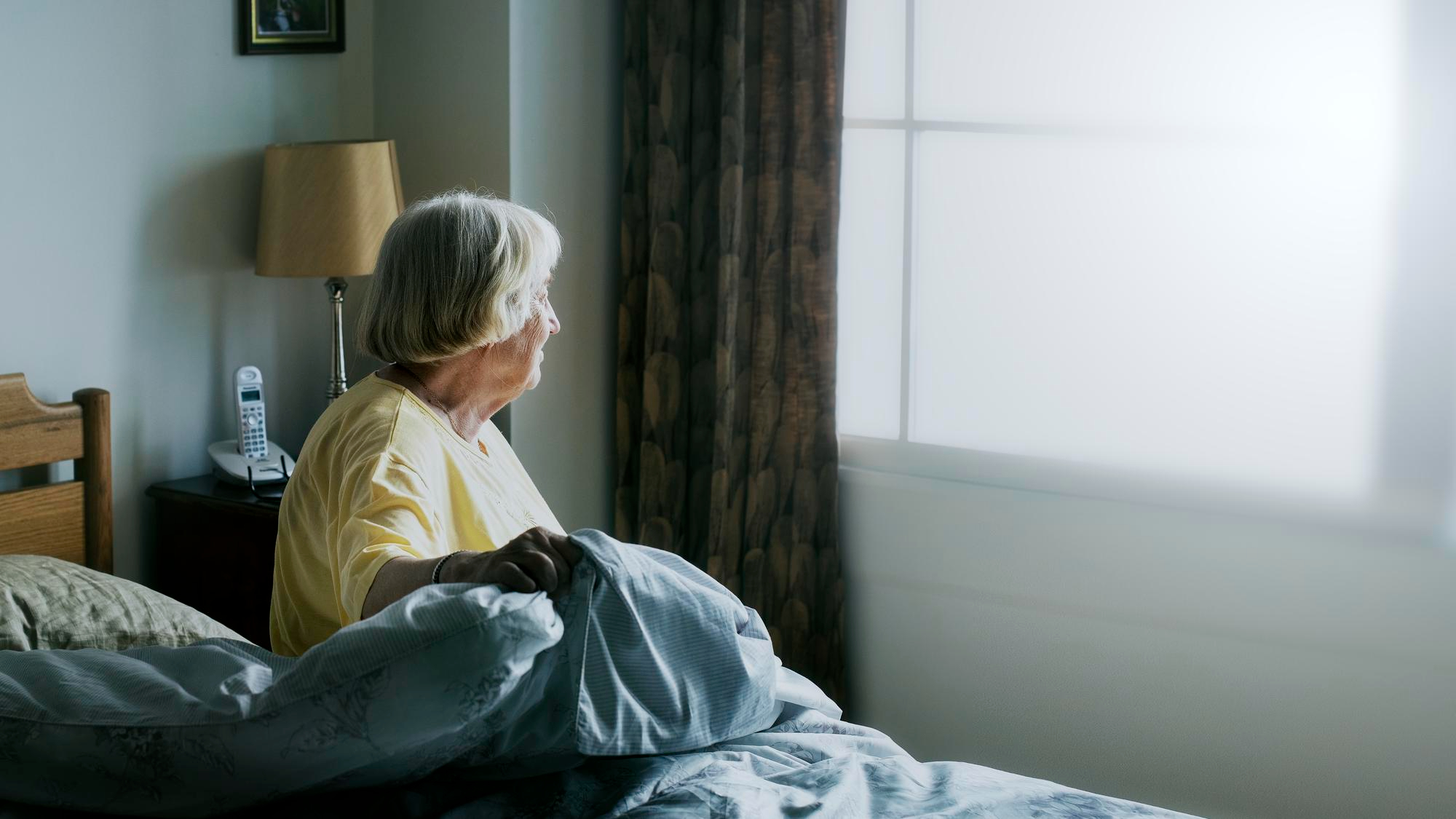
The Sound of a Secret
The kettle whistled at five forty-five in the morning, just like it did every morning. I poured two cups of tea, one for me and one for Brenda, and listened to the soft creak of my mother’s hospital bed down the hallway. The morning light was beginning to slide across the kitchen tiles, that pale, tentative light that comes just before dawn fully breaks. My hands moved through these motions without thought because after twelve years of repeating them, they’d become pure muscle memory. Kettle. Cups. Tea bag. Water. Two sugars for Brenda. No sugar for me anymore because somewhere in the past decade, I’d lost the habit of tasting anything sweetly.
Brenda let herself in without knocking, the way she’d been doing for over a decade. She was a good woman. Reliable in a way that had become the bedrock of my existence. She’d been there through the worst of it, the early years when I was still learning how to bathe someone who couldn’t stand, how to feed someone who couldn’t lift their head, how to maintain dignity for a person whose body no longer permitted any.
“You look like you didn’t sleep again, Margaret,” she said, hanging her coat by the door.
“I slept enough,” I replied, though we both knew that was a lie. Twelve years of double shifts at the office and night shifts at my mother’s bedside had carved themselves into my face in ways that sleep would never fully erase. There were lines under my eyes now that looked permanent, as though exhaustion had become the default setting of my face.
“That’s a no, then,” Brenda said, accepting the cup I handed her.
I smiled into my own tea. There wasn’t much point in pretending anymore.
“How was she last night?” I asked.
“Peaceful. Ate half her toast at dinner. Asked me to leave her alone for an hour with her phone, though.”
I looked up from my cup. “Her phone?”
Brenda shrugged, looking puzzled herself. “She’s been doing that more, sweetheart. Little stretches where she wants the door closed and some privacy. I don’t pry.”
“Mom barely knows how to text,” I said, though even as the words came out, I realized they weren’t entirely true. My mother had been learning things. There was something different about her lately, something I’d attributed to the advancing illness but which now seemed like it might be something else entirely.
“She’s learning, apparently,” Brenda said.
I laughed, but it was the kind of laugh that doesn’t contain real humor. My mother had been bedridden since I was twenty-eight years old, struck down by a stroke that had stolen most of her independence overnight. For the past twelve years, the only world she had was the one I’d built around her. The world of my schedule, my decisions, my life suspended in time around her needs. She’d never complained. She’d never asked for more than I could give. In many ways, she’d seemed to accept the life I’d constructed for us as inevitable, unavoidable, the way the world simply worked.
But something had shifted. Looking back, I could see the signs I’d willfully ignored. The phone appearing on her bedside table where it hadn’t been before. The closed door that Brenda mentioned. The way her eyes seemed to be looking at something beyond the walls of her room.
I carried her tea down the hallway that morning, pushing open the door with my hip the way I’d done thousands of times before. The room smelled like lavender soap and the lotion I rubbed into her hands every night, a ritual that had become less about physical care and more about the one moment of contact we still had.
“Morning, Mama,” I said.
“There’s my girl,” she whispered. Her hand, light as paper, found mine on the blanket.
“Brenda says you’ve been keeping secrets from her,” I said, trying to make it sound like a joke.
“A woman my age is allowed a few,” Mom said, and her eyes crinkled like they used to before everything got hard. Before the stroke. Before the years of decline. It was a glimpse of the woman she’d been, and it took my breath away a little.
I bent and kissed her forehead. She smelled like lavender soap and the lotion I rubbed into her hands every night. Everything about her was becoming more fragile, more temporary, more finite.
“I love you,” I said.
“More than you know, Margaret.”
But I was already glancing at the clock. Eight twelve. The bus came at eight twenty. I kissed her cheek and stepped out into a perfectly ordinary morning, completely unaware that everything was about to change.
Two months later, the call came while I was sitting at my desk, halfway through a stack of invoices that all looked exactly the same. Brenda’s voice was shaking so badly I almost didn’t recognize it. The normal, steady Brenda who’d been a constant in our lives had disintegrated into something fragile and uncertain.
“Margaret, you need to come home. Right now.”
I gripped the phone tighter. “Brenda, what happened? Is Mom okay? Did she fall? Did something happen?”
“Your mother let me go,” she said, and a sob broke through her voice. “There’s a man here. I don’t know who he is to her, but she chose him over me. Twelve years, Margaret, and she chose him.”
I tried to process the words, but they weren’t making sense. My mother had chosen a stranger over Brenda? My mother, who barely left her bed, who couldn’t walk, who depended entirely on the people I’d carefully selected to care for her?
“What are you talking about? Brenda, slow down,” I said.
“Just go home. Just see for yourself. I can’t be the one standing here when you do.”
The line went dead.
I grabbed my keys and left without another word. The drive home blurred past me in a sick haze. Twelve years of Brenda. Twelve years of trust and consistency and someone I’d learned to depend on. And now what? A stranger in my mother’s room? A man I didn’t know?
I pushed through the front door. The house was quiet. Too quiet. Unnaturally so. I marched straight to my mother’s bedroom and threw open the door, ready for something. An explanation. A reason. An emergency that would make this make sense.
What I found instead was my bedridden, fragile, exhausted mother beaming at a stranger like he had hung the moon.
Then I froze.
Sitting in the chair beside her bed was a man unlike anyone I’d ever seen in my mother’s room before. He was enormous, the kind of large that made the chair seem undersized. He wore a black leather vest over a dark shirt. His beard ran down to his chest, thick and graying. Tattoos crawled up his neck and across both of his enormous hands. In one of those massive, decorated hands, he held a spoon of chicken soup, gently angled toward my mother’s lips.
And my mother. My bedridden, fragile, exhausted mother was looking at him like he was the most important person in the world.
“Mom?” My voice came out smaller than I intended.
She turned, and her smile faltered just a little. “Margaret. You’re home early.”
The man set the spoon back into the bowl and wiped a drop from her chin with the kind of tenderness that made my stomach hurt. He stood up slowly, gathering the full measure of his height.
“I’ll be in the garden, Miss Margaret,” he said quietly.
He brushed past me. I waited until I heard the back door close before I turned on my mother.
“Who is that?” I hissed. “Mom, where did you find him? Brenda is crying her eyes out. She said you fired her. You can’t just fire Brenda. She’s been here for twelve years.”
“His name is Louis,” my mother said.
“That’s not an answer. Mom, look at him. Tattoos, a leather vest. He looks like he just walked out of a motorcycle bar. What if he robs you? What if he hurts you? What were you thinking, letting a complete stranger into the house while I was at work?”
“He isn’t a stranger to me.”
I stopped. “What does that mean?”
She didn’t answer. She turned her face toward the window, toward the garden, toward him. In twelve years of bathing her, feeding her, lifting her, and holding her through the worst of her illness, I had never once heard her speak to me the way she was speaking now. Like I was the one who didn’t belong in the room.
“Mom, please. Talk to me. Brenda has been with us for over a decade. She loves you. You can’t just throw her out and bring in some biker off the street.”
“He is staying,” she said. Her voice was suddenly iron, a strength I hadn’t heard from her in years. “I want Louis to be the one taking care of me. Do you hear me, Margaret? No matter what.”
I opened my mouth. I closed it again. The conversation had shifted into territory I didn’t understand, territory where my mother was suddenly someone I didn’t quite recognize.
The weeks that followed felt like a slow war fought in whispers and suspicious glances. Louis moved through our house like he had always belonged there, like he’d been waiting his entire life for permission to inhabit these rooms. He refilled my mother’s water glass without being asked. He adjusted her pillows with the kind of attention to detail that suggested he understood her body better than I did. He read aloud from her old gardening magazines, his deep voice bringing life to articles about perennials and soil composition. My mother had handled all the paperwork, the payroll, the hiring of Louis herself before I’d come home that first day. By the time I thought to demand references and check his background, the arrangement was already signed, official, impossible to undo without cause.
I watched him from doorways, from hallways, from the corner of my eye over morning coffee. I waited for the slip. The greedy glance at her jewelry box. The phone call to some accomplice. Some indication that this was all part of a con, a plan to exploit a vulnerable elderly woman. And every time I walked into the room, their voices dropped to nothing. They were discussing something I wasn’t permitted to hear.
“You don’t have to hover, Miss Margaret,” he told me one afternoon, not unkindly. “I’m not going anywhere.”
“That’s what worries me,” I shot back.
He just nodded, like my hostility was a weather pattern he’d learned to dress for. Like he understood that what I was expressing wasn’t really about him at all.
My mother, meanwhile, was blooming in ways I hadn’t thought possible. She laughed at his stories. She finished her meals, actually finishing them, not leaving half the food untouched the way she had for months. Her cheeks, hollow for years, filled out a little. There was color in her face that hadn’t been there before. She seemed to be waking up, coming alive in ways I’d thought were permanently lost.
One evening, I asked her what they were talking about when I interrupted them.
“What were you two discussing?” I asked, trying to keep my voice casual. “When I came in just now, you both went quiet.”
“Just old songs,” my mother said sweetly. “He was asking me about the songs I used to sing.”
Louis was tucking something into his vest pocket. A small leather notebook. I’d seen him writing in it before, always when he thought I wasn’t looking. Pages and pages of his careful handwriting. What was he writing about? What could possibly require that much documentation?
That night, I called Brenda from the kitchen, my voice low so Louis wouldn’t hear from wherever he was in the house.
“Brenda, please. Just tell me what you know. What was she talking about with him? Why won’t she explain anything?”
There was a long silence on the line. I could hear her breathing, the sound of her struggle to decide whether to tell me something or keep her loyalty to my mother.
“I don’t know who he is, Margaret. That’s what hurts. She wouldn’t tell me. Twelve years I sat at that woman’s table, and she wouldn’t tell me. She just said she’d chosen him and that I should mind my own business. So I left.”
“That’s not an answer,” I said.
“It’s the only one I have,” Brenda replied.
She hung up.
Three days later, my mother had the attack.
That night, while Louis slept in the guest room, I did something I was not proud of. I went through his jacket where it hung over the chair. My hands shook as I reached into the pockets. I felt like a criminal, violating someone’s privacy this way, but I needed to know. I needed to understand what was happening in my own house, what my mother was hiding.
I found the notebook.
Beneath it was a photograph, old and cracked at the corners. It showed a young woman in a hospital gown holding a newborn. Her face was turned away from the camera, but something about her shoulders, the way she was holding the baby, seemed familiar in a way I couldn’t quite place. I stared at it for a long time, trying to understand what I was looking at and why it had been hidden in Louis’s pocket.
I put everything back exactly as I’d found it, my heart pounding with questions I couldn’t answer.
The ambulance came at four in the morning. Louis carried her through the hallway and out to the waiting paramedics himself, this enormous tattooed man cradling my mother like she was made of paper, his face wet with tears I couldn’t reconcile with anything I’d told myself about him. He looked at her like she mattered. Like she was the most important thing in the world.
At the hospital, the doctor was firm and clinical in his delivery of the news.
“This is the illness, Margaret. It’s progressing. This wasn’t caused by anything someone did or didn’t do. Your mother’s condition was always going to deteriorate. This is simply part of that natural progression.”
I heard the words. I didn’t believe them. I believed instead that something about Louis’s arrival, about the emotional upheaval of his presence in our lives, had contributed to this. That if I’d been more vigilant, if I’d questioned things sooner, if I’d demanded explanations, none of this would be happening.
Louis never left her bedside. He held her hand through the IV lines. He whispered to her when the monitors beeped their anxious rhythms. He brushed her hair back like he’d been doing it his whole life. It made my skin crawl, the way he acted as if he were her son, as if he had any right to that kind of intimacy with my mother.
When my mother finally drifted into sleep, I stood up. My chest felt tight, my hands clenched into fists.
“Louis. Outside.”
He followed me into the corridor without a word. We walked until we were away from the door, away from any possibility that my mother would hear what I was about to say.
“I want you to quit,” I said. “I’ll pay you three times what she’s paying. Tonight. You walk away and you don’t come back. I’ll give you cash. I’ll give you a recommendation. I’ll give you whatever you need, but you leave my mother alone.”
He looked at me for a long moment. Then he turned and walked toward the elevator without responding.
“Louis,” I called, following him. “Answer me. You can’t just walk away without explaining yourself.”
He didn’t stop until we were through the sliding doors and standing in the cold parking lot, the fluorescent lights buzzing above us like angry wasps. The night air was sharp and clean, a contrast to the recycled hospital air we’d just left.
He turned around slowly. He took the leather notebook from his vest pocket and held it out to me.
“She asked me to stay silent,” he said. “I can’t anymore.”
He took a breath that seemed to come from somewhere incredibly deep, somewhere that had been holding onto this information for longer than I could imagine.
“Sixty years ago, before you were born, your mother had a baby,” he said quietly. “A boy. She was nineteen and unmarried, and her family wouldn’t let her keep him.”
The parking lot tilted. I reached out for something to steady myself, but there was nothing there.
“She gave him up for adoption,” Louis continued. “She registered her name with an adoption registry years later, just in case. A year ago, that boy found her.”
I knew before he said it. The photograph. The shoulders. The way my mother looked at him, like she was seeing something she’d thought was lost forever.
“You,” I whispered.
“Me,” he said. His enormous hands hung at his sides. “She didn’t want to die without knowing me, Margaret. And she didn’t want to lose you in the trying.”
I stood under the buzzing lights, and every wall I’d built came down at once.
We went back inside. My mother was awake, her thin hand resting on the blanket, her eyes tracking the door the moment Louis entered. I sank into the chair beside her bed, my voice cracking.
“Why a stranger, Mom? Why not me? Why couldn’t you tell your own daughter?”
Louis stood there, jacket folded over his arm, the notebook tucked beneath it.
She closed her eyes for a long moment.
“Because I was ashamed, Margaret. Sixty years of shame. I gave him away before you were ever born.”
“And you thought I’d hate you for that?” I asked.
“I thought you’d feel replaced,” she whispered. “I taught myself how to use the phone so I could write to him without anyone knowing. I wanted a little time with him. Just a little, before the truth came out.”
A shadow moved in the doorway. Louis stood there, his enormous frame somehow not threatening anymore, just present.
“I’ll go, Miss Margaret,” he said quietly. “If that’s what you want, I’ll go, and you’ll never see me again.”
I looked at him. This enormous, tattooed man who had been spoon-feeding my mother soup, reading to her, treating her with tenderness that I’d somehow failed to provide. Then I looked at my mother, her eyes pleading without a single word.
I stood up and walked to him. I took the notebook from his hand, then the soup container the nurse had left on the tray.
“Sit down, Louis,” I said. “She likes it when you tell her about your daughters.”
His shoulders dropped. My mother let out a breath that sounded like she’d been holding it for sixty years.
Later, I opened the notebook and found pages of questions Louis had been saving up to ask her. What songs she sang as a girl. Whether she liked the sea. What color her mother’s eyes had been. What he had looked like as a baby in the few minutes she had held him. Pages and pages of a lifetime of wondering, all documented in careful handwriting, all the things he’d wanted to know about the woman who’d given him up.
Weeks later, the three of us sat in the garden on a Sunday. Brenda came by with bread, sheepish and forgiven. My mother laughed at something Louis said, and the sound carried across the lawn like music. I realized, sitting there watching them together, that I had spent twelve years thinking I was my mother’s whole world. I’d been wrong. She had been quietly carrying another world beside it, a secret world, a world that was finally allowed to surface.
Family, I learned, wasn’t only the people you’d always known. Sometimes it was the ones brave enough to come home.

Adrian Hawthorne is a celebrated author and dedicated archivist who finds inspiration in the hidden stories of the past. Educated at Oxford, he now works at the National Archives, where preserving history fuels his evocative writing. Balancing archival precision with creative storytelling, Adrian founded the Hawthorne Institute of Literary Arts to mentor emerging writers and honor the timeless art of narrative.