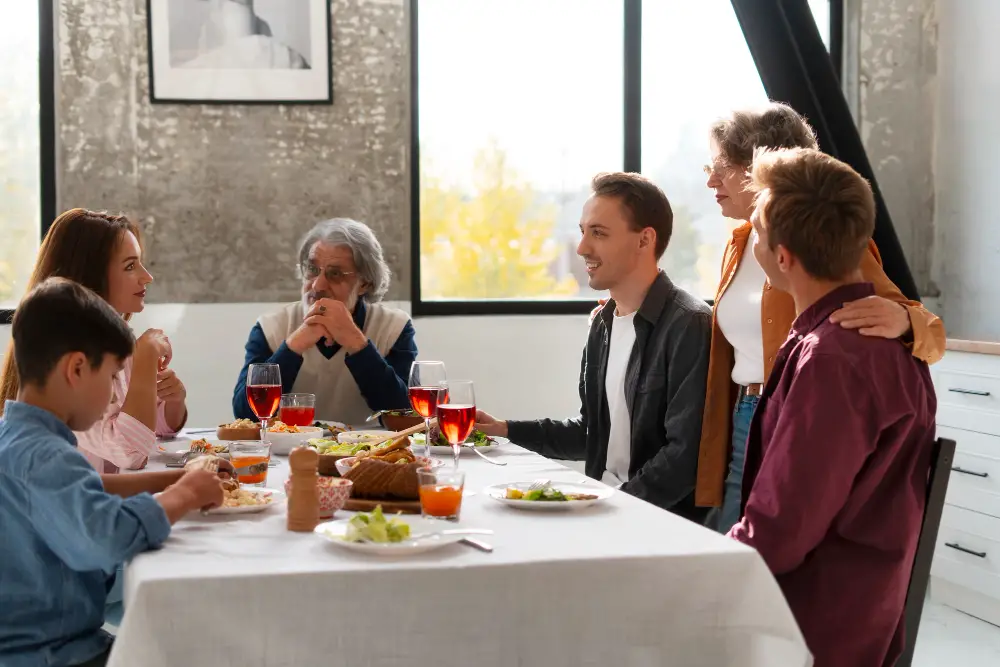
When my brother Ryan announced baby number five at Sunday dinner, my parents reacted as though he had just been elected to high office.
Dad was the first to stand, clapping Ryan hard on the back with both hands the way he only did for accomplishments he considered significant. “Great job, son,” he said, grinning across the dining room as though Ryan had personally secured the family’s future and deserved a moment to bask in it.
Mom dabbed at her eyes with a napkin. “Another blessing,” she whispered.
Across the table, my sister-in-law Madison rested one hand over her stomach and smiled the particular smile of a woman who understood that this room belonged to her at that moment, that the admiration was directed at her body and Ryan’s and the life growing inside her, and who had learned over the years that this particular announcement was the one that made everyone in my family turn soft and generous and willing.
Their four children were racing through the hallway outside the dining room, shrieking over something that had broken in the living room. I was, as far as I could tell, the only person at the table who heard the crash.
Then Mom looked at me.
“You’ll handle the kids,” she said.
Not a question. Not a request. Not a favor being asked between people who loved each other. A declaration, the way you say a fact about the weather or tell someone the meeting starts at nine.
I set down my fork.
“Absolutely not.”
The room fell silent so completely I could hear the refrigerator buzzing in the kitchen and the distant sound of the television that Ryan’s oldest had turned on in the living room after the toy broke.
Ryan frowned. “Don’t start, Olivia.”
“I’m not starting anything,” I said. “I’m ending something.”
And I meant it more than any sentence I had ever said in that house.
For eight years I had been the emergency babysitter, the weekend babysitter, the last-minute school pickup, the unpaid after-school tutor, the person who remembered class photo day when Madison forgot, the one who stayed late when Ryan’s work ran long, the one who showed up on sick days when the daycare called and Madison said she couldn’t leave a meeting. I had rearranged my schedule around their emergencies, skipped plans I wanted, and fielded phone calls on Friday evenings from people who treated my weekend like a scheduling resource. I was thirty-one years old, working full time at a job I had built carefully over a decade, living alone in an apartment I paid for entirely myself, and somehow still treated by my family as surplus capacity rather than a person. As though the fact that I had not had children meant I had excess time and energy available for redistribution. As though my life, because it did not contain what their lives contained, could be borrowed from without asking. As though I was practicing for a life I had not yet earned the right to have rather than living the one I already had.
Madison’s smile disappeared.
“You have no family,” she said. “This is your training.”
The words struck colder than I expected. Not because they were new exactly, but because she said them in the middle of a room full of my parents, in front of my brother, and not a single person flinched. My mother’s eyes moved away from mine. My father stayed quiet. Ryan only sighed, slowly, the way he sighed whenever he felt I was being difficult and wanted the room to notice that he was handling it with patience.
I got to my feet. I laid my napkin beside my plate with care, picked up my purse from the chair back, and looked at the table one last time.
Mom followed me to the front door. “Olivia, don’t be dramatic.”
I turned back and looked at the room. At my parents, who had not said a word when Madison told me I had no family. At Ryan, who sighed. At Madison, who had deployed those words as easily as she deployed everything else when she wanted something.
“I’m not dramatic,” I said. “I’m done.”
I walked out without another word and drove back to my apartment, where I sat in the kitchen for a long time and tried to decide whether what I felt was grief or relief or both at once, and eventually concluded it was both, and that both were justified.
The next morning my phone rang at 7:42.
I had been awake for a while already, not because I slept badly but because I kept waking up replaying Madison’s sentence. You have no family. This is your training. I had been turning it over and over in the early morning dark, the way you turn something over looking for an angle that makes it less sharp, and had not found one.
The number on my screen was local and unfamiliar. I almost let it go. Then something made me answer.
“Hello?”
A steady male voice. “Ma’am, this is Officer Daniels with the Brookhaven Police Department. Am I speaking with Olivia Carter?”
My stomach clenched. “Yes.”
“Your brother and sister-in-law listed you as the responsible caregiver for four minor children this morning.”
I sat upright.
“They what?”
There was a brief pause.
“Ma’am,” he said, carefully, the way someone speaks when they have already managed several difficult conversations that morning and know another one is beginning. “We need you to come to the station and make a statement. The children were found alone.”
For several seconds I did not move.
Then I heard his voice again.
“The children are safe,” he said. “A neighbor called after seeing the youngest child near the driveway without an adult present. We responded to the home. Your parents arrived shortly after. Your brother and sister-in-law are being contacted.”
My mouth went dry. “I was not watching them.”
“That is why I’m calling,” he said. “Your name and number were written on a note left on the kitchen counter.”
I stared at the bedroom wall. I was still wearing the same sweatpants I had put on after getting home the previous night. After crying harder than I had intended. After sitting in the kitchen for a long time trying to name what I was feeling.
“What note?”
He cleared his throat. “It said, ‘Olivia has the kids until noon. We’ll be at the clinic.'”
I closed my eyes.
Of course.
They had taken my refusal, erased it from the record as though it had never occurred, and decided they could reproduce my compliance in writing. They had written my name on a piece of paper and left four children in an empty house and driven away, trusting that the paper would become reality because it had always become reality before. Because I always came. Because I always helped eventually. Because the version of me who said no was the version they had simply chosen not to believe in.
“I never agreed to that,” I said. “I left my parents’ house last night before nine. I have not spoken to any of them since.”
“I understand,” Officer Daniels said. “We need that documented.”
I got dressed, made coffee I did not drink, and drove to the Brookhaven Police Department with a folder I had started keeping two years earlier.
I used to be ashamed of that folder.
It had started as a collection of a few screenshots, the ones that were so blunt in their assumption of my availability that I saved them out of a kind of stunned disbelief, the way you save a receipt for something you cannot quite believe you paid for. Over time it grew into something more systematic. Screenshots of texts, saved voicemails, calendar invitations that had arrived as faits accomplis rather than questions, records from every time Ryan and Madison had left their children with me without warning and without asking. I had started keeping them quietly, without a clear plan, but because something in me recognized that the pattern needed witnesses, even if I was the only one witnessing it.
At first I told myself I was saving them because someday, if I laid them all out in front of my family and let them see the whole picture in sequence, they might finally understand. Then I stopped believing in someday. Then I stopped believing that understanding was actually what they were missing. And I started believing instead in documentation, in the quiet discipline of keeping an accurate record of what was actually happening so that when the moment came, I would not be standing in a room armed only with my memory against their preferred version of events.
Officer Daniels met me in a small interview room. He was younger than I had imagined, somewhere in his late thirties, with tired eyes and a careful manner.
“I need to ask you directly,” he said. “Were you asked to watch the children today?”
“No.”
“Did you agree to watch them today?”
“No.”
“Did you have access to the house this morning?”
“No. I left last night and went directly to my apartment.”
He nodded, writing steadily.
“Your mother told us there was a misunderstanding,” he said.
I almost laughed. “My mother calls everything a misunderstanding when Ryan causes it.”
He looked up.
So I opened the folder.
There was Madison’s text from the previous Thanksgiving: We’re leaving the kids with you for the weekend. Don’t make it weird.
There was Ryan’s message from March: You don’t have a husband or kids, so stop acting busy.
There was the voicemail from my mother in April, her voice warm and patient in the way she used specifically to make me feel small: Family helps, Olivia. You should be grateful they need you.
There was a string of messages from the prior summer in which Ryan and Madison had arranged pickup, dropoff, and overnight care for three separate weekends using my name in their planning texts without ever once sending one to me.
Officer Daniels read in silence. His expression shifted with each page, not dramatically, but the way a person’s face shifts when something they were beginning to suspect is confirmed.
When he reached the screenshot from the previous night, he stopped.
It was a message from Madison, sent approximately forty-five minutes after I had walked out of my parents’ house.
You’ll learn one way or another. Don’t think you can walk away from family.
Officer Daniels looked at me for a moment.
“Ms. Carter,” he said, “this is no longer just a misunderstanding.”
And for the first time in years, someone outside my family looked at what they had been doing to me and named it correctly.
By noon, my parents were at the station.
Mom entered first, pale and gripping her purse like a shield, her expression the specific one she wore when she was furious but needed to appear composed. Dad came in behind her, red-faced, his jaw tight in the way that meant he had already decided someone was wrong but had not yet decided what to do about it. Ryan arrived ten minutes later with Madison, who looked less like a radiant expectant mother and more like a woman who had expected sympathy and discovered she had walked into a room full of paperwork instead.
The moment Madison saw me, her eyes narrowed.
“You called the police on us?” she said.
Officer Daniels stepped into the space between us before I could respond. “No, ma’am. A neighbor called after finding your child outside unattended.”
Madison opened her mouth, then shut it.
Ryan pointed at me. “She was supposed to be there.”
I stood slowly. “You wanted me to be there. That is not the same thing.”
Mom turned toward me and whispered sharply. “Olivia, stop making this worse.”
I looked at her carefully. “Worse than four children being left alone in a house?”
She had nothing to say to that. Her expression tightened, but the words did not come, because there were no words available that could make what had happened sound like something other than what it was.
Ryan started speaking quickly, the way he always did when he was explaining something he knew was difficult to explain. He said Madison had a morning appointment. He said they thought I would calm down after dinner and come over. He said I always helped eventually. He said family arrangements were casual and everyone understood that, and that the note was just a formality in case any of the neighbors saw the kids and got confused.
Officer Daniels listened without cutting him off.
Then he placed the note on the table.
“Who wrote this?”
Madison looked away.
Ryan swallowed.
“Who wrote the note saying Olivia had the children until noon?” Officer Daniels asked again, evenly.
Madison’s voice came out thin. “I did.”
“And did Olivia agree?”
“She should have,” Madison said.
The room went completely still.
Officer Daniels leaned back slightly. “That was not my question.”
Madison’s face flushed. A long moment passed. Everyone at the table waited, and in that waiting I felt eight years of accumulated history pressing itself into a single square foot of silence.
“No,” Madison said.
That single word changed the shape of the room.
No, I had not agreed.
No, I was not responsible for what had happened.
No, they could not continue to assign me obligations without my consent and then call it family.
The consequences that followed were not cinematic. There was no single moment of dramatic reversal, no scene where someone wept and admitted everything while the rest of us watched. Child protective services opened an inquiry. Ryan and Madison were formally warned, questioned separately, and required to demonstrate that confirmed childcare arrangements were in place for the upcoming months. My parents were asked to clarify what, if anything, they had verified before assuming I would be present that morning. The neighbor who had called gave a statement. The note became part of a file with my name on it, attached now to an account that told the truth rather than the one Madison had written.
But the real consequence happened inside that room.
For the first time, my family had to say aloud the thing they had always buried beneath guilt and expectation and the quiet assumption that I would absorb whatever they needed.
They had never asked me.
They had assigned me.
And they had done it with such confidence, for so long, that they had apparently stopped noticing the difference.
The weeks that followed were not peaceful. They were the specific discomfort of people who have been comfortable with an arrangement suddenly discovering that the arrangement required the consent of another person.
Madison sent a long text two weeks after the station visit, explaining that the stress of the pregnancy had caused her to say and do things she did not fully mean, and that she hoped we could move past it. Ryan sent a single sentence: We need to move forward.
I replied to both of them with the same answer.
I am moving forward. Without being your childcare plan.
Then I blocked both numbers for a month. Not from anger. From clarity. Because there are conversations worth having and conversations that require a period of silence before they become possible, and I had learned over eight years which category Ryan and Madison’s conversations fell into.
My parents were more difficult.
Mom cried, which was her primary response to consequences she had not anticipated. Dad apologized in pieces, incompletely at first, in the halting way of a man who was not accustomed to apologizing and was not entirely sure how. I did not demand a complete and perfect accounting. I simply told them that I would no longer attend family gatherings where my time was treated as publicly available, and I told them this without anger, as a statement of fact about how things were going to be rather than a threat about what would happen if they were not.
It took several conversations for them to understand that I was not threatening them.
I was informing them.
The pregnancy continued. Madison grew, and Ryan sent updates through my parents, and my parents passed them along to me with the careful neutrality of people managing a diplomatic channel.
Baby number five arrived on a Thursday in February.
I sent a gift. A soft blanket in pale yellow, a card with a simple congratulations, and nothing more. No offer to babysit. No note indicating emergency availability. No implicit permission embedded in the act of showing up with a bag of things and a face that said of course I’m here.
Just a blanket and a card, mailed from my apartment in the new city.
And this sounds small, but it was not. Every gift I had ever sent Ryan’s family before had come wrapped in an invisible obligation, the understanding that my presence was also available, that my care was also on offer, that the physical gift was accompanied by a standing offer of my time and energy that I had never explicitly made but had never explicitly refused. The gift had always been a gesture toward belonging, a way of saying I am here and I will keep being here in whatever form you need. This time the blanket was simply a blanket. It did not mean I would drive over. It did not mean I had softened. It did not mean I was available on Saturday.
It meant there was a new baby, and I wished them well, and that was the entirety of what I intended it to mean.
I sent it, and I did not feel guilty.
For the first time in eight years, I held my own life without feeling guilty for refusing to hand it over.
The months that followed were not dramatic. That was the part I had not expected. I had spent so long bracing for the family to collapse if I stopped being available that I had not fully imagined what would happen if it simply adjusted. I had built a fear around the collapse, added to it quietly over years, let it become one of the reasons I kept saying yes. If I stopped, the structure would fail. If I set limits, the family would crack. If I let one emergency go unanswered, something irreparable would happen and it would be my fault.
None of that happened.
The structure adjusted. Unevenly, and not without friction and resentment and several conversations that were uncomfortable in different ways, but it adjusted. Ryan and Madison hired a part-time childcare worker, which they had apparently been capable of doing the whole time. My parents stopped assuming and started asking, at first with some difficulty and then with more ease, and I started saying yes to some things and no to others, and they learned to receive both answers without treating one of them as a crisis.
I still saw my family. I went to Christmas. I attended Ryan’s oldest son’s birthday party in April and watched the kids run around a backyard full of balloons and ate cake from a paper plate and talked to my nephew about the chapter book he was reading. I was present for the moments that mattered because I chose to be, and not because someone had decided my choice was irrelevant.
That distinction changed everything about how the moments felt.
My parents and I had a long conversation one Sunday afternoon in late spring, on their back porch, with coffee getting cold on the small table between us. The yard was starting to bloom, and the neighbor’s dog was barking somewhere down the street, and I thought about how many conversations I had had in this yard over the years, how many dinners I had eaten in that house, how many nights I had driven home exhausted from their kitchen after doing something I had not agreed to do.
My father did most of the talking, which surprised me, because he was usually the one who waited for someone else to name the problem before deciding where he stood. He told me he had not understood, when it was happening, how much I had been absorbing. He said he had told himself I was fine because I did not complain, and that he now understood that this was not the same thing as being fine. He said he had confused my steadiness for contentment. He said he had been wrong about what my steadiness was costing me.
He did not apologize for everything. He did not have language for all of it, and I did not require it. He apologized for the specific things he could name, and named them carefully, and those were enough. They were a beginning, which was what I had asked for.
My mother was quieter than usual, which for her was notable. She said she had wanted to keep everyone happy for as long as she could remember, and had not always understood that keeping peace and keeping people intact were not the same project. She said she had been afraid, when I walked out that Sunday night after the dinner, that she had genuinely lost me. She said the weeks after that had been the hardest of her recent life.
I told her she had not lost me. I told her she had found a version of me that was harder to manage and easier to trust, and that I hoped, over time, easier to keep.
I meant that completely.
In the autumn I was offered a promotion at work, one that required a relocation to a city two hours away, and I took it. I told my parents after I had accepted it, not before, and this was deliberate. I had spent enough years checking whether my choices were permissible to understand that the checking had become its own form of permission-seeking, its own subtle way of making my life available for other people’s input. So I accepted the promotion, signed the paperwork, and then called my mother and told her the news.
She was quiet for a moment. Then she said she was proud of me.
I believed her.
My apartment in the new city had a second bedroom that I converted into a home office, a proper kitchen table that I picked out at a secondhand shop on a Saturday afternoon with no one else’s opinion involved, and a south-facing window where I eventually kept three houseplants, only one of which survived the winter, which I considered an acceptable outcome for a person still learning. I cooked dinners on weeknights with enough time to actually eat them before they went cold. I read in the evenings. I went to sleep when I wanted to and woke up when the alarm went off and moved through my days without the persistent background noise of someone else’s emergency.
The first winter in the new city, I flew home for Christmas.
Ryan and Madison arrived with five children and the particular controlled chaos of a family that had learned how to travel together, bags and car seats and one child carrying a stuffed animal under each arm. The baby was several months old by then, round and startled-looking, the way very young infants look as though they have arrived somewhere unexpected and are not yet certain how they feel about it.
The four older children scattered in the way children do when released into a grandparents’ house, instantly dispersing to the places they knew and the toys they remembered. Ryan set bags down near the door. Madison unzipped the baby from a small quilted jacket and handed him immediately to my mother, who took him with the kind of practiced ease that only grandmothers have.
Madison said hello to me with the careful tone of someone who has rehearsed being civil and has, through repetition, gotten reasonably good at it. Not warm, not cold. Measured. I recognized the effort it represented and I received it without comment.
I said hello back with the same care.
Ryan shook my hand, which we had never done before, and the gesture was both awkward and accurate. We were not strangers, but we were also not the same people who had sat at the same table for thirty years pretending the arrangement was working. We were people who had been honest, imperfectly and at great cost, and were now on the other side of that honesty trying to find out what remained.
My mother took the baby from Madison and walked him around the kitchen murmuring, and my father helped Ryan carry bags in from the car, and Owen, who was nine now and had grown several inches since I last saw him, found me in the hallway and said, “Aunt Olivia, did you know that the first computers were the size of a whole room?”
I said I had heard that.
He said he thought it was incredible that something so big could become something that fit in your pocket.
I said I thought so too.
He went off to find his brothers, and I stood in the hallway for a moment, between the kitchen and the living room, and thought about what it meant to make yourself smaller and smaller until you fit where other people needed you to fit, and then what it meant to stop.
It did not make me larger. It did not make me more important or more visible or more recognized. What it did was give me back the room to be exactly the size I was. And I was, as it turned out, a specific and particular person with preferences and limits and a life that was entirely my own, and those qualities had been true all along. They had simply been waiting for me to stop treating them as inconveniences.
At dinner, someone asked whether I was seeing anyone, which was the question that always arrived at family dinners with the predictability of bread.
I said not at the moment.
My mother started to say something and then stopped herself. My father looked at his plate. Ryan refilled his water glass.
Madison said, with something that was not quite warmth but was not hostility either, “You seem really good.”
I looked at her.
“I am,” I said.
And I meant it in a way I had not meant it at a family dinner in a very long time.
Later, when the dishes were done and the children were piled on the living room floor watching a movie and making occasional sharp sounds of dispute that the adults ignored, I slipped out onto the back porch with a cup of tea and stood in the cold looking at the dark yard.
I thought about Officer Daniels saying my name at 7:42 in the morning, his voice careful and steady, the practiced tone of someone who had learned not to rush a person toward panic.
I thought about the folder. About the two years I spent building it quietly, not knowing quite what I was building toward, saving each screenshot with the vague feeling that accuracy mattered even when no one was asking for it.
I thought about Madison’s text from that Sunday night: Don’t think you can walk away from family.
I had walked away from the version of family that required my erasure to function. The version that needed me to have no inconvenient limits, no compelling alternate obligations, no life so full and self-directed that it became an obstacle to their plans. The version that had concluded, somewhere in the years before I noticed, that my value to them was greatest when I was most available and least myself.
What I had walked toward was harder to name and slower to build. A life arranged around my actual choices rather than around the quiet fear of what would happen if I made them. An apartment in a new city with a kitchen table and a houseplant and evenings that belonged entirely to me. A promotion I had accepted because I wanted it. A blanket sent to a new baby without strings attached, without the invisible obligation woven into every previous gift I had ever wrapped for that family.
The porch was cold. The yard was dark. From inside, I could hear the muffled voices of my family, the baby making a small sound, one of the older children laughing at something on the television, my mother’s voice carrying the warm correcting note she used when things were about to tip into chaos.
I stayed outside a little longer, drinking my tea.
Then I went back in.
Some lessons arrive through grief, or through confrontation, or through a long conversation on a back porch in late spring with coffee cooling between your hands while you try to find words for things that were never named while they were happening. Mine arrived on a Tuesday morning in a small interview room at a police station, with the sound of a phone ringing at 7:42 and a steady voice saying my name and the understanding, sudden and completely clear, that my name had been placed on a note without my knowledge, used as a prop in someone else’s plan, and that I finally had the documentation to prove the difference between what had been assigned to me and what I had chosen.
That difference was everything.
The phone rang once more after midnight on a Saturday, months later. Ryan’s name on the screen, glowing in the dark of my bedroom in the new city.
I watched it ring.
I thought about answering.
Then I put the phone face down and went back to sleep.
In the morning, there was no message.
I made coffee. I opened the window. The city outside was doing what cities do, moving forward without asking whether I was ready.
I was.

Lila Hart is a dedicated Digital Archivist and Research Specialist with a keen eye for preserving and curating meaningful content. At TheArchivists, she specializes in organizing and managing digital archives, ensuring that valuable stories and historical moments are accessible for generations to come.
Lila earned her degree in History and Archival Studies from the University of Edinburgh, where she cultivated her passion for documenting the past and preserving cultural heritage. Her expertise lies in combining traditional archival techniques with modern digital tools, allowing her to create comprehensive and engaging collections that resonate with audiences worldwide.
At TheArchivists, Lila is known for her meticulous attention to detail and her ability to uncover hidden gems within extensive archives. Her work is praised for its depth, authenticity, and contribution to the preservation of knowledge in the digital age.
Driven by a commitment to preserving stories that matter, Lila is passionate about exploring the intersection of history and technology. Her goal is to ensure that every piece of content she handles reflects the richness of human experiences and remains a source of inspiration for years to come.