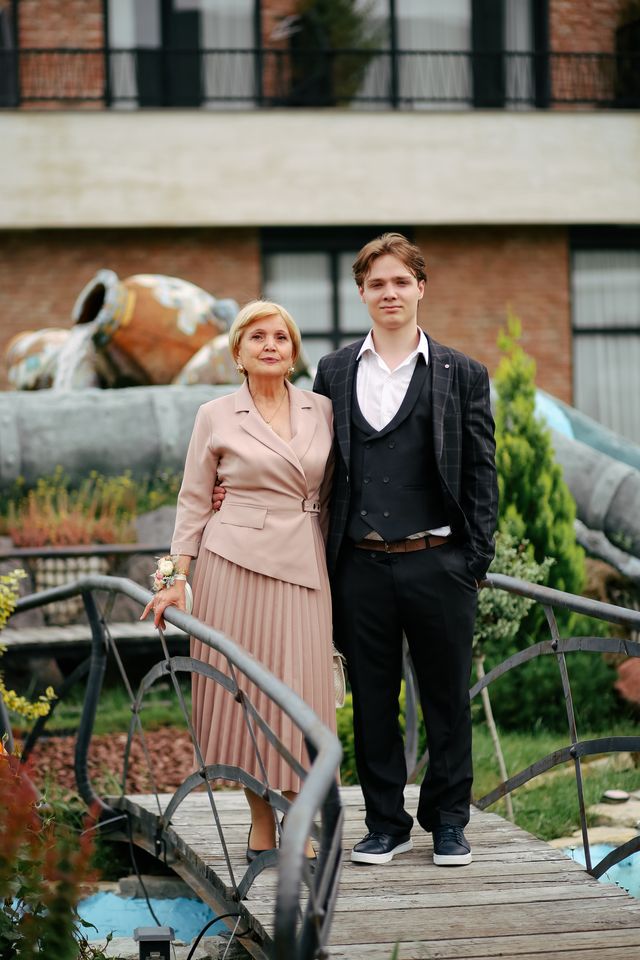
When I married Evelyn, I was twenty-five years old, broke, buried in debt, and spending my nights sleeping in the cab of my pickup truck behind a grocery store on the edge of town.
She was seventy-one. A widow. Soft-spoken. Kind. She lived in a warm little house on a quiet street where the neighbors waved from their porches and someone always seemed to be mowing a lawn or walking a dog or carrying groceries in from the car. It was the kind of street I had grown up driving past and never thought I would live on.
And no, I did not marry her out of love.
I told myself I was doing what I had to do to survive. Stay a few years. Play the role of devoted husband. Wait for the house to become mine someday. Then finally escape the life that had been grinding me down since I was nineteen. I had a plan, or what I called a plan, which was really just desperation with a timeline attached to it.
What had brought me to that point was a series of choices and circumstances that ran together so thoroughly I had stopped being able to tell them apart. I had left home at seventeen with a bag and the phone number of a cousin who turned out to have moved two states away. I had worked a string of jobs that paid just enough to keep me from being smart about money, if that makes any sense. A restaurant job led to a car payment I could not sustain. A job at a warehouse led to a loan I took out to cover the car, then another loan to cover the first one. By twenty-two I had $45,000 in debt and the earning capacity of someone who had never finished community college, which I had started twice and quit twice, once because of money and once because of what the money situation had done to me by then.
I was not a bad person. I was not unintelligent. I was simply in a hole so deep that looking up had started to feel pointless, and I had stopped looking up.
The truck was a 2003 Ford I had bought from a man in a parking lot for $900. It ran well enough. Behind the grocery store there was a section of the lot that the night manager did not patrol, and I had been parking there for four months. I kept my things in a duffel under the seat and a metal box in the back. I showered at the public recreation center. I ate from the hot food case at the gas station two blocks away.
I met Evelyn at the diner where I occasionally spent a few dollars on coffee in order to sit somewhere warm and think. She came in every Tuesday morning and always sat at the same table by the window. She ordered the same thing each time, a cup of tea and a slice of toast, and she brought a paperback book that she held with one hand while she ate. She did not look like a woman who was waiting to be talked to, but she also did not look unfriendly.
After three weeks of nodding to each other, she asked if I wanted to join her.
I said yes because the alternative was sitting alone with my thoughts, which had not been pleasant company for some time. I sat down expecting a conversation about nothing, the kind that gets you through a cup of coffee without having to look at yourself. Instead she asked, within fifteen minutes, what I was good at. Not what I did. Not where I worked. What I was good at.
It caught me off guard enough that I answered honestly.
Fixing things, I said. Figuring out how things work.
She said that was a good thing to be good at. Then she went back to her book.
When I walked out of the diner that morning, something had shifted very slightly in the pressure behind my eyes. I could not have told you what it was.
I never imagined she already understood everything.
While I was silently counting the days, she gave me more tenderness than I had any right to receive.
She made dinner every night, real meals, the kind that filled the kitchen with smell and warmth. She bought me new boots when the soles of my old ones split open, leaving them beside the door without comment, as if the gesture required no acknowledgment. She left a thick winter coat hanging by the entryway one November morning after noticing that mine barely buttoned anymore.
“You’ll freeze in that old thing,” she said gently, the way you might speak to someone who did not yet know how to take care of himself.
And the ugliest part?
I barely appreciated it.
I went through the motions, and I went through them adequately. I mowed the lawn. I carried the groceries. I sat with her in the evenings and watched whatever she put on the television, nature programs usually, and occasionally asked a follow-up question to prove I had been paying attention. I was, by any reasonable external measure, a perfectly decent husband for an elderly woman who had not asked for much.
But inside I was somewhere else almost constantly.
I tracked the prescriptions that came in the mail and counted the refill dates. I noticed, with a cold and careful attention I did not apply to anything else in my life, whenever she seemed more tired than usual or ate less at dinner or slept in later on a Sunday morning. I noted each doctor appointment in a way I cannot explain as anything other than calculation. I had convinced myself that this was simply being practical, that everyone thought in terms of outcomes and that I was just being honest about it, and that the only difference between me and other people was that I admitted the truth of it to myself.
I know how cruel that sounds. I knew it even then, in the part of myself I kept sealed off.
The truth was I never truly looked at Evelyn as my wife. To me, she was a countdown. And the worst part, the part I carried longest, was that even as I was running that calculation, something else was happening that I could not entirely block out. She was kind. Genuinely kind, in the quiet and consistent way that is harder to dismiss than dramatic gestures. She did not perform her goodness for an audience. She was simply like that, all the time, when no one was watching, when I was pretending not to notice.
She remembered things I said once in passing. She asked about them weeks later as if they mattered. She did not pry into the parts of my life I kept hidden, but she also never made me feel that those parts were something to be ashamed of, even though I believe she suspected more than she let on.
I chose not to examine that too closely at the time. Examining it would have required me to see myself, and I was not ready to do that.
Then one morning, Evelyn collapsed in the kitchen.
I heard the sound from the living room, a sudden absence of the sound she made when she moved around in there, and I found her on the tile floor with her hand still near the countertop as if she had reached for something to hold on to. I called the ambulance. I rode with her to the hospital with my hand over hers in the back of the vehicle and I did not examine why I did that.
I sat in the waiting room for four hours with my elbows on my knees and my hands folded. A nurse came out twice with updates that did not tell me enough. Other families sat around me, some of them crying, some of them just very still in the particular way that people get still in hospitals when they are not sure yet what they are waiting to hear. I kept thinking about the kitchen. About the angle of her hand near the counter. About the fact that I had been in the next room for most of the morning without checking in on her.
Three days later, she was gone.
The hospital had given me a number to call for the funeral home. I made that call. I arranged what needed to be arranged. I drove to the service in the coat she had bought me, because it was the warmest thing I owned, and when her relatives looked at me across the pews I understood exactly what they saw.
They were not entirely wrong. I knew that. There was no version of the story in which I was not guilty of having married a woman I did not love in order to eventually inherit her property. The fact that the property had not come to me did not change what I had intended. I sat through the service and I said nothing to anyone and I looked at the flowers arranged around the closed casket and I thought about the fact that she had planted similar flowers in the front garden every spring, and that I had never once asked her why she chose the ones she chose.
But when her attorney, a compact man named Mr. Vance with steel-rimmed glasses and a careful way of speaking, began reading the will, my stomach dropped.
The house went to her niece. Most of her savings went to charity, two local organizations whose names Evelyn had mentioned in passing over the years, a food bank and a shelter for families between homes. I had been in one of those families once, though I had never told her that.
I received nothing.
Then Mr. Vance placed an old shoebox on the table in front of me, sliding it forward as if it were something fragile. My name was written across the lid in Evelyn’s neat, careful handwriting, the same handwriting I had seen on grocery lists and birthday cards sent to grandchildren and the notes she left on the refrigerator for herself.
I stared at it.
“What is this?”
Mr. Vance looked directly at me and said, “She told me this was what you truly wanted.”
My hands trembled as I lifted the lid.
The first thing I saw was a stack of loose-leaf notebook pages, yellowed at the edges, bound together by a faded blue ribbon. They were not legal documents. They were not bank statements or property deeds. They were journal entries, written in Evelyn’s looping cursive, and the first one was dated exactly one week before our wedding day, which was a day I had spent sweating through my shirt, running the numbers, calculating how many years a woman of seventy-one might have left to live.
I tracked her handwriting with one finger, barely breathing.
He thinks he hides it well, she had written, but I see how hard his hands shake when he counts his change at the diner. He is only twenty-five, yet he walks like a man carrying the weight of the entire world on his shoulders. He is marrying me for this house, I know. He thinks he is playing a game, a cruel one perhaps, but a boy that desperate doesn’t need judgment or anger. He just needs a safe place to land, a warm meal, and someone to tell him he doesn’t have to freeze to death in the back of a pickup truck. I pray to God I can give him that before my time is up.
The air in the lawyer’s office felt too thick to breathe. I sat with the pages in my hands for a long moment, looking at the words without reading them anymore, feeling the particular shame of being seen accurately by someone you had underestimated. She had not been fooled. She had never been fooled, not for a single day. She had known exactly what I was doing and she had chosen not to confront it, not because she was weak or oblivious but because she had made a different calculation than I had. She had decided that what I needed was not exposure but provision. Not judgment but warmth. Not a mirror held up to my worst intentions but a door held open toward something better.
I had spent three years thinking I was the smart one.
I set the pages down and looked at the rest of what was in the box.
A crumpled receipt from the grocery store behind which I had parked my truck. A small square of silver foil from the cheap mints I used to chew to cover the smell of not having eaten that day. And at the bottom of the stack, in a clear plastic sleeve, my missing birth certificate and a set of my old credit card statements with the account numbers and balances printed across the top.
She had found them over a year earlier when she offered to wash my old canvas backpack. I had forgotten the backpack was even in the closet. She had said nothing about any of it. She had not confronted me, had not called anyone, had not asked a single question that would have forced me to explain myself or lie.
Instead, tucked inside the plastic sleeve with the birth certificate was a cashier’s check made out to my primary debt collection agency. The amount was $45,000. Stamped across it in bold blue ink: PAID IN FULL.
She had quietly, without a word or a hint, paid off every penny of the debt that had been crushing me since I was nineteen years old. She had done it months before she died and then continued on as if nothing had happened. She let me keep playing the role I had cast myself in, kept making dinner and leaving coats by the door and asking if I had gotten enough sleep, while the chains I had been dragging around for years had already been cut.
“She knew you would never accept that kind of money from her if she were alive,” Mr. Vance said. His voice had lost its professional distance. It was quieter now. “She told me that your pride was the only thing you had left to your name, Leo. She did not want to break it. She did not want you to feel like a stray dog she had bought. She wanted you to be free. Truly free. Not tied to a house out of obligation or guilt.”
I could not speak. The shame moved through me so completely and so suddenly that my knees buckled under the table and I had to grip the edge of it to stay upright.
I had spent three years calculating her death. I had listened to her cough in the winter with the cold patience of someone waiting for something inevitable. I had counted the medicine bottles on the counter like coins. And all that time, she was using her final months on this earth to quietly dismantle the cage I had been living in.
I reached back into the box with shaking hands.
At the bottom was a small velvet pouch. Inside it was a brass key, old-fashioned and heavy, with a small folded note taped to the shaft.
For your tomorrow, Leo. Don’t look back.
I left the lawyer’s office without speaking to anyone in the hallway. I walked out into the afternoon sun and stood on the sidewalk with the shoebox against my chest and I did not know what I was yet, what I would become, or whether there was any version of me worth becoming. But I knew I did not owe a single dollar to any bank or collection agency or shadow from my past. For the first time in my adult life, I was completely, legally free.
I had never felt more impoverished.
The brass key belonged to a safety deposit box at a downtown bank. The vault was cold, smelling of polished steel and old paper. A teller unlocked the outer mechanism and left me alone in a small private room with the long metal drawer.
I slid the lid back.
There were no stacks of cash. There were no property deeds or stock certificates. Instead, the box held a thick envelope of official brochures from a design academy in Chicago, a school that specialized in automotive engineering and industrial design. The exact school I had mentioned once, our first winter together, on an evening when I had drunk a little too much of the cheap wine she kept for guests and the shell I lived in had slipped, just briefly, and I had said something about how I used to draw cars as a kid, how I had spent two months at nineteen with an application from that school in my desk before the debt made it impossible. I had told her I had drawn every car I could find in magazines as a child, filling notebooks with them. I told her I had thought, at some point, that it might be something I could do, really do, before reality organized itself against that idea.
I had not thought she was really listening. She had said something kind and noncommittal and I had changed the subject immediately, embarrassed at the exposure. I did not tell people what I wanted. Wanting things had always been the first step toward losing them, in my experience, and I had long since learned to keep those thoughts to myself.
She had been listening. She had remembered. And at some point in the months that followed, between the doctor appointments and the medicine bottles and the quiet evenings watching nature programs, she had made a phone call or written a letter or driven herself to the school’s enrollment office and arranged a future for a young man who did not know he was being given one.
Attached to the brochures was a pre-paid tuition receipt and a housing stipend voucher, fully funded for a four-year program. She had bought my way into the future I had stopped believing in before I turned twenty.
Beneath the school papers, in a cheap wooden frame, was a photograph. It had been taken by her neighbor the previous Thanksgiving, the two of us on the front porch surrounded by autumn leaves. In the picture, I was looking away from the camera. My jaw was set. My expression was guarded and cold, the expression of someone who was somewhere else in his head even while standing in the physical location. I was wearing the thick winter coat she had bought me. My posture said everything about who I had been in that house.
But Evelyn was looking directly up at me.
Her face was lined with age. Her white hair moved in the autumn wind. And her eyes, looking up at my closed and absent face, were full of something so warm and so unconditional that it was physically painful to look at it straight on.
She was not looking at a con man. She was not looking at a gold digger who was waiting for her to die. She was looking at a person she believed was worth saving, even when that person could not have told you why.
A sound came out of me that I did not recognize as my own voice. It was raw and ugly and it came from somewhere I had sealed off a long time ago. I pressed the frame against my chest and I cried on the floor of a bank vault until I could not see and the sound of it seemed too large for the small room.
I wept for the woman I had failed to see while she was in front of me. I had treated her like a transaction, a temporary arrangement, a waiting room between the life I had and the life I wanted, and she had treated me like a soul worth the trouble of saving.
She had not left me the house because she understood something I had not. The house would have become a monument to everything I had done wrong. I would have spent the rest of my life pacing those floors, haunted by what I had been while I lived in them. She had seen that clearly enough to plan around it. What she left me instead was not property. It was the possibility of becoming someone other than who I had been.
She gave me exactly what I truly wanted, even when I was too broken and too frightened and too angry at the world to know what that was.
Three years have passed since the day we laid Evelyn to rest on the hill at the edge of town, under an oak tree that had probably been there longer than anyone present could remember.
I am sitting now in a small apartment in Chicago, a top-floor walk-up with a window that looks out over the elevated rail line and the rooftops of the neighborhood beyond. When I first moved here, the sound of the trains kept me awake. Now I barely notice them, and on the nights I cannot sleep, the sound of the train passing in the dark is almost like company. I have learned that sounds you live with long enough become part of the texture of home.
The drafting table in the corner is covered in drawings. Not the desperate, obsessive drawings of a kid with magazines and nowhere to put the energy, but careful, professional work that has a purpose and an audience and a place in the world. There are drawings on the desk from a project I have been working on for the past three months, a small concept study for a vehicle frame, nothing important yet, the kind of thing a junior designer brings to his supervisor and gets thoughtful feedback on and then revises and brings back again. It is the most ordinary professional experience imaginable. I have never been more grateful for anything ordinary in my life.
My graduation diploma from the design academy, stamped with honors, is framed on the wall beside the window, close enough to the light that I can read the lettering from across the room when I need to remind myself it is real. Which is not often anymore. It has been real for long enough now that most days I simply walk past it without stopping.
Tomorrow morning I start my first official day at the firm, though I have been through orientation and met the team and spent an afternoon learning the filing system, so it is not precisely the first day. It is simply the first day that matters, the first day with a real assignment and a real desk and a real place in the room where the work happens. I have been preparing for it for years in the literal sense, but I have also been preparing for it since the morning I walked out of that bank vault holding a cheap wooden frame and understood for the first time what it meant that someone had believed in me when I had given them no reason to.
I still have the shoebox. It does not live in storage and it has not been thrown away. It sits on the top shelf of my bedroom closet, the first thing I see when I open the door every morning, a plain cardboard box with my name written on the lid in the handwriting of a woman who was kinder to me than I had any right to expect.
I tried, in the months after the vault, to think of some way to repay it. To find her niece and contribute something to the estate, or to donate to the charities she had named. I did eventually donate to both of them, when I had money enough to do it in a way that felt honest rather than self-exonerating. But I understood that what she had given me could not be repaid in the financial sense. It was not that kind of debt. It was the other kind, the kind you carry not as a burden but as an instruction. She had told me, in every decision she made in those final months, what kind of life she believed I was capable of. The only repayment she had asked for was to live it.
I never went back to her house. I never asked her niece for anything from the estate, never claimed a piece of furniture or a dish or a book from the shelves. I left it all behind, which is what she had wanted. But every morning, before I pick up my keys and head out into the Chicago wind, I stop at the photograph on the entryway table. I look at her face, at those eyes looking up at my guarded, closed-off younger self, and I make sure my boots are polished.
I pull on the winter coat, the same one she left by the door that November morning when she said I would freeze in my old one, and I zip it up against the cold.
I could not love Evelyn the way she deserved while she was alive. I was too consumed by my own fear, too busy keeping count of everything, too convinced that the world owed me nothing and that I was right to take whatever I could find before it disappeared. I can never undo the thoughts I had in that house. I can never give back the warmth she offered me that I accepted without really receiving.
But I love her now, in the only way I have left.
I live the life she bought for me with her final savings. I work until my hands ache and then I work a little longer. I sit at the drafting table some evenings past midnight, not because I have to but because the work is the work and it deserves the full weight of my attention, which is something I understand now in a way I did not when I was twenty-five and calculating other people’s death dates as a life strategy.
I look people in the eye when I speak to them. I try to mean what I say and to say it plainly. I call the food bank and the shelter that Evelyn named in her will every December, not to identify myself, just to ask how they are doing and whether there is anything they need. They never know who I am and I never explain it.
And whenever I see someone standing in the cold with that particular look, the look I know from the inside, the look of someone who has been carrying more than any person should carry alone for long enough that they have forgotten there might be another way to live, I do not look away. I do not pretend not to see it. I sit down with people when they will let me. I ask what they are good at. I buy the coffee and let the conversation go wherever it needs to go.
It is not much. It is not enough to balance anything that needs balancing. But it is the only language I know how to speak now, the one she taught me by example, in a warm house on a quiet street, over three years of dinners I barely appreciated and kindnesses I mostly failed to receive.
She looked past my ugliness and saw something worth saving.
The least I can do is spend the rest of my life trying to be what she saw.

Laura Bennett writes about complicated family dynamics, difficult conversations, and the quiet moments that change everything. Her stories focus on real-life tensions — inheritance disputes, strained marriages, loyalty tests — and the strength people find when they finally speak up. She believes the smallest decisions often carry the biggest consequences.