The Baby She Couldn’t Claim
The dining room smelled like roast beef, red wine, and the lemon polish my mother had used on the mahogany table for thirty years. The same smell that had filled this house for every holiday, every birthday, every family celebration where I had learned one simple lesson: there was always room for my sister. There was only room for me when it was convenient.
My name is Harper Bennett. I was thirty-two years old and thirty-seven weeks pregnant the night my family chose my sister over me one final time. At the time, none of us realized how expensive that choice would become. Especially them.
The contractions started just before dinner, while I was getting ready in my childhood bedroom. I felt the tightening first in my back, a dull ache that came and went, building and releasing in waves. I checked the time on my phone. Seven minutes apart. Not close enough to panic. Close enough to pay attention.
I almost stayed home. I almost sent a text apologizing and crawled back into bed. But my mother had been planning this dinner for weeks. My parents wanted to meet Logan, Brianna’s fiancé, to discuss wedding plans. The entire evening had taken on the weight of occasion, and canceling would have meant disappointing my mother yet again. That was a calculation I had made a thousand times before, weighing my own needs against her hurt feelings. I always came up short.
So I drove to my parents’ house, sitting in traffic with my hand on my lower back, timing contractions on the app my doctor had recommended. Five minutes apart now. Still early labor, probably. Lots of women had long first labors. I could sit through a dinner.
Brianna was already there when I arrived, looking effortlessly beautiful in a way that had always come naturally to her. She had my mother’s sharp cheekbones and my father’s dark hair, but she had inherited something else entirely that I never seemed to grasp: the ability to make people want to say yes to her. She was twenty-nine, perpetually charming, perpetually the center of attention, and perpetually convinced that the world existed to accommodate her needs.
I texted her from the car.
Not feeling great. Having contractions. Might skip dinner.
Her response came immediately.
Don’t start. Mom’s already stressed enough.
That was Brianna’s gift. Making every situation somehow about herself, or our mother, never anyone else.
So I went.
My parents’ house was full of that particular excitement that comes before a performance. My mother, Catherine, had spent days preparing for the evening. Every surface gleamed. Fresh flowers stood in the center of the table. My father, Thomas, had opened an expensive wine that he told everyone about twice before we even sat down. Brianna wore a new dress that she pointed out was a special occasion purchase. Logan looked slightly uncomfortable, as if he was beginning to understand what he was marrying into.
I took my usual seat at the end of the table. The farther end. The one nobody noticed. The seat that had always felt like the appropriate distance from my family’s conversation, their jokes, their shared certainties about how the world worked.
Halfway through dinner, another contraction hit. This one was stronger, radiating from my back around my sides. I inhaled sharply, trying to breathe through it the way my birthing class instructor had taught me. Logan looked over immediately.
“You okay?”
“Probably,” I said.
My mother frowned, and I felt the familiar tightening in my chest. That look. The one that said I was inconveniencing her before I had even done anything.
“Please don’t tell me you’re going into labor tonight.”
I stared at her across the table, the forkful of roast beef halfway to her mouth.
“What a strange thing to say.”
She sighed, the kind of dramatic exhalation that suggested I was being difficult for no reason.
“We finally have everyone together.”
Another contraction twisted through my back, sharper this time. I gripped the edge of my chair and tried not to let my face show what I was feeling. My father noticed immediately. He had always been good at noticing physical pain, even when he was terrible at addressing emotional pain.
“How far apart?”
“Maybe five minutes.”
The room grew quieter. Not with concern. With something else. Something like resignation.
Logan looked genuinely concerned. Brianna looked annoyed, the way she looked whenever something didn’t go according to her timeline.
“You’ve been saying labor could start any day for weeks,” she said.
I laughed softly because what else could I do? “So has my doctor.”
She rolled her eyes and returned her attention to her plate, as if the conversation were settled.
The next contraction arrived harder and faster than the previous ones. I bent forward, unable to hide my reaction, unable to pretend this was manageable discomfort. My hands gripped the edge of the dining chair.
Logan pushed back his chair immediately. “I think maybe we should get you to a hospital.”
Then it happened. The moment that would split my life into before and after.
A pop. Warmth. Liquid running down my legs in a way that was unmistakable. The amniotic fluid continued to flow, soaking through my maternity pants, dripping onto the hardwood floor that my mother had just refinished six months earlier.
The room froze.
Nobody spoke.
The puddle spreading beneath my chair spoke for all of us.
My water had broken.
I looked directly at my parents, feeling oddly calm now that the ambiguity had ended.
“I’m in labor. I need to get to the hospital.”
For one brief moment, I expected them to react with the urgency that seemed appropriate. To stand. To move. To help. To call an ambulance or grab their keys or do any of the thousand things that parents do when their child is in active labor.
Instead, everyone looked at Brianna.
Not me. Brianna.
As if she had the authority to declare whether my labor was real or a performance.
She immediately shook her head. “It’s probably not active labor.”
I blinked at her. “What?”
“My friend had her water break and didn’t deliver for two days.”
Logan stared at her, his expression shifting from concerned to something else. Anger, maybe. Or disbelief.
“That doesn’t mean—”
“Harper always panics,” Brianna said, her voice taking on that familiar edge of certainty.
The words landed harder than any contraction.
Harper always panics. Harper exaggerates. Harper can handle it. Harper will figure it out.
My entire childhood condensed into one sentence by the person who had spent her whole life proving that she could not handle anything if it meant being uncomfortable for even a moment.
My father hesitated. My mother hesitated. And that hesitation told me exactly whose opinion mattered most in this family. Not mine. Not the woman currently in active labor in her mother’s dining room. Brianna’s.
“Mom,” I said quietly, trying to keep my voice steady, “I need to go to the hospital.”
She looked uncertain, her fork still in her hand.
“I mean, if you think so.”
If you think so. As though we were discussing the weather forecast or whether the roast was done. Not whether her daughter’s labor had progressed to the point of her water breaking. Not whether staying here was putting both me and my unborn daughter at risk.
Another contraction hit, this one taking my breath away. Logan grabbed his keys immediately.
“I’ll drive her.”
Brianna immediately grabbed his arm. “Don’t.”
He looked stunned. “What?”
“She’s fine.”
I met his eyes across the table. “I’m not fine.”
Nobody answered.
The silence stretched out like something alive and breathing, and then my father said the sentence I would remember forever. The one that crystallized years of feeling optional in my own family.
“If you’re worried, call a cab.”
Silence.
The chandelier hummed overhead. The roast cooled on the table. The wine glasses caught the light. And something inside me, something that had been reaching toward my family my entire life, finally stopped reaching.
I stood up slowly.
I picked up my purse. My keys. My phone. The things a woman carries when she knows she is going to have to do this alone.
Then I left.
Nobody followed. Not my mother with apologies and worried questions. Not my father with his wallet ready to pay for the cab he had so casually suggested. Not my sister with anything resembling contrition.
Only Logan.
He stood in the driveway as I made my way to my car, my legs unsteady, my pants soaked, another contraction building in my back.
“Harper,” he said.
I looked up at him, my hand on the door of my car.
His face was troubled. Confused. Ashamed.
“I’m so sorry. I didn’t know they would react like that.”
I nodded because I could not speak. Could not explain that I had known exactly how they would react. That I had always known.
Then I drove away.
Alone.
The hospital admitted me immediately. The triage nurse took one look at me and my soaked maternity pants and moved me past the waiting area without any questions. Within hours, the doctor explained that my daughter’s heart rate was dropping during contractions. The umbilical cord was compressed. An emergency C-section became necessary.
As they wheeled me into surgery, prepped and positioned and already terrified, a nurse asked for my emergency contact.
I gave the name of my seventy-one-year-old neighbor. Evelyn Carter. The woman who checked on me every week. The woman who had brought groceries during my pregnancy. The woman who had shown up more than my family ever had.
The surgery was successful. My daughter arrived at 11:41 p.m., healthy and beautiful and perfect. I named her Madeline, after David’s grandmother, a woman I had never met but who was apparently fierce and kind and a force to be reckoned with. The nurse placed her on my chest for one brief moment before they took her for the standard newborn procedures, and I felt something settle in my chest. Not just love. Something larger and more terrifying. A promise.
I spent four days recovering from blood-loss complications that left me weak and exhausted, barely able to walk to the bathroom without help. During those four days, my phone remained mostly quiet.
Mom texted once. Hope everything went okay.
Dad texted once. Let us know when you’re home.
Brianna never contacted me. Not once. Not to ask if I was okay. Not to ask if Madeline was healthy. Not even a simple acknowledgment that she existed. Nothing.
That silence told me more than words ever could.
One week later, there was a knock on my apartment door. Evelyn was in the nursery rocking Madeline, singing softly to her, the way she had been doing every afternoon since I came home from the hospital. I already knew who stood outside before I even looked through the peephole.
Mom. Dad. And surprisingly, Brianna.
The three of them stood on my porch, an awkward tableau of familial obligation. Mom carried a pink gift bag, already wrapped with a bow. Dad looked uncomfortable, his hands shoved into his pockets. Brianna looked irritated, as though this entire situation had somehow become an inconvenience for her.
Mom smiled, the smile that had always accompanied her attempts to reset difficult situations, to pretend that understanding had occurred when none had.
“Let me see the baby.”
I looked at her. Then I asked the question that changed everything.
“What baby?”
Her smile vanished. “What?”
“What baby?” I repeated, my voice steady.
My father frowned. “Madeline.”
I nodded slowly. “Oh. You mean the baby nobody asked about for a week.”
Mom’s face fell. “Harper—”
“The baby whose mother was in active labor and nobody believed her.”
Dad looked away.
“The baby whose birth came after emergency surgery because of complications nobody knew about.”
Brianna crossed her arms. “Oh, come on. Are we really doing this?”
And there it was. The same attitude that had defined my entire childhood. The same dismissal. The same certainty that she could say anything and everyone would accept it, excuse it, minimize it.
I stepped aside.
“Come in.”
Relief flooded my parents’ faces. They thought the confrontation was over, that I was still the daughter who absorbed their expectations and discomforts without complaint. They were about to learn something different.
Inside, a single printed page sat on the coffee table. Mom picked it up. Dad leaned over her shoulder. Brianna looked bored until she saw the screenshot. Then all the color left her face.
The room went silent.
Mom read it once. Then again. Her hands began to shake.
Dad grabbed the paper. His own hands trembled as he read.
It was a text message. Sent from me to Brianna at 6:03 p.m. on the night of the dinner.
Contractions are five minutes apart. Doctor says labor may be starting. I may need help tonight.
Read. Not answered. Not forgotten. Read.
My mother looked up slowly. “What is this?”
Nobody answered.
My father turned toward Brianna. “You knew?”
Brianna immediately shook her head, but her face had given her away. “I didn’t think—”
“You knew?”
Her voice cracked. “I didn’t think it was serious.”
My parents tried to defend her. I watched it happen, the reflex that had been ingrained over a lifetime. The habit. The instinct to protect Brianna from consequences.
Mom whispered: “Maybe she misunderstood.”
Dad nodded. “Maybe she thought—”
Then I handed them a second sheet of paper.
This one wasn’t from me. It was from Logan. A printed copy of a message he had sent me three days after the dinner.
I read your text that night. Brianna showed it to me before dinner and laughed. She said if everyone thought you were in labor, you’d steal attention from the wedding discussion. When your water actually broke, she told your parents you were overreacting and panicking like you always do. She was very persuasive. I should have spoken up. I should have told the truth immediately. I’m sorry I didn’t.
The room became perfectly silent.
Nobody moved. Nobody breathed. Because suddenly everything made sense.
The hesitation. The doubt. The dismissal. The suggestion to call a cab.
My parents hadn’t ignored obvious labor because they didn’t believe me. They had ignored it because Brianna convinced them not to. And Brianna had done it knowingly. Deliberately. Understanding exactly what she was doing and not caring.
Dad sat down heavily in the closest chair. Mom looked physically ill, her hand covering her mouth.
Brianna opened her mouth. Closed it. Opened it again. Finally she whispered: “It wasn’t supposed to happen like that.”
I laughed. Not because it was funny. Because somehow that made it worse. She hadn’t been trying to hurt me. She had simply cared more about herself. The damage was collateral. The same way it had always been.
Mom started crying. Dad stared at the floor. For the first time in my life, nobody was looking at Brianna like she was the victim of misunderstanding. Nobody was trying to explain away her actions or minimize her responsibility.
Finally Mom whispered: “Where’s Madeline?”
I looked toward the nursery. Then back at her. And gave the answer I had been waiting a week to give.
“What baby?”
Confusion crossed her face. “What?”
“The baby you came here to claim as your granddaughter?”
Silence.
“That baby doesn’t exist.”
I moved toward the nursery doorway, standing between them and the room where my daughter slept.
“Because no child is born owing anyone a relationship.”
My voice stayed calm. Steady. In control. “You don’t automatically become grandparents because we share DNA. You become grandparents by showing up.”
Dad flinched.
“By helping when someone needs you.”
Mom started crying harder.
“By choosing the people you claim to love when they are vulnerable.”
Silence.
“And you didn’t.”
A few moments later, Madeline cried softly from the nursery. Everyone turned toward the sound. Including my parents. Instinctively. Hopefully. Expectantly.
I didn’t move. Neither did they.
Because finally they understood.
The question wasn’t whether they wanted a relationship with Madeline. The question was whether they had earned one. Whether their actions had demonstrated that they could put her needs ahead of Brianna’s comfort. Whether they had shown any indication that they would be different with her than they had been with me.
A few minutes later they left. All three of them. They stood up slowly, awkwardly, and moved toward the door without speaking. Mom left the gift bag behind. Unopened.
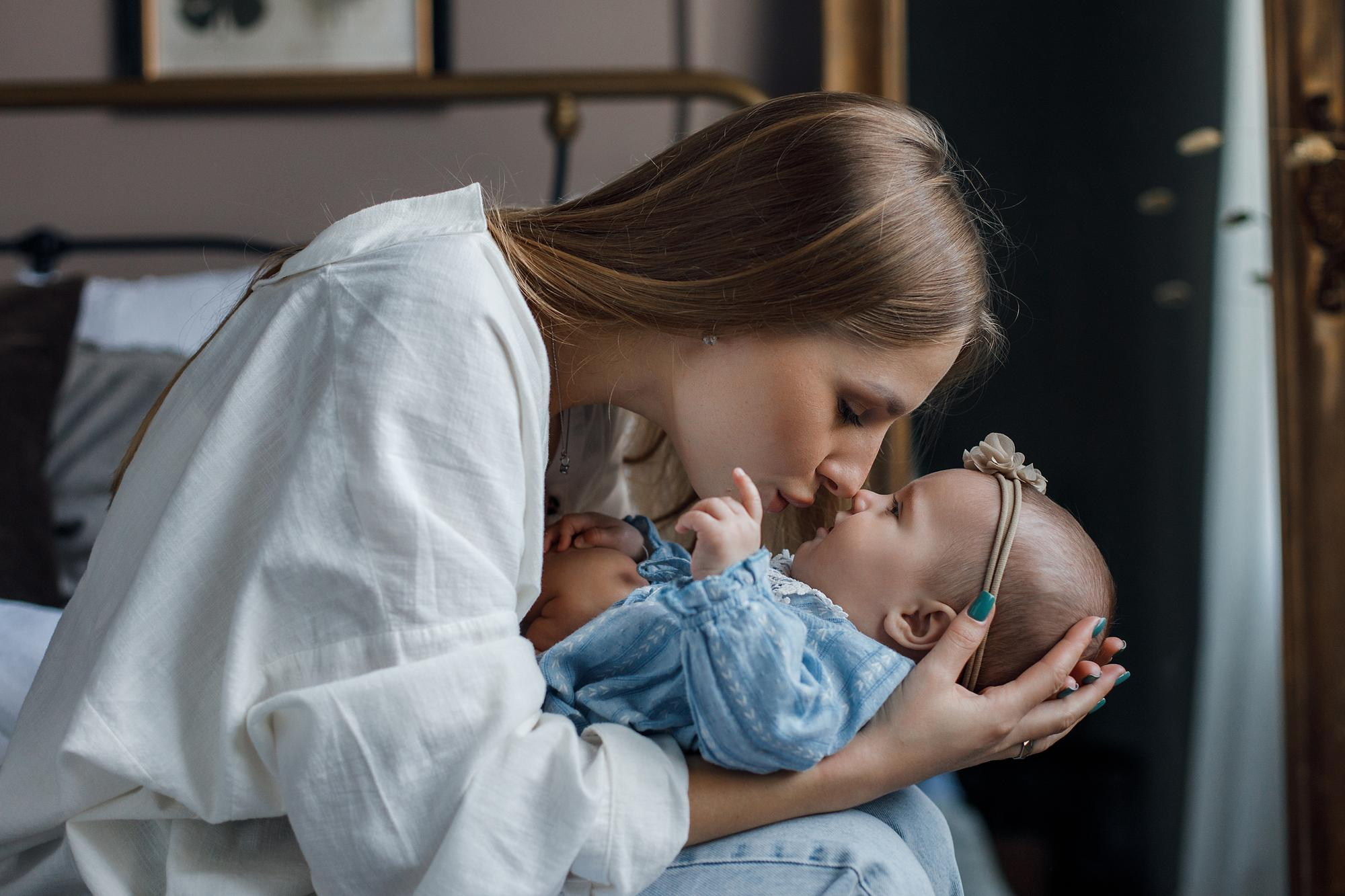
That night I sat in the nursery with Madeline asleep against my chest, her tiny hand curled around my shirt, her breathing deep and even. Outside, darkness settled across the city. The traffic sounds faded. The world became quiet.
Inside, everything felt strangely peaceful.
Seven days earlier, my family had looked at a woman in labor and decided she could handle it alone. They had made a calculation and chosen comfort over compassion. They had believed the easier lie over the difficult truth.
Now I looked at my daughter and made a different decision.
If she ever called me scared, I would come. No questions. No hesitation. No need to consider whether my convenience was more important than her safety.
If she ever called me hurt, I would listen. Not dismiss. Not minimize. Not make it about myself.
If she ever called me needing help, I would drop everything.
And for the first time in my life, I realized something profound.
The cycle hadn’t ended when I became a mother. It ended when I chose to be a different one. Not the one my family was. Not someone who measured her children against each other, who protected favorites, who abandoned people in their vulnerability.
Different.
Madeline stirred slightly, making that soft baby noise that sounds almost like contentment. I kissed the top of her head and felt the weight of that promise settle into my bones.
I would break the pattern. Not perfectly. Not without my own struggles and mistakes. But fundamentally. Irreversibly. This little girl would grow up knowing that her mother chose her. Every time. In every circumstance. Without question.
That was the only grandchild relationship my parents would have. And they had decided not to earn it.
I held that thought carefully, like something precious and fragile, and I let myself grieve the family I had wanted while celebrating the family I was creating.
It was enough. She was enough.
I was enough.

Specialty: Emotional Turning Points
Rachel Monroe writes character-driven stories about betrayal, second chances, and unexpected resilience. Her work highlights the emotional side of family conflict — the silences, the misunderstandings, and the moments when someone quietly decides they’ve had enough.