The Salute
The ballroom at Fort Henley had the particular silence of a room that was about to witness something it wouldn’t forget. I stood near the refreshment table with a glass of water I wasn’t drinking, watching the way military crowds arranged themselves like soldiers in formation even when no one had given that order.
My husband Ryan stood near the stage in his dress blues, freshly pressed, the fabric still holding the geometric lines of military precision. His captain’s rank waited on a pin in his pocket. All he needed was the ceremony, the handshake, the signature on the certificate.
All he needed was for me to stand quietly and let his family look good.
I had become very good at quiet.
Diane arrived in a cloud of expensive perfume and calculated grace, her pearls catching the overhead lights, her camera positioned to catch the moment when her son became important enough to matter. She always arrived late to entrances. It gave people time to notice her arriving.
She did not notice me at first.
That was fine.
I was good at invisible.
It was Ryan’s aunt who spotted me and waved, a small gesture that made Diane’s eyes snap to find the source of that attention. She found me. Her expression shifted. Not warmth. Reassessment. The way a person looks at a problem and decides whether to address it now or later.
She chose now.
She moved toward Ryan with the confidence of someone who had never been told no in a room she considered hers. His brother Tyler followed with the smirk he reserved for people he thought didn’t matter. Their father’s chair had been reserved but remained empty, as it had for eight years. No one mentioned it anymore.
Ryan’s face tightened as she approached. That small tension in his jaw told me everything. He knew something was coming.
“There you are,” Diane said, embracing him in a way that was more for the camera than for him. “Let me look at you. Oh, my son. Captain. Finally.”
“Mom,” Ryan said.
She turned to face the room like she was about to make an announcement at a gala.
“Ladies and gentlemen,” she called out, and the room noticed. Military rooms always notice when someone raises their voice with authority they don’t possess. “This is such a proud day. My son, rising through the ranks despite the challenges life has thrown at him.”
Her eyes moved to me.
“I paid for their first apartment,” she said. “I bought their furniture.”
She hadn’t.
“I watched my son work himself sick while she sat home pretending to be mysterious.”
The word mysterious was meant to sting. It did.
Tyler laughed. That sharp, cruel bark that had always been designed to make the target feel small. I looked at him. The laugh died faster than it started.
He knew I had seen him. Two nights ago. Behind the VFW hall. The tan pickup. The sealed envelope.
I said nothing about it.
Yet.
Diane turned toward the assembled guests like she was performing. “And today my son becomes a captain. A real leader. A real soldier. This family deserves to stand with people who support that.”
Ryan’s voice came out soft. “Mom.”
“No,” Diane said. “You are too kind. You always have been. But I won’t let her ruin this day.”
The room shifted. There is a particular quality to the silence when people realize they are about to witness something ugly disguised as truth. I felt every uniform in the room stiffen. Military crowds understand power and its abuse. They just rarely comment on it.
“She’s a deadbeat,” Diane announced.
The room stopped.
Not paused.
Stopped.
I looked down at the folded program in my hand. Ryan Walker Promotion Ceremony. First Lieutenant to Captain.
Once, I had loved that name enough to change my own life around it.
Once, I had believed that love was enough.
“I paid for everything,” Diane continued, her voice rising. “Everything. And she has not worked a day since they married. Just sat there, spending his money.”
A woman near me whispered something to her husband. He didn’t respond.
I picked up my water.
I took one sip.
I set it down.
Diane’s eyes sharpened. She was waiting for a crack. A sob. An insult. Shaking hands. Anything she could point to later and say, See? That’s what I mean. Unstable. Ungrateful.
I gave her nothing.
“I watched my son work himself sick,” she repeated, louder this time. “Day after day. Night after night. All while she—”
The ballroom doors opened.
The air changed.
Everyone felt it.
Colonel Matthew Reeves walked in wearing dress blues so precise they looked carved from midnight. Beside him was a woman in a gray suit carrying a leather portfolio. Behind them came Command Sergeant Major Ellis, whose face held the calm hardness of someone who had seen every kind of failure and was no longer surprised by any of it.
Ryan straightened.
Every soldier in the room changed shape at once. Spines lifted. Shoulders squared. Eyes fixed on a point that wasn’t the floor.
Diane’s mouth stayed half open.
Her audience had arrived, but they had brought the wrong script.
Colonel Reeves did not look at her. He looked at me. For one full second, his eyes held mine. Then I saw recognition move across his face like a door opening.
He brought his heels together.
His right hand rose.
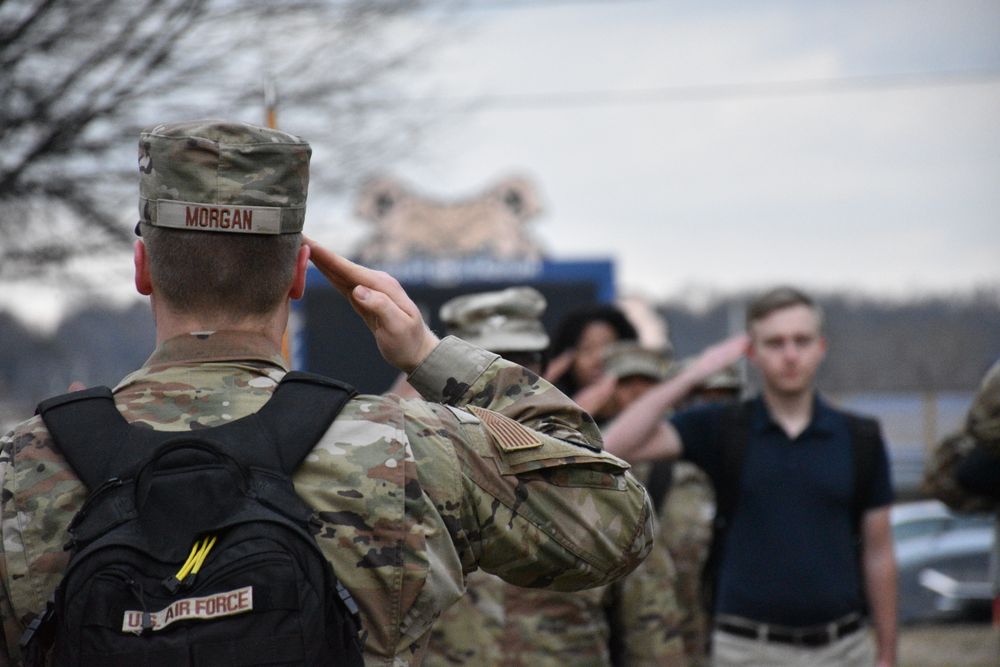
And my husband’s commanding officer saluted me first.
The room froze.
Ryan’s face went white.
Tyler lowered his phone.
Diane’s pearls caught the light as her hand dropped to her side.
I returned the salute. Clean. Sharp. The muscle memory of the body remembering what the heart had spent years trying to forget.
“Major Hayes,” the colonel said.
He did not say Mrs. Walker. He did not say ma’am with the careful courtesy reserved for wives. He said my rank. My real name. The name Diane had never bothered to learn.
The room heard it.
The room understood it.
Everything changed in that single moment.
Diane’s face reddened. “What is this?”
Colonel Reeves finally looked at her. “Mrs. Walker. Do not speak again until I ask you to.”
Her mouth opened. Ellis took one step. She sat back down.
Reeves looked at Ryan. “Lieutenant, I need to speak with you privately. And Major Hayes will be present for that conversation.”
Ryan’s eyes moved from Reeves to me to his mother in rapid succession, trying to calculate what had just happened and how it had happened so fast.
“Sir, I don’t understand,” he said.
“No,” Reeves agreed. “You don’t. But you will.”
The woman in the gray suit extended her hand toward Ryan. “My name is Rebecca Sloan. I’m with the Inspector General’s office.”
The weight of those words settled over the room like snow.
IG.
Everyone understood what that meant.
Diane stood again. “This is outrageous. I demand to know what this is about.”
Reeves turned to her with the patience of a man who was going to give an order whether she cooperated or not. “Your son will be interviewed regarding financial irregularities, falsified documentation, and a promotion packet containing materially inaccurate information.”
Diane’s face went pale.
“I don’t know what you’re talking about.”
I stepped forward slightly.
“The hardship statement,” I said. “In Ryan’s packet. The one that says I’m unemployed.”
Ryan turned to me. “Emily, what is this?”
I kept my eyes on Diane. “The statement that says I have no income. No contribution. That I’m a dependent burden requiring financial support.”
Sloan opened her portfolio. She was watching Diane’s face the way a doctor watches a patient who has just been given bad news.
“We received a report four months ago detailing unauthorized access to joint marital accounts, falsified medical documentation, and misrepresentation in military promotion materials.”
Ryan said, “What report?”
I did not answer.
Sloan did. “A report filed by Major Hayes with the Inspector General’s office.”
The words landed like gunfire in a quiet room.
Ryan turned to me slowly. “You reported my mother?”
“I reported missing money.”
“When?”
“Four months ago.”
He closed his eyes. Four months. Four months of him calling me paranoid. Four months of him saying his mother just wanted to help. Four months of him sleeping beside me while his brother photographed my mail and his mother accessed my accounts.
Diane stepped toward Sloan. “This is slander. I have no idea what she’s talking about.”
I reached into my dress pocket and removed a folded receipt. I held it out to Sloan without ceremony.
“First Carolina Federal,” I said. “Cashier’s check. Twelve thousand dollars. Drawn from our joint account three days after Ryan deployed. Payable to Walker Home Consulting.”
Diane’s eyes followed the paper like it was a weapon.
Ryan looked confused. “I don’t know that company.”
I looked at Diane. “It’s her LLC.”
His face changed.
For the first time, he stopped calculating and started feeling the weight of what had been happening under his own roof.
Sloan placed the receipt in her portfolio. “Major Hayes provided us with copies of several transactions. We are not here to fully review Mrs. Walker’s conduct today. That will be referred as appropriate.”
Reeves said, “But we are very interested in your promotion packet.”
Ryan swallowed. “My packet?”
“Did you sign a hardship statement?” Sloan asked.
“Yes.”
“Did you read it?”
There was the pause. The moment where character decides whether to tell the truth or protect the comfortable lie.
“I skimmed it,” Ryan said finally. “My mother wrote a draft. She said the wording was normal.”
Diane whispered something to Tyler. He shook his head.
“And what did the statement claim?” Sloan pressed.
“That my wife was unemployed and that I was under financial strain.”
“Without confirming either of those facts with your wife?”
Ryan looked at me.
I did not look away.
“Yes,” he said.
The room’s stillness deepened.
Sloan turned to me. “Major Hayes, you also referenced an envelope delivery to Tyler Walker two nights ago.”
Ryan’s head snapped toward his brother.
Tyler had gone very still.
I nodded. “Parking lot behind the VFW. 9:43 p.m. Tan Ford pickup.”
Sloan wrote something in her portfolio. “And you photographed this exchange?”
“I did.”
Diane stood. “This is enough. Ryan, we’re leaving.”
Reeves said, “No.”
She sat.
Ellis moved slightly. Just enough to indicate that sitting was now mandatory.
Sloan removed a printed photograph and placed it on the table where everyone could see.
It showed the parking lot. Tyler’s back. A man I recognized.
Caleb Voss.
The name pulled something dark through my memory. Afghanistan. Procurement. Missing manifests. The report I had filed that had gotten buried under political weight.
Ryan whispered, “Who is that?”
Sloan said, “Former procurement liaison. Currently under federal investigation. And apparently working with your mother’s LLC.”
Diane’s face had gone gray.
I said, “Rebecca, can we speak privately?”
Sloan looked at Reeves.
He nodded.
I stood and walked toward the conference room. As I passed Ryan, he reached for my arm.
“Emily, wait.”
I did not stop.
In the smaller room, Sloan removed another photograph. Different angle. The man’s face visible.
My stomach tightened.
“He’s dead,” I said. “That man died in 2016.”
Sloan watched me carefully. “According to federal records, yes.”
“Then who is meeting Tyler?”
She removed another file. Bank transfers. Walker Home Consulting. Voss Strategic Services. Three amounts circled.
“We believe your mother-in-law’s LLC is a pass-through,” Sloan said quietly.
“For what?”
“We’re still determining that.”
I looked at the amounts. Too clean. Too regular. Not desperate theft. A system.
“Does Reeves know?”
“Yes.”
“Does Ryan?”
“No.”
I nodded once. “Good.”
My phone buzzed. Then immediately rang.
Ryan’s name on the screen.
I answered.
His voice came through broken and fast. “Emily, don’t go home.”
“Why?”
I heard wind. Traffic. Then, distantly, Diane screaming his name.
“Because,” Ryan whispered, “my mother just admitted she didn’t write the forged medical file in my packet.”
My hand tightened around the phone.
“She said my father wrote it.”
The room went very cold.
“Emily, my father died eight years ago.”
Behind his voice, through the open line, through the silence of my empty house, I heard someone laugh.
Not Diane.
Not Tyler.
Someone else.
Someone who had been dead.
Someone who apparently had not stayed that way.
Ryan said, “Emily, who is in our house?”
I looked at Sloan.
She was already reaching for her phone.
This promotion ceremony had ended.
This was where the real war began.
THE END

Ethan Blake is a skilled Creative Content Specialist with a talent for crafting engaging and thought-provoking narratives. With a strong background in storytelling and digital content creation, Ethan brings a unique perspective to his role at TheArchivists, where he curates and produces captivating content for a global audience.
Ethan holds a degree in Communications from Zurich University, where he developed his expertise in storytelling, media strategy, and audience engagement. Known for his ability to blend creativity with analytical precision, he excels at creating content that not only entertains but also connects deeply with readers.
At TheArchivists, Ethan specializes in uncovering compelling stories that reflect a wide range of human experiences. His work is celebrated for its authenticity, creativity, and ability to spark meaningful conversations, earning him recognition among peers and readers alike.
Passionate about the art of storytelling, Ethan enjoys exploring themes of culture, history, and personal growth, aiming to inspire and inform with every piece he creates. Dedicated to making a lasting impact, Ethan continues to push boundaries in the ever-evolving world of digital content.